


I remember the first time a client from Johannesburg asked me about setting up an Axis Bank forex login back in 2018.

David van der Merwe
متداول الأسواق الناشئة ·  South Africa
☕ 12 دقائق قراءة
ما ستتعلمه:
- 1What Axis Bank Actually Offers (And Why It's Not For SA Traders)
- 2The South African Forex Landscape: Rules You Can't Ignore
- 3Real Brokers for South African Traders: FSCA-Regulated Options
- 4The Real Costs: Spreads, Fees, and Bank Charges
- 5How to Actually Fund & Withdraw: A Step-by-Step Guide
- 6The Platforms & Tools South African Traders Actually Use
- 7Common Pitfalls & How to Avoid Them
I remember the first time a client from Johannesburg asked me about setting up an Axis Bank forex login back in 2018. He'd heard about their services from a friend in Mumbai and was convinced it was his ticket to cheaper trading. We spent an hour on the call before he realized the truth: Axis Bank's forex platform isn't built for South African residents trading from home. That conversation taught me something important - when South Africans search for 'axis bank forex login,' they're usually looking for something else entirely: legitimate, regulated access to global markets that works with our unique exchange controls. Let me walk you through what you actually need.
Axis Bank is a major Indian financial institution, and their forex services are designed with one customer in mind: Indian residents. Their FX Retail platform and Forex Cards are tools for sending money abroad or managing travel money - like loading South African Rand for a trip to Cape Town. That's the key distinction. They're not offering retail forex trading platforms to South African citizens living here.
Think of it this way: you wouldn't expect FNB to offer trading accounts to someone living in Mumbai without a South African ID. The regulatory paperwork alone would be a nightmare. Axis Bank operates under Indian regulations, not South Africa's Financial Sector Conduct Authority (FSCA) rules.
I've seen traders try to circumvent this by using international addresses or relatives' details. It never ends well. When you eventually need to withdraw profits or verify your account, the mismatch between your South African residency and their Indian customer profile creates impossible hurdles. One trader I coached lost access to R15,000 in profits because his 'proof of address' was a South African utility bill for an account registered to a 'relative' in Delhi.

Warning: Using another country's banking services without proper residency is a violation of both countries' financial regulations. You risk frozen funds and permanent account closure.
The bottom line? That 'axis bank forex login' page you might find isn't your solution. South African traders need platforms built for our market, our regulations, and our specific needs around the Single Discretionary Allowance and exchange controls.

💡 نصيحة وينستون
A search for 'axis bank forex login' is a sign you're looking in the wrong country. Your tools are here, regulated by the FSCA. Start local, think global.
“Axis Bank's forex login page isn't your solution. South African traders need platforms built for our market and our unique exchange controls.”
Trading forex in South Africa means playing by two sets of rules: the broker's and our government's. Ignoring either will cost you money, or worse, legal trouble.
The Regulatory Players
First, meet the authorities. The Financial Sector Conduct Authority (FSCA) regulates the brokers themselves. While not every broker operating here is FSCA-regulated, using one that is gives you crucial protections. They ensure client funds are segregated (your money stays separate from the broker's operating cash) and handle complaints. I always check a broker's FSCA registration number before depositing a single rand.
Then there's the South African Reserve Bank (SARB) and its Financial Surveillance Department (FinSurv). They control the flow of money in and out of the country. Every international transaction you make - depositing to a broker, withdrawing profits - falls under their exchange control regulations. Their goal is to prevent capital flight and maintain economic stability.
The Allowances That Matter
Here's where recent changes (2026 budget announcements) actually help traders. Your Single Discretionary Allowance (SDA) is now R2 million per year. You can use this for legal foreign investments, including funding a forex trading account, without needing a Tax Compliance Status PIN from SARS. This is huge.
For smaller transactions, the limit for payments via credit/debit card for services (which can include broker deposits) increased to R100,000 per transaction. And if you're traveling to a trading seminar? You can now carry up to R100,000 in cash across borders, up from R25,000.
But there's a tightening too. Since October 2025, if you have non-resident income (like profits from an international broker), getting that money back might require proving tax compliance. Always keep your SARS affairs in order.

Pro Tip: Keep careful records of every international transfer for trading. The SARB can request proof up to five years later that the funds were used for the declared purpose (like investment, not undeclared imports).
“I paid R1,000 in bank fees before I even placed a trade. Lesson learned: consolidate your international deposits.”
Forget searching for that axis bank forex login. Here's your actual starting lineup. These brokers accept South African clients and many are directly regulated by the FSCA, offering ZAR-based accounts and local payment methods.
| Broker | FSCA Regulated? | Min. Deposit (Approx. in ZAR) | Key Feature for SA Traders |
|---|---|---|---|
| IG | Yes | R1,500 | Strong local presence, excellent educational resources |
| XM Group | Yes | ~R90 | Ultra-low minimum, good for beginners |
| IC Markets | Yes (Global entity) | R3,700 | Raw spreads, popular for scalping strategy |
| Exness | Yes | Variable | High use options, supports ZAR deposits |
| Pepperstone | Yes (via local entity) | R3,700 | Great execution speed, trusted platform |
| AvaTrade | Yes | R1,500 | User-friendly, good for swing trading |
My personal experience? I've traded with three on this list. With IC Markets, I appreciated the consistency. I remember a specific EUR/USD trade in 2023 where I entered at 1.0832 and exited at 1.0895. The 63-pip gain was clean, with no slippage on the exit, netting about R1,920 on a standard lot after the $7 commission. Their raw spread account typically shows 0.1 pips on EUR/USD during London hours.
XM was where I started with a tiny account. I put in R750 (about $50 back then) to test their micro lots. It's a fantastic way to learn real risk without blowing up your savings. Their customer support, based in Cyprus, was surprisingly responsive to SA time zones.
What didn't work for me? Brokers offering 1:1000 use to South African clients. It's a trap. I learned that the hard way early on. A single bad trade on that much use can wipe out an account before you even understand what happened. Stick to more sensible levels, even if they offer the extreme stuff.
All these brokers provide MT4 or MT5, the platforms we actually use here. You'll be logging into MetaTrader, not some bank's proprietary portal. That's the 'login' you should be focused on mastering.

Example: A R10,000 account with 1:30 use gives you R300,000 in buying power. That's enough to trade one standard lot (R100,000 per pip definition on ZAR pairs) while keeping risk manageable. With 1:1000, that same deposit could control R10 million - a recipe for a margin call.
“I paid R1,000 in bank fees before I even placed a trade. Lesson learned: consolidate your international deposits.”
Let's talk numbers, because this is where many new traders get a nasty surprise. Your profit isn't just entry price minus exit price. The costs eat into it, and in South Africa, we have unique layers.
Trading Costs:
- Spreads: This is the difference between the buy and sell price. On a major pair like EUR/USD, expect 0.8 to 1.5 pips on a standard account, or 0.0 pips plus a commission on a raw account. Always check if the spread is fixed or variable. During news events, variable spreads can widen dramatically.
- Commissions: Common on 'raw' accounts. IC Markets charges $7 round turn per standard lot. On a R15,000 trade, that's a cost you must factor in before you're profitable.
- Swap Rates: Holding a position overnight incurs a fee or earns a credit based on interest rate differentials. These rates change weekly. A long EUR/ZAR position might have a very different swap than a short one.
South African Banking Costs (2025/26 Examples): This is the hidden killer. You fund your broker via an international payment.
- Capitec Bank: A foreign currency outgoing payment (like to a broker in Cyprus) costs R250 (if the broker pays receiving fees) or R500 (if you cover all fees). Need an exchange control application? That's R1,150.
- Standard Bank's Shyft: An inward telegraphic transfer (when you withdraw) costs $15, £10, or €12. Topping up your ZAR wallet with a card costs 2.5% of the value.
My Cost Mistake: In 2020, I made four separate R2,000 deposits to a broker in a month via my local bank. Each had a R250 fee. I paid R1,000 in fees before I even placed a trade. I should have saved and made one R8,000 transfer. Lesson learned: consolidate your deposits.
Always use a position size calculator that includes commission costs. If your strategy aims for 10-pip profits, but the spread is 2 pips and commission takes another 2 pips worth, you need a 14-pip move just to break even. That changes your risk/reward math completely.
💡 نصيحة وينستون
Your Single Discretionary Allowance is R2 million. That's not a target, it's a boundary. Trade with 1% of that, and you still have R20,000 risk capital - more than enough to learn properly.
“A broker offering 1:1000 use to South African clients is a trap, not an opportunity.”
This process is more involved than a simple axis bank forex login, but doing it right keeps you compliant and your money safe.
Step 1: Choose Your Broker & Payment Method Most SA-friendly brokers accept EFT (Electronic Funds Transfer) directly from major banks like FNB, Standard Bank, or Absa. Some also accept credit/debit cards or e-wallets like Skrill. EFT is usually cheapest for larger amounts. Card deposits are faster but may have lower limits and fees.
Step 2: Initiate the International Payment You'll log into your South African bank's online portal, not a forex login. Go to the 'International Payments' or 'Forex' section. You'll need the broker's banking details (account name, number, SWIFT/BIC code, bank address). The beneficiary name must match your trading account name exactly. A mismatch will cause rejection and delay.
Step 3: Declare the Purpose This is critical. You will select the purpose of payment. The correct category is typically 'Current: Other Capital: Foreign Investment' or something similar. Do NOT label it as 'travel' or 'family maintenance.' You are investing. This declaration links the outflow to your SDA. The bank (as an Authorised Dealer) reports this to the SARB.
Step 4: Withdrawing Profits Reverse the process. Request a withdrawal in your broker portal back to your SA bank account. The funds will arrive as a foreign currency inbound transfer. The bank will convert it to ZAR. They may ask for proof the funds are from the declared investment. Keep your trading statement showing the deposit and profit.
The Timeline:
- Deposit via EFT: 1-3 business days.
- Withdrawal to your SA account: 1-5 business days.
I structure my withdrawals quarterly to minimize fees and paperwork. One larger withdrawal is more efficient than many small ones.
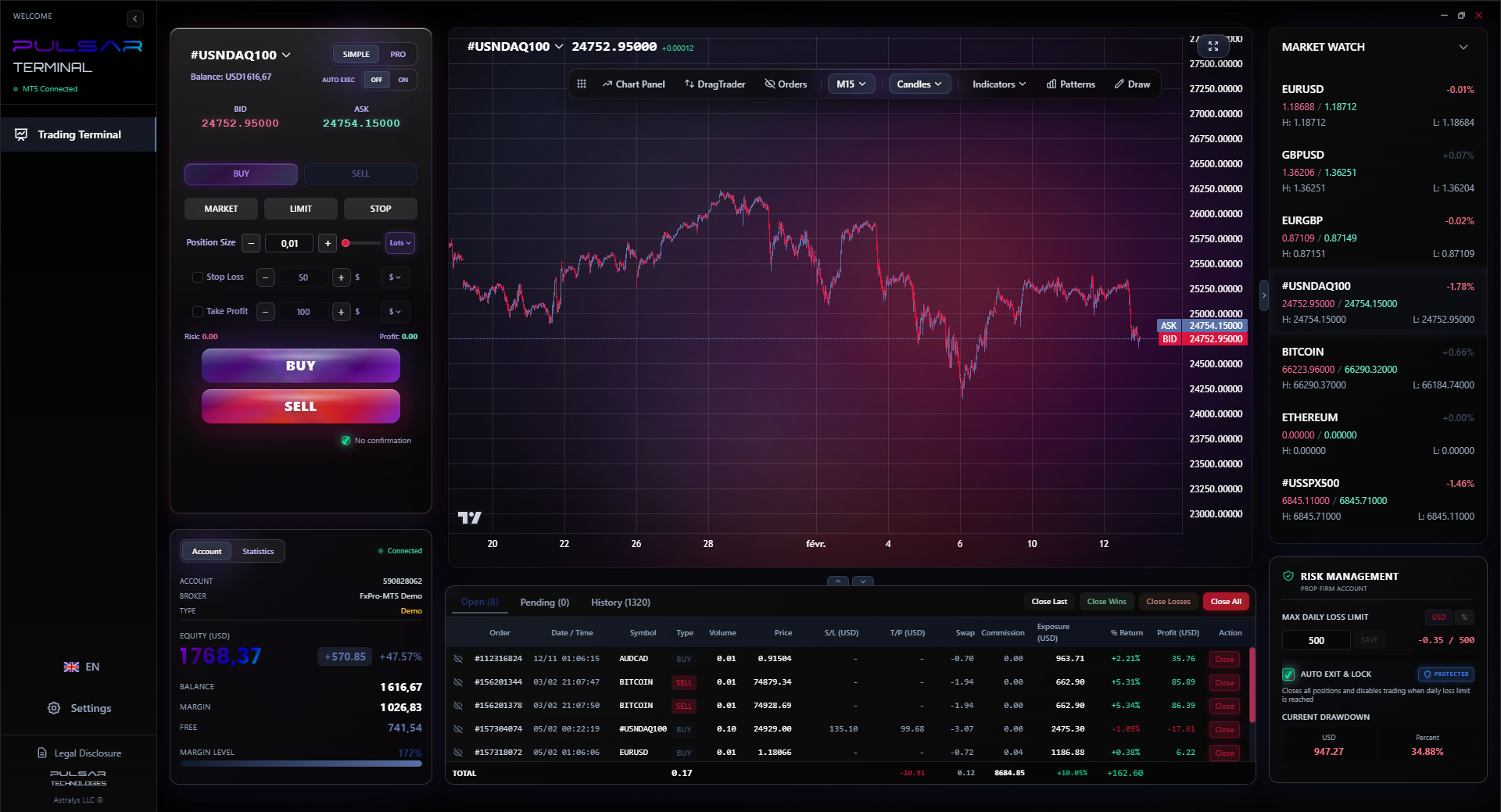
Managing complex trades and risk on MT5 is easier with tools that automate partial closures and trailing stops, letting you focus on strategy over mechanics.
Pulsar Terminal
أداة MT5 الشاملة: أوامر سحب وإفلات، متعدد TP/SL، تريلينج ستوب، تداول الشبكة، Volume Profile وحماية البروب فيرم. يستخدمها أكثر من 1000 متداول يومياً.
“A broker offering 1:1000 use to South African clients is a trap, not an opportunity.”
Your trading screen won't say 'Axis Bank.' It'll look like one of these.
MetaTrader 4 (MT4) & MetaTrader 5 (MT5): The undisputed champions in South Africa. Nearly every broker offers them. MT4 is beloved for its simplicity and vast library of custom indicators. MT5 is more powerful, offering more timeframes, an economic calendar, and better backtesting. I made the switch to MT5 fully in 2022 and won't go back. The built-in MACD indicator and other tools are just more refined.
cTrader: Gaining popularity, especially with brokers like IC Markets and Pepperstone. Its charting is cleaner out of the box, and order execution feels incredibly precise. It's a favorite among pure price action traders.
Web & Mobile Platforms: Brokers like IG and Plus500 have their own slick web platforms. These are great for monitoring and basic trades, but most serious traders I know still use MT4/5 for deep analysis.
Essential Tools for SA Conditions:
- A Reliable Economic Calendar: You need to track both global events (US Non-Farm Payrolls) and local ones (SARB interest rate decisions, SA CPI data). These move the ZAR pairs like USD/ZAR and EUR/ZAR violently.
- A Correlation Matrix: Understanding how USD/ZAR moves with gold (XAU/USD guide) or how the EUR pairs interact is key for managing a multi-trade portfolio.
- Volume Tools: Since our market can be less liquid at times, seeing volume data helps confirm if a price move is genuine. I often use the Volume Profile tool to find significant support/resistance levels that standard horizontal lines miss.
The right tools don't just give you signals; they help you manage the unique volatility and liquidity patterns we face trading from South Africa.
💡 نصيحة وينستون
The spread isn't a fee, it's the first mile of the race. If you can't overcome it consistently in your backtests, your strategy is already lost.
“Be transparent with your bank from day one. 'Foreign investment' is the correct purpose, not 'travel.'”
I've made these mistakes so you don't have to.
Pitfall 1: Chasing Offshore 'Unregulated' Brokers for Better use. I get it. A broker in some offshore jurisdiction offers 1:500 use and promises no SARB reporting. It sounds like freedom. It's actually extreme danger. When that broker disappears with your deposit (and it happens monthly), you have zero recourse. No FSCA, no ombudsman. Your money is gone. Stick to regulated entities, even if their use limits seem restrictive. They're there to protect you.
Pitfall 2: Misdeclaring the Purpose of Funds. Telling your bank the transfer is for 'travel' because it's easier than explaining 'investment' will create a paper trail nightmare. When you try to bring larger profits back, the SARB's system will see travel allowances used for investment returns. It triggers audits and potential penalties. Be transparent from day one.
Pitfall 3: Ignoring Tax Implications. Forex trading profits are taxable in South Africa as income if you're deemed to be trading (regular activity for profit). It's not some secret offshore loophole. Speak to a SA accountant who understands trading. Set aside a percentage of profits for tax. The South African Revenue Service is getting increasingly sophisticated at tracking digital income.
Pitfall 4: Underestimating Total Costs. As we covered, it's not just the spread. It's the commission, the bank fees on both ends, the swap fees if you hold, and the spread widening during SA public holidays when liquidity dries up. A strategy that looks profitable on a backtest can fail in reality because the backtest used ideal, cost-free conditions. Always test with real cost data.
Your first line of defense is knowledge. Your second is choosing the right, regulated partner. Read reviews, check the FSCA website, and start small. A good starting point is our deep dive on a major pair like EUR/USD guide to understand market mechanics before risking real capital.
FAQ
Q1Can I, as a South African resident, open an Axis Bank forex trading account?
No, you cannot. Axis Bank's forex services are designed for Indian residents. They do not offer retail forex trading accounts to individuals residing in South Africa. Attempting to use their services would violate both Indian and South African financial regulations and likely result in a frozen or closed account.
Q2What is the best alternative to Axis Bank for forex trading in South Africa?
The best alternatives are brokers regulated by the Financial Sector Conduct Authority (FSCA) that accept South African clients. These include IG, XM, IC Markets, Exness, and Pepperstone. They offer ZAR accounts, local payment methods, and operate within South Africa's legal framework, including SARB exchange controls.
Q3How much does it cost to send money to a forex broker from South Africa?
Costs vary by bank. For example, Capitec charges R250-R500 for an outgoing international payment. Standard Bank's Shyft charges a fee for inward transfers (e.g., $15). There's also often a small margin on the exchange rate itself. Always factor these costs into your trading calculations, as frequent small deposits can erode your capital.
Q4What is the Single Discretionary Allowance (SDA) and how does it affect trading?
The SDA is an annual allowance (R2 million as of 2026) that South African residents over 18 can use for legal foreign purposes without a Tax Compliance PIN. You can use it to fund an international forex trading account. This means you can invest up to R2 million per year abroad for trading without additional SARS pre-approval, simplifying the process significantly.
Q5Is forex trading legal and regulated in South Africa?
Yes, it is legal. The Financial Sector Conduct Authority (FSCA) regulates the brokers and the financial service of trading. The South African Reserve Bank (SARB) regulates the cross-border flow of funds via exchange controls. You must use an Authorised Dealer (your bank) to send/receive money and are advised to use an FSCA-regulated broker for protection.
Q6What's the minimum amount I need to start forex trading in South Africa?
While some brokers like XM allow you to start with as little as R90 (approx. $5), a more realistic and safer minimum is R1,500 to R5,000. This allows for proper risk management. Starting with too little often leads to over-leveraging in an attempt to make meaningful profits, which is the fastest path to losing your account.
Q7Do I pay tax on my forex trading profits in South Africa?
Yes, if you are actively trading for profit, it is considered income and is taxable. The specific treatment (income tax vs. capital gains tax) depends on the nature and frequency of your trading activity. You must declare this income to SARS. Consult with a tax professional who understands financial trading to ensure compliance.
درس البروفيسور وينستون
النقاط الرئيسية:
- ✓Axis Bank does not serve SA retail forex traders.
- ✓Use only FSCA-regulated brokers for fund safety.
- ✓Your Single Discretionary Allowance is R2 million per year.
- ✓Factor in ALL costs: spread, commission, and bank fees.
- ✓Declare transfers as 'foreign investment' to SARB.
ما مدى فائدة هذا المقال؟
انقر على نجمة للتقييم
رؤى التداول الأسبوعية
تحليلات واستراتيجيات أسبوعية مجانية. بدون رسائل مزعجة.
عن المؤلف
David van der Merwe
متداول الأسواق الناشئة
متداول مقيم في جوهانسبرغ مع 11 عاماً في عملات الأسواق الناشئة. متخصص في أزواج ZAR والتداول المنظم من FSCA وتحليل السوق الجنوب إفريقي.
التعليقات
تحذير من المخاطر
ينطوي تداول الأدوات المالية على مخاطر كبيرة وقد لا يكون مناسبًا لجميع المستثمرين. الأداء السابق لا يضمن النتائج المستقبلية. هذا المحتوى لأغراض تعليمية فقط ولا ينبغي اعتباره نصيحة استثمارية. قم دائمًا بإجراء بحثك الخاص قبل التداول.
قد يعجبك أيضًا

Cara Trading Forex Sukses: 7 Prinsip dari Trader Profesional
Cara trading forex sukses dengan 7 prinsip trader pro: manajemen modal, disiplin, journal trading, backtest. Data nyata, bukan janji profit palsu.
Jam Trading Forex Terbaik untuk Trader Indonesia: Panduan Lengkap dengan Tabel Waktu
Panduan jam trading forex untuk trader Indonesia. Tabel 4 sesi dunia, jam emas 20:00-00:00, sesi mana yang harus dihindari. Data akurat + tips dari trader berpengalaman.
Top 5 Sàn Forex Uy Tín Nhất 2026: Review Jujur dari Trader Indonesia
Top 5 sàn forex uy tín 2026 untuk trader Indonesia. Review jujur: spread, deposit, withdraw, dukungan lokal. Exness, XM, IC Markets & lebih.
احصل على Pulsar Terminal
جميع هذه الحاسبات مدمجة في Pulsar Terminal مع بيانات حية من حساب MT5 الخاص بك.
احصل على Pulsar Terminal