


Here's a stat that should make you pause: 77% of retail CFD traders lose money.

Sarah Collins
استراتيجي تداول ·  United Kingdom
☕ 8 دقائق قراءة
ما ستتعلمه:
Here's a stat that should make you pause: 77% of retail CFD traders lose money. A big part of that failure comes from picking the wrong instrument. It's not just about strategy; it's about choosing a market you can actually read. For us in the UK, with the FCA's 1:30 use cap and London's $2.7 trillion daily session, some pairs are simply better suited to our environment than others. Let's cut through the noise and find the pairs that give you a real edge.
Forget what you've heard about 'volatility equals opportunity.' That's a quick way to get stopped out before breakfast. A good pair for a UK trader has three things: liquidity, sensible spreads, and predictable behaviour during our prime hours.
Liquidity means the market is deep. You can get in and out at the price you see, without massive slippage. This is why the majors - EUR/USD, GBP/USD, USD/JPY - are the backbone. The spread, the difference between the buy and sell price, is your first cost of doing business. On a razor-thin account, a 0.1 pip spread on EUR/USD is a fraction of the cost of a 3-pip spread on an exotic.
But here's the local angle: predictable behaviour. The London session (8 AM to 5 PM GMT) is when we have the most influence. Pairs with the GBP or EUR tend to see their most decisive moves when European markets are open. Trading AUD/JPY at 2 AM might work for some, but if you're trading around a day job in Manchester, you need action when you're awake.

Warning: Don't confuse low spreads with low cost. A 'commission-free' account often has the commission baked into a wider spread. Always calculate the total round-turn cost (spread x pip value + any commission) before you judge a pair. My position size calculator factors this in automatically.
I learned this the hard way early on. I was scalping GBP/CAD, attracted by its moves. But the spreads would widen from 3 pips to 8 pips right as London opened, wiping out my tiny profit targets before I'd even made a pence. I was fighting the market's structure, not trading with it.

💡 نصيحة وينستون
A young trader once asked me how to choose a pair. I told him to watch the spread for a week. The pair that consistently offers the fairest price is the market inviting you in. The one with the wild, widening spread is the dealer laughing you out the door.
These are the heavyweights, the most traded pairs in the world. For FCA-regulated traders with use capped at 1:30, their stability is a feature, not a bug. You need less margin to hold a position, which helps manage risk under the stricter rules.
EUR/USD (The Euro / US Dollar)
This is the king. It often has the tightest spreads (I've seen 0.04 pips on a Razor account) and immense liquidity. It's less prone to random, news-driven spikes than GBP pairs. Its movements are often more technical and trend-based. For learning price action, it's your best textbook. My most consistent scalping strategy runs almost exclusively on EUR/USD during the London/New York overlap.
GBP/USD (Cable)
The home team pair. It's liquid, but mate, it can be a drama queen. UK economic data, BoE speeches, and Brexit aftershocks can send it gyrating. This creates opportunity but requires stricter risk management. The spread is usually slightly wider than EUR/USD. I treat it as a higher-volatility cousin of EUR/USD.
USD/JPY (The Dollar / Yen)
This is the 'risk sentiment' gauge. When global investors are fearful, they buy JPY. When they're chasing yield, they sell it. It trends beautifully and respects technical levels like few others. It's a fantastic pair for swing trading. Just watch out for Bank of Japan intervention whispers – they can cause short-term chaos.

Example: Cost Comparison. On a standard lot (100,000 units):
- EUR/USD: 0.1 pip spread = $1 cost + £2.25 commission = ~$3.25 total cost to enter and exit.
- An exotic pair: 5 pip spread = $50 cost, no commission. The exotic is over 15 times more expensive to trade, just on spread.
“You'll learn more about the market by mastering one instrument than by dabbling in ten.”
Once you're comfortable with the majors, crosses (pairs without the USD) are where you can find stronger, cleaner trends. They're a staple for many UK traders.
EUR/GBP
This is a pure Eurozone vs. UK economy play. It's less volatile than GBP/USD and can trend for months. It's brilliant for positional trades based on interest rate differentials between the ECB and BoE. The spread is reasonable for a cross.
GBP/AUD or GBP/CAD
These are 'commodity crosses.' They're more volatile. When the UK economy looks strong and iron ore or oil prices are weak, GBP/AUD can rocket. I had a great run with GBP/AUD in late 2025, catching a 1200-pip trend move by focusing on the RBA's dovish stance versus the BoE's hikes. The key? Patience. These pairs can chop around for ages before the trend kicks in.
EUR/CHF
The 'safe-haven' cross. It's often slow, but when the European political winds blow, money flows into CHF. It's a pair for very patient, macro-focused traders. I use it more as a hedge or a sentiment indicator than a primary pair.
The FCA's lower use on minors (1:20) means you need to size these positions slightly more conservatively than majors. It's a built-in safety check.
This is where many accounts go to die. Exotic pairs involve a currency from a small or emerging economy, like USD/TRY (Turkish Lira) or GBP/ZAR (South African Rand).
Their spreads are enormous – routinely 10 to 50 pips. You're starting every trade in a deep hole. Their liquidity is poor, meaning your orders might not get filled where you want, and slippage can be brutal. They're also vulnerable to sudden political shocks or central bank interventions that make no technical sense.
I blew up my first live account, a £2,000 pot, chasing USD/MXN. The spread was 15 pips, my target was 20. I was basically trading just to pay the broker. A small, unexpected gap wiped out 30% of my capital overnight. It was a brutal, expensive lesson in respecting costs and liquidity.
Also, remember the FCA ban: you cannot trade cryptocurrency CFDs as a retail client in the UK. So any 'crypto pair' offered by an offshore broker to a UK resident is a major red flag and likely operating outside FCA protection, meaning no negative balance protection and no FSCS safety net.
💡 نصيحة وينستون
In my City days, the best Sterling traders weren't the loudest. They were the ones who could sit through a week of 30-pip ranges in GBP/JPY without forcing a trade. Liquidity is a tide. Don't swim against it; wait for it to carry you.
“The exotic is over 15 times more expensive to trade, just on spread.”
Your personality and diary are as important as the charts.
The London Session Day Trader (8 AM - 5 PM): You want action. Focus on EUR/USD, GBP/USD, and EUR/GBP. Their liquidity peaks between 8 AM and 12 PM when London is in full swing and other European markets are open. This is when you'll get the truest price action and best fills.
The Evening Swing Trader: If you analyse charts after work, USD/JPY and GBP/AUD are your friends. You can plan trades based on daily or 4-hour charts and set orders to catch moves during the Asian or US sessions. You're not chasing tiny intraday moves.
The News Trader: If you live for economic calendars, GBP pairs are your arena. Non-Farm Payrolls (USD), UK CPI, and BoE/ECB decisions are your key events. This is high-risk, high-reward. You need a broker with reliable execution and a solid economic calendar.
My own routine? I'm a morning person. I'm at my desk for the London open, watching the first hour of EUR/USD action to gauge the day's sentiment. I might take one or two high-conviction scalps, then switch to managing longer-term swing positions in USD/JPY or GBP/AUD. Trying to force a scalp in a sleepy afternoon market just leads to overtrading.
Managing multiple swing trades and precise scalps requires tools that go beyond basic MT5; Pulsar Terminal's drag-and-drop orders and multi-TP/SL management let you execute complex strategies without the manual hassle.
Pulsar Terminal
أداة MT5 الشاملة: أوامر سحب وإفلات، متعدد TP/SL، تريلينج ستوب، تداول الشبكة، Volume Profile وحماية البروب فيرم. يستخدمها أكثر من 1000 متداول يومياً.
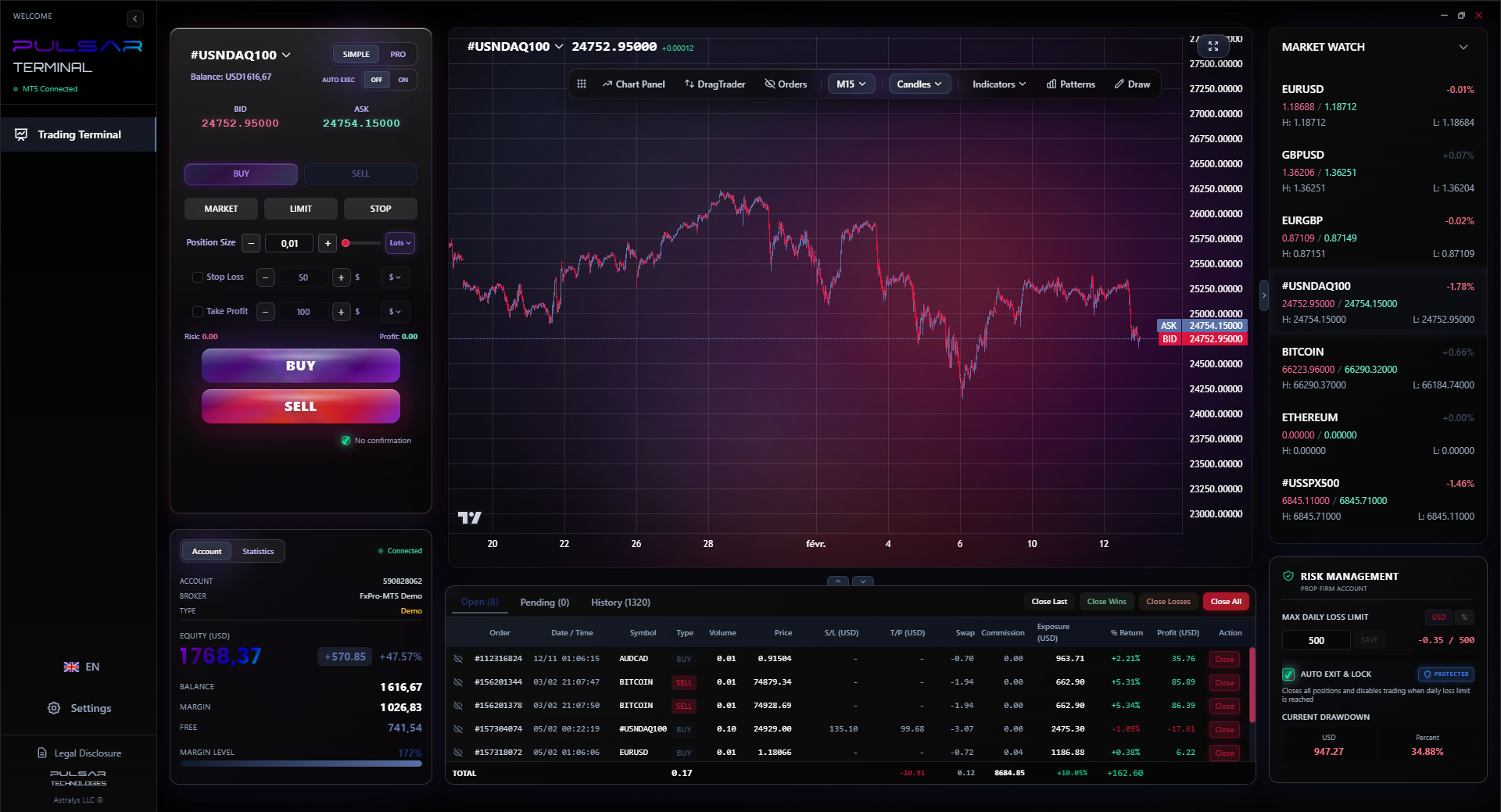
Theory is great, but let's get practical. Here’s your checklist.
- Choose an FCA Broker: This is non-negotiable for the £85,000 FSCS protection and negative balance protection. Look at Pepperstone for raw spreads, IC Markets for value, or XM if you're starting with a smaller amount. Check their specific spreads on the pairs you want to trade.
- Start with a Demo: Don't just test your strategy. Test the broker's platform. Are the spreads consistent with what they advertise? How fast are executions during news events?
- Define Your Costs: Know your all-in cost per trade. If you're paying a 3-pip spread on GBP/USD, you need a strategy that targets much more than 3 pips to be profitable.
- Start with ONE Major: Pick EUR/USD or GBP/USD. Learn its personality. Trade it exclusively for your first 100 live trades. You'll learn more about the market by mastering one instrument than by dabbling in ten.
- Use the Tools: Don't guess your position size. Use a calculator. Learn one or two indicators deeply, like the RSI for momentum or MACD for trend confirmation, rather than cluttering your chart.

Pro Tip: Tax efficiency matters. While forex trading profits are subject to Capital Gains Tax, spread betting with an FCA broker is tax-free for UK residents. It's the exact same market movement, but a different financial instrument. For active traders, this can make a monumental difference to your net returns. Always consult an accountant for your specific situation.
FAQ
Q1What is the most traded forex pair in the UK?
Globally and in the UK, it's EUR/USD. It offers the highest liquidity and typically the lowest spreads, making it the default choice for many professional and retail traders.
Q2Why is use for forex trading so low in the UK?
The FCA imposed a 1:30 use cap for retail clients on major forex pairs in 2018 to protect traders from the excessive losses that were common with 1:100 or 1:500 use. It forces more sensible position sizing and risk management.
Q3Can I trade cryptocurrency pairs in the UK?
No, not as CFDs. The FCA banned the sale of cryptocurrency CFDs (like BTC/USD) to retail clients due to their extreme volatility and perceived harm. You can still buy and hold the actual cryptocurrencies on exchanges, but you cannot trade them as leveraged derivatives with FCA-regulated brokers.
Q4What's a good spread for a currency pair?
For majors like EUR/USD, a 'good' spread is under 1.0 pip on a standard account, and often 0.1-0.5 pips on a raw spread account (plus commission). For a cross like EUR/GBP, 1.0-2.0 pips is standard. Anything consistently over 3 pips for a major is expensive, and exotic pairs often have spreads of 10 pips or more.
Q5Should I trade GBP pairs because I'm in the UK?
Not necessarily. While you might understand UK news better, GBP/USD can be more volatile and unpredictable than EUR/USD. Many UK traders find EUR/USD a more stable and technically reliable market to learn on. It's about the pair's behaviour, not your passport.
Q6What's the best time of day to trade forex in the UK?
The most active and liquid time is the London session overlap, from 8:00 AM to 12:00 PM GMT. This is when London and other European financial centres are fully open, providing high volume and tighter spreads, especially on EUR and GBP pairs.
درس البروفيسور وينستون
النقاط الرئيسية:
- ✓Master EUR/USD first; it's the market's cleanest language.
- ✓Calculate total trade cost (spread + commission) before entry.
- ✓Avoid exotics; their cost structure is designed for you to lose.
- ✓Match your pair to your actual trading schedule, not your ambition.
ما مدى فائدة هذا المقال؟
انقر على نجمة للتقييم
رؤى التداول الأسبوعية
تحليلات واستراتيجيات أسبوعية مجانية. بدون رسائل مزعجة.
عن المؤلف
Sarah Collins
استراتيجي تداول
استراتيجية تداول مقيمة في لندن مع 12 عاماً من الخبرة في الأسواق المالية. محللة سابقة في شركة وساطة في حي المال بلندن. تغطي أزواج الجنيه الإسترليني والأسواق الأوروبية والتداول المنظم من FCA.
التعليقات
تحذير من المخاطر
ينطوي تداول الأدوات المالية على مخاطر كبيرة وقد لا يكون مناسبًا لجميع المستثمرين. الأداء السابق لا يضمن النتائج المستقبلية. هذا المحتوى لأغراض تعليمية فقط ولا ينبغي اعتباره نصيحة استثمارية. قم دائمًا بإجراء بحثك الخاص قبل التداول.
قد يعجبك أيضًا

Cara Trading Forex Sukses: 7 Prinsip dari Trader Profesional
Cara trading forex sukses dengan 7 prinsip trader pro: manajemen modal, disiplin, journal trading, backtest. Data nyata, bukan janji profit palsu.
Jam Trading Forex Terbaik untuk Trader Indonesia: Panduan Lengkap dengan Tabel Waktu
Panduan jam trading forex untuk trader Indonesia. Tabel 4 sesi dunia, jam emas 20:00-00:00, sesi mana yang harus dihindari. Data akurat + tips dari trader berpengalaman.
Top 5 Sàn Forex Uy Tín Nhất 2026: Review Jujur dari Trader Indonesia
Top 5 sàn forex uy tín 2026 untuk trader Indonesia. Review jujur: spread, deposit, withdraw, dukungan lokal. Exness, XM, IC Markets & lebih.
احصل على Pulsar Terminal
جميع هذه الحاسبات مدمجة في Pulsar Terminal مع بيانات حية من حساب MT5 الخاص بك.
احصل على Pulsar Terminal