


I remember the first time I saw a BlackBull Markets ad.

David van der Merwe
متداول الأسواق الناشئة ·  South Africa
☕ 10 دقائق قراءة
ما ستتعلمه:
- 1The Regulatory Reality: FSCA, FMA, and That Seychelles License
- 2Accounts, Fees, and The Real Cost of Trading
- 3Getting Your Money In and Out: ZAR, SARB, and Practical Tips
- 4Trading Platforms: MT5, cTrader, and What Actually Works
- 5use Up to 1:500: A Powerful and Dangerous Tool
- 6How Does BlackBull Compare to Local SA Brokers?
- 7Final Verdict: Who Is BlackBull Forex Really For in SA?
I remember the first time I saw a BlackBull Markets ad. It was all slick graphics and promises of raw spreads. I funded a Prime account with $2,500, eager to trade the EUR/USD with those 0.0 pip headlines. What I didn't fully grasp was how the regulatory setup would affect me in Cape Town. A few months later, a messy trade exit left me questioning the dispute process. That experience taught me more about broker due diligence than any winning streak ever did. Let's talk about what BlackBull Forex really means for you, trading from South Africa.
This is the most important part, so let's get straight to it. BlackBull Markets is not regulated by the FSCA. For a South African trader, that's your first red flag to understand, not necessarily a deal-breaker, but a major consideration.
They operate under two main licenses: the Financial Markets Authority (FMA) in New Zealand and the Financial Services Authority (FSA) in Seychelles. Here's the kicker for us: when you sign up from South Africa, you're typically placed under their Seychelles entity (BBG Limited) by default. The FSA Seychelles is what we call an offshore regulator. The protections are lighter.
You can request to be under their FMA regulation. I did this after my early scare. It involved a few extra forms and confirming a higher minimum deposit, but it felt worth it. The FMA requires client funds to be segregated in top-tier banks, offers negative balance protection, and subjects the broker to regular audits. The Seychelles entity? The rules aren't as strict.

Warning: Trading with a non-FSCA broker means you cannot lodge a complaint with the South African regulator if something goes wrong. Your recourse is with the broker's home regulator (FMA or FSA). This adds a layer of complexity and distance if you have a serious issue.
The FSCA strongly advises trading only with licensed providers. While not illegal to use BlackBull, you're stepping outside the local safety net. Always weigh this against the broker's offerings.
Why does this matter to you? If you're starting with a smaller account (under $2,000), the hassle and minimums for the FMA account might not make sense, leaving you with the Seychelles option. For larger capital, insisting on the FMA oversight is a no-brainer for asset security. It's a clear trade-off: potentially better pricing for slightly less peace of mind.

💡 نصيحة وينستون
A broker's headline use is a test of your discipline, not a measure of opportunity. The smartest traders I know use the least use available to them.
BlackBull offers three main account types. The marketing focuses on the low spreads, but your total cost depends on your trading style.
Breaking Down the Account Types
| Account Type | Min. Deposit (Typical) | EUR/USD Spread | Commission | Best For... |
|---|---|---|---|---|
| ECN Standard | $0 | From 0.8 pips | None | Beginners, small accounts, cost simplicity. |
| ECN Prime | $2,000 | From 0.0 pips | $6 per lot (round turn) | Active traders, scalpers wanting raw spreads. |
| ECN Institutional | $20,000 | From 0.0 pips | $4 per lot (round turn) | High-volume traders, small funds. |
Notice the "from"? That's the catch. The 0.0 pip spread is a snapshot in time during high liquidity. The average is higher. I've logged my Prime account spreads on the EUR/USD guide for a month. The average was 0.2 pips during London/NY overlap, plus my $6 commission. That's still excellent, but not free.
For a Standard account user, that 0.8 pip average is your all-in cost. It's clean and simple.
The Hidden (and Not-So-Hidden) Fees
- Withdrawals: There's usually a $5 fee. I got this waived once as a Prime+ member, but it's not guaranteed. Factor this in, especially if you withdraw small amounts frequently.
- Currency Conversion: If you fund in ZAR but trade USD pairs, your bank or the broker will charge a conversion fee. This can eat 1-2% of your deposit. Their position size calculator is in USD, so always do your math in your account's base currency.
- Overnight Fees (Swaps): These are standard. If you're holding positions for more than a day, check the swap rates. They can work for or against you. For swing trading strategies, this is a key input.

Example: Trade 1 lot EUR/USD on a Prime Account.
- Entry/Exit Spread: 0.2 pips = $2
- Commission: $6
- Total Transaction Cost: $8 You need the price to move 0.8 pips just to break even on costs. This is why understanding your pip definition and true cost is critical.
“The 0.0 pip spread is a snapshot in time during high liquidity. The average is higher.”
This is where being South African gets specific. BlackBull does offer ZAR as a account currency option, which is a big plus. It means you can see your balance in Rands and avoid conversion on every trade's profit/loss display.
Depositing: They accept bank wire, credit/debit cards (Visa/Master), and e-wallets like Skrill. The broker doesn't charge a fee, but your bank might for an international transfer. I use a Visa card for instant deposits; the conversion rate is okay, and it's in my account in minutes. Remember SARB rules: you have your Single Discretionary Allowance (R1 million per calendar year) for international transfers without pre-approval. For most retail traders, this is plenty.
Withdrawing: This is slower. It takes 1-3 business days for them to process, plus bank time. The $5 fee stings on a small withdrawal. Always withdraw back to the same method you used to deposit; it's smoother and raises fewer anti-money laundering flags.
The biggest headache I've had (and heard from others) is with bank wires to South African banks. Sometimes the receiving bank asks questions about the international payment. Have your BlackBull transaction receipt and a simple explanation ready ("forex trading profits"). It's legal, but banks can be cautious.

Pro Tip: If you trade actively, do fewer, larger withdrawals to minimize that $5 fee impact. And always keep a record of every deposit and withdrawal confirmation. You'll need it for tax time anyway.
BlackBull shines here. They offer MT4, MT5, cTrader, and even integration with TradingView. Most South African traders I know are on MT4 or MT5, so you'll feel right at home.
I primarily use MT5 with them. The execution is fast, and I've had very few requotes, even during news events. The platform connects reliably from SA. Their cTrader offering is also top-notch if you prefer that cleaner interface and direct market access feel. It's a proper ECN experience on cTrader.
Where it gets interesting is their proprietary tools. BlackBull Trade is their web platform. It's decent for checking your account on the go, but I wouldn't use it for serious analysis. BlackBull CopyTrader is functional if you're into social trading, but I find the community and strategy transparency better on dedicated platforms.
For me, the value is in the core platforms. Having strong MT5 and cTrader access with good liquidity means I can focus on my strategy, not fighting the software. If you're into advanced order types or scalping strategy, the low latency on these platforms is a genuine advantage. Just remember, no matter the platform, your risk management is on you. A slick platform won't save you from a bad trade or a margin call.
💡 نصيحة وينستون
Always calculate your total cost per trade: spread + commission + potential conversion fees. A 'zero spread' account can be more expensive for small trades than a standard account with a slightly wider spread.
“Just because you *can* use 1:500 use doesn't mean you *should*. I now never use more than 1:20.”
BlackBull offers use up to 1:500 across all accounts. That's massive. In South Africa, where many local FSCA brokers cap use at 1:30 or 1:50 for retail clients, this stands out.
Let's be brutally honest: 1:500 use is a double-edged sword that's mostly sharp on the side that cuts you. It means with $1,000, you can control a $500,000 position. A 0.2% move against you wipes out your entire margin.
I used high use foolishly when I started. I put on a gold (XAU/USD guide) trade with too much size, using nearly all my margin. A normal retracement triggered a margin call before the trade could even play out. I lost $400 in seconds on what became a winning idea. The trade eventually hit my target, but my account was already wounded.
Just because you can use 1:500 doesn't mean you should. I now never use more than 1:20 on my main account, regardless of what's available. It forces better position sizing and lets me weather volatility. Use their high use for one thing only: to reduce the margin requirement on very small, carefully sized positions. Never to maximize position size.
Your risk management, using tools like a solid position size calculator, is what separates a survivor from a statistic. The use is a setting, not a strategy.
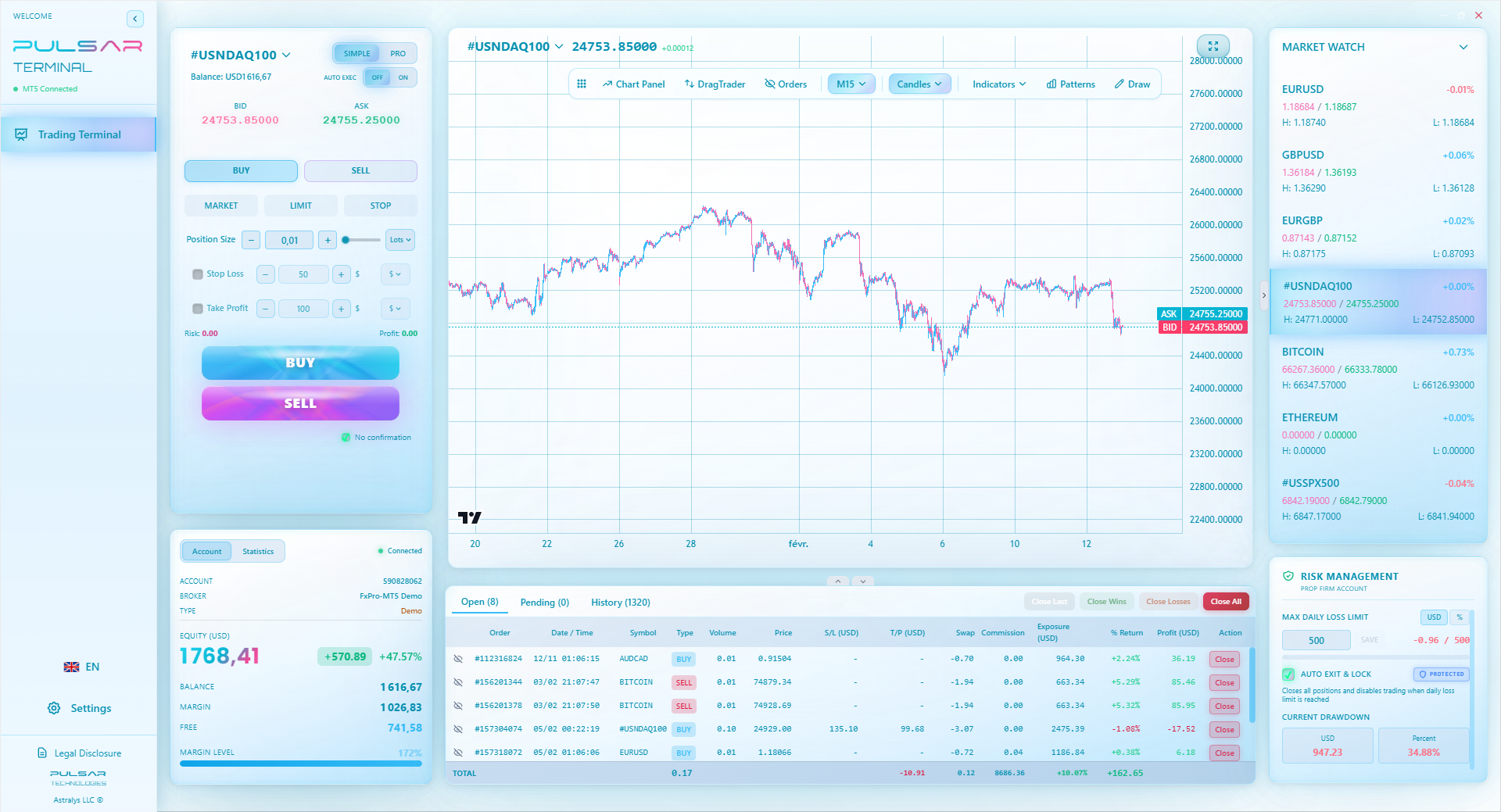
Managing high-leverage trades requires precision; Pulsar Terminal's drag-and-drop order management and multi-TP/SL brackets on MT5 help you execute complex risk plans instantly.
Pulsar Terminal
أداة MT5 الشاملة: أوامر سحب وإفلات، متعدد TP/SL، تريلينج ستوب، تداول الشبكة، Volume Profile وحماية البروب فيرم. يستخدمها أكثر من 1000 متداول يومياً.
This is the real question. Should you go with an international broker like BlackBull or stick with an FSCA-regulated local one?
BlackBull Markets Pros:
- Lower Costs: Generally, tighter spreads and direct ECN access.
- Higher use: 1:500 vs. typical local caps of 1:30.
- Platform Choice: Access to cTrader and often better MT4/5 server performance.
- Global Asset Range: Often more CFDs on international stocks, indices, and commodities.
Local FSCA Broker Pros:
- FSCA Protection: Direct recourse, mandatory compensation schemes, stricter oversight.
- ZAR Everything: Local bank deposits/withdrawals with no international fees or delays.
- Local Support: Phone support that understands SA banking hours and tax issues.
- Simplicity: No SARB allowance calculations or currency conversion confusion.
My take: If you're a sophisticated trader who understands the regulatory trade-off, values ultra-low costs for high-frequency strategies like scalping strategy, and is comfortable managing international transfers, BlackBull is a compelling option. I use it for a portion of my capital specifically for its cTrader execution.
If you're newer, value maximum safety, want everything in Rands without hassle, and prefer dealing with a locally licensed entity, then an FSCA broker is the wiser choice. You can always move to an international broker later. Brokers like Exness review or IC Markets review also compete in this space and are worth comparing directly.
“Trading with a non-FSCA broker means you cannot lodge a complaint with the South African regulator if something goes wrong.”
After years of using them, here's my blunt assessment.
BlackBull is a good fit for:
- The cost-sensitive active trader (scalper, day trader) who trades larger volumes and can benefit from raw spreads.
- The technically-minded trader who wants and knows how to use platforms like cTrader or advanced MT5 tools.
- The trader with sufficient capital (over $5,000) who can reasonably opt for the FMA-regulated account for better safety.
- Someone who already has experience with international brokers and isn't fazed by the regulatory nuance.
BlackBull is likely NOT the best fit for:
- Absolute beginners in South Africa. The lack of FSCA oversight is a significant added risk when you're still learning.
- Traders with very small accounts (under $1,000). The withdrawal fees and currency costs will eat you alive.
- Anyone who values ultimate simplicity and local support above all else. The local broker experience is smoother for day-to-day banking.
- Traders who don't understand or won't bother to manage their use responsibly. The 1:500 rope is long enough to hang yourself many times over.
My journey with them had a rocky start due to my own ignorance about regulations. Once I moved to their FMA entity and adjusted my trading to their cost structure, it's been a reliable platform for specific strategies. They are a serious broker, not a scam. But for a South African, they come with an asterisk. Do your homework, start slow if you choose them, and never, ever let the high use dictate your position size. Your first job is to protect your capital, not chase the lowest possible spread definition.
FAQ
Q1Is BlackBull Markets legal and safe for South African traders?
It is legal to use, but it's not regulated by the South African FSCA. They are regulated by the FMA in New Zealand and the FSA in Seychelles. Safety depends on which entity you're under. The FMA offers strong protections (segregated funds, negative balance protection), while the FSA Seychelles is a lighter-touch offshore regulator. You can request the FMA account, but it often requires a higher minimum deposit.
Q2Can I open a ZAR account with BlackBull Markets?
Yes, BlackBull Markets offers ZAR as a base currency option for trading accounts. This helps you see your balance and equity in Rands, avoiding constant mental currency conversion. However, if you trade instruments denominated in USD (like EUR/USD), your profit/loss in those trades will still be subject to the USD/ZAR exchange rate when converted to your account currency.
Q3What are the typical withdrawal times and fees to South Africa?
Withdrawals usually take 1-5 business days to reach your South African bank account. BlackBull typically charges a $5 withdrawal fee per request (though it may be waived for premium clients). Your local bank may also charge a fee for receiving an international wire transfer. Always withdraw to the same method you used to deposit.
Q4How does BlackBull's 1:500 use compare to South African brokers?
It's significantly higher. Most FSCA-regulated brokers in South Africa are restricted to offering maximum use of 1:30 or 1:50 to retail clients due to local regulations aimed at protecting traders. BlackBull's 1:500 is a major difference, offering more power but also exponentially greater risk. It should be used with extreme caution and proper position size calculator discipline.
Q5Which trading platforms can I use with BlackBull in SA?
You have access to MetaTrader 4 (MT4), MetaTrader 5 (MT5), and cTrader. All are popular, professional-grade platforms with reliable connectivity from South Africa. They also offer their own web platform (BlackBull Trade) and a copy trading system. MT5 and cTrader are particularly well-regarded for their execution speed and advanced features.
Q6What is the minimum deposit for a South African trader?
Technically, you can open an ECN Standard account with $0. However, to trade effectively and cover costs, a minimum of $100-$200 is practical. For the popular ECN Prime account (with raw spreads + commission), the typical minimum is $2,000. If you want to be under their stronger FMA regulation, you may need to confirm a higher minimum deposit directly with them.
Q7Are there any good alternatives to BlackBull for South Africans?
Yes. You should compare them with both international brokers that accept SA clients (like IC Markets review, Pepperstone review, or XM review) and local FSCA-regulated brokers. Local brokers offer easier ZAR banking and direct regulatory protection, while international brokers often compete on spreads and platform choice. The best alternative depends on whether you prioritize cost or local safety/simplicity.
درس البروفيسور وينستون
النقاط الرئيسية:
- ✓Regulation is your first filter, not your last.
- ✓True cost is spread + commission + fees.
- ✓use above 1:30 is for margin efficiency, not size.
- ✓Local brokers simplify banking; international ones can cut costs.
ما مدى فائدة هذا المقال؟
انقر على نجمة للتقييم
رؤى التداول الأسبوعية
تحليلات واستراتيجيات أسبوعية مجانية. بدون رسائل مزعجة.
عن المؤلف
David van der Merwe
متداول الأسواق الناشئة
متداول مقيم في جوهانسبرغ مع 11 عاماً في عملات الأسواق الناشئة. متخصص في أزواج ZAR والتداول المنظم من FSCA وتحليل السوق الجنوب إفريقي.
التعليقات
تحذير من المخاطر
ينطوي تداول الأدوات المالية على مخاطر كبيرة وقد لا يكون مناسبًا لجميع المستثمرين. الأداء السابق لا يضمن النتائج المستقبلية. هذا المحتوى لأغراض تعليمية فقط ولا ينبغي اعتباره نصيحة استثمارية. قم دائمًا بإجراء بحثك الخاص قبل التداول.
قد يعجبك أيضًا

Cara Trading Forex Sukses: 7 Prinsip dari Trader Profesional
Cara trading forex sukses dengan 7 prinsip trader pro: manajemen modal, disiplin, journal trading, backtest. Data nyata, bukan janji profit palsu.
Jam Trading Forex Terbaik untuk Trader Indonesia: Panduan Lengkap dengan Tabel Waktu
Panduan jam trading forex untuk trader Indonesia. Tabel 4 sesi dunia, jam emas 20:00-00:00, sesi mana yang harus dihindari. Data akurat + tips dari trader berpengalaman.
Top 5 Sàn Forex Uy Tín Nhất 2026: Review Jujur dari Trader Indonesia
Top 5 sàn forex uy tín 2026 untuk trader Indonesia. Review jujur: spread, deposit, withdraw, dukungan lokal. Exness, XM, IC Markets & lebih.
احصل على Pulsar Terminal
جميع هذه الحاسبات مدمجة في Pulsar Terminal مع بيانات حية من حساب MT5 الخاص بك.
احصل على Pulsar Terminal