


Here's a hard truth most new traders in South Africa don't want to hear: about 80% of what looks like a trend is just noise.

David van der Merwe
متداول الأسواق الناشئة ·  South Africa
☕ 9 دقائق قراءة
ما ستتعلمه:
Here's a hard truth most new traders in South Africa don't want to hear: about 80% of what looks like a trend is just noise. You'll see the Rand pairs move, get excited, jump in, and then get stopped out as the price reverses. It's frustrating and expensive. The real skill isn't just spotting a move, it's knowing when a move has the power to keep going. That's where understanding a break of structure forex comes in. It's the difference between catching a wave and getting dumped by one.
Let's cut through the jargon. In simple terms, a break of structure (BOS) is the market's way of telling you the current trend has real momentum. It's not a guess. It's a confirmed event on the chart.
Think of it like this. In an uptrend, price makes a series of higher highs and higher lows. That's the basic structure. A break of structure happens when the price pushes past the most recent significant high. It's a clean, decisive move that says, "The buyers are still in control, and they're stronger than before." The opposite is true for a downtrend: a break below the most recent significant low.
I made the mistake for years of calling every little new high a 'breakout.' It led to countless bad trades. The key word is structure. You're not looking at any random level. You're looking for the breach of a level that, if it held, would suggest the trend might be stalling or reversing. When it doesn't hold, it's a powerful signal.

Example: Let's say USD/ZAR is in an uptrend. It makes a high at R18.90, pulls back to R18.70 (a higher low), then rallies again. A true break of structure occurs when it cleanly moves above R18.90 and closes a 4-hour or daily candle above it. That R18.90 level was the structure point. Breaking it confirms the uptrend's continuation.

💡 نصيحة وينستون
A true break of structure isn't just a price tag. It's a closing price that declares a new high ground. Always wait for the candle to close.
This is where your money is made or lost. The market loves to fake a break of structure, suck in all the eager traders, and then reverse sharply. I've been caught more times than I care to admit. Here’s how to tell the difference.
A genuine BOS has conviction. The candle that breaks the level is typically a strong bullish or bearish candle, not a tiny doji or a pin bar that just wicks past the level. The break should also see a follow-through. The price shouldn't immediately fall back below the broken level on the next candle.
A fakeout, on the other hand, often shows weakness right away. You'll see a long wick piercing the level, but the candle closes back below it. Or, the break happens on very low volume or during a quiet trading session (like late Friday night SA time).
My Costly Lesson with EUR/USD
I remember a specific trade on the EUR/USD guide. Price was in a downtrend and approached a previous swing low at 1.0750. It spiked down to 1.0745 on a 15-minute chart - breaking the structure! I sold immediately. But the candle closed at 1.0760, back above the level. Within the hour, it rocketed up 60 pips. I took a R1,200 loss because I reacted to the wick, not the close. I learned to wait for the candle to close beyond the level before considering the structure broken.
Using an indicator like the RSI indicator can help here. If price is making a new high but RSI is making a lower high (divergence), that 'break' is highly suspect. It's a classic fakeout signal.
“The real skill isn't just spotting a move, it's knowing when a move has the power to keep going.”
Okay, you've spotted a clean break. Now what? You don't just buy or sell at the market. You need a plan. Here’s a simple, effective method I've used for years.
First, wait for the break to happen and then for the price to retest the broken level. In an uptrend break, the old resistance (the swing high that was broken) should now act as new support. You want to see the price come back to that level, touch it, and show signs of bouncing again. That's your high-probability entry zone.
Your stop loss goes just below this new support level (for a long trade). If the price slides back below it, the break has failed, and you need to get out. Your take-profit target should be at least 1.5 to 2 times your risk. You can look for the next obvious resistance level or use a previous swing high as a guide.

Warning: Never forget about the spread definition. With a volatile pair like USD/ZAR, the spread can be 10-15 pips or more during certain times. If your entry zone is only 5 pips wide, the spread alone can eat your potential profit. Always factor in your broker's costs. This is why many local traders prefer brokers like IC Markets review or Pepperstone review for their tight spreads on majors, even when trading ZAR pairs indirectly.
Trading BOS strategies in South Africa comes with its own set of practical realities, mainly centered on use and broker choice.
The FSCA caps use for retail clients at 30:1. This is a good thing for new traders, even if it feels restrictive. Trading a break of structure often involves placing stops a fair distance away to avoid being shaken out by normal volatility. With 30:1 use, a R10,000 account gives you R300,000 in buying power. That's more than enough to make meaningful trades while keeping your risk sane. I've seen too many guys blow accounts using the 500:1 or 1000:1 use offered by some offshore brokers. They get one BOS trade wrong and it's a margin call.
Your broker choice is critical. You need a platform with reliable execution so your orders are filled at the price you see, especially during a fast break. You also need clear charts to draw your structure levels accurately. Many South Africans use brokers like Exness review or XM review for their local support and accessibility, but always check their specific execution policies.
Most importantly, use a position size calculator. Every single time. If your stop loss on a USD/ZAR BOS trade is 50 pips away, you must know exactly how much that 50 pips is worth in Rands before you enter. Risking no more than 1-2% of your account per trade isn't just a suggestion, it's the rule that keeps you in the game.
💡 نصيحة وينستون
The retest after a break is where the real money is made. It's the market offering you a second chance with much better odds. Impatience is the enemy of profit.
“I made the mistake for years of calling every little new high a 'breakout.' It led to countless bad trades.”
A break of structure is a powerful signal, but it's not a holy grail. It gets even better when it agrees with other pieces of evidence. This is called confluence.
Volume: A break of structure on high volume is a much stronger signal than one on low volume. It shows big money is participating. Most platforms have a volume indicator.
Moving Averages: In a strong uptrend, price should be above a key moving average like the 50 or 200 EMA. A BOS that occurs while price is already above these averages has the wind at its back.
Market Context: Is the break happening at a key round number? Near a major economic news time? For a pair like XAU/USD (gold), a BOS during US market hours might be more reliable than one during Asian hours. Check out our specific guide on XAU/USD guide for how structure plays out with gold.
I often use the MACD indicator for extra confirmation. If the MACD histogram is strengthening and the MACD line is above the zero line when a bullish BOS occurs, I have much more confidence in the trade. It's about stacking the odds in your favor.
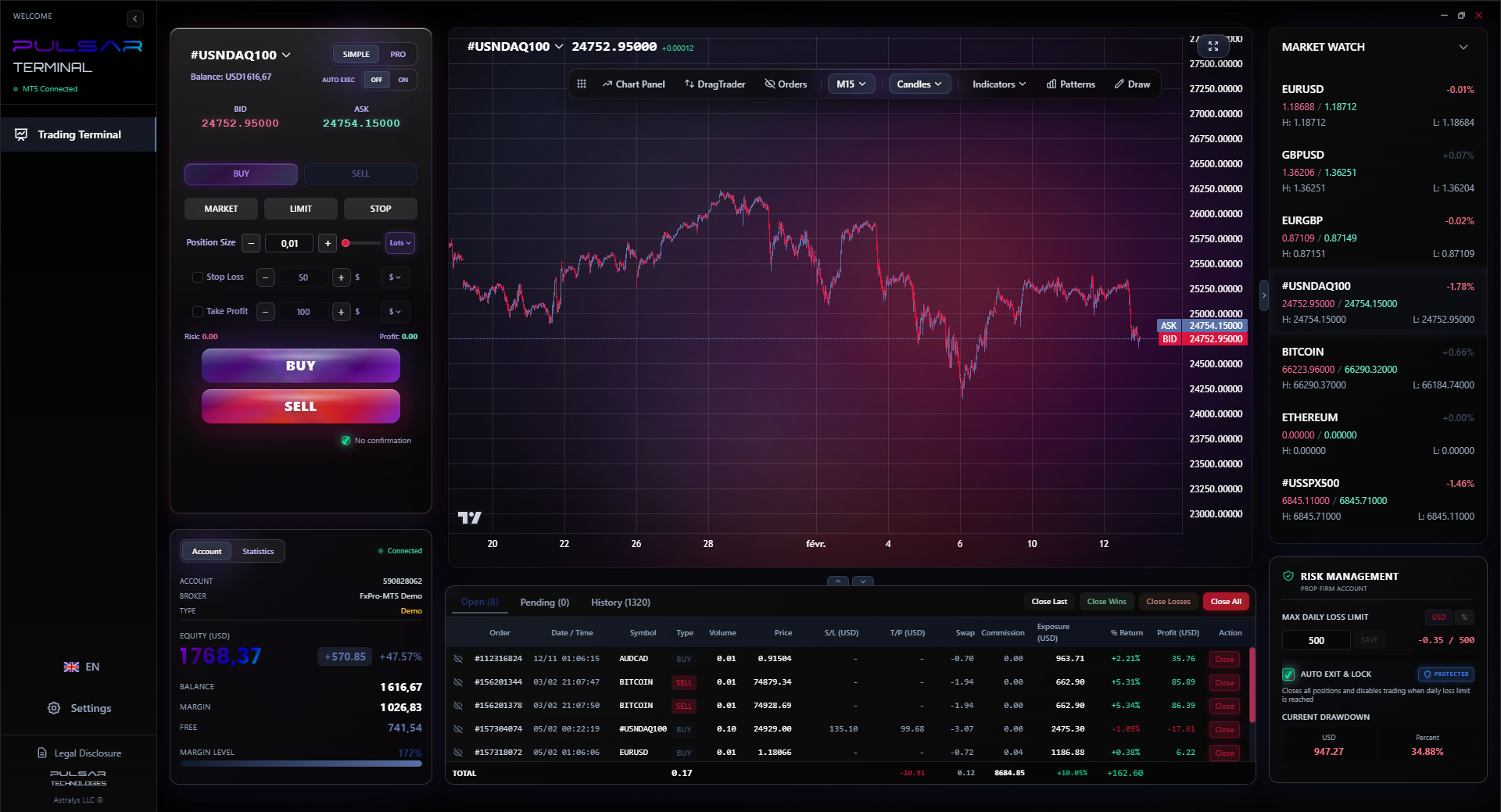
Managing multiple BOS trades with precise stop losses and take-profit levels is complex, but tools like Pulsar Terminal automate this directly on your MT5 platform.
Pulsar Terminal
أداة MT5 الشاملة: أوامر سحب وإفلات، متعدد TP/SL، تريلينج ستوب، تداول الشبكة، Volume Profile وحماية البروب فيرم. يستخدمها أكثر من 1000 متداول يومياً.
Let me save you some pain by listing the errors I see all the time (and have made myself).
- Trading Every Tiny Break: On a 5-minute chart, price breaks a minor high every hour. That's noise, not structure. Move to a higher timeframe like the 1-hour or 4-hour to identify the significant swing points that matter. A scalping strategy might use small structures, but for most, bigger is better.
- No Patience for the Retest: This is the big one. You see the break, FOMO kicks in, and you chase the price. Nine times out of ten, it will pull back. Wait for that retest. It gives you a better entry and confirms the level is now acting as support/resistance.
- Ignoring the Overall Trend: Trying to trade a bullish BOS in a clear, larger downtrend is fighting the tide. Look for BOS signals that align with the higher timeframe trend. This is a core principle of swing trading.
- Setting Stops Too Tight: If you place your stop loss 5 pips below a structure level in USD/ZAR, you will get stopped out by normal market jitter. Give your trade room to breathe. A valid BOS trade might need a 30-50 pip stop. That's why position sizing is non-negotiable.
- Forgetting About Loadshedding & Internet: A real-world SA problem. You don't want to be in a trade when your power or Wi-Fi cuts out. Have a plan: use a mobile data backup, or consider brokers with apps that allow you to set stop losses and take profits easily on your phone.
“With 30:1 use, you're forced to size your positions appropriately, which aligns perfectly with the risk management needed.”
Let's walk through a hypothetical but realistic trade using the South African Rand.
The Setup: On the USD/ZAR daily chart, we're in an uptrend. Price makes a swing high at R19.00, then pulls back to R18.60 (forming a higher low). It starts climbing again.
The Break: Price moves up and closes a daily candle above R19.00 at R19.05. This is our confirmed break of structure.
The Plan: We don't buy at R19.05. We wait for a retest. A few days later, price dips back to the R19.00 area and finds support, bouncing off it. This is our entry signal.
The Trade:
- Entry: Buy at R19.02 (on the bounce).
- Stop Loss: Place at R18.90, just below the broken structure level at R19.00.
- Risk: That's a 12-pip stop (R19.02 - R18.90).
- Position Size: If our account is R20,000 and we risk 1.5%, that's R300. With a 12-pip risk, each pip is worth R25. A standard lot on USD/ZAR is roughly $10 per pip, but with the Rand value, you'd use a position size calculator to get the exact lot size for your broker.
- Take Profit: We aim for a 2:1 reward-to-risk. Our target is 24 pips above entry at R19.26. We could also look for the next resistance level on the chart.
This is a structured, low-stress way to trade. You're not predicting; you're reacting to what the market has already shown you.
FAQ
Q1What is the best timeframe to trade break of structure?
Start with the 4-hour and daily charts. These timeframes filter out market noise and help you identify the significant swing highs and lows that define real structure. Once you're comfortable, you can apply the same rules to the 1-hour chart for more opportunities. Avoid the 1-minute and 5-minute charts when you're learning.
Q2Can I use break of structure for scalping?
You can, but it's trickier. Scalping requires faster decisions and tighter stops. The basic principle is the same - you're looking for price to break a minor swing point on a 1 or 5-minute chart. However, fakeouts are far more common. It's an advanced application. I'd master it on higher timeframes first before trying a scalping strategy with it.
Q3How does FSCA use affect trading BOS?
The 30:1 use limit is actually a protective blessing for this strategy. Since BOS trades often need wider stop losses to be valid, high use would make those stops dangerously expensive in terms of risk per trade. With 30:1, you're forced to size your positions appropriately, which aligns perfectly with the risk management needed for successful structure trading.
Q4What's the difference between BOS and a simple breakout?
All BOS events are breakouts, but not all breakouts are BOS. A breakout is any move beyond a level. A break of structure specifically refers to breaking the last significant swing point in a trend. It's a higher-quality breakout because it confirms the trend's continuity, rather than just a move out of a sideways range.
Q5Should I trade BOS on exotic pairs like USD/ZAR?
Yes, but be aware of the wider spreads and potentially more volatile price action. The principles are identical. Just make sure your broker offers competitive spreads on the pair, and always factor the spread cost into your entry/exit calculations. A 15-pip spread on ZAR means your trade needs to move 15 pips just to break even.
Q6How many pips should a valid BOS move?
There's no fixed number. It's about the decisiveness of the move, not the distance. A clean break that closes 5 pips past a key level on a daily chart is more valid than a messy 20-pip spike that immediately reverses. Focus on the candle's close relative to the level.
درس البروفيسور وينستون
النقاط الرئيسية:
- ✓Wait for the candle CLOSE beyond the level.
- ✓The retest is your high-probability entry, not the initial break.
- ✓Use higher timeframes (4H/Daily) to find significant structure.
- ✓Always combine BOS with at least one other confirming factor.
- ✓Risk a maximum of 2% per trade, no exceptions.
ما مدى فائدة هذا المقال؟
انقر على نجمة للتقييم
رؤى التداول الأسبوعية
تحليلات واستراتيجيات أسبوعية مجانية. بدون رسائل مزعجة.
عن المؤلف
David van der Merwe
متداول الأسواق الناشئة
متداول مقيم في جوهانسبرغ مع 11 عاماً في عملات الأسواق الناشئة. متخصص في أزواج ZAR والتداول المنظم من FSCA وتحليل السوق الجنوب إفريقي.
التعليقات
تحذير من المخاطر
ينطوي تداول الأدوات المالية على مخاطر كبيرة وقد لا يكون مناسبًا لجميع المستثمرين. الأداء السابق لا يضمن النتائج المستقبلية. هذا المحتوى لأغراض تعليمية فقط ولا ينبغي اعتباره نصيحة استثمارية. قم دائمًا بإجراء بحثك الخاص قبل التداول.
قد يعجبك أيضًا

Cara Trading Forex Sukses: 7 Prinsip dari Trader Profesional
Cara trading forex sukses dengan 7 prinsip trader pro: manajemen modal, disiplin, journal trading, backtest. Data nyata, bukan janji profit palsu.
Jam Trading Forex Terbaik untuk Trader Indonesia: Panduan Lengkap dengan Tabel Waktu
Panduan jam trading forex untuk trader Indonesia. Tabel 4 sesi dunia, jam emas 20:00-00:00, sesi mana yang harus dihindari. Data akurat + tips dari trader berpengalaman.
Top 5 Sàn Forex Uy Tín Nhất 2026: Review Jujur dari Trader Indonesia
Top 5 sàn forex uy tín 2026 untuk trader Indonesia. Review jujur: spread, deposit, withdraw, dukungan lokal. Exness, XM, IC Markets & lebih.
احصل على Pulsar Terminal
جميع هذه الحاسبات مدمجة في Pulsar Terminal مع بيانات حية من حساب MT5 الخاص بك.
احصل على Pulsar Terminal