


Most traders think the butterfly pattern is just another fancy drawing on a chart.

David van der Merwe
متداول الأسواق الناشئة ·  South Africa
☕ 10 دقائق قراءة
ما ستتعلمه:
- 1What Exactly Is a Butterfly Pattern?
- 2The Non-Negotiable Fibonacci Ratios
- 3Spotting and Trading It in the South African Context
- 4Risk Management & The Real Cost of Trading in SA
- 5Common Mistakes South African Traders Make (And How to Avoid Them)
- 6Butterfly vs. Other Harmonic Patterns
- 7Putting It All Together: A Realistic Weekly Routine
Most traders think the butterfly pattern is just another fancy drawing on a chart. They slap it on, see a potential reversal, and jump in without a second thought. That's a fast track to blowing up your account, especially with the rand's volatility. I've been there, chasing what looked like a perfect butterfly on USD/ZAR only to get stopped out because I ignored the local market context. This guide isn't about making the pattern look pretty. It's about using it as a precise, evidence-based tool to find high-probability reversals while navigating the unique costs and rules of the South African market.
Forget the complex math for a second. A butterfly pattern is a specific harmonic price structure that signals a potential trend exhaustion and reversal. It's not a guess. It's a geometry-based setup with very specific Fibonacci ratios that define its turning points (labeled X, A, B, C, and D).
The core idea is that price makes an initial move (X to A), retraces (A to B), extends again (B to C), and then makes a final, powerful reversal move to point D. The magic - and the risk - is in those Fibonacci measurements. A valid butterfly pattern has a distinct 'M' shape (for bearish) or 'W' shape (for bullish) where point D extends beyond point X.

Warning: The biggest mistake is seeing a rough 'M' or 'W' and calling it a butterfly. If the Fibonacci ratios aren't precise, it's just a squiggle, not a tradeable signal. Garbage in, garbage out.
I learned this the hard way in 2019. I saw a beautiful 'W' forming on EUR/USD and entered long at what I thought was point D. The problem? My B point retracement was at 0.786, not the required 0.786 of the XA leg. The pattern failed, and I took a 2.4% account loss on what was an oversized position. That trade taught me to be a slave to the ratios.
This is where you separate the pros from the gamblers. A butterfly pattern isn't valid unless it hits these specific Fibonacci retracement and extension levels. Don't approximate.
For a Bearish Butterfly Pattern (M Shape):
- AB Leg: Must retrace to the 0.786 Fibonacci level of the XA leg.
- BC Leg: Can extend to either the 0.382 or 0.886 Fibonacci retracement of the AB leg.
- CD Leg: This is the critical one. It must extend to the 1.618 or 2.0 Fibonacci extension of the XA leg. This creates the point D, your potential selling zone.
For a Bullish Butterfly Pattern (W Shape):
- AB Leg: Same rule. 0.786 retracement of XA.
- BC Leg: 0.382 or 0.886 retracement of AB.
- CD Leg: 1.618 or 2.0 extension of XA. This defines your potential buying zone at point D.
Using Your Platform's Tools
Every decent platform has Fibonacci drawing tools. You draw from X to A to get your 0.786 level for the B point. Then draw from A to B to find where BC should terminate. Finally, use the Fibonacci extension tool from X to A to project where the 1.618 and 2.0 levels sit - that's your point D Potential Reversal Zone (PRZ).

Example: On USD/ZAR, price moves from 18.5000 (X) to 18.2000 (A). The 0.786 retracement of that 300-pip move is at 18.3640. Price must retrace to around that level to form point B. If it bounces to 18.1000 for point C, you then project the 1.618 extension of XA (18.5000 to 18.2000) which is 18.0140. That's your target for point D.

💡 نصيحة وينستون
A pattern is just geometry. The market's reaction to that geometry is what you're betting on. Always wait for the market to confirm your hypothesis with a clear price action signal.
“The FSCA's 30:1 use cap is a blessing in disguise for pattern trading. It forces you to size properly.”
Trading the butterfly pattern forex in South Africa adds layers you can't ignore: liquidity events, rand volatility, and real costs. You can't just trade the pattern in isolation.
Best Pairs and Times
- Major Pairs (EUR/USD, GBP/USD): Cleanest patterns due to high liquidity. Ideal for learning. Check our EUR/USD guide for pair-specific dynamics.
- USD/ZAR & EUR/ZAR: This is where local knowledge pays. Patterns form, but you must be acutely aware of SARB announcements, political news, and local market opens (9am SAST). Liquidity can dry up fast, widening spreads dramatically.
- Gold (XAU/USD): Often exhibits beautiful harmonic patterns. It's a favourite for butterfly hunters. Our XAU/USD guide covers its unique drivers.
The best time to hunt for setups is during the London-New York overlap (3pm - 5pm SAST) for majors, and during the Johannesburg stock exchange hours for ZAR pairs.
The Full Trade Plan
- Identify & Measure: Find a potential M or W shape. Draw your Fibonacci tools. If the ratios don't align, walk away.
- Wait for Confluence at Point D: Never enter just because price hits the 1.618 extension. Wait for price action confirmation in the PRZ - a bearish engulfing candle for a sell, a bullish engulfing for a buy. Use an oscillator like the RSI indicator showing divergence.
- Enter: Place your entry order after the confirming candle closes. For a sell, place a sell limit order just below the PRZ.
- Stop Loss: For a bearish butterfly, your stop goes above point D. For a bullish, below point D. The width of the PRZ helps define your risk.
- Take Profit: Your first target (TP1) is the 0.382 retracement of the AD move. TP2 is the 0.618 retracement. I often bank 50% of my position at TP1 and trail the rest.
Brokers like IC Markets or Pepperstone are good for this because their tight spreads (sometimes 0.0 pips on majors) mean your entry and exit prices aren't eaten by costs before the move even starts.
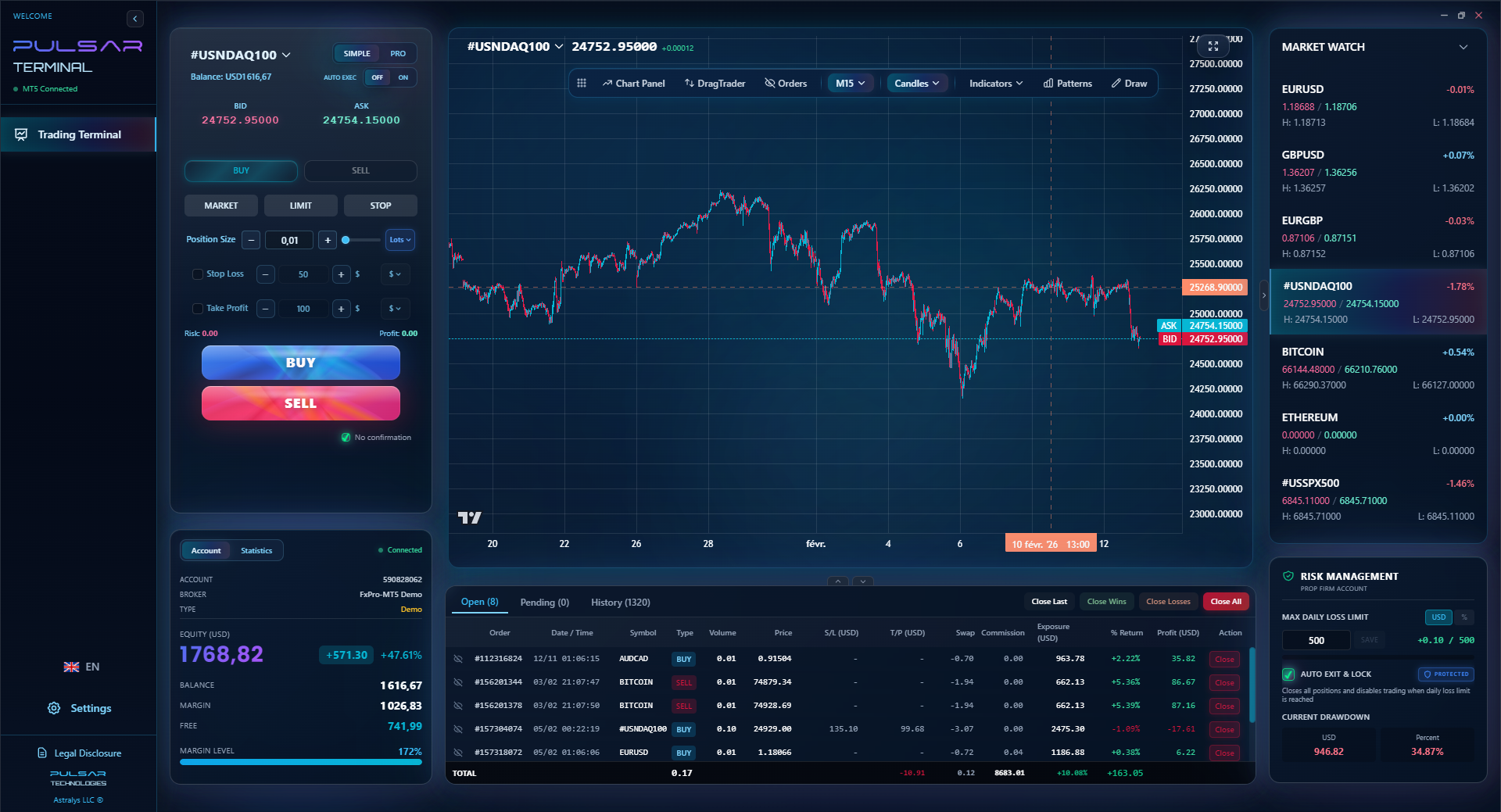
Managing multiple take-profit levels and a trailing stop on a harmonic pattern trade is complex, but Pulsar Terminal automates this directly on your MT5 platform.
Pulsar Terminal
أداة MT5 الشاملة: أوامر سحب وإفلات، متعدد TP/SL، تريلينج ستوب، تداول الشبكة، Volume Profile وحماية البروب فيرم. يستخدمها أكثر من 1000 متداول يومياً.
This is the section that keeps you alive. The FSCA's 30:1 use cap for retail traders is a blessing in disguise for pattern trading. It forces you to size properly. A butterfly pattern trade isn't a scalping strategy where you're in and out in minutes. It's a swing trading setup that requires room to breathe.
Position Sizing is Everything
Let's say you have a R50,000 account. Your point D to stop loss distance on a USD/ZAR trade is 80 pips. With USD/ZAR, a pip on a standard lot is roughly R7.40 (it changes with the rate).
If you risk 1% of your account (R500), your position size calculation is: R500 / (80 pips * R7.40 per pip) = approximately 0.84 standard lots. You'd round down to 0.8 lots. Never guess this. Use a position size calculator.
The Hidden Cost Breakdown
That R500 risk isn't your only cost. You must factor in:
- The Spread: On USD/ZAR, a competitive spread might be 50 pips during active hours. On a 0.8 lot trade, that's an immediate cost of 50 pips * R7.40 * 0.8 = R296. That's nearly 60% of your risk budget just to get in! This is why trading minor or exotic pairs with large patterns is often a loser's game.
- Overnight Swaps: Holding a ZAR short position overnight often incurs a negative swap (you pay). This erodes profits on longer holds.
- Inactivity Fees: If you're a patient butterfly hunter waiting for perfect setups, choose a broker like XM or Exness that don't charge inactivity fees. Getting slapped with a R1500 fee from another broker while you wait for a setup is a nightmare.
A failed pattern isn't just a stop-loss hit. It's the loss plus all these baked-in costs. It adds up faster than you think.
💡 نصيحة وينستون
In South Africa, your biggest enemy trading USD/ZAR isn't the pattern being wrong. It's the 50-pip spread eating your edge before you start. Factor it into your position size as a hard cost.
“A failed pattern isn't just a stop-loss hit. It's the loss plus all the baked-in costs. It adds up faster than you think.”
I've made most of these. Let's save you the money.
- Trading Pre-Mature Patterns: Jumping in at point C, hoping D will happen. You're predicting, not reacting. Wait for the PRZ and confirmation.
- Ignoring the 0.786 Rule: The B point must be at 0.786 of XA. A 0.618 or 0.886 retracement forms a different pattern (like a Gartley). Trading it as a butterfly will fail.
- Neglecting Higher Timeframe Context: Finding a bullish butterfly on the 1-hour chart when the daily chart is in a crushing downtrend is fighting the tide. The higher timeframe trend usually wins.
- Using the Pattern in Isolation: A butterfly at a major previous support/resistance level is strong. A butterfly in the middle of nowhere is weak. Use it with confluence.
- Forgetting About ZAR-Specific News: Trying to enter a USD/ZAR butterfly during a budget speech or SARB rate decision is suicide. The news will obliterate any technical pattern. Know the economic calendar.

Pro Tip: Keep a trading journal. Sketch every butterfly pattern you see, both the ones you trade and the ones you don't. Note the ratios, the outcome, and the market context. After 50 entries, you'll develop a gut feel for which setups are high-probability and which are traps.
The butterfly has cousins. Knowing the difference prevents misidentification.
| Pattern | Key Difference from Butterfly | Typical Use |
|---|---|---|
| Gartley | Point B retraces to 0.618 of XA, not 0.786. Point D is at 0.786 retracement of XA. | Earlier trend reversal signal. |
| Bat | Point B retraces less than 0.618 of XA. Point D is at a 0.886 retracement of XA. | Very deep retracement, potential for strong reversal. |
| Crab | Point B is at a 0.382 or 0.618 retracement of XA. Point D is a massive 1.618 extension of XA. | Extreme reversal, often at major market extremes. |
The butterfly is unique because of that deep 0.786 B point retracement and the extended 1.618/2.0 D point. It often signals a final, exhaustive move. Confusing it with a Gartley, which has a shallower B point, is a classic error that leads to entering too early.
I once misidentified a Bat pattern as a Butterfly on GBP/JPY. The B point was only at 0.50. I entered at my projected Butterfly D point, but price just blew straight through it because the pattern wasn't complete. The real D point (for the Bat) was much deeper. Another 2% lesson learned.
💡 نصيحة وينستون
If you find yourself forcing a Fibonacci level to fit a pretty picture, you've already lost. The market doesn't care about your drawing. Trade what's there, not what you want to see.
“Patience is the ultimate edge. You might only get 2-3 high-quality butterfly setups per month. That's fine.”
You don't find butterfly patterns every day. Here's a sustainable routine for a South African trader.
Sunday Evening: Scan weekly and daily charts of your 5-6 watchlist pairs (include USD/ZAR and a major like EUR/USD). Look for obvious, large-scale M or W structures. No drawing yet, just visual.
Monday - Thursday (Pre-Market):
- Check the SA and global economic calendar for high-impact news.
- On the 4-hour and 1-hour charts of your watchlist, use automated pattern recognition tools (if your platform has them) to flag potential harmonic setups. Never trust them blindly. They are scanners, not trade signals.
- Manually measure any flagged patterns. Draw your Fibs. Validate the ratios. If it passes, mark the Potential Reversal Zone (PRZ) on your chart.
- Set a price alert 20 pips above/below the PRZ so you're notified when price approaches.
When the Alert Hits:
- Switch to a 1-hour or 15-minute chart for entry timing.
- Wait. Do nothing until price is in the PRZ AND shows a reversal candle.
- Execute your pre-calculated trade plan: entry, stop loss, take profit. Use a position size calculator every single time.
- Manage the trade. Move to breakeven when price hits TP1.
Patience is the ultimate edge. You might only get 2-3 high-quality butterfly pattern forex setups per month. That's fine. One good one can yield 3-5% on your account. Consistency beats frenzy every time.
FAQ
Q1Is the butterfly pattern profitable in forex?
It can be, but not as a standalone magic bullet. Its profitability comes from strict rule adherence, precise Fibonacci ratios, and most importantly, combining it with price action confirmation and proper risk management. Used sloppily, it's a sure way to lose money.
Q2What is the success rate of the butterfly pattern?
There's no universal number. A valid pattern with proper confluence (like at a key support level) and confirmed by price action can have a high win rate, perhaps 60-70% on a risk/reward of 1:1.5 or better. However, if you count every rough 'M' shape as a butterfly, the success rate plummets. Your discipline defines the success rate.
Q3Which time frame is best for the butterfly pattern?
The pattern develops across multiple timeframes. Use the daily or 4-hour chart to identify the major structure (XABCD points). Then use the 1-hour or 15-minute chart to fine-tune your entry and manage the trade. Avoid using it on timeframes below 15 minutes, as market noise will distort the pattern.
Q4How do I know if a butterfly pattern is valid?
Check three things: 1) The B point must be at or very near the 0.786 Fibonacci retracement of the XA leg. 2) The D point must be at the 1.618 or 2.0 Fibonacci extension of the XA leg. 3) The overall shape should be a clear 'M' (bearish) or 'W' (bullish). If any of these are off, it's invalid.
Q5Can I use the butterfly pattern with other indicators?
Absolutely, and you should. Use indicators for confirmation, not for finding the pattern. The MACD indicator showing divergence at point D is a strong signal. The RSI indicator moving out of overbought/oversold territory as price enters the PRZ also helps. The pattern provides the location; indicators can help confirm the reversal momentum.
Q6What's the biggest risk when trading this pattern in South Africa?
Beyond standard risks, the two biggest are: 1) Spread costs on ZAR pairs. A wide spread can consume most of your potential profit on a small move. 2) Event risk. South African-specific news (political, SARB) can violently override any technical pattern on USD/ZAR or EUR/ZAR. Always check the calendar.
Q7Should I use automated tools to find butterfly patterns?
Use them as scanners, not as trade signals. Let a tool on your MT4/MT5 or a platform like TradingView highlight potential patterns. Then, you must manually verify every single Fibonacci ratio. I've seen automated tools label patterns that are 0.1 off the critical 0.786 level - enough to make the trade fail. Trust, but verify.
درس البروفيسور وينستون
النقاط الرئيسية:
- ✓The 0.786 B-point retracement is non-negotiable for a valid butterfly.
- ✓Always wait for price action confirmation in the Potential Reversal Zone (PRZ).
- ✓Factor the spread as a direct cost, especially on ZAR pairs (can be 50+ pips).
- ✓Use the pattern as a location tool, not a standalone entry signal.
ما مدى فائدة هذا المقال؟
انقر على نجمة للتقييم
رؤى التداول الأسبوعية
تحليلات واستراتيجيات أسبوعية مجانية. بدون رسائل مزعجة.
عن المؤلف
David van der Merwe
متداول الأسواق الناشئة
متداول مقيم في جوهانسبرغ مع 11 عاماً في عملات الأسواق الناشئة. متخصص في أزواج ZAR والتداول المنظم من FSCA وتحليل السوق الجنوب إفريقي.
التعليقات
تحذير من المخاطر
ينطوي تداول الأدوات المالية على مخاطر كبيرة وقد لا يكون مناسبًا لجميع المستثمرين. الأداء السابق لا يضمن النتائج المستقبلية. هذا المحتوى لأغراض تعليمية فقط ولا ينبغي اعتباره نصيحة استثمارية. قم دائمًا بإجراء بحثك الخاص قبل التداول.
قد يعجبك أيضًا

Cara Trading Forex Sukses: 7 Prinsip dari Trader Profesional
Cara trading forex sukses dengan 7 prinsip trader pro: manajemen modal, disiplin, journal trading, backtest. Data nyata, bukan janji profit palsu.
Jam Trading Forex Terbaik untuk Trader Indonesia: Panduan Lengkap dengan Tabel Waktu
Panduan jam trading forex untuk trader Indonesia. Tabel 4 sesi dunia, jam emas 20:00-00:00, sesi mana yang harus dihindari. Data akurat + tips dari trader berpengalaman.
Top 5 Sàn Forex Uy Tín Nhất 2026: Review Jujur dari Trader Indonesia
Top 5 sàn forex uy tín 2026 untuk trader Indonesia. Review jujur: spread, deposit, withdraw, dukungan lokal. Exness, XM, IC Markets & lebih.
احصل على Pulsar Terminal
جميع هذه الحاسبات مدمجة في Pulsar Terminal مع بيانات حية من حساب MT5 الخاص بك.
احصل على Pulsar Terminal