


Most Nigerian traders think China's $3.2 trillion in forex reserves is just a number for economists.

Olumide Adeyemi
رائد التداول في غرب أفريقيا ·  Nigeria
☕ 9 دقائق قراءة
ما ستتعلمه:
- 1It's Not Just a Number: What $3.2 Trillion Actually Means for You
- 2The Naira-Yuan Swap: Your Direct Link to Beijing
- 3The $20 Billion Trade Imbalance: Finding Your Edge
- 4Nigeria's Own Reserves: The Local Backstop
- 5How to Actually Trade This Information
- 6Brokers, Payments, and Your Bottom Line
- 7Mistakes I've Made (So You Don't Have To)
Most Nigerian traders think China's $3.2 trillion in forex reserves is just a number for economists. They're wrong. Those reserves are actively shaping the liquidity, volatility, and even the spreads you see on your MT5 platform right now. From the renewed 15 billion yuan swap deal to the pressure on our own $48.5 billion reserves, China's financial muscle is a silent partner in every trade you make. I'll show you exactly how to read its movements and, more importantly, how to trade them.
When you hear 'China's forex reserves,' picture the largest financial shock absorber in the world. It's not sitting idle. The People's Bank of China uses this war chest to manage the yuan's value, influence global commodity prices, and provide liquidity during crises. For you, trading from Lagos or Abuja, this matters because China is Nigeria's biggest trading partner. That $22.6 billion annual trade flow? It's a pipeline that connects China's reserve management directly to Naira liquidity.
Think of it like this: when China decides to support the yuan by selling dollars from its reserves, it affects global dollar strength. A stronger dollar usually means more pressure on the Naira. I learned this the hard way in early 2024. I was short on USD/NGN, betting on Naira strength after some positive local news. Then, China reported a larger-than-expected draw on its dollar reserves to curb yuan weakness. Global dollar demand spiked, and my stop-loss was hit for a 2.3% loss before our local market even opened. The lesson was clear: ignore Beijing's balance sheet at your own peril.

Warning: Don't make the mistake of only watching the CBN. Major moves by China's State Administration of Foreign Exchange (SAFE) can override local sentiment in minutes, especially on USD pairs.
This is where it gets real for Nigerian traders. That 15 billion yuan (about $2.09 billion) currency swap agreement renewed in December 2024 isn't political fluff. It's a direct financial bridge. It allows Nigerian importers to pay for Chinese goods in yuan, and vice versa, without first converting to dollars. This reduces immediate demand for dollars in our market, which can temporarily ease pressure on the Naira.
How This Shows Up on Your Charts
You'll see the effects around major trade settlement periods. When a large batch of letters of credit is settled through the swap facility, dollar demand dips. This can cause temporary strength in USD/NGN or a stabilization period. It creates short-term trading ranges. I once caught a nice 150-pip swing on USD/NGN by noticing a lull in interbank dollar demand that coincided with a reported drawdown on the swap line. The trade wasn't based on a fancy indicator, but on understanding this mechanical flow.
The $10 Billion Question
Nigeria is pushing to expand this swap to $10 billion. If that happens, the impact would be significant. It would institutionalize a major non-dollar corridor for trade. For traders, this could mean USD/NGN becomes less volatile in response to Nigeria-China trade data, but CNH/NGN (if your broker offers it) or even USD/CNH would become more critical to watch. You'd need to adjust your watchlist.

Pro Tip: Follow the CBN's quarterly reports on external reserves. Look for any mention of 'currency swap utilization' or 'yuan-denominated assets.' An increase is a subtle signal of reduced near-term dollar pressure, which can be a catalyst for short-term Naira recovery plays.

💡 نصيحة وينستون
The market discounts everything, even swap agreements. The price move happens on the rumor of the deal, not the signing. Trade the anticipation, not the announcement.
“China's $3.2 trillion reserve is a shock absorber for the global economy, and you feel the tremors in every Naira pip.”
Here's the raw deal: Nigeria imports over $20 billion worth of goods from China annually but exports only about $2 billion back. This deficit is a constant source of dollar outflow. Every month, Nigerian businesses need billions of dollars to pay Chinese suppliers. This structural demand is a fundamental weight on the Naira.
As a trader, you can use this. The data is published. When Chinese export figures to Nigeria spike (like the $12.95 billion in the first nine months of 2024), you can anticipate increased dollar demand in the Nigerian forex market in the following 1-2 months as those shipments are paid for. This isn't instant, but it's predictable. It's a macro backdrop that favors being long the dollar against the Naira over the medium term, all else being equal.
The coming 'zero-tariff' policy from China in May 2026 is a potential game-changer. If it actually boosts Nigerian exports, it could slowly rebalance this equation. A trader's job is to watch the export numbers for a sustained uptick. The first few months of real growth could spark a major sentiment shift and a swing trading opportunity in Naira pairs.

Our story isn't just about China. Nigeria's external reserves are the CBN's ammunition to defend the Naira. After hitting a low, they've been climbing: $40.8 billion (end of 2024), $45.5 billion (end of 2025), to about $48.5 billion by mid-February 2026. The CBN thinks we could hit $51 billion by year-end.
This recovery is crucial. Higher reserves mean the CBN has more firepower to intervene in the forex market to smooth out volatility. For you, this changes risk calculations. When reserves were at $35 billion, a sharp Naira drop could turn into a freefall because the CBN's ability to intervene was limited. Now, with closer to $50 billion, sharp drops are more likely to find a floor. This creates a different market environment - one where range-trading strategies might work better during periods of stress than aggressive breakout chasing.
Remember, our reserves are mostly in dollars and other convertible currencies. The yuan swap is a separate tool. But a stronger reserve position overall gives the CBN more confidence, which filters down to market psychology. I always check the latest reserve figure on the CBN website before placing any large, directionally biased trade on a Naira pair. It's a fundamental position size calculator input.
💡 نصيحة وينستون
A $20 billion trade deficit is a tide. You can't fight the tide, but you can surf the waves within it. Look for short-term reversals against the dominant trend for better risk/reward.
“The currency swap isn't political news; it's a liquidity report that should be on your weekly checklist.”
Theory is fine, but how do you make money from this? You need to translate macro flows into a trading plan.
The Instruments to Watch
- USD/NGN: The main event. Pressure from the trade deficit with China is a long-term bearish factor for the Naira here. Swap-facilitated settlements are short-term bullish factors. Watch for conflicts between these forces.
- USD/CNH: The offshore yuan pair. If China is tapping its reserves to support the yuan (selling USD/CNH), it contributes to global dollar strength, which hurts Naira. A weak yuan also makes Chinese imports cheaper, potentially worsening our trade deficit. This pair is a leading indicator.
- XAU/USD (Gold): China often diversifies its reserves into gold. Big gold purchases can signal a desire to move away from dollars, potentially weakening the dollar in the medium term. Check our XAU/USD guide for how to trade gold moves.
Building a Simple Watchlist Strategy
I keep a simple weekly checklist:
- China SAFE Reserve Data: Released monthly. A large unexpected change >$20B is a market mover.
- Nigeria-China Trade Data: Look for spikes in imports.
- CBN Reserve Data: Is the buffer growing or shrinking?
- Swap Line Utilization Reports: Any news on drawings from the 15bn yuan facility.
When two or more of these line up, I have a thesis. For example, rising Nigerian reserves + news of active swap use + a monthly drop in Chinese imports to Nigeria could signal a good environment to try a short-term long Naira trade. I'll then use technicals on USD/NGN for precise entry.

Example: In Q1 2025, reserves were rising and swap usage was high. USD/NGN was in a tight range on the daily chart. I bought at the bottom of the range (789.50) with a tight stop, targeting the top (802.00). The macro backdrop supported the range, and the trade worked for a 1.6% gain. The macro didn't tell me the exact levels, but it gave me the confidence to execute the technical setup.
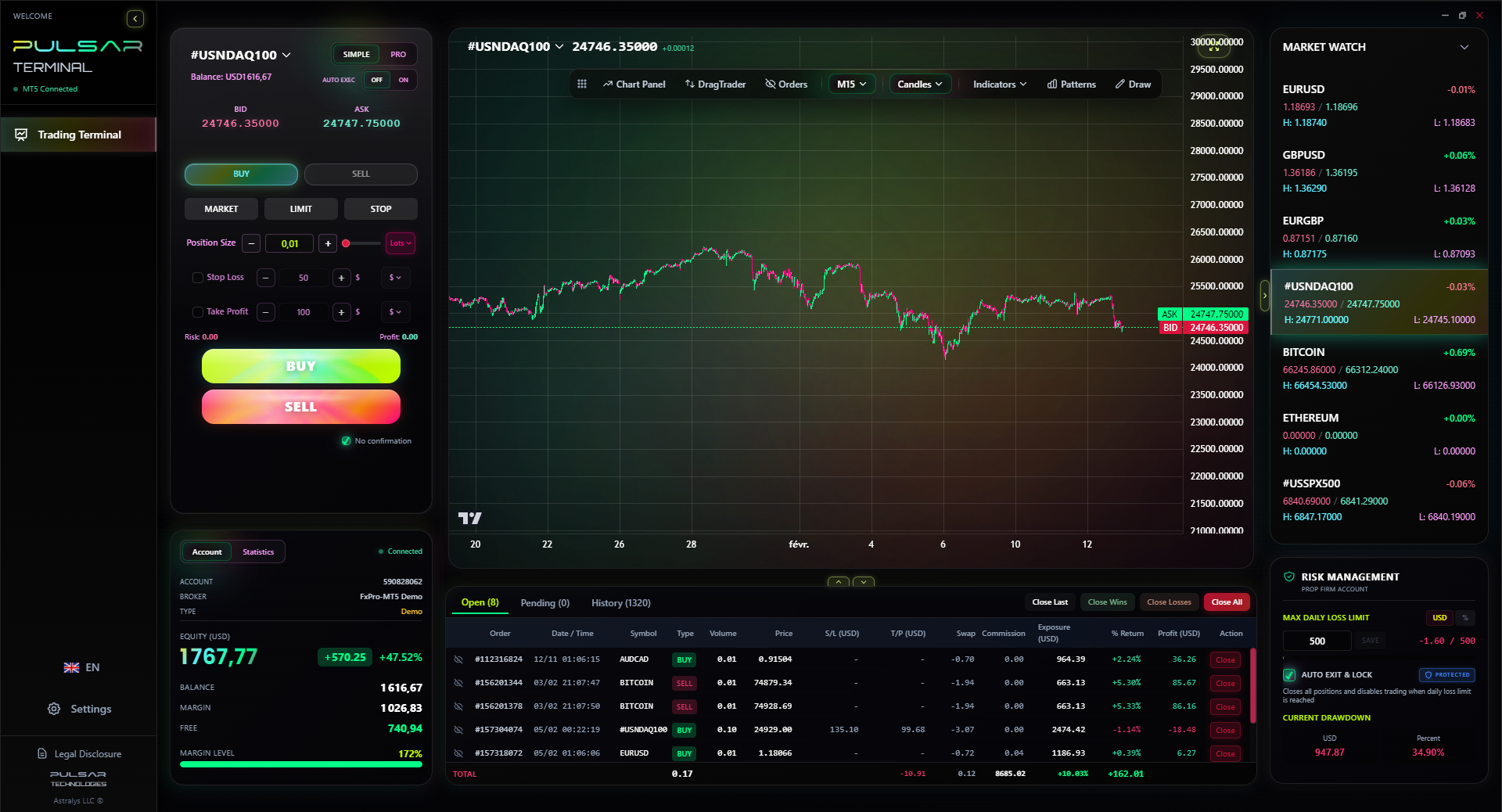
When trading the nuanced signals between China's macro data and Naira price action, precise order management is non-negotiable. Pulsar Terminal's drag-and-drop orders and multi-take-profit tools let you execute complex trade plans on MT5 instantly, so you can focus on the analysis, not the clicks.
Pulsar Terminal
أداة MT5 الشاملة: أوامر سحب وإفلات، متعدد TP/SL، تريلينج ستوب، تداول الشبكة، Volume Profile وحماية البروب فيرم. يستخدمها أكثر من 1000 متداول يومياً.
All this analysis is useless if you can't fund your account efficiently. Thankfully, Nigeria's payment scene is getting better. You can fund most international brokers like Exness, IC Markets, or Pepperstone using naira cards, bank transfers, or e-wallets like OPay and Flutterwave.
Be smart about fees. That 0.5% to 5% on card payments adds up. I always calculate the fee as part of my trade's spread definition cost. If I'm making a scalping strategy where my profit target is 10 pips, a 3% deposit fee on my capital is a huge hurdle. I use bank transfers for larger, less frequent deposits to keep costs down.
Choose a broker with tight spreads on major pairs because you'll be watching USD/CNH closely. Raw spread accounts from brokers like FP Markets or Exness, with spreads from 0.0 pips plus commission, are ideal for this. You need to see the true price action without a wide spread definition obscuring small but important moves in the yuan.
“I learned the hard way: a headline from Beijing can hit your stop-loss in Lagos before your local market even opens.”
Let me be honest about where I've gotten burned linking China to my trades.
Mistake 1: Overreacting to Headlines. When the swap was renewed, I immediately went heavy short USD/NGN, thinking the dollar pressure would vanish overnight. The market had already priced it in. The actual liquidity effect was gradual. I gave back a week's profits in a day.
Mistake 2: Ignoring the Lag. China's reserve data impacts the yuan first, then global dollar sentiment, then maybe the Naira. It's a chain, not a simultaneous event. I used to enter Naira trades the minute China data dropped. Now I wait 12-24 hours to see how USD/CNH and broader DXY digest the news first.
Mistake 3: Forgetting Local Factors. China's reserves are a global force, but the Naira is also slammed by local fuel subsidies, election cycles, and CBN policy. In 2024, I was so focused on a big drawdown in China's reserves (bullish for Naira) that I ignored a simultaneous CBN announcement about clearing a FX backlog (bearish for Naira). The local factor won. My trade lost.
The key is synthesis. Use China's forex reserves as one major piece of your puzzle, not the whole picture. Combine it with a solid read of local policy and a disciplined technical approach. That's how you build an edge that lasts.
FAQ
Q1Do China's forex reserves directly set the USD/NGN rate?
No, not directly. The rate is set by market forces and CBN intervention. However, China's management of its reserves influences global dollar strength/weakness and provides alternative liquidity (via the yuan swap) that indirectly affects the supply and demand dynamics for dollars in Nigeria, thereby impacting the rate.
Q2As a Nigerian trader, should I start trading the Chinese Yuan (CNH)?
It's a great idea for correlation analysis, but trading it directly depends on your broker. Many international brokers offer USD/CNH. It's less volatile than some pairs and can be a good way to gain direct exposure to China's economic policy shifts that affect Nigeria. Start by adding it to your watchlist.
Q3How does the currency swap help stabilize the Naira?
It helps by reducing immediate demand for US dollars. If a Nigerian importer can pay for Chinese machinery in yuan directly from the swap line, they don't need to buy dollars from the Nigerian forex market first. This reduced dollar demand eases downward pressure on the Naira's value.
Q4What's the single most important China-related data point I should watch?
The monthly change in China's total foreign exchange reserves, published by the State Administration of Foreign Exchange (SAFE). A large, unexpected decrease (e.g., over $30 billion) often signals China is selling dollars to support the yuan, which can strengthen the dollar globally and pressure emerging market currencies like the Naira.
Q5Can the CBN use the yuan from the swap to boost Nigeria's forex reserves?
Not directly for reserve reporting in the traditional sense. The swap is a credit line for facilitating trade, not a direct addition to reserves. However, by conserving dollars that would have been used for China trade, it helps preserve Nigeria's dollar reserves. The yuan drawn from the swap would be a liability, not a free asset.
Q6With the trade imbalance, is it always right to bet against the Naira?
It's a strong long-term headwind, but not a sure thing every day. The CBN's reserve levels, oil prices, and periodic inflows (like Eurobonds) can provide powerful counter-trend rallies. The deficit creates a bearish bias, but you still need to pick your entries and exits carefully. Never trade on a single factor.
درس البروفيسور وينستون
النقاط الرئيسية:
- ✓China's reserve changes >$20B move global USD liquidity.
- ✓The 15bn yuan swap reduces immediate Naira pressure.
- ✓Nigeria's $20bn import deficit is a structural Naira weight.
- ✓Trade the rumor of policy, not the official signing.
- ✓Always synthesize China data with local CBN action.
ما مدى فائدة هذا المقال؟
انقر على نجمة للتقييم
رؤى التداول الأسبوعية
تحليلات واستراتيجيات أسبوعية مجانية. بدون رسائل مزعجة.
عن المؤلف
Olumide Adeyemi
رائد التداول في غرب أفريقيا
أحد أنشط معلمي تداول الفوركس في نيجيريا. 8 سنوات من الخبرة في التداول من لاغوس. متخصص في استراتيجيات رأس المال المنخفض وتحديات شركات البروب للمتداولين الأفارقة.
التعليقات
تحذير من المخاطر
ينطوي تداول الأدوات المالية على مخاطر كبيرة وقد لا يكون مناسبًا لجميع المستثمرين. الأداء السابق لا يضمن النتائج المستقبلية. هذا المحتوى لأغراض تعليمية فقط ولا ينبغي اعتباره نصيحة استثمارية. قم دائمًا بإجراء بحثك الخاص قبل التداول.
قد يعجبك أيضًا

Cara Trading Forex Sukses: 7 Prinsip dari Trader Profesional
Cara trading forex sukses dengan 7 prinsip trader pro: manajemen modal, disiplin, journal trading, backtest. Data nyata, bukan janji profit palsu.
Jam Trading Forex Terbaik untuk Trader Indonesia: Panduan Lengkap dengan Tabel Waktu
Panduan jam trading forex untuk trader Indonesia. Tabel 4 sesi dunia, jam emas 20:00-00:00, sesi mana yang harus dihindari. Data akurat + tips dari trader berpengalaman.
Top 5 Sàn Forex Uy Tín Nhất 2026: Review Jujur dari Trader Indonesia
Top 5 sàn forex uy tín 2026 untuk trader Indonesia. Review jujur: spread, deposit, withdraw, dukungan lokal. Exness, XM, IC Markets & lebih.
احصل على Pulsar Terminal
جميع هذه الحاسبات مدمجة في Pulsar Terminal مع بيانات حية من حساب MT5 الخاص بك.
احصل على Pulsar Terminal