


Here's a fact that will save you a lot of money: 95% of the 'strategies' you find online are pure garbage.
Rajesh Sharma
محلل فوركس أول ·  India
India
☕ 9 دقائق قراءة
ما ستتعلمه:
- 1Forget Everything You Know (The Indian Trader's Reality Check)
- 2Scalping the Forex Markets (The 5-Minute Grind)
- 3Swing Trading Setups (The Patient Hunter)
- 4Position Trading: The Big Picture Game
- 5Risk Management: The Only Non-Negotiable Strategy
- 6Tools & Indicators: Keep It Stupidly Simple
- 7Putting It All Together: Your Trading Plan

Here's a fact that will save you a lot of money: 95% of the 'strategies' you find online are pure garbage. They're backtested on perfect data, ignore transaction costs, and fall apart the second real money is on the line. I've blown up an account testing them so you don't have to. In India, with our unique market hours and regulatory quirks, you need a different playbook. This isn't about fancy theories. It's about currency trading strategies you can execute before your morning chai gets cold, using setups that have paid my bills for over a decade.
Before we talk strategy, let's get real about the playing field. Trading EUR/USD at 3 AM IST because some guru on YouTube said so is a recipe for burnout and losses. Your edge isn't in fighting the London open half-asleep. It's in understanding your market's rhythm.
The most liquid sessions for us are the overlap of the Asian and early European sessions (roughly 9:30 AM to 2:30 PM IST). This is when you'll see decent movement on major pairs without the insane volatility of the US open. This is your prime time for most currency trading strategies.
Then there's the broker landscape. You're likely trading with an international broker's subsidiary or a registered entity. This means you're often dealing with higher fixed spreads on exotic pairs and potential slippage during local news events. A strategy that works on a razor-thin ECN spread might get eaten alive by the costs here. I learned this the hard way trying to implement a pure scalping strategy on USD/INR during low liquidity. The spread was wider than my profit target.

Warning: Many 'demo account champions' fail live because they never factor in the real cost of a spread. If your strategy needs a 1-pip move to be profitable and your broker's typical spread is 1.5 pips, you're mathematically doomed before you start.

“95% of the 'strategies' you find online are pure garbage. They're backtested on perfect data and fall apart the second real money is on the line.”
Scalping is for the disciplined, the quick, and the emotionally detached. It's not gambling. It's a surgical extraction of small, frequent profits. In India, this works best during those high-liquidity overlap hours I mentioned.
The 1-Minute Momentum Fade
This is my bread and butter for a quick morning trade. I look at EUR/USD or GBP/USD on a 1-minute chart. I wait for a sharp, news-driven spike of 7-10 pips in under a minute. The herd is piling in. I then wait for the first sign of exhaustion - a small bearish pin bar or a divergence on a fast stochastic. I enter against the spike, aiming for a 5-8 pip profit as the move retraces.
Real Trade: On March 15th, a fake UK jobs number spike sent GBP/USD from 1.2805 to 1.2815 in 45 seconds. I shorted at 1.2813 after a pin bar formed. Stop loss at 1.2820 (7 pips). Took profit at 1.2806 (7 pips). 7 pips in 3 minutes. Small, but it adds up.
The key is position size. You're targeting small gains, so you need volume to make it meaningful, but not so much that a 10-pip loss wrecks you. Always, always use a position size calculator. For this strategy, my stop loss is always my profit target. A 1:1 risk-reward. It feels wrong, but with a 55-60% win rate, the math works.

Pro Tip: Never scalp during major US news releases (8:30 PM IST). The spreads widen to absurd levels, and slippage will guarantee you get filled at the worst possible price. It's a broker's holiday, not yours.

💡 نصيحة وينستون
Your first profit target should often be to cover your spread and commission. Think of it as getting your trade 'to free.' Anything after that is pure profit, and you can move your stop to breakeven. This psychology changes everything.

“Trading EUR/USD at 3 AM IST because some guru on YouTube said so is a recipe for burnout and losses. Your edge is in understanding *your* market's rhythm.”
If scalping is a sprint, swing trading is a marathon. You're holding trades for days, sometimes weeks, catching the meat of a trend. This suits the Indian trader who can't stare at screens all day. You check in the morning, maybe at lunch, and set your orders.
My favorite setup is the Daily Chart Pullback. I use the 50-day and 200-day Exponential Moving Averages (EMAs) to identify the trend. For a long setup, price must be above both EMAs. Then, I wait for it to pull back to the 50-day EMA or a key support level on the daily chart. I enter on a 4-hour or 1-hour chart confirmation - like a bullish engulfing pattern or a break of a minor downtrend line.
The Trade That Taught Me Patience: Back in 2022, I was bullish on XAU/USD (Gold). It was above its key EMAs and pulled back to $1780. I bought, expecting a run to $1850. It dipped to $1775 the next day. I got scared, doubted my analysis, and exited for a tiny loss. It then proceeded to rally straight to $1870 without me. I broke my own rule because of intraday noise. The lesson? Swing trade on the daily frame, manage on the 4-hour, and ignore the 15-minute chaos.
Risk management is different here. Your stop loss is wider - maybe 50-100 pips - so your position size must be smaller. Your profit target should be at least 1.5 to 3 times your risk. This is where tools that help manage multiple take-profit levels are useful, letting you scale out of a position as it runs.
“Trading EUR/USD at 3 AM IST because some guru on YouTube said so is a recipe for burnout and losses. Your edge is in understanding *your* market's rhythm.”
This is macro-economics meets technicals. You're trading based on interest rate differentials, central bank policy, and long-term chart patterns. Trades last for months. You need a stomach of steel and capital you can truly afford to forget about.
For the Indian trader, this often means looking at pairs like USD/INR (though direct trading is restricted), or using major pairs as a proxy for global risk sentiment that will eventually impact our markets.
My framework is simple:
- Fundamental Bias: Is the US Fed hiking while the ECB is dovish? That's a long-term bullish bias for USD against EUR.
- Weekly Chart Technicals: I only use the weekly chart. I'm looking for multi-month consolidation breaks, major support/resistance flips, and sustained closes above/below key moving averages.
- Entry on the Monthly/Weekly Close: I don't try to pick the bottom or top. I wait for a confirmed weekly close that validates my fundamental view. The entry is terrible, but the confirmation is strong.
This strategy requires the least screen time but the most conviction. A single trade might be 5% of your capital, with a stop loss 200-300 pips away. You will sit on drawdowns for weeks. It's not for everyone. But when it works, it pays for a year of smaller trades. Understanding the long-term flow in a pair like EUR/USD is critical for this approach.
💡 نصيحة وينستون
If you find yourself constantly moving your stop loss further away because 'it'll come back,' you've already lost. You're not managing a trade; you're praying. The market doesn't hear prayers.

“The indicator rabbit hole is where trading careers go to die. You'll meet traders with charts so cluttered it looks like a UFO dashboard. They're usually losing.”
You can have the best entry strategy in the world and still go bust. I did. My first major account blow-up wasn't from bad analysis; it was from betting 15% of my account on a 'sure thing.' Spoiler: nothing is sure.
Here's the unsexy, non-negotiable rule: Never risk more than 1% of your trading capital on a single trade. For a ₹100,000 account, that's ₹1,000.
How does that translate to pips? Let's say you're swing trading GBP/JPY. Your stop loss is 50 pips away. The pip value for a standard lot is roughly ₹700 (varies with rate). To risk only ₹1,000, you can only trade a position size where 50 pips = ₹1,000. That's a micro lot (1,000 units) or less. Use a calculator. Every time.

Example: Account: ₹500,000. 1% Risk = ₹5,000. Trade: Buy USD/CAD, Stop Loss = 30 pips. Pip value for standard lot ≈ ₹600. Max position = (₹5,000 risk) / (30 pips * ₹600/pip) ≈ 0.27 lots. You'd round down to 0.25 lots.
The other killer is the margin call. Over-leveraging is the fastest path to zero. If your broker offers 500:1 use, that doesn't mean you should use it. I never use more than 10:1 effective use on my total account. It keeps you in the game after a string of losses, which will happen.
Finally, have a daily loss limit. Mine is 3%. If I lose 3% of my account in a day, I shut it down. No revenge trading. Go for a walk. This single rule has saved me from turning a bad day into a catastrophic month.

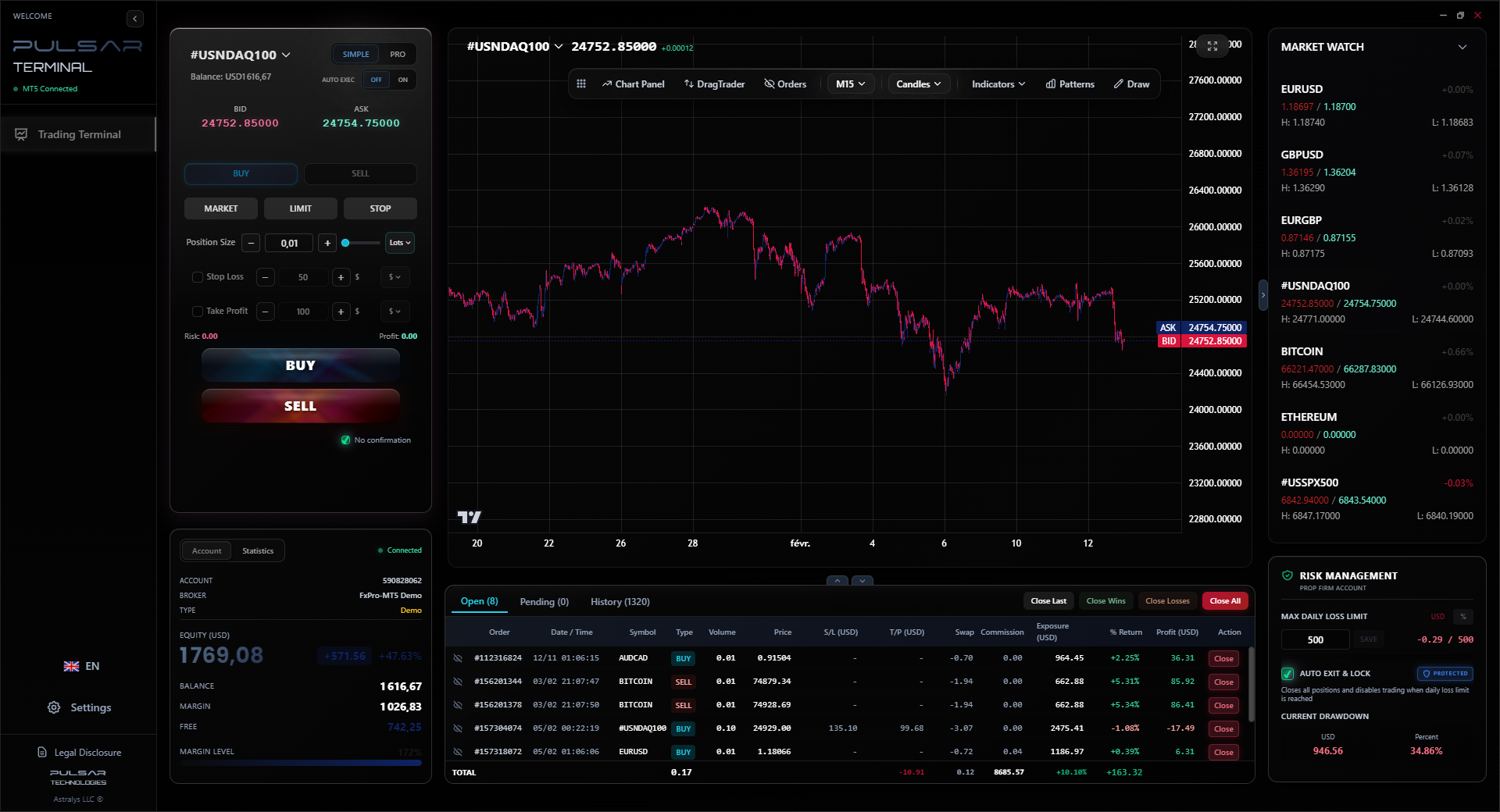
Managing multiple take-profit levels and moving stops to breakeven manually is a hassle; Pulsar Terminal automates this directly on your MT5 chart, letting you focus on the next setup.
Pulsar Terminal
أداة MT5 الشاملة: أوامر سحب وإفلات، متعدد TP/SL، تريلينج ستوب، تداول الشبكة، Volume Profile وحماية البروب فيرم. يستخدمها أكثر من 1000 متداول يومياً.
“The indicator rabbit hole is where trading careers go to die. You'll meet traders with charts so cluttered it looks like a UFO dashboard. They're usually losing.”
The indicator rabbit hole is where trading careers go to die. You'll meet traders with charts so cluttered it looks like a UFO dashboard. They're usually losing.
After 12 years, I use three things:
- Price Action & Support/Resistance: The oldest tool in the book. It works because everyone else sees the same levels. Draw horizontal lines at obvious swing highs and lows.
- Two Moving Averages: A fast one (like 20-period EMA) and a slow one (50-period EMA) on the H1 or H4 chart. I don't trade the crossovers. I use them to visualize the trend and dynamic support/resistance.
- One Oscillator for Divergence: Usually the RSI indicator. I don't care if it's overbought or oversold. I care when price makes a new high but RSI makes a lower high (bearish divergence), or vice versa. It's a great warning sign of momentum fading.
That's it. I don't use Bollinger Bands, Ichimoku Clouds, or the Alligator. More tools mean more conflicting signals, which means more paralysis.
The most sophisticated tool you need is a journal. Write down every trade: entry, exit, reason, emotional state. Review it weekly. You'll find your personal patterns - maybe you're great at breakouts but terrible at fades. Double down on your strengths and stop taking the trades that consistently lose.
💡 نصيحة وينستون
The best indicator of future price action is often past price action. Before adding another line to your chart, ask: 'What is price actually doing right now?' Support, resistance, and trendlines are free and used by every big bank desk in the world.
“A strategy without a plan is just a wish. Write it down, follow it for 100 trades, and let the data - not your gut - tell you what works.”
A strategy without a plan is just a wish. Here’s a template you can steal:
1. Market Condition: Am I scalping (high volatility, overlap session) or swing trading (established trend on H4/Daily)? 2. Pair Selection: For scalping, I stick to majors (EUR/USD, GBP/USD). For swings, I'll look at crosses (EUR/GBP, AUD/CAD) for cleaner trends. 3. Entry Trigger: Specific rule. Not 'it looks good.' It's: 'Buy if price pulls back to the 50 EMA on H4 and forms a bullish engulfing candle.' 4. Exit Strategy: Defined before entry.
- Stop Loss: Based on technical level, not a random pip amount.
- Take Profit: At least 1.5x my risk. Consider scaling out (close half at 1x risk, let rest run). 5. Position Size: Calculated via position size calculator based on my 1% account risk and the distance to my stop. 6. Post-Trade: Log it. No exceptions.
Stick to this plan for 100 trades. No tweaking, no adding new indicators after two losses. You're testing the system, not your luck. Only after 100 trades do you have enough data to know if it works for you.
The final piece? Choosing a broker that doesn't work against you. Low, stable spreads are crucial. I've had good execution experiences with brokers like IC Markets and Pepperstone for their raw spreads, especially during our key trading hours. Do your own due diligence.

FAQ
Q1Which currency trading strategy is best for beginners in India?
Swing trading on the 4-hour or daily chart. It gives you time to think, doesn't require glued-to-screen attention, and has wider stop losses that are more forgiving of slightly imperfect entries. Start with one major pair like EUR/USD. Avoid scalping until you have solid discipline.
Q2How much money do I need to start trading forex in India?
Technically, some international brokers allow you to start with $100 (approx. ₹8,300). But realistically, to properly implement risk management (the 1% rule) and not get wiped out by a few losses, you should start with at least ₹50,000-₹100,000. This allows for meaningful position sizing without over-leveraging.
Q3Is forex trading legal in India?
Trading in foreign exchange pairs is legal through SEBI-registered brokers or international brokers. However, there are restrictions. You cannot directly trade INR pairs like USD/INR for speculative purposes on most platforms available to retail traders. You are limited to major, minor, and exotic forex pairs that do not involve the Indian Rupee.
Q4What's the biggest mistake Indian traders make?
Trading the wrong session. Trying to trade the London or New York session at odd hours leads to fatigue and chasing moves. Your edge is in the Asian/European overlap (9:30 AM - 2:30 PM IST). Also, ignoring the real cost of spreads and commissions, which turns a theoretically profitable strategy into a losing one.
Q5Can I use automated trading or robots?
You can, but be extremely skeptical. Most EAs are sold, not used by their creators. They're often curve-fitted to past data and fail in live markets. The market conditions in India (spreads, liquidity at your trading time) are rarely what the EA was tested on. It's better to learn to trade manually first.
Q6How do I know if my strategy is working?
After a minimum of 30-50 trades, look at your expectancy. (Average Win * Win Rate) - (Average Loss * Loss Rate). If it's positive, you have a statistical edge. If it's negative, the strategy is broken. Your trading journal provides this data. Feelings and memory are liars; the journal tells the truth.
درس البروفيسور وينستون
النقاط الرئيسية:
- ✓Trade your session: 9:30 AM - 2:30 PM IST is your liquidity sweet spot.
- ✓Never, ever risk more than 1% of your capital on a single trade.
- ✓Price action and horizontal lines beat a screen full of lagging indicators.
- ✓A positive expectancy after 50 trades beats a 10-trade winning streak.
ما مدى فائدة هذا المقال؟
انقر على نجمة للتقييم
رؤى التداول الأسبوعية
تحليلات واستراتيجيات أسبوعية مجانية. بدون رسائل مزعجة.
عن المؤلف
Rajesh Sharma
محلل فوركس أول
أكثر من 10 سنوات في تداول الأسواق الهندية وجنوب آسيا. بدأ بالمشتقات النقدية في NSE قبل الانتقال إلى الفوركس الدولي. متخصص في USD/INR وأزواج الأسواق الناشئة.
التعليقات
تحذير من المخاطر
ينطوي تداول الأدوات المالية على مخاطر كبيرة وقد لا يكون مناسبًا لجميع المستثمرين. الأداء السابق لا يضمن النتائج المستقبلية. هذا المحتوى لأغراض تعليمية فقط ولا ينبغي اعتباره نصيحة استثمارية. قم دائمًا بإجراء بحثك الخاص قبل التداول.
قد يعجبك أيضًا

Cara Trading Forex Sukses: 7 Prinsip dari Trader Profesional
Cara trading forex sukses dengan 7 prinsip trader pro: manajemen modal, disiplin, journal trading, backtest. Data nyata, bukan janji profit palsu.
Jam Trading Forex Terbaik untuk Trader Indonesia: Panduan Lengkap dengan Tabel Waktu
Panduan jam trading forex untuk trader Indonesia. Tabel 4 sesi dunia, jam emas 20:00-00:00, sesi mana yang harus dihindari. Data akurat + tips dari trader berpengalaman.
Top 5 Sàn Forex Uy Tín Nhất 2026: Review Jujur dari Trader Indonesia
Top 5 sàn forex uy tín 2026 untuk trader Indonesia. Review jujur: spread, deposit, withdraw, dukungan lokal. Exness, XM, IC Markets & lebih.
احصل على Pulsar Terminal
جميع هذه الحاسبات مدمجة في Pulsar Terminal مع بيانات حية من حساب MT5 الخاص بك.
احصل على Pulsar Terminal