


You want to make money from forex, right? We all did.

Olumide Adeyemi
رائد التداول في غرب أفريقيا ·  Nigeria
☕ 8 دقائق قراءة
ما ستتعلمه:
- 1use: The Double-Edged Sword That Cuts Deep
- 2Emotional Volatility (That's You)
- 3The Unregulated Broker Minefield
- 4The Hidden Killers: Slippage & Requotes
- 5Overtrading: The Slow Cancer of Your Account
- 6Indicator Overload & Analysis Paralysis
- 7The Silent Failure: No Trading Journal
- 8A Realistic Path Forward (If You Continue)
You want to make money from forex, right? We all did. But before you fund that account, you need to understand what you're really getting into. This isn't about getting rich quick. It's about navigating a minefield where the biggest danger isn't the market moving against you, it's you. I've blown accounts, fallen for scams, and sat frozen as my screen turned red. Let me walk you through the real dangers of forex trading, so you don't have to learn the hard way.
Every broker in Nigeria advertises it: 'Trade with 1:500 use!' 'Maximize your profits!' It sounds like free money. Let me tell you, it's not. It's a loan with instant consequences.
use amplifies everything. A 1% move in the market doesn't mean a 1% change in your account. With 1:100 use, that's a 100% change. You can double your money, or wipe it out, on a tiny price swing. My first major blow-up came from this. I deposited ₦200,000, used 1:200 use on a EUR/USD trade, and got stopped out on a routine 50-pip retracement. Gone. Just like that. I didn't understand that high use demands microscopic position size calculator precision. It turns a small mistake into a catastrophe.
The Margin Call Monster
This is use's ugly cousin. When your losses eat up your usable margin, the broker closes your trades to protect their loan. It's not a warning, it's an execution. You're left with a fraction of your capital, or worse, a negative balance. I've seen a margin call wipe out three weeks of careful profits in 30 seconds because I was over-leveraged on a single GBP/JPY news spike.

Warning: High use is a trap for new traders. It makes small accounts look powerful, but it dramatically shortens your learning curve by destroying your capital before you've learned anything.
Start low. I mean 1:10 or 1:20. Get used to the real pace of the market. The pros I know who trade large volumes use surprisingly low use. They let their strategy and position size calculator do the work, not a dangerous multiplier.

💡 نصيحة وينستون
use is a multiplier for losses first, profits second. If you can't be profitable at 1:10, you'll be destroyed at 1:100.
We talk about market volatility, but your emotional state is ten times more volatile and dangerous. Greed, fear, and hope are not strategies, they are liabilities.
Greed makes you double your lot size after a win. Fear makes you close a winning trade too early. Hope makes you hold a losing trade as it sinks into oblivion. I have a journal entry from 2019 that just says, 'Held USD/CHF short, hoping for a reversal. Ignored my stop. Lost ₦85,000. Stupid.' Hope is not a risk management tool.
The most dangerous phase is after a big loss. The urge for 'revenge trading' is overwhelming. You jump back in with a larger size to win back what you lost, usually without a plan. That's how a ₦30,000 loss becomes a ₦100,000 disaster. I've done it. You need a rule: after a max daily loss, walk away. Shut the platform. This is where a structured swing trading plan can save you, because it removes the need for impulsive, emotional decisions.
“Hope is not a risk management tool.”
This is a uniquely critical danger in Nigeria. Not all 'brokers' are brokers. Some are outright scams. Others are 'bucket shops' that profit when you lose. Your first line of defense is knowing who holds your money.
I learned this the painful way early on. A slick platform, promises of huge bonuses, and local bank deposits sucked me in. Withdrawals? 'Processing.' Then 'technical issue.' Then silence. ₦150,000 gone. Poof. It was a costly lesson in due diligence.
You must check regulation. Look for brokers with strong, reputable licenses from bodies like the FCA (UK), ASIC (Australia), or CySEC (Cyprus). These entities enforce client fund segregation, meaning your money is held separately from the broker's operating funds. They also offer compensation schemes. I only trust my capital with heavily regulated entities now, like the ones we review thoroughly (Exness review, IC Markets review).

Pro Tip: If a broker's main selling point is a '100% deposit bonus,' run. Bonuses always come with impossible withdrawal conditions. Real brokers sell tight spreads and reliable execution, not fairy tales.
You won't see these dangers in the brochure. You only feel them in your account balance. They happen during fast markets, like news releases (NFP, ECB statements).
Slippage: You click 'buy' at 1.1050. Your order fills at 1.1065. That's 15 pips of instant, unavoidable loss before the trade even moves. I once had 28 pips of negative slippage on a GBP/USD Brexit headline. It turned a planned 50-pip profit into a 22-pip loss instantly.
Requotes: The price changes as you click. The platform pops up: 'Price has changed to 1.1052. Accept?' By the time you click 'accept,' it's changed again. You're chasing a moving train, often into worse prices. This makes certain scalping strategy approaches nearly impossible on some brokers.
These are execution dangers. They highlight why your broker's technology and liquidity matter. A broker with poor liquidity will give you more slippage. This is a hidden cost that eats into your edge. It's why I'm picky about execution quality and stick to brokers known for it, like Pepperstone or XM on their better account types.
“Overtrading is a thousand small cuts. Paying the spread on low-probability setups bleeds your account dry.”
This is the most common, insidious danger. It's not one big explosion, it's a thousand small cuts. Overtrading is taking trades out of boredom, to 'be in the market,' or to make up for a quiet week. It's violating your own rules because you're itchy.
Every trade has a cost: the spread definition. Pay that spread 50 times in a day on low-probability setups, and you've bled your account dry without a single major move going against you. I've had weeks where I was 'right' on direction 60% of the time but still lost money because I traded 40 times, paying spreads and commissions that destroyed my gains.
Your strategy should tell you when to trade. If the MACD indicator and RSI indicator aren't aligning on your chosen timeframe, you do nothing. Sitting in cash is a valid position. The market will be there tomorrow. Protecting your capital is job number one. Waiting for the A+ setup is the discipline that separates survivors from casualties.
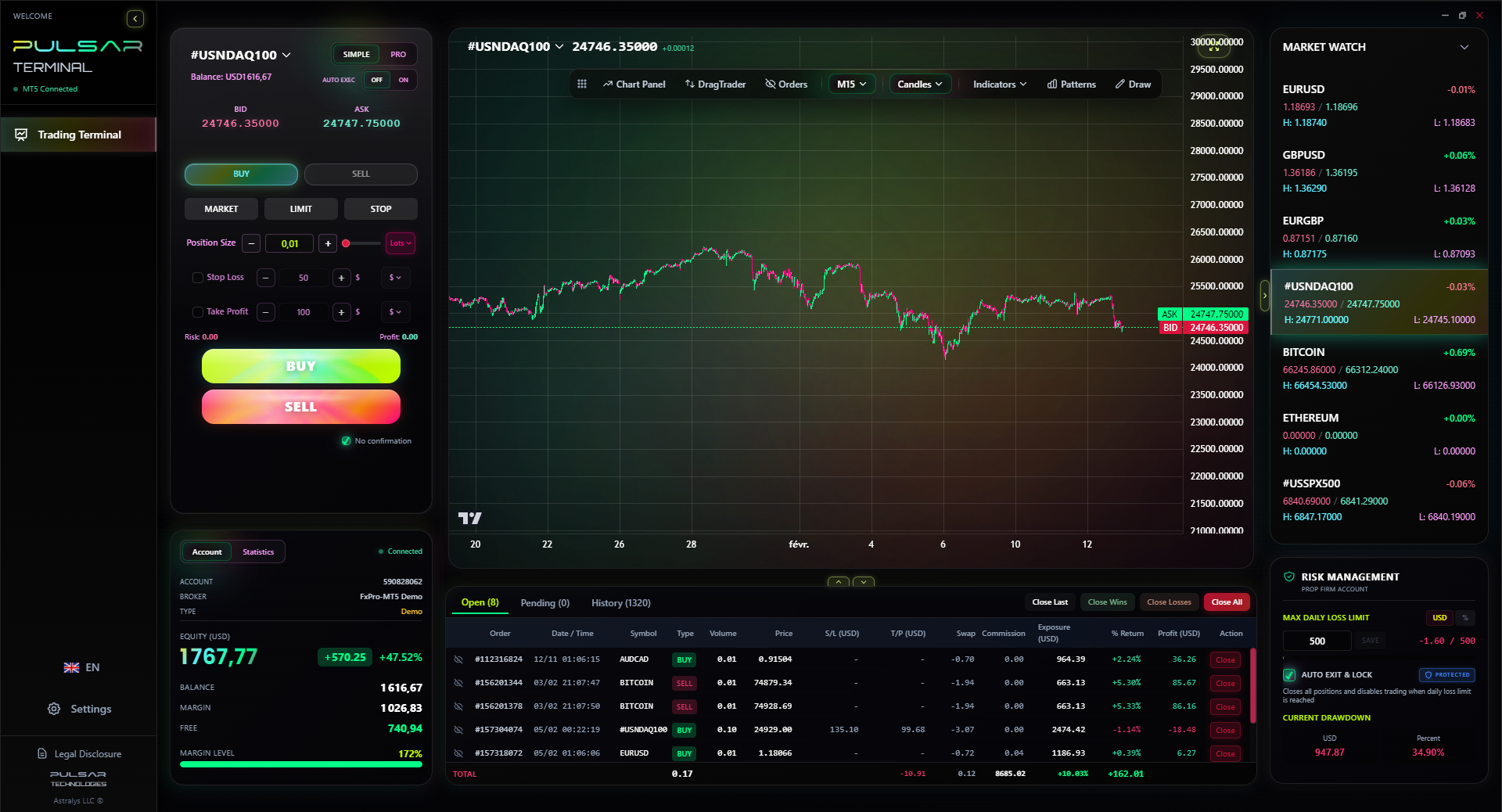
Overtrading often comes from poor trade management; Pulsar Terminal's drag-and-drop orders and multi-TP/SL tools help you execute your plan precisely, removing emotional decisions from the process.
Pulsar Terminal
أداة MT5 الشاملة: أوامر سحب وإفلات، متعدد TP/SL، تريلينج ستوب، تداول الشبكة، Volume Profile وحماية البروب فيرم. يستخدمها أكثر من 1000 متداول يومياً.
New traders think the secret is in the indicator. They stack 10 oscillators and moving averages on their chart until it looks like a rainbow threw up. I did this. I had Bollinger Bands, Stochastics, RSI, MACD, and three EMAs all at once. The signals constantly contradicted each other. I was paralyzed.
An indicator is just a derivative of price. It lags. Using too many gives you noise, not clarity. The danger is you see a 'signal' in the noise that isn't there, and you take a bad trade, blaming the indicator instead of your spaghetti-chart methodology.
Pick one or two that complement your strategy. Understand what they actually measure. For example, I might use a 200-period EMA for the long-term trend and the RSI for overbought/oversold conditions on a pullback. That's it. Clean charts lead to clear decisions. All those fancy tools in platforms? Most are distractions you need to learn to ignore.
“If you're not journaling, you're guaranteed to repeat your mistakes.”
This isn't a market danger, it's a self-imposed one. If you're not journaling, you're guaranteed to repeat your mistakes. You'll forget what you did right and, more importantly, what you did wrong.
My journal forced me to face ugly truths. I had a page that showed 80% of my losses came from trades taken between 2 PM and 4 PM Lagos time. I was tired, impatient, and forcing trades in a slow session. Without the journal, I'd have never spotted that pattern.
Your journal must be specific:
- Date, Instrument, Direction (Buy/Sell)
- Entry Price, Stop Loss, Take Profit
- Reason for Entry (e.g., 'Daily support bounce, RSI oversold')
- Result (Pips & Naira)
- Screenshot of the chart
- Emotional State / Lesson Learned
This turns random gambling into a reviewable process. It's the single most important tool for improving. More than any indicator.
💡 نصيحة وينستون
Your trading journal is your only true mentor. The data doesn't lie. If you see 'revenge trade' written three times in a week, you have a problem no indicator can fix.
Knowing the dangers of forex trading is the first step to managing them. It's not about avoiding risk, it's about identifying and controlling it.
- Treat it as a business. You need a business plan. That's your trading plan. It outlines your strategy, risk per trade (I risk 1% max, never more), and your rules.
- Start with a demo, but graduate. Demo trading is essential to learn the platform. But it's not real. The moment real money is on the line, psychology changes. Move to a live micro account with the smallest possible deposit. Trade 0.01 lots. The goal is to be consistent for 3-6 months, not to get rich.
- Education is ongoing. The market changes. Your education never stops. But be wary of 'gurus' selling dreams. Real education is boring: it's price action, risk management, and psychology books.
- Protect your capital above all. Your capital is your inventory. If a shopkeeper burns his inventory, he's out of business. You are no different. Every trade should be sized to survive a string of losses.
Forex can be a legitimate way to generate income, but it's a brutal skillset to acquire. The market doesn't care about your rent, your dreams, or your situation. It just is. Your job is to build a system that respects that reality. I wish someone had given me this blunt talk years ago. It would have saved me a lot of money and heartache.
FAQ
Q1What is the biggest danger for a new forex trader in Nigeria?
Without a doubt, it's the combination of using excessive use and trading with an unregulated or offshore broker. The use will magnify your inevitable early mistakes into account-blowing events, and the unregulated broker might make it impossible to withdraw whatever you have left. Start with low use (1:20 or less) and only use well-regulated brokers.
Q2Can I start forex trading in Nigeria with ₦50,000?
Technically, yes. Realistically, it's extremely difficult. After accounting for proper risk management (risking no more than 1% per trade, which is ₦500), the position sizes you can take are tiny. A single pip definition move will have a very small effect. The psychological pressure to over-use to 'make it worthwhile' is huge. It's better to save more capital (₦200,000+) or treat the ₦50,000 as a pure tuition fee for learning, with the expectation you might lose it all while gaining experience.
Q3Are forex trading bonuses a good thing?
Almost never. They are a major red flag. These bonuses come with restrictive terms (like trading volume requirements 30-50 times the bonus amount) that make it nearly impossible to withdraw your own money. They are a marketing tool to lock you into a platform. A legitimate broker makes money from your trading activity (spreads/commissions), not from trapping your deposit.
Q4How can I check if a forex broker is regulated?
Go to the broker's website and find their 'Regulation' or 'Legal' section. They should list a license number and the regulatory body (e.g., FCA, ASIC, CySEC). Then, go to the official website of that regulator and use their public register to search for the license number. Confirm the company name and the permitted activities match. Don't just trust the badge on the broker's site.
Q5What's more important, a good strategy or good psychology?
In the long run, psychology is everything. You can have a statistically profitable strategy, but if fear, greed, or indiscipline cause you to deviate from it - by moving stops, overtrading, or revenge trading - you will lose. A simple strategy followed with robotic discipline will beat a brilliant strategy executed emotionally every single time.
Q6Is it possible to make a living from forex trading in Nigeria?
It is possible, but it is exceptionally rare and should not be the initial goal. It requires significant capital (millions of Naira), years of consistent profitability on a small scale, and immense psychological fortitude. The vast majority of traders should view forex as a way to potentially grow savings over time, not as a primary income source, especially in the first 3-5 years.
درس البروفيسور وينستون
النقاط الرئيسية:
- ✓Never risk more than 1% of capital on a single trade.
- ✓Verify broker regulation on the regulator's own website.
- ✓Start with use at 1:20 or lower.
- ✓A trading journal is non-negotiable for growth.
- ✓After a max daily loss, walk away. No revenge trading.
ما مدى فائدة هذا المقال؟
انقر على نجمة للتقييم
رؤى التداول الأسبوعية
تحليلات واستراتيجيات أسبوعية مجانية. بدون رسائل مزعجة.
عن المؤلف
Olumide Adeyemi
رائد التداول في غرب أفريقيا
أحد أنشط معلمي تداول الفوركس في نيجيريا. 8 سنوات من الخبرة في التداول من لاغوس. متخصص في استراتيجيات رأس المال المنخفض وتحديات شركات البروب للمتداولين الأفارقة.
التعليقات
تحذير من المخاطر
ينطوي تداول الأدوات المالية على مخاطر كبيرة وقد لا يكون مناسبًا لجميع المستثمرين. الأداء السابق لا يضمن النتائج المستقبلية. هذا المحتوى لأغراض تعليمية فقط ولا ينبغي اعتباره نصيحة استثمارية. قم دائمًا بإجراء بحثك الخاص قبل التداول.
قد يعجبك أيضًا

Cara Trading Forex Sukses: 7 Prinsip dari Trader Profesional
Cara trading forex sukses dengan 7 prinsip trader pro: manajemen modal, disiplin, journal trading, backtest. Data nyata, bukan janji profit palsu.
Jam Trading Forex Terbaik untuk Trader Indonesia: Panduan Lengkap dengan Tabel Waktu
Panduan jam trading forex untuk trader Indonesia. Tabel 4 sesi dunia, jam emas 20:00-00:00, sesi mana yang harus dihindari. Data akurat + tips dari trader berpengalaman.
Top 5 Sàn Forex Uy Tín Nhất 2026: Review Jujur dari Trader Indonesia
Top 5 sàn forex uy tín 2026 untuk trader Indonesia. Review jujur: spread, deposit, withdraw, dukungan lokal. Exness, XM, IC Markets & lebih.
احصل على Pulsar Terminal
جميع هذه الحاسبات مدمجة في Pulsar Terminal مع بيانات حية من حساب MT5 الخاص بك.
احصل على Pulsar Terminal