


I lost $1,200 in 47 minutes.
James Mitchell
محلل تداول أول
☕ 13 دقائق قراءة
ما ستتعلمه:
- 1The US Regulatory Cage (It's For Your Own Good)
- 2The Real Costs of Trading: Spreads, Commissions, and the Math That Kills You
- 3Picking a US Forex Broker in 2026: It's a Short List
- 4When to Trade: Riding the Liquidity Waves
- 5A Simple, Boring Day Trading Framework That Works
- 6The Psychology: It's 80% of Your Results
- 7Tools & Tech: What Actually Helps
- 8The Harsh Truth About Success (And Failure)

I lost $1,200 in 47 minutes. It was a Tuesday morning, and EUR/USD was choppy. I saw a false breakout, chased it with a 2-lot position, and watched it reverse instantly. My stop-loss was too tight, I moved it, and then the real move happened - against me. That trade taught me more about day trading forex than any book. It’s not about getting rich quick. It’s about surviving the US regulatory cage, managing microscopic edges, and fighting your own psychology every single session. Let’s talk about what it really takes.
If you're day trading forex in the US, you're playing in the most heavily padded room in the world. The CFTC and NFA are your strict, no-nonsense babysitters. This isn't a bad thing. It means your broker has to have at least $20 million in net capital. Your funds are segregated. And you can't blow yourself up with 500:1 use like you can with some offshore brokers.
The use caps are the big one: 50:1 on majors like EUR/USD, 20:1 on minors. For a $10,000 account, that's a max position size of $500,000 on EUR/USD. Sounds like a lot? It is. It's more than enough to wipe you out if you're careless. I've seen traders try to circumvent this by using unregulated brokers. Don't. You might get your use, but you also get the risk of your broker disappearing with your money. The trade-off isn't worth it.
One crucial point: the Pattern Day Trader (PDT) rule that plagues stock traders? It doesn't apply to forex. You don't need $25,000 in your account to make more than three day trades in a week. This is a massive advantage for forex day traders starting with smaller capital. However, your broker might have its own rules, so always check.

Warning: Just because the PDT rule doesn't apply doesn't mean you should trade a $500 account. With US use limits, your position size on a tiny account will be so small that spreads and commissions will eat you alive. You need enough capital to make the math work.
The regulation feels restrictive, but it's designed to keep you from committing financial suicide in one session. Embrace it. Your first job in day trading forex is risk management, and these rules force you to start there.

💡 نصيحة وينستون
Your first $10,000 in trading isn't capital. It's tuition. Expect to pay it to learn what the charts don't show you.
You don't pay a ticket fee to enter the market. You pay a toll every single time you cross the bid-ask spread. This is where most new day traders get their math wrong.
Let's use real 2026 numbers. On a major pair like EUR/USD, the average spread on a standard US broker account is about 0.6 pips. Some brokers like FOREX.com or OANDA might show 0.8-1.0 pips during quiet times. On a "raw spread" or commission account, you might see 0.1 pips, but you'll pay a commission - say, $5 per 100k traded (which is 0.5 pips per side).
The Scalper's Nightmare
Here’s the brutal arithmetic for a scalper. Say you're aiming for a 5-pip profit on EUR/USD. Your cost to enter and exit (the round turn) is at least 1.2 pips on a standard account. That's already 24% of your target profit gone before the market even moves. On a commission account, your all-in cost might be 1.1 pips (0.1 spread + 0.5 commission each way). Still 22%.
You need the market to move 5 pips in your favor just to net 3.8. This is why scalping with poor execution is a loser's game. Your win rate needs to be astronomically high to overcome this friction. I learned this the hard way trying to scalp news events. I'd be right on direction, but the spread would widen to 5 pips the second the news hit, instantly putting me in a hole.
Minimum Deposit Reality Check
Brokers advertise $0 minimums (OANDA, Interactive Brokers). That's great for testing. But for serious day trading forex, a $500 account is practically useless with US use. Let's say you risk 1% per trade ($5). With a 1.2 pip cost on EUR/USD, you need the trade to move over 2 pips just to break even on a micro lot. Your room for error is zero. I recommend a minimum of $5,000 to start. It gives you breathing room to use sensible position sizing without being destroyed by costs. Use our position size calculator to see how capital affects your risk per trade.

Example: Trade on $10,000 account, 1% risk ($100). Trading EUR/USD, stop loss is 20 pips away. Position size = $100 / (20 pips * $1 per pip on micro lot) = 5 micro lots. Your trade cost is 1.2 pips * 5 * $1 = $6. You need the trade to move 1.2 pips just to cover costs. This is the baseline math you must master.

“The spread isn't a fee, it's a toll. And it collects from the impatient every single time they cross the bridge.”
Your choices are limited, but that makes it easier. Every broker on this list is CFTC/NFA regulated. The differences come down to platforms, fees, and tools.
| Broker | Key For Day Traders | Minimum Deposit | Platform Notes |
|---|---|---|---|
| tastyfx (ex-IG US) | Excellent platforms, tight spreads, great research. | As low as $1 | Offers MT4, TradingView, & ProRealTime. A top all-rounder. |
| OANDA | Trusted name, $0 min, powerful proprietary platform. | $0 | OANDA Trade platform is superb for analysis. Also has MT4. |
| FOREX.com | Wide range of pairs (80+), strong education. | $100 (rec. $2,500) | Their advanced platform has good charting tools. MT4/MT5 available. |
| Interactive Brokers | Lowest fees for large volume, agency execution. | $0 | Platform is complex but incredibly powerful for the serious trader. |
I have accounts with both OANDA and tastyfx. For pure day trading forex, I lean towards tastyfx for its TradingView integration and consistently reliable execution. Slippage on news is minimal compared to my early experiences with other firms. OANDA's research is unmatched, though. Their economic calendar integration into the chart is something I use daily.
Don't get hung up on "which is best." Open demo accounts with two. Test their execution speed during the London and New York opens (7-10 AM EST). See which platform you click with. Your platform is your cockpit; if you hate it, you'll make mistakes. For a deep dive on one popular global broker (not US), you can read our Exness review to see what offshore options look like, but remember they aren't available to US residents.
The forex market is open 24/5, but it's not equally alive all the time. Your edge as a day trader depends on trading when the big players are active.
The New York Session (8 AM - 5 PM EST) is your home game. This is when volume and volatility peak for USD pairs. The sweet spot is the overlap with London (8 AM - 12 PM EST). This 4-hour window sees the highest liquidity, meaning tighter spreads and cleaner, more sustained trends. Most of my profitable trades happen here. Trying to day trade the Asian session (7 PM - 4 AM EST) from the US is a recipe for boredom and chop, unless you're specifically trading AUD or JPY pairs.
Economic News is your double-edged sword. The Non-Farm Payrolls report (first Friday of the month, 8:30 AM EST) can move EUR/USD 50-100 pips in seconds. I used to try to trade these events. My record? I lost on 8 out of 10 attempts. The spread widening and violent whipsaw are brutal. Now, I either close all positions before major news or wait for the initial 5-minute chaos to settle and then trade the established direction. Don't be a hero. The scalping strategy you use at 10 AM will get slaughtered at 8:31 AM on NFP day.

Pro Tip: Focus on one or two major pairs. Master EUR/USD. It has the lowest spreads, highest liquidity, and clearest trends. Adding GBP/USD or USD/JPY is fine. Don't jump into exotic pairs; their wide spreads will consume your profits. Our EUR/USD guide breaks down its specific behaviors.
💡 نصيحة وينستون
If you can't explain your trade setup in one simple sentence, you don't have a setup. You have a hope.
“A good target is a positive risk-to-reward ratio, not a pip count. The market doesn't owe you 50 pips a day.”
Forget the complex indicators. Successful day trading forex is about structure and patience. Here's the framework I've used for the last five years.
1. The Daily Bias Check (5 Minutes): Before the New York open, look at the daily chart. Is price above or below the key moving average (like the 200 EMA)? Is there a clear higher high/higher low? This doesn't tell you when to enter, but it tells you which direction to favor for your day trades. Only take trades in the direction of the daily bias 70-80% of the time.
2. Find the Intraday Zone (15 Minutes): Zoom into the 1-hour or 4-hour chart. Identify the previous day's high and low, and today's Asian session range. These are your support and resistance zones. Price will often react at these levels. I mark them on my chart and do nothing until price approaches one.
3. The 5-Minute Trigger: I only look for entries on the 5-minute chart. I wait for price to reach one of my zones. Then, I look for a rejection candle (a pin bar or engulfing pattern) or a simple break and retest of a minor trendline. That's my entry signal. My stop-loss goes just beyond the zone. My profit target is usually 1.5 to 2 times my risk (a 2:1 or 1.5:1 reward-to-risk ratio).
I might only get 1-3 of these setups a day. Some days, I get none. That's okay. Forcing a trade is the #1 cause of losses. This method is a form of swing trading but compressed into a daily timeframe. It requires waiting, which is the hardest skill to learn.
I once paper-traded this method for a month, taking every valid signal. Result: 24 trades, 14 wins, 10 losses. Average win was 22 pips, average loss was 12 pips. That's a 58% win rate with a positive risk/reward. It proved the edge existed. Then I had to execute it with real money and emotions.
You can have the best strategy in the world and still blow up your account. I've done it. Here’s what no one tells you about the mental game of day trading forex.
The Morning Routine is Non-Negotiable. You wouldn't run a marathon without warming up. Don't trade without a mental reset. My routine: coffee, 10 minutes of meditation (just focusing on breathing), review my trading plan on paper, check economic calendar. This gets me out of "normal life" mode and into "analyst" mode.
Loss Amnesia is a Disease. After a losing trade, the desperate urge to "make it back now" is overwhelming. This is when you double your position size, ignore your rules, and take a terrible trade. My rule: After two consecutive losses, I shut down the platform for the day. Go for a walk. The market will be there tomorrow. Protecting your capital is more important than protecting your ego.
Tracking is Your Teacher. You must journal every trade. Entry, exit, reason, emotional state. I use a simple spreadsheet. After 100 trades, you'll see your ugly truth. Mine was that my winning trades were held for an average of 18 minutes, but my losing trades averaged 42 minutes because I kept moving my stop-loss, hoping for a reversal. That's a recipe for a margin call. Fixing that one habit changed my profitability.
Warning: If you find yourself constantly staring at the screen, gripping the mouse, and feeling your heart pound, you're over-leveraged. Your position size is too big. Scale down until the trade feels boring. Trading should be analytical, not exhilarating.

“After two consecutive losses, shut down the platform. Protecting your capital is more important than protecting your ego.”
You don't need a $10,000 Bloomberg terminal. But a few key tools separate the amateur from the professional.
A Reliable Internet Connection: This is your lifeline. A powerline ethernet adapter is a better investment than a new indicator if your WiFi is spotty.
A Trading Journal Software: While a spreadsheet works, dedicated software like Tradervue or Edgewonk can auto-import trades and provide better analytics on your performance.
A Good Charting Package: Your broker's free platform might suffice. But many serious day traders use TradingView for analysis (even if they execute on MT5). Its drawing tools and community scripts are powerful. For MT5 users, companion apps can add crucial functionality.
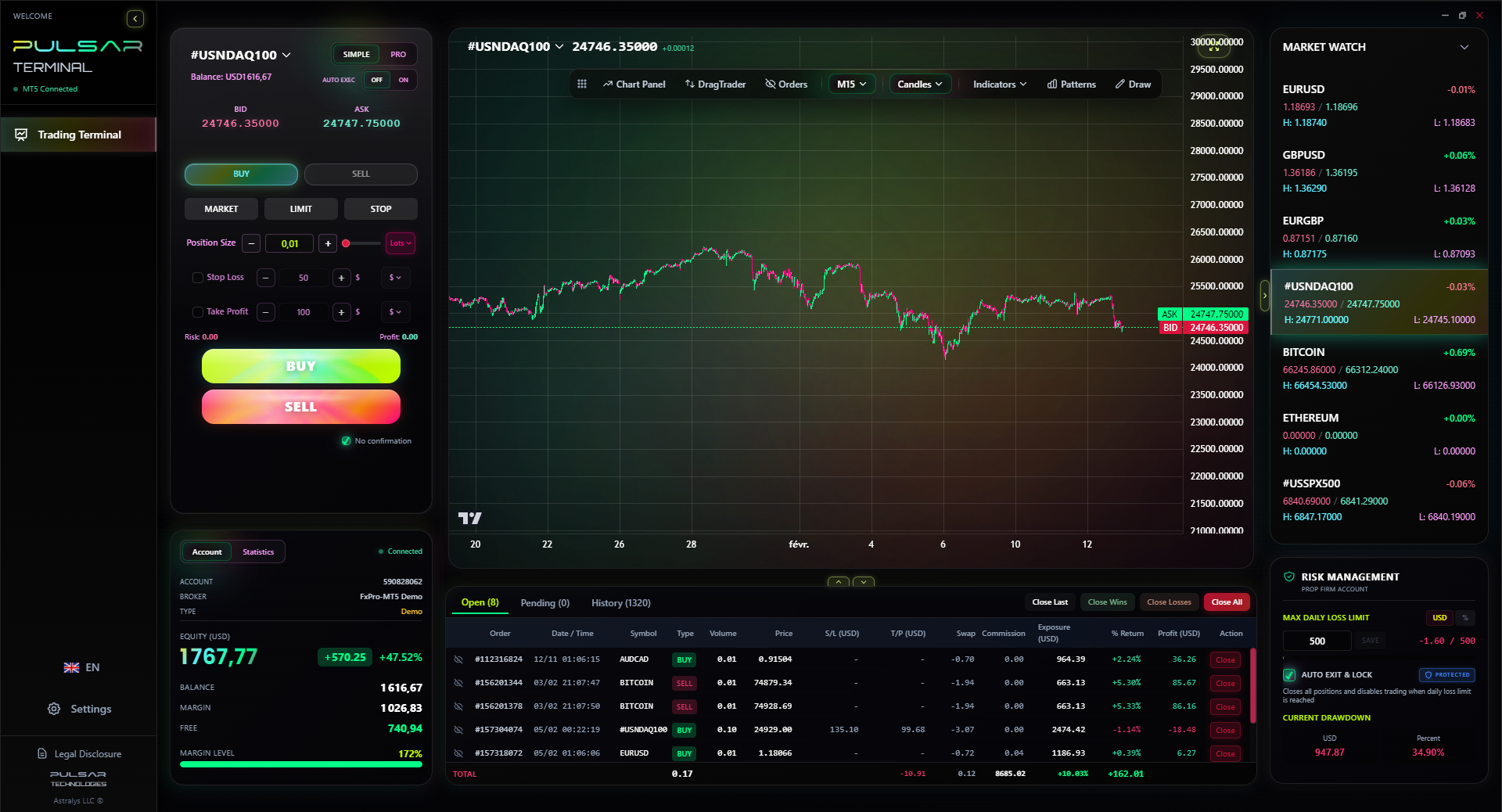
Speaking of MT5, one of the biggest frustrations is managing multiple trades and advanced orders. Manually moving stop-losses to breakeven or setting a trailing stop on a fast-moving pair is clunky and error-prone.
This is where a tool designed for active traders makes a difference. Imagine having a single panel where you could drag a line to set a take-profit, automatically set a trailing stop that engages after a certain profit, and close partial positions with one click - all without opening multiple order windows. For traders using strategies that rely on precise, multi-level order management, that kind of efficiency isn't just nice, it's essential for capturing profit and limiting risk in real-time. It turns a reactive process into a proactive one.
Finally, keep your chart clean. I use a 200 EMA on the daily, horizontal support/resistance lines, and maybe volume. That's it. I wasted years layering on the RSI indicator, MACD indicator, and a dozen others. They just gave conflicting signals and paralyzed me.
💡 نصيحة وينستون
The most important indicator on your screen is your open P&L. If watching it makes you sweat, your position is too large. Cut it in half.
Managing complex multi-level orders and trailing stops manually on MT5 is slow and error-prone, which is why tools like Pulsar Terminal that automate these processes are essential for serious day traders.
Pulsar Terminal
أداة MT5 الشاملة: أوامر سحب وإفلات، متعدد TP/SL، تريلينج ستوب، تداول الشبكة، Volume Profile وحماية البروب فيرم. يستخدمها أكثر من 1000 متداول يومياً.
Let's revisit the statistics from the briefing because they matter. Between 72% and 84% of retail forex traders lose money. In the US, maybe 30-35% are consistently profitable over a period. Only about 1% stay profitable for over a year.
Why? It's not a conspiracy. It's math and human nature. The costs (spreads, commissions) create a built-in hurdle. The use allows for outsized losses. And most people approach this like gambling, not a probabilistic business.
You will have losing days. You will have losing weeks. A 60% win rate is exceptional. That means you lose 4 out of every 10 trades. Can you handle that emotionally? Can you stick to your plan through a string of 3, 4, 5 losses? If not, this isn't for you.
My first year, I was in the 84%. I lost $8,000. My second year, I broke even. My third year, I made a 15% return. That's not glamorous. That's the reality of grinding out an edge. The goal of day trading forex shouldn't be a Lamborghini. It should be consistent, risk-adjusted returns that outperform a savings account over time.
If you read this and feel discouraged, good. That's the right starting point. Respect the challenge. Now, go open a demo account. Practice the boring framework for three months. Then, fund a small live account and treat it like a paid internship. This is a marathon, and the first mile is admitting you don't know a thing. I've been doing this for 12 years, and I'm still learning that lesson.


FAQ
Q1What is the minimum amount needed to start day trading forex in the US?
Technically, $0 with some brokers. Realistically, I wouldn't start with less than $5,000. With US use caps (50:1), a smaller account forces you to risk a too-high percentage per trade to make the profits meaningful, or you'll be eaten alive by the spread. A $5k account allows for sensible 1% risk ($50) and room to breathe.
Q2Can I day trade forex without the $25,000 Pattern Day Trader rule?
Yes. The PDT rule is a FINRA/SEC regulation for trading stocks and options on margin. The forex market is regulated by the CFTC/NFA, and this rule does not apply. You can make as many forex day trades as you want, regardless of your account size.
Q3What's the best time of day to trade forex in the US?
The most active and liquid time is the overlap between the London and New York sessions, from 8:00 AM to 12:00 PM Eastern Time. This is when you'll see the strongest trends and tightest spreads, especially on major pairs like EUR/USD and GBP/USD.
Q4How many pips can a forex day trader make per day?
This is the wrong question. Focus on risk, not reward. A good target is a positive risk-to-reward ratio (e.g., aiming for 20 pips with a 10-pip stop-loss). On a great day, you might net 30-50 pips across a few trades. On a bad day, you might lose 20. The key is that your average winning pip value is larger than your average losing pip value.
Q5Are there any tax advantages to forex trading in the US?
Forex trading is taxed. The big distinction is between Section 988 (ordinary gain/loss) and Section 1256 (60/40 long-term/short-term capital gains treatment). To qualify for 1256, you must make a formal election and meet specific criteria (like trading futures or futures-style options). Most spot forex retail traders fall under 988, where all profits are taxed as ordinary income. Always consult a tax professional.
Q6Is it better to use a standard account (wider spread, no commission) or a commission account (tight spread + fee)?
For day trading, the commission account is almost always cheaper. Calculate the "effective spread": spread + commission converted to pips. On a standard account, EUR/USD might be 0.9 pips with no commission. On a raw account, it might be 0.1 pips + $5 commission per 100k lot. That $5 is about 0.5 pips, so your effective spread is 0.6 pips. The raw account is cheaper. Use our spread definition guide to understand this fully.
درس البروفيسور وينستون
النقاط الرئيسية:
- ✓US use caps (50:1) protect you from yourself. Use them.
- ✓Trade the London/NY overlap (8 AM-12 PM EST) for cleanest moves.
- ✓Aim for a 1.5:1 reward-to-risk ratio minimum.
- ✓Your first $5k is for learning, not earning.
- ✓One major pair (EUR/USD) mastered beats ten traded poorly.
ما مدى فائدة هذا المقال؟
انقر على نجمة للتقييم
رؤى التداول الأسبوعية
تحليلات واستراتيجيات أسبوعية مجانية. بدون رسائل مزعجة.
عن المؤلف
James Mitchell
محلل تداول أول
يقيم في نيويورك ولديه أكثر من 9 سنوات من الخبرة في التداول. يركز على أزواج الدولار الرئيسية وتحديات شركات البروب وبيئة التنظيم الأمريكية.
التعليقات
تحذير من المخاطر
ينطوي تداول الأدوات المالية على مخاطر كبيرة وقد لا يكون مناسبًا لجميع المستثمرين. الأداء السابق لا يضمن النتائج المستقبلية. هذا المحتوى لأغراض تعليمية فقط ولا ينبغي اعتباره نصيحة استثمارية. قم دائمًا بإجراء بحثك الخاص قبل التداول.
قد يعجبك أيضًا

Cara Trading Forex Sukses: 7 Prinsip dari Trader Profesional
Cara trading forex sukses dengan 7 prinsip trader pro: manajemen modal, disiplin, journal trading, backtest. Data nyata, bukan janji profit palsu.
Jam Trading Forex Terbaik untuk Trader Indonesia: Panduan Lengkap dengan Tabel Waktu
Panduan jam trading forex untuk trader Indonesia. Tabel 4 sesi dunia, jam emas 20:00-00:00, sesi mana yang harus dihindari. Data akurat + tips dari trader berpengalaman.
Top 5 Sàn Forex Uy Tín Nhất 2026: Review Jujur dari Trader Indonesia
Top 5 sàn forex uy tín 2026 untuk trader Indonesia. Review jujur: spread, deposit, withdraw, dukungan lokal. Exness, XM, IC Markets & lebih.
احصل على Pulsar Terminal
جميع هذه الحاسبات مدمجة في Pulsar Terminal مع بيانات حية من حساب MT5 الخاص بك.
احصل على Pulsar Terminal