


You're looking at short-term trading and wondering which path to take: day trading or scalping.
James Mitchell
محلل تداول أول
☕ 11 دقائق قراءة
ما ستتعلمه:
You're looking at short-term trading and wondering which path to take: day trading or scalping. It feels like a choice between two fast cars, but I'm here to tell you it's more like picking which cliff to drive off. Most traders get this wrong from the start. They focus on the glamour of quick profits without understanding the mechanical, mathematical reality that separates the 1% from the 99% who lose. Let's cut through the noise. This isn't about which is 'better.' It's about which one will statistically destroy your account slower, and which one you might have a fighting chance with.
Everyone says scalping is faster than day trading. That's obvious. The real difference is in the psychological load and the type of market noise you're trying to capture.
A day trader might hold a position for 30 minutes to 4 hours. You're riding a wave, looking for a move of maybe 50 to 200 pips on a major forex pair, or a 1-3% move on a stock. Your enemy is boredom and impatience. You set a trade, manage your stop, and wait. The market will test you, shake you out if your conviction is weak. I've sat on a EUR/USD trade for two hours watching it do nothing, only for it to finally hit my 80-pip target. The mental game is endurance.
A scalper is a different beast. You're in and out in seconds to minutes, hunting for 5 to 20 pips. Your enemy is speed itself. You have no time for doubt. The moment you hesitate on an entry or exit, that tiny profit window slams shut, often turning into a loss. You're not trading a trend; you're trading order flow and immediate supply/demand imbalances. The mental game is pure, unadulterated reaction and discipline. There's no 'waiting for it to come back.'

Warning: Don't choose based on which sounds cooler. Choose based on which mental torture you're better built to withstand. If you hate waiting, you'll revenge-trade as a day trader. If you can't handle intense pressure, you'll freeze as a scalper.
The Profit Target Illusion
New traders think scalping is 'safer' because you take small profits. This is a catastrophic misunderstanding. Yes, your profit per trade is smaller. But your risk, as a percentage of your account, must be the same as any professional trader - typically 1-2% max. To make a meaningful return scalping tiny moves, you need an insanely high win rate or a huge number of trades. A 5-pip win with a 5-pip stop-loss requires a 60%+ win rate just to break even after commissions. Most can't sustain that.
A day trader aiming for 80 pips with a 30-pip stop can have a 40% win rate and still be very profitable. The math of your position size calculator doesn't care about your strategy's name. It only cares about your risk/reward and win rate.

💡 نصيحة وينستون
If you can't articulate your exact entry, stop, and target before the trade, you're not trading. You're gambling. Write it down.
“Most retail traders' accounts are just a vehicle to transfer their money to their broker via fees and spreads.”
This is where dreams go to die. Short-term trading is a volume business for your broker. Every single cost is magnified.
Let's talk real numbers from my own trading journal. When I was testing a scalping strategy on the E-mini S&P 500 (ES) futures:
- Commission & Fees: All-in round trip was $3.12 per contract. Seems small.
- The Reality: I was making 10-15 trades a day. One contract per trade. That's $31.20 to $46.80 in fees per day. To net $500 for the day, I first had to make over $550 just to cover costs. A single losing trade wiped out the profits of 3-4 winners.
Forex isn't much kinder. That 'tight 0.1 pip spread' on a Raw account comes with a commission - often $5-$7 per 100k lot round turn. Scalp 10 micro lots (1 standard lot) 10 times a day? There's $50-$70 gone before you've made a cent.

Example:
- Scalper: 20 trades/day, $5 commission per 100k lot. Trade size: 2 standard lots (200k).
- Daily Commission Cost: 20 trades * (200k/100k) * $5 = $200/day
- Monthly Cost (20 days): $4,000 You need to make $4,000 a month just to pay your broker.
Day traders face this too, but with fewer trades, the absolute cost is lower. The spread definition becomes your primary foe on standard accounts. A 1.2 pip spread on EUR/USD means you're down $12 on a standard lot the moment you click buy. Your trade needs to move 1.2 pips in your favor just to reach breakeven. For a scalper targeting 5 pips, that's 24% of your target gone immediately. For a day trader targeting 80 pips, it's only 1.5%.
The brutal truth? Most retail traders' accounts are just a vehicle to transfer their money to their broker via fees and spreads. They're customers, not traders.
“The math of your position size calculator doesn't care about your strategy's name. It only cares about your risk/reward and win rate.”
If you're in the US trading stocks or options, this rule defines your existence. The Pattern Day Trader (PDT) rule states: if you make 4 or more day trades (open and close a position in the same day) in a 5-business-day period in a margin account, you are flagged as a PDT. You must then maintain $25,000 in minimum equity in that account.
Fall below $25k? Your account gets locked from opening new day trades until you deposit back above the limit. It's a hard barrier that makes small-account scalping of stocks nearly impossible legally. This is why many US traders flock to forex or futures for scalping - these markets are not subject to the PDT rule.
But here's the critical update: This is changing. As of late 2025/early 2026, FINRA has proposed eliminating the fixed $25,000 minimum. The new system would be risk-based. The 4-trade-in-5-days trigger might be gone. This could open the doors for smaller accounts, but don't mistake access for profitability. The math of costs and odds remains the same. A lower barrier to entry often just means a faster path to blowing up a $2,000 account instead of needing $25,000 to start.
I've seen traders get a margin call not from bad trades, but from violating PDT buying power rules. They over-traded, got a call, couldn't meet it, and were shut down for 90 days. The rule forces a certain capital seriousness, for better or worse.
“The math of your position size calculator doesn't care about your strategy's name. It only cares about your risk/reward and win rate.”
The strategies aren't interchangeable. The chart timeframes and indicators you use for one will fail you in the other.
For Day Trading: You're looking at the 15-minute, 1-hour, and 4-hour charts for context. You enter on the 5-minute or 2-minute chart. You're trading breakouts from consolidations, pullbacks to moving averages on higher timeframes, or reactions to economic news. Indicators like the MACD indicator on the 1-hour chart can show you momentum direction. The RSI indicator can help spot overbought/oversold conditions on the 15-minute chart for entry. Your stop-loss is based on recent swing highs/lows. It's a game of patience and confirmation.
For Scalping: The 1-minute and 5-minute charts are your world. The 15-minute chart is your 'big picture.' You're trading pure price action: order book imbalances (Level 2 data), immediate support/resistance levels, and the exhaustion of moves. I've had the most scalping success simply using a 20-period exponential moving average and horizontal lines on a 1-minute chart, looking for price to reject or accept a level with momentum. Indicators are often too slow. You need to see what's happening right now. Volume Profile tools, which show where most trading activity occurred, are gold for identifying key scalping levels.

Pro Tip: Whatever you choose, paper trade it for a month. Not a week - a month. Log every trade. If you can't be profitable on paper with zero emotion, you have zero chance with real money. I learned this the hard way after losing $2,800 in three days trying to scalp crude oil without a tested plan.
💡 نصيحة وينستون
Your first $10,000 in the market is tuition, not capital. Expect to pay it to learn. The goal is to make the lessons cheap.
“Scalping taught me discipline, but it wasn't my endgame.”
For day trading, a good all-around broker like Interactive Brokers or Thinkorswim (Charles Schwab) works. Execution speed is important, but you have a bit more leeway.
For scalping, your broker is part of your strategy. You need three things:
- Raw Spreads & Clear Pricing: You need to see the true cost. A commission-based model is often better than a wide, variable spread. Check brokers like Pepperstone or IC Markets for their raw accounts (though note these are not US brokers; US traders would look at Forex.com's Raw account or Interactive Brokers).
- Lightning-Fast Execution: Latency is profit. A 100-millisecond delay can be the difference between a 5-pip win and a 2-pip loss. Look for brokers publishing their average execution speeds.
- No Dealing Desk (NDD) / Straight Through Processing (STP): You don't want your broker taking the other side of your trade. They have a conflict of interest. You want your order routed directly to the liquidity pool.
I made a mistake early on with a market-maker broker while scalping. During high volatility, my orders would constantly re-quote or get slipped 3-4 pips against me. That's a total killer. I switched to a true ECN broker and while the commissions were higher, the fills were honest and instant. My performance improved immediately because my edge wasn't being eroded by poor execution.
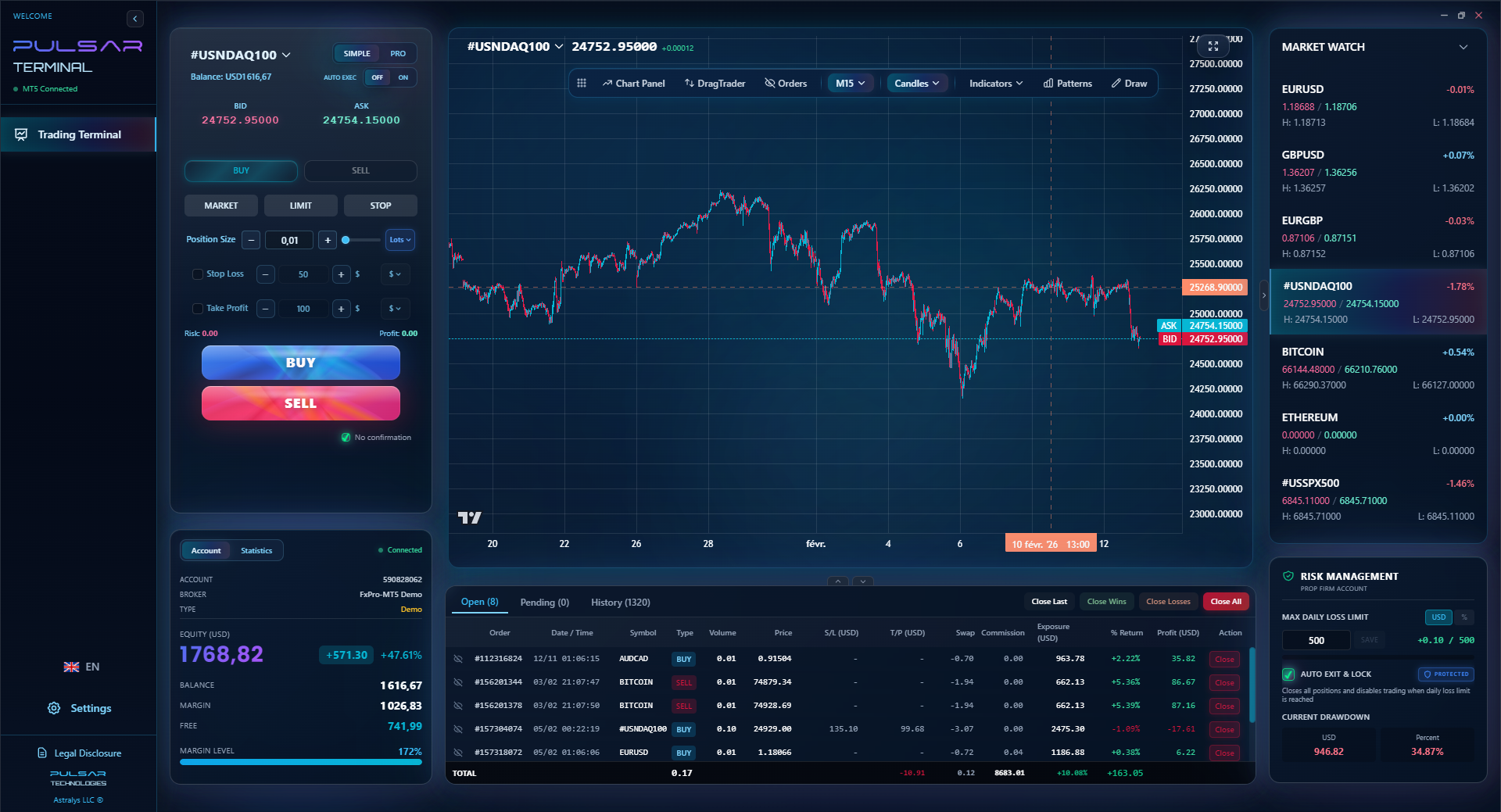
This is where tools like Pulsar Terminal become non-negotiable for serious scalpers. When you're entering 20+ trades a day, manual order placement is a drag. The ability to set multi-level take-profits with partial closures, or drag a trailing stop directly on the chart, turns complex risk management into a single click. That speed saves pips, and pips are money.
When you're entering dozens of trades a day, manual order management is a profit killer; Pulsar Terminal automates complex entries, multi-level exits, and trailing stops directly on your MT5 chart.
Pulsar Terminal
أداة MT5 الشاملة: أوامر سحب وإفلات، متعدد TP/SL، تريلينج ستوب، تداول الشبكة، Volume Profile وحماية البروب فيرم. يستخدمها أكثر من 1000 متداول يومياً.
“Scalping taught me discipline, but it wasn't my endgame.”
Let's be brutally honest.
Choose Day Trading if:
- You have a day job but can monitor the market in chunks.
- You have patience and can tolerate watching a trade unfold.
- Your account size is above $10,000 (to comfortably manage risk and PDT rules).
- You prefer analysis over reaction.
- You're okay with 2-5 high-quality setups per day.
Choose Scalping if:
- You can dedicate focused, uninterrupted screen time for hours.
- You have ice in your veins and can execute without hesitation.
- You have a very small account and need to grow it (understanding the extreme risk).
- You thrive on fast-paced action and have incredible discipline.
- You're willing to pay thousands in commissions to learn.
My personal story? I started as a scalper. I loved the action. I turned $5,000 into $7,200 in two weeks. I felt invincible. Then, in one afternoon of revenge trading after three small losses, I gave back $1,900. The emotional rollercoaster was unsustainable. I switched to swing trading and longer-term day trades. My blood pressure dropped, and my consistency improved. Scalping taught me discipline, but it wasn't my endgame.
The data doesn't lie. Remember those statistics: maybe 5-10% of day traders are profitable. The number for scalpers is likely lower. It's the hardest game in the house.
“The market doesn't care what you choose. It will happily take your money either way.”
- Start with a Cash Account (for stocks): Avoid the PDT rule entirely while you learn. You're limited by settled funds, which forces discipline. No margin, no overtrading.
- Master One Instrument: Don't jump from EUR/USD guide to gold to the NASDAQ. Pick one. Learn its personality, its average daily range, when it's most active. I traded nothing but the Euro for my first year.
- Define Your Rules BEFORE You Trade: Write them down. 'I will only enter if X, Y, and Z align. My stop-loss is always at A. My profit target is always B. I will never risk more than 1% per trade.' Sign it. This is your contract with yourself.
- Track Everything: Use a journal. Entry, exit, reason, emotion, screenshots. Review it weekly. Your biggest edge isn't a secret indicator; it's understanding your own behavioral pitfalls.
- Accept That Losses Are the Cost of Business: Your goal isn't to be right. Your goal is to be profitable over a series of trades. A 40% win rate with a 2:1 risk/reward is a goldmine. Protect your capital at all costs. The money you save by avoiding one catastrophic loss is worth more than 10 small wins.
, the choice between day trading vs scalping is less about markets and more about self-awareness. The market doesn't care what you choose. It will happily take your money either way. Your job is to build a process so strong that it can survive your own worst impulses.
💡 نصيحة وينستون
The best trade you'll ever make is the one you don't take. Preserving capital for a high-probability setup is a skill in itself.
FAQ
Q1Can I scalp with less than $25,000 in the US?
Yes, but not on US stocks or options in a margin account due to the PDT rule. You can scalp forex, futures, or cryptocurrencies, or trade stocks in a cash account (subject to settlement rules). The proposed elimination of the PDT rule may change this for stocks in the future.
Q2Is scalping more profitable than day trading?
Statistically, no. Both have very low success rates, but scalping's higher transaction costs and need for near-perfect execution make it exceptionally difficult to maintain long-term profitability. A day trader with a solid risk/reward ratio often has a better statistical chance.
Q3What's a realistic daily profit goal for a scalper?
For a skilled professional, 0.5% to 2% of account capital per day is a realistic but aggressive target. For a $10,000 account, that's $50 to $200. However, achieving this consistently is rare. Most beginners should focus on not losing money first.
Q4Do I need special software for scalping?
It's highly recommended. A direct-access trading platform with Level 2 data, fast execution, and hotkeys is essential. Advanced charting tools that allow quick order management (like trailing stops directly on the chart) are a major advantage and can save crucial pips.
Q5How many trades does a scalper make per day?
It varies widely. A hyper-active scalper might make 50-100+ trades. A more selective one might make 10-30. The key isn't the quantity, but the quality and the mathematical edge of each trade after costs.
Q6Can I be a part-time day trader or scalper?
Day trading, yes. You can focus on specific market sessions (e.g., the first 2 hours of the US open). Scalping, much less so. Scalping requires constant screen focus and rapid reaction; it's nearly impossible to do effectively part-time.
Q7What's the biggest mistake beginners make?
They underestimate costs (commissions, spreads, slippage) and overestimate their ability to win. They trade too large a position size, turning a series of small wins into one devastating loss that wrecks their account. They have no written plan.
درس البروفيسور وينستون
النقاط الرئيسية:
- ✓Costs define short-term trading. Calculate them first.
- ✓Scalping requires a 60%+ win rate. Day trading can profit at 40%.
- ✓PDT rule mandates $25k for US stock/option day trading.
- ✓Your broker's execution speed is part of your scalping edge.
- ✓Choose based on your psychology, not perceived profits.
ما مدى فائدة هذا المقال؟
انقر على نجمة للتقييم
رؤى التداول الأسبوعية
تحليلات واستراتيجيات أسبوعية مجانية. بدون رسائل مزعجة.
عن المؤلف
James Mitchell
محلل تداول أول
يقيم في نيويورك ولديه أكثر من 9 سنوات من الخبرة في التداول. يركز على أزواج الدولار الرئيسية وتحديات شركات البروب وبيئة التنظيم الأمريكية.
التعليقات
تحذير من المخاطر
ينطوي تداول الأدوات المالية على مخاطر كبيرة وقد لا يكون مناسبًا لجميع المستثمرين. الأداء السابق لا يضمن النتائج المستقبلية. هذا المحتوى لأغراض تعليمية فقط ولا ينبغي اعتباره نصيحة استثمارية. قم دائمًا بإجراء بحثك الخاص قبل التداول.
قد يعجبك أيضًا

Cara Trading Forex Sukses: 7 Prinsip dari Trader Profesional
Cara trading forex sukses dengan 7 prinsip trader pro: manajemen modal, disiplin, journal trading, backtest. Data nyata, bukan janji profit palsu.
Jam Trading Forex Terbaik untuk Trader Indonesia: Panduan Lengkap dengan Tabel Waktu
Panduan jam trading forex untuk trader Indonesia. Tabel 4 sesi dunia, jam emas 20:00-00:00, sesi mana yang harus dihindari. Data akurat + tips dari trader berpengalaman.
Top 5 Sàn Forex Uy Tín Nhất 2026: Review Jujur dari Trader Indonesia
Top 5 sàn forex uy tín 2026 untuk trader Indonesia. Review jujur: spread, deposit, withdraw, dukungan lokal. Exness, XM, IC Markets & lebih.
احصل على Pulsar Terminal
جميع هذه الحاسبات مدمجة في Pulsar Terminal مع بيانات حية من حساب MT5 الخاص بك.
احصل على Pulsar Terminal