


Most traders get the double top forex pattern completely wrong.

David van der Merwe
متداول الأسواق الناشئة ·  South Africa
☕ 10 دقائق قراءة
ما ستتعلمه:
- 1What Exactly Is a Double Top? (It's Not What You Think)
- 2How to Spot a Real Double Top (And Avoid the Fakes)
- 3Your Trading Plan: Entry, Stop Loss, and Taking Profit
- 4Three Costly Mistakes South African Traders Make
- 5Is It a Double Top or Something Else?
- 6Using Indicators to Stack the Odds in Your Favour
- 7Trading Double Tops with the South African Rand

Most traders get the double top forex pattern completely wrong. They see two peaks, slam the sell button, and then watch the market rip higher, taking their money with it. I've been there, burning through a few thousand rand learning the hard way that it's not about the shape, it's about the story it tells. Let's set the record straight on how to trade this classic reversal pattern without getting caught in the fakeouts.
A double top is a bearish reversal pattern that forms after a strong uptrend. It looks like the letter 'M'. You get two distinct peaks at roughly the same price level, separated by a trough (called the neckline). The key word there is 'reversal'. If there's no clear uptrend beforehand, you're not looking at a double top, you're just looking at a messy chart.
The psychology is simple. The first peak represents the bulls pushing price as high as they can. Sellers step in, pushing it back down. The bulls, still confident, have another go. They push price back to that previous high, but fail to break it. That second failure is a massive red flag. It tells you the buying pressure is exhausted. When price then breaks below the neckline (the low point between the two peaks), it confirms the sellers have taken control.

Warning: The biggest mistake I see in South African trading groups is calling every pair of highs a double top. If it forms in the middle of a range or during a downtrend, it's meaningless. Context is everything. The pattern needs a clear, preceding uptrend to have any significance.
I learned this the expensive way trading USD/ZAR a few years back. Price made two nice peaks around R14.80, and I shorted the break of the neckline. What I missed was that the overall trend on the weekly chart was still powerfully bullish. The 'pattern' was just a pause. The market reversed and took out my stop loss, costing me about R1,200 before it finally did turn. The trend always overrules the pattern.
“A double top isn't about the shape, it's about the story of buyer exhaustion.”
Spotting a genuine double top is about quality, not just geometry. Here’s what I look for, step by step.
The Preceding Trend
First, zoom out. You need a defined uptrend on your timeframe. On the 4-hour or daily chart, this should be obvious - a series of higher highs and higher lows. If you can't easily draw a rising trendline, abort mission.
The Two Peaks
The peaks should be distinct and sharp, not rounded. They don't have to be identical, but they should be within 0.3% to 0.5% of each other. A wider variance than that and the pattern loses its meaning. The time between peaks can vary. Sometimes it's a few days, sometimes weeks. In my experience, patterns that take longer to form often lead to stronger moves.
Volume Tells the Story
This is the secret sauce most retail traders ignore. Volume should diminish on the second peak. The first peak has high volume as the bulls make their big push. The second peak should have noticeably lower volume - it shows fewer buyers are willing to step in at that high price. Then, watch for a spike in volume on the break below the neckline. That's the confirmation of the new selling pressure.
The Neckline Break
This is your trigger. The neckline is the support level drawn across the low point between the two peaks. A genuine break means a daily or 4-hour candle closing below this line, not just a quick spike. I always wait for the close. Getting in early on a wick is a great way to get stopped out. For more on precise entries, our guide on scalping strategy discusses similar confirmation principles.

Example: Let's say USD/ZAR is in an uptrend. Peak 1 is at R18.50. It pulls back to R18.20 (the neckline). It rallies again to R18.49 (Peak 2). Volume on Peak 2 is 30% lower than on Peak 1. Price falls back to R18.20, consolidates, and then a 4-hour candle closes at R18.15 on high volume. That's your confirmed double top signal.

💡 نصيحة وينستون
The market's memory is at the peaks. If buyers couldn't push past it twice, why would they succeed a third time? The failure is the signal.

“The biggest mistake is calling every pair of highs a double top. Context is everything.”
Now for the part that makes or loses you money: the execution. A good pattern with a bad plan is still a loser.
Entry Point: Your sell entry order should be placed just after a confirmed close below the neckline. Don't chase it. If you miss the initial break, wait for a retest of the neckline (which now acts as resistance) for a second chance entry. This retest happens more often than you'd think and offers a better risk/reward.
Stop Loss Placement: This is non-negotiable. Your stop loss goes just above the second peak. Why above the second peak? Because if price moves above that level, the pattern's premise - that buyers are exhausted - is invalidated. The whole setup is broken. Never place your stop loss above the first peak or just above the neckline; that's asking to get taken out by normal volatility.
Profit Target (Take Profit): The most common measure is the pattern's height. Measure the vertical distance from the peaks down to the neckline. Then, project that same distance downward from the point where price broke the neckline.
Let's use a real trade I took on EUR/USD (though the principle is the same for any pair). Peaks at 1.1250. Neckline at 1.1150. Pattern height = 100 pips. Price broke the neckline at 1.1140. My first profit target was at 1.1140 - 100 pips = 1.1040. I placed a sell order after the close below 1.1150, my stop at 1.1270 (above the peak), and my first target at 1.1040. I closed half my position there for a 100-pip gain, and moved my stop to breakeven on the remainder. Managing trades like this is key for consistent swing trading success.

Pro Tip: Always use a position size calculator. If your stop is 120 pips away, you need to know exactly how many lots to trade so that a loss doesn't blow a hole in your account. Risking 1% of a R20,000 account is R200. If your stop is 120 pips on USD/ZAR (where a pip is roughly R0.67 per standard lot for a ZAR-based account), you can work out your position size to keep that loss at R200. This math keeps you in the game.
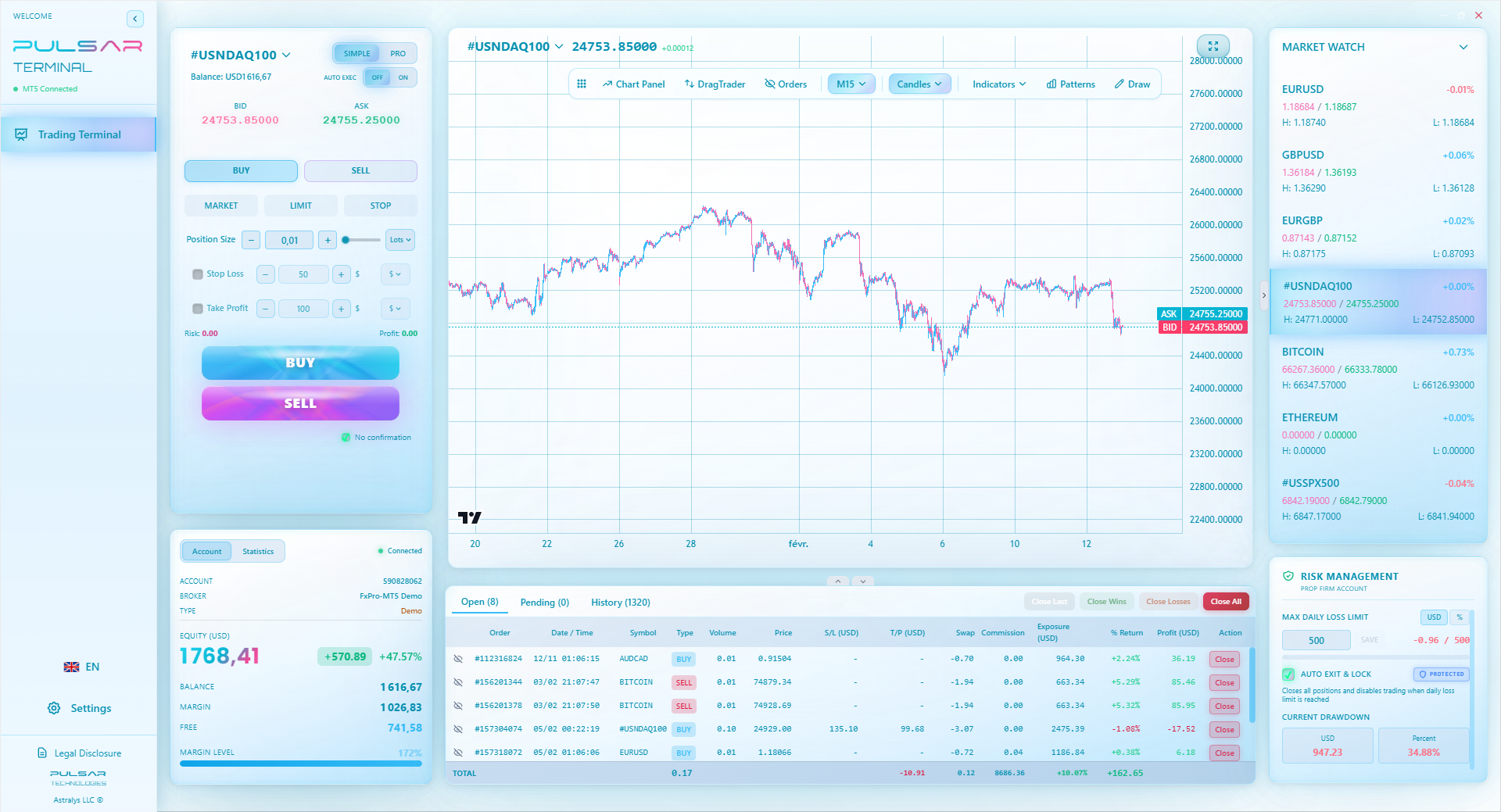
Managing multiple profit targets and moving stops to breakeven on a double top trade is much simpler with a tool that automates it directly on your MT5 chart.
Pulsar Terminal
أداة MT5 الشاملة: أوامر سحب وإفلات، متعدد TP/SL، تريلينج ستوب، تداول الشبكة، Volume Profile وحماية البروب فيرم. يستخدمها أكثر من 1000 متداول يومياً.
“The biggest mistake is calling every pair of highs a double top. Context is everything.”
I've made these, my friends have made these. Let's save you the tuition fees.
-
Trading the Anticipation, Not the Confirmation. This is the killer. You see the second peak forming and you jump in early, shorting before the neckline breaks. You're trying to pick the top. Nine times out of ten, the market will squeeze higher one last time to liquidate all those premature shorts. Wait for the close below the neckline. Patience pays.
-
Ignoring the Overall Market Context. A double top on GBP/ZAR might look perfect, but if the US Dollar (DXY) is in a freefall, your short is probably doomed. You have to know what the underlying drivers are. Is it risk-on/risk-off? What is the SARB doing? A pattern against the major trend is a low-probability trade. Check the higher timeframes first.
-
Setting Unrealistic Profit Targets. The measured move target is a guide, not a guarantee. Sometimes the market will blow right through it, sometimes it will reverse early. Use it as your primary target, but pay attention to other support levels on the way down. Consider taking partial profits at 50% or 75% of the target, especially if price hits a previous swing low or a key psychological level. Greed turns winners into breakevens.
💡 نصيحة وينستون
A pattern without volume confirmation is like a car without fuel. It might look ready to go, but it won't get you anywhere. Always check the volume story.
“Your stop loss goes above the second peak. If price goes there, the story is wrong and you must exit.”
Not every 'M' is a double top. Here’s how to tell it apart from its cousins.
| Pattern | Key Difference | What It Means |
|---|---|---|
| Double Top | Two clear peaks after an uptrend, break below neckline. | Bearish Reversal. Trend change from up to down. |
| Triple Top | Three peaks at a similar level. Takes longer to form. | Even stronger exhaustion signal. Often a major top. |
| Head and Shoulders | Three peaks: left shoulder, higher head, right shoulder. | The most reliable reversal pattern. The neckline is often sloped. |
| Bullish Flag/Pennant | Looks like a small 'M' or consolidation during a strong uptrend. | Continuation pattern. The trend resumes higher after the break. |
The head and shoulders is the big one to not confuse. If that middle peak is clearly higher than the other two, you've got a head and shoulders, which has its own trading rules. A triple top is just a double top that tested the level one more time. The main takeaway? If the pattern forms during a consolidation with no clear prior trend, it's not a reversal pattern. It might be a range. Understanding these nuances is as crucial as knowing your pip definition and spread definition.

“Your stop loss goes above the second peak. If price goes there, the story is wrong and you must exit.”
A naked chart is great, but a few key indicators can help confirm the double top's story. Don't use ten of them - that creates confusion. Pick one or two.
The RSI Divergence: This is my favourite confirmation tool. As price makes that second peak at a similar high, look at the RSI indicator. If the RSI is making a lower high while price makes an equal high, that's bearish divergence. It shows upward momentum is fading, which perfectly aligns with the double top psychology. I look for this on the 4-hour or daily chart.
The MACD Cross: Watch the MACD indicator on the timeframe you're trading. A bearish crossover (the MACD line crossing below the signal line) occurring around the time of the neckline break adds another layer of confirmation. It signals that momentum has officially shifted to the downside.
Volume Profile: This is an advanced but powerful tool. If you see a high volume node (a price level where lots of trading happened) sitting right at the double top peaks, it reinforces that this is a major area of supply. The break below the neckline should see volume expanding into lower prices.
The goal isn't to find an indicator that 'gives the signal'. The price action gives the signal. The indicator's job is to say, 'Yes, I agree with that story.' If the RSI shows strong bullish momentum at the second peak, maybe your double top isn't as strong as you think. Be prepared to walk away.
💡 نصيحة وينستون
In volatile markets like the Rand, your initial profit target is just a suggestion. Use a trailing stop to let the market show you how far it wants to run.
“A pattern against the major trend is a low-probability trade. Check the higher timeframes first.”
Trading USD/ZAR, EUR/ZAR, or GBP/ZAR with this pattern requires some local knowledge. Our market has its own quirks.
Liquidity and Spreads: The ZAR pairs are less liquid than majors like EUR/USD. This means spreads can be wider, especially around local market open (9am SAST) and during major data releases. A wider spread affects your entry and exit precision. Always check the live spread from your broker before entering. I've had trades on Exness where the spread on USD/ZAR was fantastic during London hours, but I'd avoid trading it during thin Asian session hours. You can compare brokers in our Exness review and IC Markets review.
Local Catalysts: A double top on USD/ZAR might be forming, but then the SARB (South African Reserve Bank) makes a surprise interest rate announcement or a major local political event hits. These can override any technical pattern instantly. Always have an economic calendar open. Know when the MPC (Monetary Policy Committee) meetings are.
Volatility is Your Friend (and Enemy): ZAR pairs move. A lot. A 100-pip stop loss might be too tight for USD/ZAR's normal daily range, which can easily be 200-300 pips. You might need to place your stop wider, which means trading a smaller position size to keep your risk percentage the same. That increased volatility also means the measured move profit target is often reached quickly. Be ready to manage the trade actively, perhaps using a trailing stop to capture the momentum. The key is to never let a good winner turn into a loser because you forgot to manage it.
FAQ
Q1How reliable is the double top pattern in forex?
It's one of the more reliable reversal patterns, but 'reliable' in trading doesn't mean 'always works'. Its success rate improves massively when you strictly wait for the neckline break confirmation, see volume decline on the second peak, and ensure it forms after a clear uptrend. On its own, maybe 60-65% if traded perfectly. With proper context and confirmation, you can improve those odds.
Q2What timeframe is best for trading double tops?
They can work on any timeframe, but the higher the timeframe, the more significant the signal. A double top on a 4-hour or daily chart carries far more weight than one on a 5-minute chart. I primarily look for them on the 4H and daily charts for swing trades. The patterns need space to develop properly, which shorter timeframes often don't provide.
Q3Can a double top fail after the neckline break?
Absolutely. This is called a 'false breakout' or 'bull trap'. Price breaks below the neckline, triggers all the sell orders, and then reverses sharply back above it. This is why your stop loss must be above the second peak. If the break fails and price reclaims the neckline, the pattern is invalidated and you should be out of the trade with a small, defined loss. It happens, and it's just part of the business.
Q4Should I use fundamental analysis with double tops?
Yes, 100%. A technical pattern gives you the 'when' and 'where'. Fundamentals give you the 'why'. If USD/ZAR is forming a double top, but the US Federal Reserve is hinting at aggressive rate hikes while SA faces load-shedding and growth fears, the fundamental pressure might be too strong for the pattern to hold. The pattern shows seller exhaustion, but fundamentals can bring in new, powerful buyers. Always know the fundamental backdrop.
Q5How do I calculate the position size for a double top trade?
First, determine your risk in Rands (e.g., R500). Then, measure the distance in pips from your entry to your stop loss (e.g., 150 pips). You need to know the Rand value of a pip for the pair you're trading. For USD/ZAR, with an account in ZAR, 1 pip on a standard lot is roughly R0.67 (this changes with the rate). Use the formula: Position Size = (Risk in Rands) / (Stop Loss in Pips * Pip Value in Rands). Better yet, use a free online position size calculator to do the math for you and avoid costly errors.
Q6What's the difference between a double top and a resistance level?
A resistance level is a single price zone where selling has previously emerged. A double top is a specific event that creates and confirms a resistance level. The two failed attempts at the same price (the peaks) tell a story of buyer exhaustion. When price then breaks below the neckline, it confirms that this resistance level is now active and the trend has likely reversed. Think of a double top as the process of building a very strong resistance level.
درس البروفيسور وينستون
النقاط الرئيسية:
- ✓Always wait for the daily/4H close below the neckline.
- ✓Place your stop loss above the second peak, not the first.
- ✓Measure the pattern height for your initial profit target.
- ✓Check for RSI divergence on the second peak for confirmation.
- ✓Risk no more than 1-2% of your capital on any single pattern trade.
ما مدى فائدة هذا المقال؟
انقر على نجمة للتقييم
رؤى التداول الأسبوعية
تحليلات واستراتيجيات أسبوعية مجانية. بدون رسائل مزعجة.
عن المؤلف
David van der Merwe
متداول الأسواق الناشئة
متداول مقيم في جوهانسبرغ مع 11 عاماً في عملات الأسواق الناشئة. متخصص في أزواج ZAR والتداول المنظم من FSCA وتحليل السوق الجنوب إفريقي.
التعليقات
تحذير من المخاطر
ينطوي تداول الأدوات المالية على مخاطر كبيرة وقد لا يكون مناسبًا لجميع المستثمرين. الأداء السابق لا يضمن النتائج المستقبلية. هذا المحتوى لأغراض تعليمية فقط ولا ينبغي اعتباره نصيحة استثمارية. قم دائمًا بإجراء بحثك الخاص قبل التداول.
قد يعجبك أيضًا

Cara Trading Forex Sukses: 7 Prinsip dari Trader Profesional
Cara trading forex sukses dengan 7 prinsip trader pro: manajemen modal, disiplin, journal trading, backtest. Data nyata, bukan janji profit palsu.
Jam Trading Forex Terbaik untuk Trader Indonesia: Panduan Lengkap dengan Tabel Waktu
Panduan jam trading forex untuk trader Indonesia. Tabel 4 sesi dunia, jam emas 20:00-00:00, sesi mana yang harus dihindari. Data akurat + tips dari trader berpengalaman.
Top 5 Sàn Forex Uy Tín Nhất 2026: Review Jujur dari Trader Indonesia
Top 5 sàn forex uy tín 2026 untuk trader Indonesia. Review jujur: spread, deposit, withdraw, dukungan lokal. Exness, XM, IC Markets & lebih.
احصل على Pulsar Terminal
جميع هذه الحاسبات مدمجة في Pulsar Terminal مع بيانات حية من حساب MT5 الخاص بك.
احصل على Pulsar Terminal