


You're looking at ETFs in India because you want the diversification of a mutual fund with the control of a stock.
Rajesh Sharma
محلل فوركس أول ·  India
India
☕ 11 دقائق قراءة
ما ستتعلمه:
- 1Why Most Indian ETF Traders Lose Money (It's Not What You Think)
- 2The New Rules & Taxes You Can't Ignore (2026 Update)
- 3Core Strategies for Different Goals
- 4Execution & Risk Management: The Nuts and Bolts
- 5Picking Your Broker & Understanding the Real Costs
- 6Advanced Tactics: Gold, Global, and Thematic ETFs
- 7Putting It All Together: Building Your ETF Portfolio
You're looking at ETFs in India because you want the diversification of a mutual fund with the control of a stock. But are you just buying and hoping, or do you have a real strategy? The market's changed. The old 'buy and forget' Nifty 50 ETF playbook doesn't cut it anymore, not with SEBI's new rules and a 20% tax on short-term gains. I've watched traders lose lakhs by treating ETFs like a safe parking spot without understanding the mechanics. Let's talk about how to actually trade them.
It's not about picking the wrong fund. It's about misunderstanding what you're even buying. An ETF isn't a stock. Its price is supposed to track an index's Net Asset Value (NAV), but there's often a gap - the premium or discount. Before SEBI's proposed changes, we used a T-2 day NAV for price bands. That created a massive one-day lag. You could be buying at a 2% premium to the actual value without knowing it. I did this in 2023 with a banking ETF. Bought at ₹520, thinking it was cheap. The NAV was ₹509. I was down 2% the second I entered. That gap eats your margin for error.
Then there's liquidity. You see the Nifty Bees trading crores daily, so you assume all ETFs are liquid. Try selling a thematic ESG ETF or a mid-cap index fund in a down market. The bid-ask spread can blow out to 5%. Your exit becomes a fire sale. Combine that with the new flat 20% tax on any equity ETF gain under 12 months, and your scalping strategy just got a lot more expensive to execute.
The biggest mistake? Using the same position size calculator you use for Reliance or TCS. ETFs feel safer, so people size up. A 5% move in a sectoral ETF can wipe out a month of careful gains from your core portfolio. You have to respect the volatility.

💡 نصيحة وينستون
The expense ratio is a guaranteed loss. The market's return is a hopeful gain. Always fight the guaranteed loss first. Pick the cheapest fund that does the job.
If you're using strategies from before July 2024, you're trading with outdated maps. The Union Budget changed everything.
The 20% Tax Trap
For equity ETFs (those with >65% in domestic stocks), short-term capital gains (held <12 months) are now taxed at a flat 20%. Gone is the 15% rate. That's a 33% increase in your tax liability on short-term trades. It directly attacks frequent trading. A ₹50,000 short-term gain now costs you ₹10,000 in tax, not ₹7,500. It forces a fundamental question: is your strategy good enough to overcome this higher hurdle?
Long-term gains (>12 months) are taxed at 12.5%, with the first ₹1.25 Lakh exempt per year. This is the government gently pushing you towards longer holding periods. For gold ETFs, it's worse. No indexation benefit. Gains are just added to your income and taxed at your slab rate. That can be 30%+.
SEBI's Dynamic Price Bands (Coming Soon)
This is a game-changer for intraday traders. The fixed ±20% band is going away. The proposal:
- Equity/Index ETFs: Start at ±10%. If it hits the limit, a 15-minute cooling-off, then it expands to ±20%. Can only happen twice a session.
- Gold/Silver ETFs: Start at ±6%, adjustable in 3% stages up to ±20%, based on international moves.
- Liquid ETFs: Fixed ±5%.
Why does this matter? It kills the 'stoploss hunting' theory for liquid ETFs. The volatility is capped. But for equity ETFs, that initial ±10% band means you could hit a circuit faster on a gap-down open. Your risk management has to be tighter. You can't just set a mental stop at -15% and assume you'll get out.

Warning: The new tax rules make short-term ETF trading a much tougher business. That 20% bite comes right off your bottom line. Before you enter any trade, ask: "Would I still take this if my profit was instantly reduced by a fifth?"
“The new 20% tax on short-term ETF gains isn't a tweak; it's a wall built to discourage frequent trading.”
Your strategy must match your goal, timeframe, and tolerance for getting slapped by the taxman.
The Foundation Builder (Long-Term Investor)
This is about cost and consistency. You're building wealth over years, not months.
- Tools: Broad-based, low-cost index ETFs. Think Nifty 50, Nifty Next 50, or a Nifty 100 ETF.
- Tactic: Systematic Investment Plan (SIP). Set it, forget it. Let rupee-cost averaging do its work. The key here is the expense ratio. Fight for every basis point. A 0.05% fee vs. a 0.10% fee saves you ₹500 annually on a ₹10 lakh investment. Over 20 years, that's a meaningful difference.
- My Mistake: I used to chase the slightly better-performing ETF with a 0.15% higher fee. Over a decade, the low-cost one won. Every time.
The Tactical Allocator (Swing Trader)
You're looking at cycles, sector rotations, and holding for weeks to months.
- Tools: Sectoral ETFs (Banking, IT, Auto), Thematic ETFs (Infrastructure, Defence), and Smart Beta ETFs (Low Volatility, Quality).
- Tactic: Use technical analysis on the ETF chart itself. Support/Resistance, moving averages, and the RSI indicator work here. But you must overlay sector fundamentals. I bought an IT ETF in early 2024 based on a bullish chart pattern, ignoring the worsening US recession chatter. It was a 7% loss. The chart was right until the sector news overwhelmed it.
- Tax Consideration: You're likely hitting that 12-month mark to avoid the 20% STCG. This changes your exit timing. A 15% gain in 11 months is less attractive than a 15% gain in 13 months.
The Income Seeker (Using Debt & Liquid ETFs)
This is for parking cash or generating modest, stable returns.
- Tools: Liquid ETFs (like Liquid BeES) and Target Maturity Date ETFs (like Bharat Bond ETFs).
- Tactic: For emergency funds or short-term goals, Liquid ETFs offer better yields than a savings account with instant liquidity. For known future expenses (a payment due in 2028), a Bharat Bond ETF maturing that year locks in a yield. There's no interest rate risk if you hold to maturity.
- Crucial Note: Gains from debt ETFs are now taxed as per your income slab, regardless of holding period. There is no long-term capital gains benefit. This makes them less tax-efficient than certain debt mutual funds for high-income investors.
This is where plans die. You have a great strategy, then you botch the trade.
Avoiding the Premium/Discount Trap
Always check the iNAV (Indicative NAV). Your broker's platform should show it. Don't buy an ETF trading at a premium >0.5% to its iNAV unless you have a very strong reason. For illiquid ETFs, use limit orders only. A market order is a blank cheque.
Position Sizing is Everything
An ETF is not "safe." A Nifty ETF can drop 10% in a bad month. Use a proper position size calculator. My rule: I never risk more than 1% of my trading capital on a single ETF idea. If my stop loss is 5% away, I buy only 1/5th the quantity I would if my stop was 1% away.
The Exit Plan
Before you enter, know three things:
- Target: Where do I take profit? (e.g., previous resistance, a 15% gain).
- Stop Loss: Where am I wrong? (e.g., below the 200-day moving average, a 7% loss).
- Time Limit: How long will I wait for this to work? (e.g., 8 weeks).
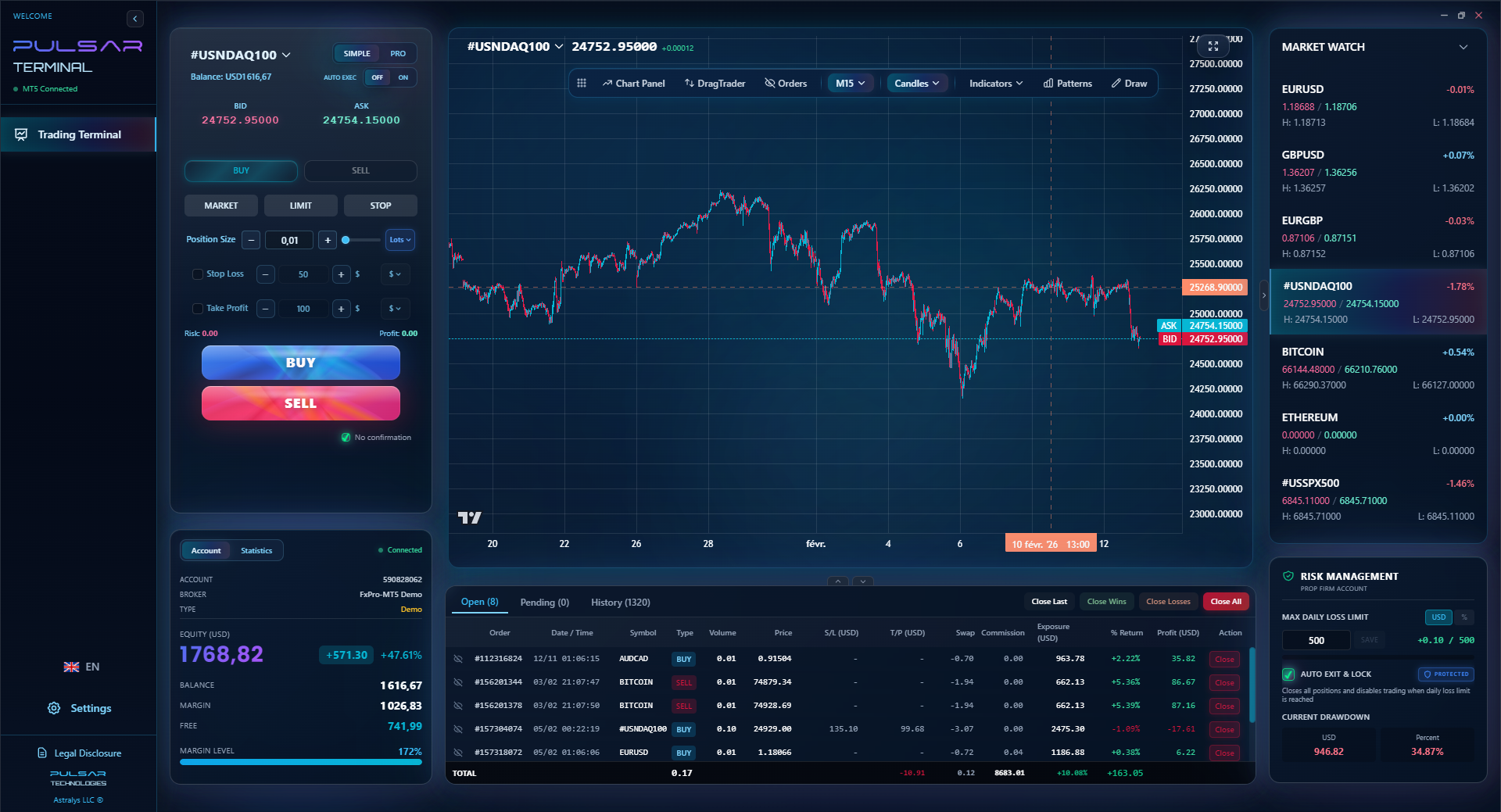
For swing trades, a trailing stop loss is powerful. If the ETF rallies 10%, move your stop to breakeven. Then trail it. Most platforms have automated trailing stop functions, but you have to set them. Tools like Pulsar Terminal can automate this directly on your trading platform, which is crucial because emotion will stop you from moving the stop.

Example: You buy a Banking ETF at ₹450. Your capital is ₹10 lakh. Your 1% risk is ₹10,000. You place a stop loss at ₹425 (a 5.56% drop). Maximum position size = ₹10,000 / 0.0556 = ₹1,79,856. So you buy roughly ₹1.8 lakh worth, about 400 units. Not your entire capital.
💡 نصيحة وينستون
Liquidity isn't about how many units are outstanding. It's about whether you can sell your entire position in 60 seconds without moving the price 2%. Test it with a small sell order first.
“Your biggest risk in an ETF isn't the index falling. It's buying at a 3% premium or selling at a 5% discount because you ignored liquidity.”
The 'zero brokerage' ads are catchy, but they're not the whole story. Your total cost to trade an ETF in India is a layer cake of fees.
Let's break down a ₹1,00,000 purchase of a Nifty ETF:
| Fee Component | Typical Charge | Approx. Cost on ₹1 Lakh | Notes |
|---|---|---|---|
| Brokerage | ₹0 (Zerodha, Dhan) | ₹0 | The big headline. But check for hidden platform fees. |
| Exchange Transaction Charge | 0.00297% (NSE) | ₹2.97 | Paid to the exchange. Unavoidable. |
| SEBI Turnover Fee | 0.0001% | ₹0.10 | Tiny, but it's there. |
| GST | 18% on above fees | ~₹0.55 | On brokerage + transaction charge + SEBI fee. |
| Stamp Duty | 0.005% on buy value | ₹5.00 | State government levy. |
| STT | 0.001% on sell value | ₹1.00 (on exit) | Only on sale of equity ETFs. |
| DP Charges | ₹13 + GST (on sell) | ~₹15.34 (on exit) | Charged by your Depository Participant when you sell. |
| Expense Ratio | 0.05% p.a. | ₹50/year | Drawn daily from the fund's NAV. You don't see it. |
| Bid-Ask Spread | 0.05% - 0.1% | ₹50 - ₹100 | The hidden entry/exit cost. Worse for illiquid ETFs. |
Total One-Way Cost (approx.): ₹8-10 + Spread. The spread is the silent killer. On a ₹1 lakh trade in a liquid ETF, it's fine. On a ₹10 lakh trade in a low-volume thematic ETF, it could be ₹5,000.
Broker Choice: For pure ETF trading, a low-cost, reliable platform like Zerodha or Dhan is perfect. If you need advanced charting and order types, check our Angel One review for their offerings. For access to international ETFs, a broker like Interactive Brokers is necessary, but mind the higher minimums and currency conversion costs.

Pro Tip: Always check the average daily volume of the ETF on the NSE/BSE website before trading. If it's less than ₹5 crore, be very careful. Your large order could move the price against you.
Managing multiple ETF positions with different stop losses and profit targets is complex, but tools like Pulsar Terminal let you set and automate multi-level exit strategies directly on your MT5 platform.
Pulsar Terminal
أداة MT5 الشاملة: أوامر سحب وإفلات، متعدد TP/SL، تريلينج ستوب، تداول الشبكة، Volume Profile وحماية البروب فيرم. يستخدمها أكثر من 1000 متداول يومياً.
Once you've mastered the core, these tools can add specific flavors to your portfolio.
Gold ETFs as a Hedge
Gold ETFs (like Gold BeES) track physical gold prices. They're not for trading like a stock. They're insurance. I allocate 5-10% of my long-term portfolio and only rebalance once a year. When equities are in a panic (like during COVID's first wave), gold often holds or rises. It smooths the ride. Remember the tax: no indexation benefit. It's all slab-based.
Global ETFs for Diversification
ETFs like the Motilal Oswal NASDAQ 100 let you bet on Apple or Microsoft without a US trading account. But you're taking on currency risk. If the Nasdaq goes up 10% but the INR strengthens 5% against the USD, your return is only ~5%. Watch the USD/INR chart as closely as the ETF chart.
Thematic & Sectoral ETFs - High Risk, High Reward
These are concentrated bets. An India Defence ETF or a EV theme ETF. The potential is huge, but so is the volatility and the liquidity risk. My strategy here is simple: treat it like a venture capital bet. Tiny position size (never more than 2% of capital), clear thematic thesis (e.g., "government defence spending will double in 5 years"), and a long time horizon. These are not for swing trading unless you have a very strong stomach.
Using the MACD indicator on weekly charts can help identify the start and end of major thematic trends, giving you a better entry and exit framework than just guessing.
💡 نصيحة وينستون
A thematic ETF is a bet on a story. Stories are fragile. Size them like a lottery ticket, not like a pension contribution.
“An ETF portfolio without a written rebalancing rule is just a collection of random bets drifting with the market's mood.”
Let's build a sample portfolio for a ₹20 lakh capital, moderate-risk Indian trader.
The 70% Core (Set and Forget):
- 50% in a Ultra Low-Cost Nifty 50 ETF (Expense Ratio <0.06%). This is your market anchor.
- 20% in a Nifty Next 50 ETF. For mid-cap growth exposure. This is more volatile, hence the smaller slice.
The 20% Tactical (Active Management):
- 10% in a Banking Sector ETF. You trade this based on interest rate cycles and technicals.
- 5% in an IT Sector ETF. For global tech exposure.
- 5% in a Gold ETF. Pure hedge, rebalanced annually.
The 10% Satellite (High-Conviction / Speculative):
- 5% in a single Thematic ETF (e.g., Manufacturing).
- 5% in a Global ETF (NASDAQ 100).
Rules for this portfolio:
- Rebalance the Core once a year, no matter what.
- Any Tactical position has a predefined stop loss (7-10%). No exceptions.
- Satellite positions are reviewed quarterly. If the thesis breaks, exit.
- All new capital from savings first goes to the Core until its allocation is restored.
This structure gives you stability, controlled aggression, and a place for your best ideas without letting them sink the ship. It forces discipline, which is the only thing that works over the long run in the Indian ETF market.
FAQ
Q1What is the best ETF trading strategy for beginners in India?
Start with a single, low-cost Nifty 50 or Sensex ETF. Use a Systematic Investment Plan (SIP) to invest a fixed amount monthly. This automates rupee-cost averaging and builds discipline. Focus on learning about expense ratios, tracking error, and the new tax rules before trying anything fancy. Trading is a secondary skill; investing is the primary one.
Q2How are ETF profits taxed in India after the 2024 budget?
For Equity ETFs (>65% in domestic stocks): Gains under 12 months (STCG) are taxed at 20%. Gains over 12 months (LTCG) are taxed at 12.5%, with the first ₹1.25 Lakh of LTCG exempt per financial year. For Gold ETFs: All gains are added to your income and taxed at your slab rate - no indexation benefit. For Debt ETFs: All gains are taxed as per your income slab, regardless of holding period.
Q3What is the difference between an ETF and an index fund in India?
An ETF trades on the stock exchange like a share, with real-time pricing and intraday liquidity. You need a Demat account. An index fund is a mutual fund that you buy/sell at the day's end NAV directly from the fund house. ETFs generally have slightly lower expense ratios, but index funds are easier for SIPs and don't have bid-ask spreads. Post SEBI's TER reduction in 2025, the cost difference has narrowed significantly.
Q4Can I do intraday trading with ETFs in India?
Yes, technically. But it's often a bad idea. The new 20% STCG tax makes it very costly. Liquidity can be an issue except for the top 5-10 ETFs, leading to wide spreads. SEBI's proposed dynamic price bands will also add complexity. It's possible, but the odds are stacked against you compared to trading highly liquid large-cap stocks or indices.
Q5What are the hidden costs of trading ETFs?
The bid-ask spread is the biggest hidden cost, especially for low-volume ETFs. Others include DP charges (when selling), GST on all fees, and the impact cost - your large order moving the price against you. The expense ratio is also a direct drag on returns, though it's not a 'trading' cost.
Q6Is it safe to invest in thematic ETFs for the long term?
"Safe" is the wrong word. Thematic ETFs are concentrated, higher-risk bets. A theme can go out of fashion for years (e.g., ESG underperformance in 2022-23). They can be part of a long-term portfolio, but with very small allocation (say, 2-5%), and you must be prepared to hold through severe volatility and have a strong, ongoing conviction in the theme's decade-long story.
Q7How do I check if an ETF is trading at a fair price?
Look for the iNAV (Indicative Net Asset Value) on your broker's platform or the fund house's website. Compare the ETF's last traded price to the iNAV. A difference of more than 0.5% (premium or discount) is a red flag for liquid ETFs. For illiquid ones, the gap can be larger - this is why you must use limit orders.
درس البروفيسور وينستون
النقاط الرئيسية:
- ✓STCG tax is now 20% - kills frequent trading
- ✓Always check iNAV vs. price before buying
- ✓Liquidity > Past Performance for ETFs
- ✓Core (70%) / Tactical (20%) / Satellite (10%) portfolio structure works
- ✓The bid-ask spread is your silent enemy
ما مدى فائدة هذا المقال؟
انقر على نجمة للتقييم
رؤى التداول الأسبوعية
تحليلات واستراتيجيات أسبوعية مجانية. بدون رسائل مزعجة.
عن المؤلف
Rajesh Sharma
محلل فوركس أول
أكثر من 10 سنوات في تداول الأسواق الهندية وجنوب آسيا. بدأ بالمشتقات النقدية في NSE قبل الانتقال إلى الفوركس الدولي. متخصص في USD/INR وأزواج الأسواق الناشئة.
التعليقات
تحذير من المخاطر
ينطوي تداول الأدوات المالية على مخاطر كبيرة وقد لا يكون مناسبًا لجميع المستثمرين. الأداء السابق لا يضمن النتائج المستقبلية. هذا المحتوى لأغراض تعليمية فقط ولا ينبغي اعتباره نصيحة استثمارية. قم دائمًا بإجراء بحثك الخاص قبل التداول.
قد يعجبك أيضًا

Cara Trading Forex Sukses: 7 Prinsip dari Trader Profesional
Cara trading forex sukses dengan 7 prinsip trader pro: manajemen modal, disiplin, journal trading, backtest. Data nyata, bukan janji profit palsu.
Jam Trading Forex Terbaik untuk Trader Indonesia: Panduan Lengkap dengan Tabel Waktu
Panduan jam trading forex untuk trader Indonesia. Tabel 4 sesi dunia, jam emas 20:00-00:00, sesi mana yang harus dihindari. Data akurat + tips dari trader berpengalaman.
Top 5 Sàn Forex Uy Tín Nhất 2026: Review Jujur dari Trader Indonesia
Top 5 sàn forex uy tín 2026 untuk trader Indonesia. Review jujur: spread, deposit, withdraw, dukungan lokal. Exness, XM, IC Markets & lebih.
احصل على Pulsar Terminal
جميع هذه الحاسبات مدمجة في Pulsar Terminal مع بيانات حية من حساب MT5 الخاص بك.
احصل على Pulsar Terminal