


Let's cut through the noise.

Olumide Adeyemi
رائد التداول في غرب أفريقيا ·  Nigeria
☕ 11 دقائق قراءة
ما ستتعلمه:
Let's cut through the noise. You don't need to know everything about forex to make money. You just need to know the 20% that matters and avoid the 80% that gets people wrecked. I've watched traders in Lagos, Port Harcourt, and Abuja blow up account after account chasing the same myths. This isn't another motivational speech. This is a risk manager's breakdown of the Nigerian forex scene - the real costs, the legal grey areas, and the psychological traps that separate the survivors from the statistics. I'll show you everything you need to know about forex, starting with why the promise of easy money is the most expensive lie you'll ever believe.
First, let's talk about the elephant in the room: regulation. Or rather, the lack of it. Nigeria has a 'twin-peak' system with the SEC and CBN, but as of now, there are no specific forex trading rules for local brokers. That means you, as a Nigerian resident, are legally trading in a grey area. You're not breaking the law by trading, but you have zero protection from a Nigerian regulatory body.
This pushes everyone towards international brokers. You'll be dealing with firms regulated in places like South Africa (FSCA), Mauritius (FSC), Kenya (CMA), Australia (ASIC), or Cyprus (CySEC). Your safety net is their rulebook, not Nigeria's. This is critical to understand before you deposit a single kobo. Your broker's head office and legal jurisdiction are probably thousands of miles away.

Warning: High use is a trap, not a feature. Brokers like Exness advertise use up to 1:3000 to Nigerian clients. That's not a tool; it's a financial suicide pact. With 1:3000, a 0.03% move against you wipes out your entire account. They offer it because they know most people can't resist it, and it makes them money when you lose.
The other hard truth is the loss rate. Broker data isn't pretty. Firms like Capital.com report over 81% of retail clients lose money on CFDs. IC Markets shows 73%, XTB shows 76%. These aren't guesses; they're mandatory disclosures from regulated entities. In Nigeria, with our appetite for risk and get-rich-quick narratives, I'd bet the real figure is even higher.
I learned this the hard way early on. I deposited $500 with a broker offering 'unbeatable' 1:500 use. I traded GBP/USD, got a few small wins, and felt like a genius. Then one news event hit. The pair moved 50 pips against my position in seconds. My stop-loss didn't fill at the price I set (slippage), and I was liquidated. Account balance: $0. The entire process took less than two minutes. That's when I realized use isn't about amplifying gains; it's about accelerating your path to a margin call.

💡 نصيحة وينستون
A plan for a 1-pip profit is a plan for poverty. Focus on the ratio of your potential profit to your risk (Reward:Risk). Aim for scenarios where you can gain 2 or 3 times what you're risking.
Choosing a broker in Nigeria is less about finding the 'best' and more about avoiding the worst. You need to prioritize real regulation and transparent costs over flashy bonuses or insane use offers.
Regulation is Your First Filter
Never, ever use an unregulated 'bucket shop'. If you can't find clear licensing info from a reputable authority like the FSCA or ASIC on their website, walk away. For Nigerian traders, brokers regulated by the CMA in Kenya or the FSC in Mauritius are common and generally considered legitimate options. Check our detailed Exness review and IC Markets review for examples of what proper regulation looks like.
The Real Cost of Trading
You think the spread is your only cost? Think again. Here’s where your money really goes:
| Cost Type | What It Is | Example for EUR/USD |
|---|---|---|
| Spread | Difference between buy/sell price | 0.6 pips (IC Markets) to 1.0 pip (AvaTrade) |
| Commission | Fee per lot traded | $3.50 per round lot (Pepperstone Raw Account) |
| Swap/Rollover | Overnight financing fee | Can be +/- $5 per lot per night |
| Payment Fees | Deposits/Withdrawals | Many like Fusion Markets offer free withdrawals, but some don't. |
That 0.6 pip spread on EUR/USD sounds cheap. But if you're paying a $7 round-turn commission on a standard lot, that adds 0.7 pips to your cost. Suddenly, your break-even point is 1.3 pips away before you've even made a cent.

Example: Let's say you use a scalping strategy aiming for 5-pip profits. Your cost is 1.3 pips. You need to be right 26% of the time just to cover costs (1.3/5.0). To actually profit, your win rate needs to be significantly higher. Most scalpers don't do this math.
Funding Your Account
This is a practical headache. Most international brokers don't offer direct Naira pairs or seamless local bank transfers. You'll be funding in USD, EUR, or GBP. Common methods are credit/debit cards (which your bank might block, calling it 'international forex'), or e-wallets like Skrill, Neteller, or cryptocurrency. Always check the broker's specific options for Nigeria. Brokers like Vantage are noted for good variety, while others may be more limited.
Minimum deposits can be low - HotForex starts at $5, RoboForex at $10. But starting small isn't just about affordability; it's about risk management. Your first goal shouldn't be to make money. It should be to not lose your deposit while you learn.
“Your first goal shouldn't be to make money. It should be to *not lose* your deposit while you learn.”
You see guys on YouTube with 15 indicators on their screen. It's nonsense. You need to understand four things: pairs, pips, lots, and orders.
Currency Pairs: You're trading the value of one currency against another. EUR/USD is the Euro vs. the US Dollar. In Nigeria, you'll mostly trade majors (EUR/USD, GBP/USD, USD/JPY) and maybe some minors. You won't be trading NGN pairs directly.
Pips: A pip is the smallest price move. For most pairs, it's 0.0001. If EUR/USD moves from 1.0850 to 1.0851, it moved 1 pip. This is how you measure profit and loss.
Lots: This is your trade size. A standard lot is 100,000 units of the base currency. A 1-pip move on a standard lot of EUR/USD is worth about $10. A mini lot (10,000 units) is $1 per pip. A micro lot (1,000 units) is $0.10 per pip. Start with micro lots. Always. Use a position size calculator for every single trade.
Order Types:
- Market Order: Buy/sell right now at the current price.
- Limit Order: Buy/sell only when the price reaches a better level than now.
- Stop-Loss Order (SL): An order to close a trade at a specific loss level. This is your lifeline. Set it before you enter the trade.
- Take-Profit Order (TP): An order to close at a specific profit level.
Here's my mistake: I used to place a trade and then think about where my stop should go. By the time I decided, the market had often moved against me, and I'd place the stop further away to 'give it room.' That's not giving it room; that's rationalizing a larger loss. Now, I decide my stop-loss distance first, based on the chart, then calculate my position size so that loss is never more than 1-2% of my account. The entry comes last.
There are two main ways people try to predict forex moves: technical analysis (charts) and fundamental analysis (news, economies). Both are useful. Both are also full of crap if you're not careful.
Technical Analysis is about finding patterns in price action. The big secret? Price action is just a record of mass psychology - fear and greed on a chart. Tools like RSI or MACD can help, but they're lagging. They tell you what has happened, not what will happen.
I spent years looking for the perfect indicator. I'd combine RSI, MACD, Bollinger Bands, and Stochastic, only getting conflicting signals. The reality is simple: support and resistance are king. Price tends to bounce off certain levels where lots of buyers or sellers have stepped in before. Drawing these levels on a clean chart is often more powerful than any indicator.
Fundamental Analysis is about the 'why.' Why is the Naira falling? Why is the US raising interest rates? Events like Central Bank of Nigeria (CBN) announcements, US Non-Farm Payrolls, or inflation data cause big volatility.

Pro Tip: Don't trade the news announcement unless you're a pro with a direct news feed. The spike in volatility will widen spreads massively and cause insane slippage. Your stop-loss can get obliterated. I prefer to wait for the dust to settle - 30 minutes to an hour after a major release - and then assess the new trend.
The best approach is a blend. Use fundamentals to decide the overall direction (is the USD strong or weak this quarter?). Then use technicals to find precise entry and exit points within that trend. For example, if the CBN hikes rates to defend the Naira, that's a fundamental USD/NGN bearish signal (in theory). But you'd wait for a technical pullback to a resistance level on the USD/NGN chart before entering a short trade. This is the essence of swing trading.
💡 نصيحة وينستون
The market doesn't care about your rent, your bills, or your dreams. Trading to 'make money today' is the surest way to lose it. Trade the chart in front of you, nothing else.
“A good trade with a small loss is better than a bad trade with a lucky win.”
This is it. This is where 80% of the game is played. Your strategy can be mediocre, but with iron-clad psychology, you might survive. A brilliant strategy with weak psychology will always fail.
The Two Killers: Fear and Greed. Greed makes you risk too much on one trade. It makes you move your stop-loss further away because 'it'll come back.' It makes you hold a winning trade too long until it turns into a loser. Fear makes you close a winning trade too early for a small profit. It makes you avoid pulling the trigger on a valid setup.
I have a rule: I never touch a stop-loss after I've set it. Moving it once is a slippery slope. In 2022, I had a short GBP/USD trade that went against me by 15 pips. My stop was 20 pips away. Greed whispered, 'The London session hasn't opened yet, it'll reverse.' I moved my stop to 30 pips. It went against me another 10. I moved it to 50. The trade eventually hit my widened stop for a loss 2.5 times larger than I'd planned. That one broken rule wiped out a week of disciplined profits.
The Solution is a System. You combat emotion with boring, mechanical rules. A trading plan is your constitution. It must answer:
- What pairs do I trade? (Stick to 1-2, like EUR/USD or XAU/USD)
- What's my daily/weekly loss limit? (e.g., -3% daily, -10% weekly = STOP TRADING)
- What's my risk per trade? (1-2% of account)
- What are my entry/exit rules? (Be specific: 'Buy if price bounces off this support with a bullish pin bar')
Write it down. Sign it. Follow it like a robot. The moment you start improvising, you're gambling.
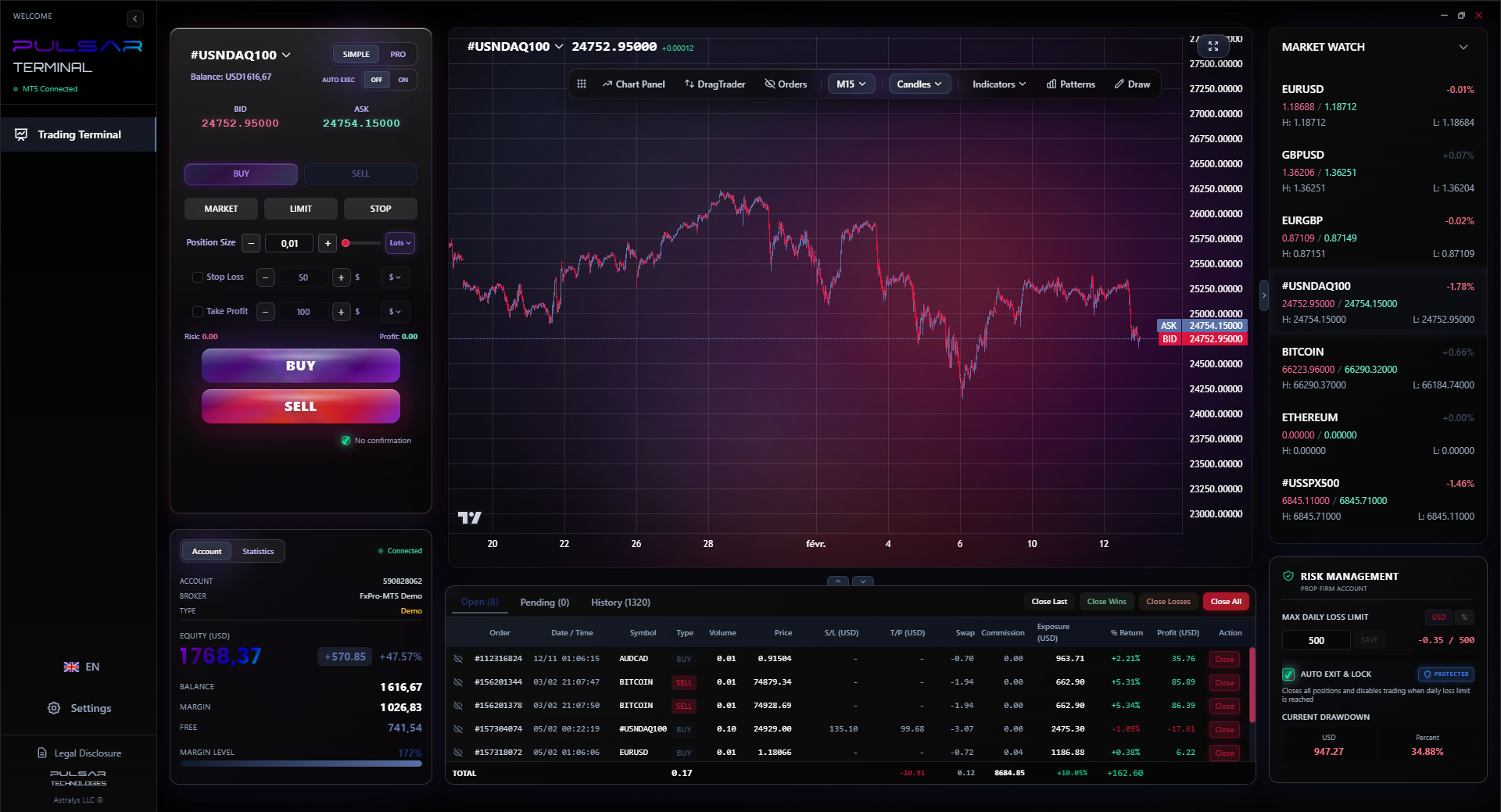
Sticking to a disciplined plan with precise stop-loss and take-profit levels is hard, but tools like Pulsar Terminal automate this execution directly on your MT5 charts, removing emotional interference.
Pulsar Terminal
أداة MT5 الشاملة: أوامر سحب وإفلات، متعدد TP/SL، تريلينج ستوب، تداول الشبكة، Volume Profile وحماية البروب فيرم. يستخدمها أكثر من 1000 متداول يومياً.
So here's your actionable checklist, the condensed version of everything you need to know about forex to not blow up in your first year.
- Start Regulated: Pick a broker from our reviews like Pepperstone or XM that is clearly regulated internationally. Verify their license number.
- Start Small: Open an account with the minimum deposit. Use a demo account first, but know that it feels different when real money is on the line.
- Cap Your use: In your account settings, manually lower your use to 1:10 or 1:20 maximum. Ignore the broker's default high setting.
- Define Risk First: Before every trade, use a calculator to determine your position size so your potential loss is 1% of your account. A $1,000 account risks $10 per trade.
- Use Stop-Losses Religiously: Every. Single. Trade. No exceptions.
- Keep a Journal: Record every trade: entry, exit, reason, profit/loss, and - most importantly - your emotional state. Review it weekly.
- Specialize: Don't jump from EUR/USD to Bitcoin to Oil. Master one major currency pair. Understand its daily rhythm.
- Accept Losses: A good trade with a small loss is better than a bad trade with a lucky win. You will have losing trades. It's a cost of doing business.
The goal for your first six months isn't profitability. It's consistency and capital preservation. If you can end the period with roughly the same amount you started with, you're in the top 20% of beginners. You've learned how to not lose. Only then can you learn how to win.
FAQ
Q1Is forex trading legal in Nigeria?
Yes, it's legal for Nigerian residents to trade forex with international brokers. However, Nigeria's SEC hasn't set specific rules for local forex brokers yet, so you're operating in an unregulated domestic space. Your protection comes from the foreign regulator overseeing your chosen broker (e.g., FSCA in South Africa, CMA in Kenya).
Q2What is the minimum amount I need to start forex trading in Nigeria?
Technically, you can start with as little as $5 with some brokers like HotForex. But realistically, you need enough to survive inevitable losses while learning. A more practical start is $100-$200, traded in micro lots ($0.10 per pip), so you can practice proper risk management without blowing the account on a few bad trades.
Q3Why do most forex traders lose money?
The core reasons are excessive use, poor risk management (not using stop-losses or risking too much per trade), emotional trading (fear and greed), and a lack of a tested, disciplined trading plan. Broker data consistently shows 65-82% of retail clients lose money, often because they treat trading like gambling instead of a skilled profession.
Q4Can I fund my forex account with Nigerian Naira (NGN)?
Most international brokers do not accept Naira directly. You'll typically fund your account in USD, EUR, or GBP using methods like international bank transfers, credit/debit cards (which may be flagged by your bank), or e-wallets like Skrill. You then trade major currency pairs like EUR/USD, not NGN pairs.
Q5What is a pip and how is it calculated?
A pip is the standard unit for measuring a change in a currency pair's value. For most pairs (like EUR/USD), a pip is 0.0001. If EUR/USD moves from 1.0850 to 1.0855, it moved 5 pips. The monetary value of a pip depends on your trade size (lot size). A 1-pip move on a standard lot (100,000 units) is roughly $10. Use a pip calculator to figure it out for each trade.
Q6Which trading platform is best for beginners in Nigeria?
MetaTrader 4 (MT4) is the most common and beginner-friendly. It's offered by almost all brokers, has a simple interface, and there's a massive amount of free educational material available for it. MetaTrader 5 (MT5) is also popular. Stick with these standard platforms before considering any broker's proprietary software.
Q7How do I choose a reliable forex broker in Nigeria?
First, check for legitimate international regulation (FSCA, ASIC, CMA, etc.). Second, compare real costs: spreads, commissions, and withdrawal fees. Third, ensure they offer practical deposit/withdrawal methods for Nigerians. Fourth, test their customer support. Reading detailed, unbiased reviews like our IC Markets review can give you a clear picture.
درس البروفيسور وينستون
النقاط الرئيسية:
- ✓Regulation is your first filter, not your last.
- ✓Cap use at 1:20, no matter what's offered.
- ✓Risk a maximum of 1-2% of your account per trade.
- ✓A stop-loss is non-negotiable. Set it first.
- ✓The goal of your first 100 trades is education, not profit.
ما مدى فائدة هذا المقال؟
انقر على نجمة للتقييم
رؤى التداول الأسبوعية
تحليلات واستراتيجيات أسبوعية مجانية. بدون رسائل مزعجة.
عن المؤلف
Olumide Adeyemi
رائد التداول في غرب أفريقيا
أحد أنشط معلمي تداول الفوركس في نيجيريا. 8 سنوات من الخبرة في التداول من لاغوس. متخصص في استراتيجيات رأس المال المنخفض وتحديات شركات البروب للمتداولين الأفارقة.
التعليقات
تحذير من المخاطر
ينطوي تداول الأدوات المالية على مخاطر كبيرة وقد لا يكون مناسبًا لجميع المستثمرين. الأداء السابق لا يضمن النتائج المستقبلية. هذا المحتوى لأغراض تعليمية فقط ولا ينبغي اعتباره نصيحة استثمارية. قم دائمًا بإجراء بحثك الخاص قبل التداول.
قد يعجبك أيضًا

Cara Trading Forex Sukses: 7 Prinsip dari Trader Profesional
Cara trading forex sukses dengan 7 prinsip trader pro: manajemen modal, disiplin, journal trading, backtest. Data nyata, bukan janji profit palsu.
Jam Trading Forex Terbaik untuk Trader Indonesia: Panduan Lengkap dengan Tabel Waktu
Panduan jam trading forex untuk trader Indonesia. Tabel 4 sesi dunia, jam emas 20:00-00:00, sesi mana yang harus dihindari. Data akurat + tips dari trader berpengalaman.
Top 5 Sàn Forex Uy Tín Nhất 2026: Review Jujur dari Trader Indonesia
Top 5 sàn forex uy tín 2026 untuk trader Indonesia. Review jujur: spread, deposit, withdraw, dukungan lokal. Exness, XM, IC Markets & lebih.
احصل على Pulsar Terminal
جميع هذه الحاسبات مدمجة في Pulsar Terminal مع بيانات حية من حساب MT5 الخاص بك.
احصل على Pulsar Terminal