


Let's be honest: most 'forex branch' guides you find online are generic rubbish, written by people who've never placed a real trade on USD/ZAR.

David van der Merwe
متداول الأسواق الناشئة ·  South Africa
☕ 11 دقائق قراءة
ما ستتعلمه:
Let's be honest: most 'forex branch' guides you find online are generic rubbish, written by people who've never placed a real trade on USD/ZAR. They don't tell you about the R1 million SARS approval, the FSCA's recent R1 million fines, or why starting with less than R5,000 is a fast track to a margin call. I've traded here for over a decade, and I'll show you exactly how the local market works - the real costs, the regulated brokers that won't disappear with your money, and the strategies that actually fit our volatile Rand.
When we talk about the 'forex branch' in South Africa, we're not talking about a physical bank location. We're talking about the entire environment: the regulated brokers, the FSCA rules, the SARB exchange controls, and us - the traders navigating the wild swings of the Rand. It's a market that did over $21 billion a day in 2025. That's serious volume.
Think of it as the local chapter of the global forex market, but with our own rulebook. The Financial Sector Conduct Authority (FSCA) is the headmaster here. Since 2021, they've capped use for retail traders at 1:30. That might feel restrictive if you've read about 1:500 use offshore, but trust me, it's for your own good. I learned that the hard way early on.
Back in 2018, I got cocky with high use on a USD/ZAR trade. I was right on the direction, but a 50-pip spike against me before the market turned wiped out my account because my position was too big. That 1:30 rule would have saved me R8,000. The FSCA isn't trying to spoil your fun; they're trying to stop you from blowing up your account in one trade. Your first job is to only use a broker regulated by them. It's your single biggest protection against scams and insolvency. You can check our detailed Exness review and IC Markets review for examples of brokers with solid FSCA presence.

💡 نصيحة وينستون
The FSCA's 1:30 use limit feels like a leash. It's not. It's a seatbelt. In my 40 years, I've seen more accounts wrecked by excessive use than by being wrong on direction.
“The FSCA's 1:30 use rule would have saved me R8,000 on one bad trade early in my career.”
FSCA Regulations: Your Safety Net
Your money's safety hinges on FSCA rules. Regulated brokers must keep your trading funds in segregated accounts. This means if the broker goes under (it happens), your money isn't mixed with their operating cash to pay their bills. They also have strict AML and KYC. You'll need your ID and proof of address to open an account - no way around it.
The SARB & Your Money
This is where many guides go silent. The South African Reserve Bank controls how money moves in and out. For you, the key number is R1 million. If you want to send more than that offshore in a year (for example, to an international broker not holding FSCA license), you need a Tax Compliance Status (TCS) pin from SARS first. It's a hassle. This is a major reason to use an FSCA-regulated broker with a ZAR account - it keeps everything local and simpler.
Breaking Down the Real Costs
Forget the 'trade from R100' hype. Let's talk real numbers.
Starting Capital: Yes, some brokers like XM let you start with $5. But with a R5,000 account (about $265) and a sensible 1% risk per trade, you're risking R50. On USD/ZAR, where the spread can be 5-10 pips, you're nearly 20% down before the trade even moves. A realistic starting point for actual learning without constant frustration is R5,000 to R20,000. Use a position size calculator religiously with this capital.
Spreads & Commissions: This is your main trading cost.
| Pair | Typical Spread (Pips) | Notes |
|---|---|---|
| EUR/USD | 0.6 - 1.2 | Major pair, low cost |
| USD/ZAR | 5 - 15 | Our local exotic, wider spread |
| EUR/ZAR | 14 - 25 | Even wider, higher cost |
Brokers like IC Markets offer raw spreads from 0.0 pips on majors but charge a commission (e.g., $7 per lot). For USD/ZAR, Pepperstone often has spreads around 5 pips. You need to factor this in. A 10-pip spread on USD/ZAR means the price needs to move 10 pips just for you to break even.

Warning: Trading exotics like USD/ZAR with a tiny account is a sure way to lose to spreads and commissions. Start practicing on majors like EUR/USD where costs are lower, then graduate to ZAR pairs. Our EUR/USD guide is a great starting point.
The Hidden Bank Fees: If you use a local bank like Capitec for international transfers, you'll pay. An outgoing foreign payment can cost R250-R500. An incoming one R250-R350. These fees eat into small profits fast. Another vote for using a broker's local ZAR deposit option.
“Trading USD/ZAR with a R5,000 account means you're nearly 20% down before the trade even moves, just from the spread.”
This isn't about who has the flashiest ads. It's about who gives you a fair, regulated, and cost-effective platform to trade. Here’s a snapshot based on early 2026 data:
| Broker | FSCA Regulated | Min. Deposit (ZAR approx) | Key Feature for SA Traders |
|---|---|---|---|
| IC Markets | Yes | ~R3,700 ($200) | Raw spreads, fast execution. Great for scalping strategy. |
| XM | Yes | ~R90 ($5) | Ultra-low minimum, offers ZAR accounts. |
| Pepperstone | Yes | ~R3,700 ($200) | Good USD/ZAR spreads (from ~5 pips). |
| Khwezi Trade | Yes | R500 | Local broker, built for SA market. |
My personal workhorse for years has been IC Markets for their reliability on execution, especially during our volatile local news events. But I keep an XM account for testing new strategies with tiny risk because of their low minimum. Don't just take my word for it, read the full Pepperstone review and XM review for deeper dives.
The ZAR Account Advantage: If a broker offers it, use it. Depositing and withdrawing in Rands avoids the bank's foreign exchange fees and spreads. Your profit and loss are still in the currency pair you trade, but the cash in your brokerage account is in ZAR, simplifying your accounting for SARS.
Platform Choice: MetaTrader 4 (MT4) and MT5 are king here. The community, the available indicators, the automated trading (Expert Advisors) - it's all built around these platforms. Most local support groups and signal providers (be wary of those!) use MT4/5. cTrader is excellent too, often favored for its cleaner execution on brokers like Pepperstone.
💡 نصيحة وينستون
Your first R10,000 in the market is tuition, not investment. Pay it willingly to learn. If you somehow profit, consider it a scholarship. The goal is to graduate with your account intact.
“Your goal in the first year isn't to buy a Ferrari. It's to not lose money.”
Trading USD/ZAR or EUR/ZAR is different from trading EUR/USD. It's an exotic pair. That means higher volatility, wider spreads, and it's more sensitive to local news.
What Moves the Rand?
- SARB Interest Rate Decisions: This is the big one. The repo rate announcements cause immediate, sharp moves. I once caught a 300-pip move on USD/ZAR in 15 minutes after a hike announcement.
- Eskom & Load-Shedding Schedules: Seriously. Grid stability reports move the Rand. Bad news = Rand weakens.
- Commodity Prices: We're a resource economy. Strong gold and platinum prices often strengthen the ZAR.
- US Dollar Strength: Since it's USD/ZAR, anything that rockets the DXY (US Dollar Index) will push this pair up.
- Political & Budget News: The annual budget speech is a guaranteed volatility festival.
A Strategy That Fits the Volatility
Trying to day-trade ZAR pairs around news is like juggling knives. I prefer a swing trading approach.
Here’s a real example from early 2026: USD/ZAR was trending down from its 2025 highs (the Rand strengthening). After a pullback to around 18.20, I saw a bearish divergence on the daily RSI indicator while price was failing to break a key resistance. I entered short at 18.18. My stop loss was at 18.65 (47 pips away). My first take-profit was at 17.80, and I trailed the rest. The trade ran for two weeks, eventually hitting 16.80. I didn't catch the whole move, but banking 200+ pips on a partial close paid for a lot of spreads.
The key is wider stops. A 50-pip stop on USD/ZAR can get taken out by normal noise. I rarely use stops tighter than 80-100 pips on the daily chart. This requires a smaller position size to keep your risk at 1-2% of your account. It forces patience.

Pro Tip: Pair your technical analysis with a fundamental filter. If you're looking to short USD/ZAR, wait for a day when gold is strong and there's no load-shedding crisis in the news. It stacks the odds slightly more in your favor.
“Your goal in the first year isn't to buy a Ferrari. It's to not lose money.”
The Tax Man Cometh
Your forex profits are taxable income in South Africa. It's not a 'hobby' in SARS's eyes. You need to declare it on your annual return. Keep a detailed trade journal (your broker statements help, but a dedicated log is better). Note the opening/closing prices, profit/loss in Rands, and any fees. Some FSCA brokers provide tax reports, but it's your responsibility to get it right. A good accountant who understands trading is worth every cent.
The Classic SA Trader Mistakes I Made
- Trading Too Big, Too Soon: With a R10,000 account, I'd risk R500 per trade thinking I needed to 'grow fast.' Three losing trades and I was down 15%, panicking. Now, 1% risk feels boring but sustainable.
- Chasing 'ZAR Guru' Signals: I paid R2,000/month for a signals service in 2019. The signals were late, and the guy was just copying a free Telegram channel. The FSCA fined one such unregistered provider over R1 million in 2024. Do your own analysis.
- Ignoring Overnight Fees (Swaps): Holding a USD/ZAR position overnight pays or charges a swap based on the interest rate differential. Going long USD/ZAR (betting the Rand weakens) often has a negative swap - you pay daily. I once held a long swing trade for three weeks and paid more in swaps than I made on a small 30-pip win. Check the swap rates on your platform before holding for days.
A Realistic Path to Building Capital
Start with money you can afford to lose - R5,000 to R20,000. Your goal in the first year isn't to buy a Ferrari. It's to not lose money. Aim for a small, consistent return. If you can make 2-4% a month consistently, you're in the top tier of traders. Reinforce your account with a portion of your profits each quarter. This slow grind is how you build a real forex branch of your own financial tree, not a get-rich-quick scheme that gets chopped down by the first gust of wind. Understanding your spread definition and pip definition in this context is non-negotiable for this grind.
💡 نصيحة وينستون
A trading journal is more important than any indicator. If you're not writing down why you took every trade, you're not trading. You're gambling and hoping to remember your lucky numbers.
“The Rand's volatility isn't going away. That's both a risk and an opportunity.”
The Software You Actually Need
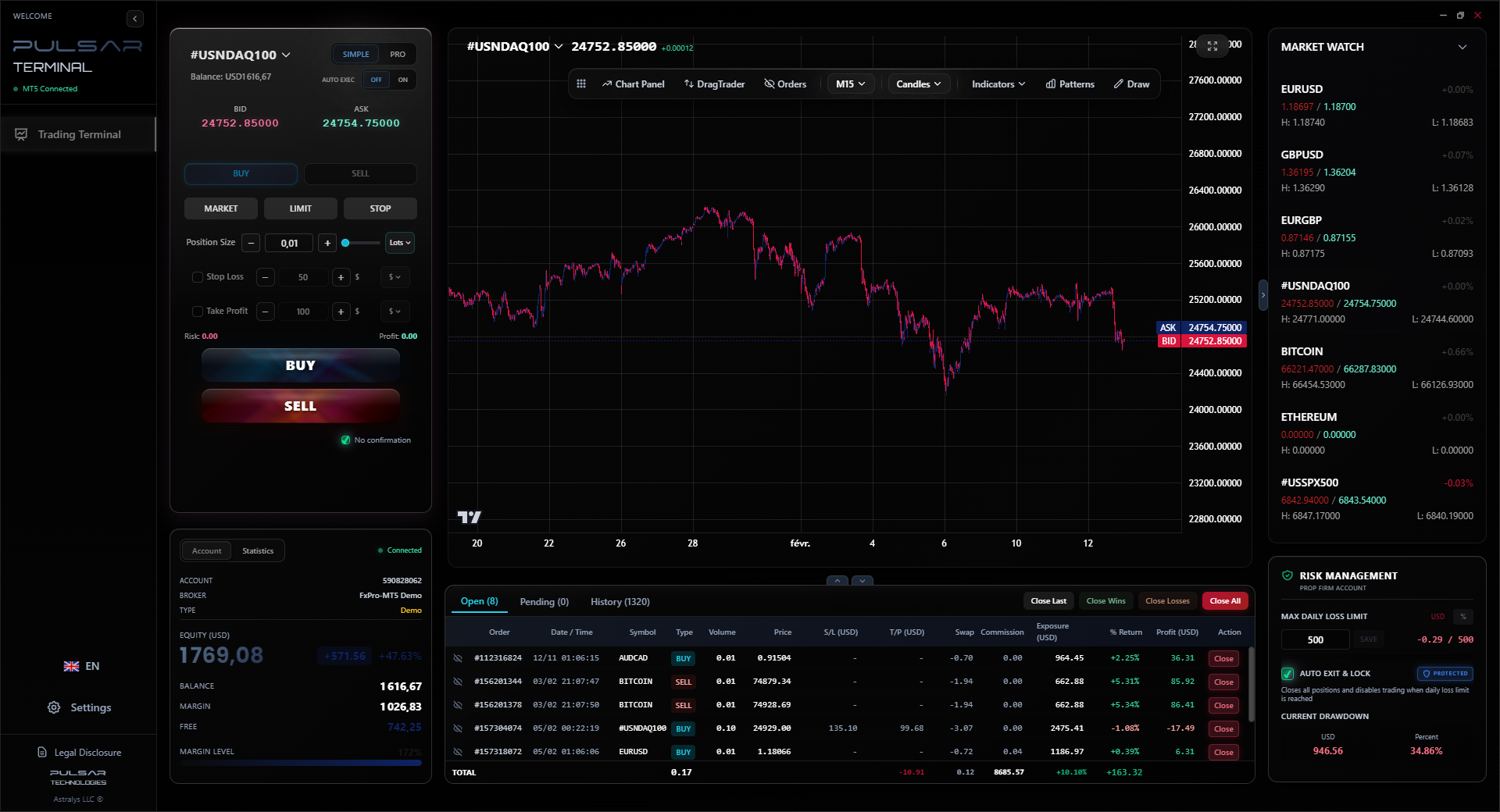
You need a good charting platform. TradingView is fantastic for analysis and ideas. But for execution, you'll likely be on MT5. This is where tools that plug into MT5 become force multipliers. Imagine being able to set a multi-level take-profit order, or a trailing stop that activates automatically, or a breakeven stop that moves without you staring at the screen all day. Managing these manually on a volatile pair like USD/ZAR is stressful and error-prone.
Having a tool that lets you drag and drop orders directly on the chart, set a grid of orders for a range-bound market, or automatically protect your daily loss limit (crucial if you ever try a prop firm challenge) turns MT5 from a basic terminal into a professional cockpit. It lets you focus on the strategy, not the button-clicking.
Looking Ahead: 2026 and Beyond
The FSCA is only getting stricter. The Conduct of Financial Institutions Bill will further solidify the framework. Crypto is now a regulated financial product here too. The trend is clear: regulated, transparent, and accountable. The wild west days are over.
The Rand's volatility isn't going away. That's both a risk and an opportunity. With the right regulated broker, a solid risk-management-first mindset, and the tools to execute your plan precisely, the South African forex branch offers a legitimate path to growing your capital. It's not easy, but nothing worthwhile ever is. Start small, learn constantly, and always respect the market. And remember, the goal is to survive long enough in the game to get good at it. For managing complex trades on our volatile markets, mastering tools that go beyond basic MT5 is no longer a luxury, it's a necessity for serious traders.
Managing complex orders and protecting profits on volatile pairs like USD/ZAR is critical, and tools like Pulsar Terminal automate this directly within your MT5 platform.
Pulsar Terminal
أداة MT5 الشاملة: أوامر سحب وإفلات، متعدد TP/SL، تريلينج ستوب، تداول الشبكة، Volume Profile وحماية البروب فيرم. يستخدمها أكثر من 1000 متداول يومياً.
FAQ
Q1Is forex trading legal in South Africa?
Yes, it's completely legal for South African residents, but you must trade through a financial services provider authorized by the Financial Sector Conduct Authority (FSCA). Trading with unregulated offshore brokers can be risky and may violate exchange control regulations.
Q2What is the minimum amount I need to start forex trading in South Africa?
While some brokers accept deposits as low as R90 (like XM's $5 minimum), a practical and sustainable minimum to properly manage risk and costs is between R5,000 and R20,000. Starting with too little means spreads and small losses can disproportionately hurt your account.
Q3How are my forex trading profits taxed?
Profits from forex trading are considered taxable income by SARS. You must declare your net profit (total profits minus total losses and expenses) on your annual income tax return. Keep careful records of all your trades, including broker statements.
Q4Can I use use of 1:500 in South Africa?
No, not as a retail trader. The FSCA has capped maximum use for retail clients at 1:30 since 2021. Some brokers may offer higher use (like 1:500) to clients who qualify as 'professional' traders, but this involves meeting strict financial and experience criteria.
Q5What is the most important thing to check before choosing a broker?
Verify their FSCA regulation status above all else. You can search for the broker's company name on the FSCA's official website. This ensures client fund segregation, fair practice, and gives you a formal recourse if something goes wrong.
Q6Why are the spreads on USD/ZAR so much higher than on EUR/USD?
USD/ZAR is an exotic currency pair with lower liquidity compared to major pairs like EUR/USD. Lower liquidity means wider spreads. It's also more volatile and sensitive to local South African news and economic data, which adds to the broker's risk and cost, passed on as a wider spread.
Q7What's the biggest mistake new South African forex traders make?
Two stand out: risking far too much of their capital on single trades due to greed or a small account size, and blindly following unregulated 'gurus' or signal sellers instead of learning to analyze the market themselves. Both lead to rapid account depletion.
درس البروفيسور وينستون
النقاط الرئيسية:
- ✓FSCA regulation is non-negotiable for safety.
- ✓Start with at least R5,000 to manage realistic risk.
- ✓Use a ZAR account to avoid costly bank FX fees.
- ✓Wider stops (80-100 pips) are essential for ZAR pairs.
- ✓Tax your profits; SARS always finds its share.
ما مدى فائدة هذا المقال؟
انقر على نجمة للتقييم
رؤى التداول الأسبوعية
تحليلات واستراتيجيات أسبوعية مجانية. بدون رسائل مزعجة.
عن المؤلف
David van der Merwe
متداول الأسواق الناشئة
متداول مقيم في جوهانسبرغ مع 11 عاماً في عملات الأسواق الناشئة. متخصص في أزواج ZAR والتداول المنظم من FSCA وتحليل السوق الجنوب إفريقي.
التعليقات
تحذير من المخاطر
ينطوي تداول الأدوات المالية على مخاطر كبيرة وقد لا يكون مناسبًا لجميع المستثمرين. الأداء السابق لا يضمن النتائج المستقبلية. هذا المحتوى لأغراض تعليمية فقط ولا ينبغي اعتباره نصيحة استثمارية. قم دائمًا بإجراء بحثك الخاص قبل التداول.
قد يعجبك أيضًا

Cara Trading Forex Sukses: 7 Prinsip dari Trader Profesional
Cara trading forex sukses dengan 7 prinsip trader pro: manajemen modal, disiplin, journal trading, backtest. Data nyata, bukan janji profit palsu.
Jam Trading Forex Terbaik untuk Trader Indonesia: Panduan Lengkap dengan Tabel Waktu
Panduan jam trading forex untuk trader Indonesia. Tabel 4 sesi dunia, jam emas 20:00-00:00, sesi mana yang harus dihindari. Data akurat + tips dari trader berpengalaman.
Top 5 Sàn Forex Uy Tín Nhất 2026: Review Jujur dari Trader Indonesia
Top 5 sàn forex uy tín 2026 untuk trader Indonesia. Review jujur: spread, deposit, withdraw, dukungan lokal. Exness, XM, IC Markets & lebih.
احصل على Pulsar Terminal
جميع هذه الحاسبات مدمجة في Pulsar Terminal مع بيانات حية من حساب MT5 الخاص بك.
احصل على Pulsar Terminal