


I was short EUR/USD in late 2022, thinking the ECB would stay dovish.

David van der Merwe
متداول الأسواق الناشئة ·  South Africa
☕ 10 دقائق قراءة
ما ستتعلمه:
- 1What Actually Counts as 'Breaking News'? (It's Not What You Think)
- 2Why the Madness Happens: The Psychology of a News Spike
- 3Your Game Plan: Strategies Before the News Drops
- 4Risk Management When All Hell Breaks Loose
- 5Where to Get Your News (Without the Lag)
- 6The Graveyard of Mistakes (I've Made Most of These)
- 7Your South African Breaking News Checklist
I was short EUR/USD in late 2022, thinking the ECB would stay dovish. The news hit: a surprise 75bps hike. The chart didn't just move, it screamed. Price ripped through my stop loss so fast my broker's platform lagged. I was filled 18 pips below where I'd set my stop. That was R1,850 gone in under three seconds. That moment, more than any textbook, taught me what forex breaking news really is: a trap for the unprepared and a tool for the ruthless. Let's make sure you're the latter.
Most traders get this wrong. They think breaking news is any headline on Fin24. It's not. For your trading account, breaking news is any scheduled or unscheduled event that causes a massive, immediate repricing of a currency pair's value. The market's perception of value changes in seconds.
The Two Main Types
You've got scheduled and unscheduled events. Scheduled ones are your bread and butter: Interest Rate Decisions, CPI inflation prints, GDP figures, and Employment Data (like the US Non-Farm Payrolls). These are on the economic calendar. The unscheduled ones are the landmines: emergency central bank meetings, surprise political resignations, sudden geopolitical escalations, or a major bank collapsing. These are what blow accounts up.

Warning: In South Africa, load-shedding announcements from Eskom can act as unscheduled news for the ZAR. I've seen USD/ZAR jump 50 pips on a Stage 6 announcement. It's a local factor most international guides miss.
The key metric is volatility. A true breaking news event will cause a spike in the Average True Range (ATR) that's 3-5 times the normal daily range within minutes. If you're not seeing that, it's just noise.
For scheduled events, the devil is in the deviation. The market has a 'consensus forecast'. The actual number vs. that forecast is what matters. A South African CPI print coming in at 5.2% vs. a 5.0% forecast might cause a small ZAR rally. The same print at 5.5%? That's breaking news territory. You need a reliable economic calendar and understand how to interpret the numbers, not just read them.

💡 نصيحة وينستون
If you can't explain your news trade plan in one sentence before the event, you have no plan. You have a hope.
It's pure, unadulterated fear and greed. Institutional algorithms are programmed to react to specific data keywords and numeric thresholds. When the news hits, thousands of these bots execute orders simultaneously, creating a liquidity vacuum. There are simply more market orders than limit orders at the current price.
This causes the infamous 'spike'. Human traders (like you and me) then panic. Those holding losing positions get margin called. Those waiting on the sidelines FOMO in. This second wave of human emotion amplifies the move. For a few minutes, logic is suspended. It's all about order flow.
I learned this the hard way trading a UK CPI print. The number was bad for GBP. It sold off instantly. I jumped in short, thinking 'the trend is my friend'. What I didn't account for was the massive number of stop-loss orders clustered below the pre-news low. When those were hit, it triggered a violent short-covering rally that took out my profit and then some. The initial move is often just the first act. The real play is in the retracement and consolidation that follows once the algos have done their thing and the humans are left scrambling.
This is why understanding concepts like a margin call is non-negotiable. Your broker's risk systems don't care about your analysis during these events.
“Forex breaking news is a trap for the unprepared and a tool for the ruthless.”
This is where you win or lose. Entering a trade after the news hits is like chasing a minibus taxi in Joburg traffic - you'll likely get burned.
The Straddle/Strangle (The Most Common Approach): You place both a buy stop and a sell stop order equidistant from the current price. Whichever way it breaks, you're in. Sounds perfect, right? It's not. The problem is slippage and false breaks. Price can whip through your buy stop, trigger it, then reverse and hit your sell stop, leaving you with two losing trades. I tried this with the US Fed decision in March 2023. Got filled on the buy stop, then the sell stop 30 seconds later. Net loss: 47 pips. Ouch.
The 'Fade the Spike' Method (For the Patient): You do nothing during the initial spike. You wait. You let the algos and panic traders exhaust themselves. You then look for a clear rejection pattern (like a pin bar or a double top/bottom on the 1 or 5-minute chart) at a key support/resistance level and trade the retracement back towards the pre-news range. This requires iron discipline and a very tight stop loss.
The Only Safe Bet: For most retail traders, the safest strategy is to simply be flat. Close all positions 30-60 minutes before a major high-impact news event. Protect your capital. Watch the chaos unfold from the sidelines with no money at risk. You can always enter later when the dust settles and a new, clearer trend establishes itself. This is a core principle of smart swing trading.

Pro Tip: Adjust your position size calculator settings for news days. If you must trade, cut your normal position size by at least 50%. The volatility will provide the movement; you don't need a huge size to make money.
Your standard risk rules go out the window during a news spike. Here’s what you must do differently.
Forget Your Mental Stops: If you're not using a hard, automated stop loss, you're already dead. Slippage is guaranteed. On major news, expect 5-25 pips of slippage on major pairs like EUR/USD, and even more on exotics or XAU/USD (gold). Your stop loss becomes a 'stop range'. If your risk tolerance is 50 pips, you might need to set your technical stop 70 pips away to account for the slippage, which means you must trade a smaller position size to keep the rand loss the same.
Beware of Widening Spreads: Brokers aren't charities. They widen spreads to protect themselves. A 1-pip spread on EUR/USD can balloon to 10-15 pips instantly. You start your trade 10 pips in the hole. This murders scalping strategy attempts. Check your broker's policy. Some like IC Markets and Pepperstone have 'raw spread' accounts that are generally better, but even they see widening.
A Real Example from My Journal:
- Event: US NFP (Non-Farm Payrolls)
- Pair: GBP/USD
- Pre-news spread: 0.9 pips
- Spread at news hit: 14.2 pips (I have the screenshot)
- My intended entry: Sell at 1.2550
- My actual fill: 1.2564 (14 pips of spread cost)
- Outcome: The trade went my way, but my profit was slashed by the initial spread cost. It turned a great trade into a merely good one.
The lesson? Factor in the spread cost to your reward-to-risk ratio. If you need a 30-pip profit, but the spread is 12, you effectively need a 42-pip move just to break even.
💡 نصيحة وينستون
The spread is the admission fee to the news volatility circus. If you aren't willing to pay it upfront, don't enter the tent.
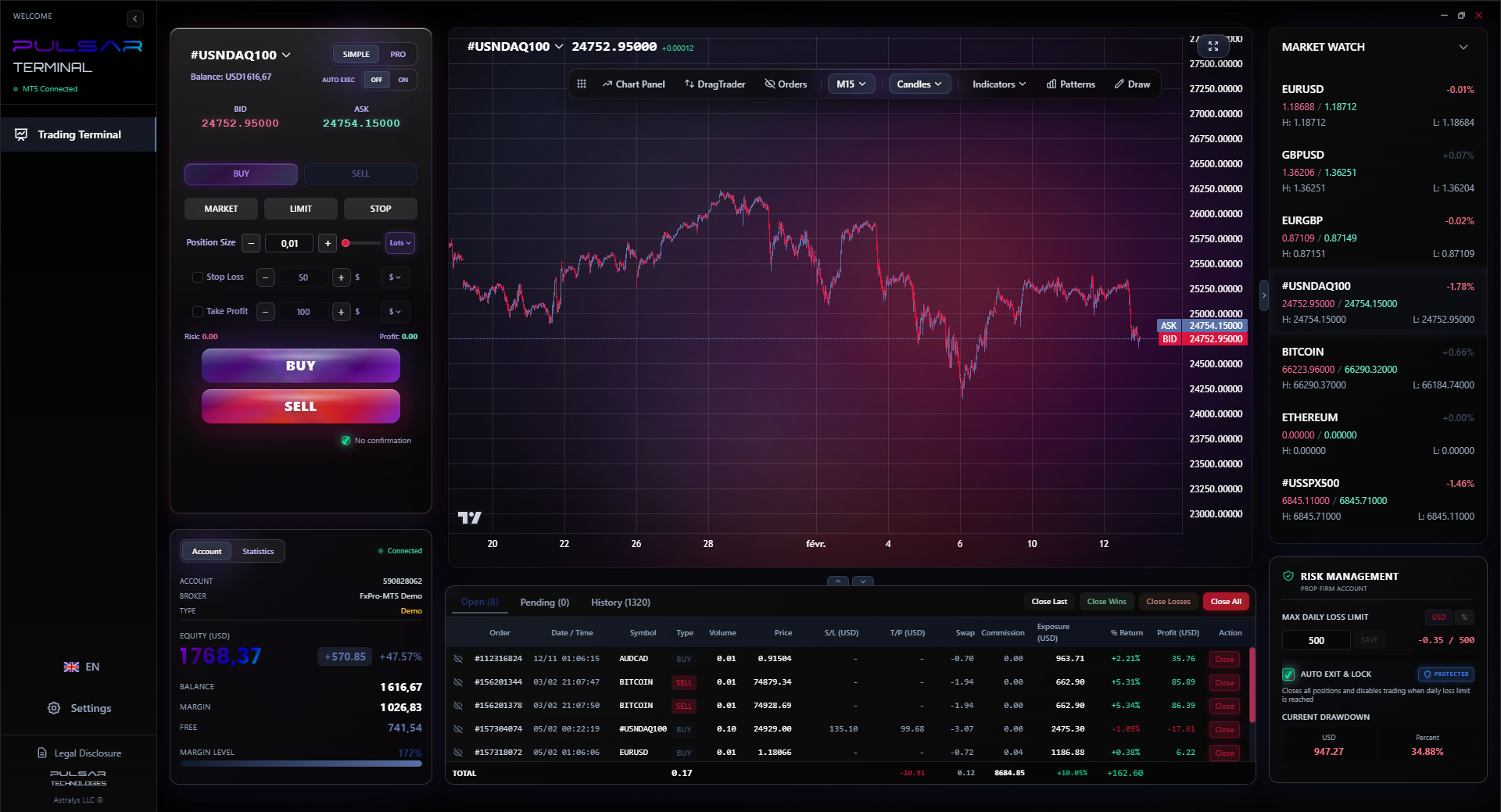
Managing multiple orders and stops during news chaos is nearly impossible manually, which is where a tool like Pulsar Terminal's drag-and-drop order system and automated trailing stops become a sanity-saver on MT5.
Pulsar Terminal
أداة MT5 الشاملة: أوامر سحب وإفلات، متعدد TP/SL، تريلينج ستوب، تداول الشبكة، Volume Profile وحماية البروب فيرم. يستخدمها أكثر من 1000 متداول يومياً.
“The initial spike is often just the first act. The real play is in the retracement.”
If you're relying on Twitter (X) or general news sites, you're last in line. The pros get the data milliseconds before it's public via direct newswires. We can't compete with that, but we can get close.
Primary Sources (Fastest):
- Forex Factory Calendar: The community standard. It's free, has a good mobile app, and color-codes impact (red for high). Set alerts.
- Investing.com Calendar: Another solid, free option. I often cross-reference between the two.
- Your Broker's Economic Calendar: Built into platforms like MT4/5. Convenient, but sometimes slower to update.
Newswires (For the Text):
- Reuters & Bloomberg: The gold standard. You won't have terminal access, but their free websites and apps are fast enough for retail. Follow their main finance Twitter accounts for headlines.
- Moneyweb & BusinessLive (SA): Essential for South African-specific data and ZAR-sensitive news like mining output, Eskom statements, or SARB commentary.
The Speed Test: I did an experiment. I timed the release of a SARB interest rate decision.
- Forex Factory Alert: 8 seconds after the scheduled time.
- Reuters Twitter Feed: 5 seconds.
- My broker's MT5 news feed: 12 seconds.
- A popular SA financial news site: 22 seconds.
That 14-second difference between Reuters and the SA site is an eternity in the market. It could be 20 pips of movement. Use the fastest sources you can.
Let's save you some money and heartache.
1. Trading Without a Plan: 'I'll just wing it when the news hits.' This is a recipe for an emotional, reactive disaster. Decide your strategy (straddle, fade, or flat) before the event. Write it down.
2. Adding to a Losing News Trade: The move is going against you. 'It's just a spike, it'll come back.' You average down. This is how you turn a 20-pip loss into a 200-pip blowout. News trends can be relentless. One loss is better than a margin call.
3. Chasing the Move: You see EUR/USD fly up 60 pips. You FOMO buy at the very top. It immediately reverses 40 pips. You're now holding a bag of regret. The initial spike is often the end of the most explosive move, not the beginning.
4. Ignoring Confluence: Trading a news event in isolation is dumb. Is the price reacting at a major weekly support/resistance level? Is it going with or against the overall daily trend? A bullish news spike hitting a massive resistance level is a sell signal, not a buy. Use your MACD indicator or RSI indicator on a higher timeframe for context.
5. Using Low-Liquidity Pairs or Times: Trading ZAR/JPY or TRY/JPY during major news is asking for 50-pip spreads. Stick to the major pairs during core London or New York session overlaps for the best liquidity.
My worst mistake? Trading the Swiss National Bank (SNB) event in 2015... from my phone, on 3G, while in a meeting. The connection stuttered at the crucial moment. By the time my order went through, the market was miles away. The lesson: stable internet and a dedicated environment are not optional.
“Sometimes, the most profitable trade you make is the one you don't take.”
Print this. Stick it next to your screen.
24 Hours Before:
- Check the calendar. Identify all high-impact (red) events for the next day.
- Decide which, if any, you will trade. Be selective. Not every red event is tradable.
- For your chosen event, identify key support/resistance levels on the 1H and 15M charts.
- Calculate your position size using your position size calculator with a reduced capital risk (e.g., 0.5% instead of 1%).
- Set price alerts 30 pips above and below the current price if you're using a straddle method.
30 Minutes Before:
- Close any unrelated positions you don't want exposed to volatility.
- Ensure you have no pending orders from previous sessions that could get accidentally triggered.
- Open your charts, news feed, and trading platform. Do a quick platform check.
- Breathe. Remind yourself of your plan.
5 Minutes Before to 15 Minutes After:
- Execute your pre-defined plan. No deviations.
- If you get filled, manage your trade according to your rules. If using a trailing stop, consider setting it wider than normal.
- If you're flat and watching, analyze the price action. Look for the consolidation. The real trading opportunity often comes 10-30 minutes after the initial madness, when a new short-term trend establishes itself.
Remember, the goal of trading forex breaking news isn't to catch every spike. It's to survive them with your capital intact so you can trade another day. Sometimes, the most profitable trade you make is the one you don't take.
FAQ
Q1What is the most important forex news for the South African Rand (ZAR)?
South African CPI inflation data, the SARB (South African Reserve Bank) Interest Rate Decision, National Budget Speech, and Eskom's load-shedding announcements. For global impact on ZAR pairs, US data (like NFP and CPI) and China's economic data (due to commodity demand) are critical.
Q2Can I use a demo account to practice news trading?
Absolutely, and you must. But be warned: demo accounts often don't replicate real-world slippage and spread widening accurately. Use demo to practice your entry/exit mechanics and emotional control, but expect worse fills in live trading. Most brokers like XM or Exness offer unlimited demo accounts for this purpose.
Q3How much money do I need to start trading news?
More than you think. Due to slippage and wider stops, you need a buffer. If a typical stop loss might be 50 pips, on news you may need 80. For a micro lot (1,000 units), that's an $8 risk instead of $5. Your account needs to withstand that. I wouldn't recommend it with less than $2,000 (roughly R37,000), and even that is tight. Proper capitalisation is your first defence.
Q4Is trading the 'rumour' before the 'news' a good strategy?
It's a terrible strategy for retail traders. You're gambling on unverified information. The 'sell the rumour, buy the fact' adage only works if you know what the rumour is before the market does - you don't. Trade the confirmed price action after the release, not the gossip before it.
Q5What's the best time of day to trade news in South Africa?
The most volatile overlaps are 3:00 PM - 5:00 PM SAST (when London is open and US data starts to release) and 9:00 PM - 11:00 PM SAST (during the US session peak). South African data is usually released around 11:00 AM SAST. Avoid trading major news outside of London or NY hours due to poor liquidity.
Q6Do all brokers allow news trading?
Most do, but some 'market maker' brokers may restrict guaranteed stop losses during high volatility or have stricter margin requirements. Always check your broker's policy on trading around news events. ECN/STP brokers like Pepperstone are generally more transparent and suitable for this style.
درس البروفيسور وينستون
النقاط الرئيسية:
- ✓Slippage is guaranteed, not a possibility.
- ✓Cut position size by 50% on news days.
- ✓The spread is part of your risk calculation.
- ✓Be flat 30 mins before major high-impact events.
ما مدى فائدة هذا المقال؟
انقر على نجمة للتقييم
رؤى التداول الأسبوعية
تحليلات واستراتيجيات أسبوعية مجانية. بدون رسائل مزعجة.
عن المؤلف
David van der Merwe
متداول الأسواق الناشئة
متداول مقيم في جوهانسبرغ مع 11 عاماً في عملات الأسواق الناشئة. متخصص في أزواج ZAR والتداول المنظم من FSCA وتحليل السوق الجنوب إفريقي.
التعليقات
تحذير من المخاطر
ينطوي تداول الأدوات المالية على مخاطر كبيرة وقد لا يكون مناسبًا لجميع المستثمرين. الأداء السابق لا يضمن النتائج المستقبلية. هذا المحتوى لأغراض تعليمية فقط ولا ينبغي اعتباره نصيحة استثمارية. قم دائمًا بإجراء بحثك الخاص قبل التداول.
قد يعجبك أيضًا

Cara Trading Forex Sukses: 7 Prinsip dari Trader Profesional
Cara trading forex sukses dengan 7 prinsip trader pro: manajemen modal, disiplin, journal trading, backtest. Data nyata, bukan janji profit palsu.
Jam Trading Forex Terbaik untuk Trader Indonesia: Panduan Lengkap dengan Tabel Waktu
Panduan jam trading forex untuk trader Indonesia. Tabel 4 sesi dunia, jam emas 20:00-00:00, sesi mana yang harus dihindari. Data akurat + tips dari trader berpengalaman.
Top 5 Sàn Forex Uy Tín Nhất 2026: Review Jujur dari Trader Indonesia
Top 5 sàn forex uy tín 2026 untuk trader Indonesia. Review jujur: spread, deposit, withdraw, dukungan lokal. Exness, XM, IC Markets & lebih.
احصل على Pulsar Terminal
جميع هذه الحاسبات مدمجة في Pulsar Terminal مع بيانات حية من حساب MT5 الخاص بك.
احصل على Pulsar Terminal