


I lost 1.8% of my account in a single, stupid afternoon back in 2017.

Olumide Adeyemi
رائد التداول في غرب أفريقيا ·  Nigeria
☕ 10 دقائق قراءة
ما ستتعلمه:
- 1What Exactly is a Forex Clock? (It's Not Just a Fancy Watch)
- 2Why This Clock is Non-Negotiable for Nigerian Traders
- 3Breaking Down Each Session: Who's Trading and What Moves
- 4Building Your Nigerian Trading Schedule Around the Clock
- 5Beyond the Clock: Tools and Indicators That Love Volatility
- 6Mistakes I've Made (So You Don't Have To)
- 7Choosing Your Forex Clock Tool
- 8The Bigger Picture: Weekly and Monthly Rhythms

I lost 1.8% of my account in a single, stupid afternoon back in 2017. I was trading GBP/USD from my flat in Lagos at 3 PM local time, convinced my RSI divergence signal was a sure thing. The price just... sat there. For hours. Then it spiked against me on what felt like zero news. The problem wasn't my analysis. It was my timing. I was trying to force a move during the dead zone between the London close and the New York afternoon lull. I was fighting the market's natural rhythm. That's the day I truly understood why a forex clock isn't just a widget on your screen, it's the foundation of your entire trading schedule.
Forget complex definitions. A forex clock is simply a tool that shows you which of the world's major financial centers are open for business right now. It visualizes the 24-hour forex market cycle, broken into four key sessions: Sydney, Tokyo, London, and New York. Your local time in Nigeria (WAT) is just one piece of the puzzle. The real power comes from seeing how your 9 AM stacks up against the opening bell in London (9 AM WAT) or the lunch hour in New York (2 PM WAT).
Most clocks use color-coding: green for 'open and active,' amber for 'open but winding down,' and red for 'closed.' Some advanced versions show overlap periods, which are pure gold for volatility. The core idea is to align your trading activity with the times when big money - the banks, funds, and institutional players - are at their desks moving price. Trading outside these times is like opening a shop in a deserted market; you might get a customer, but you're wasting your light bill.

Warning: Don't confuse a forex clock with an economic calendar. The clock tells you when liquidity and volatility are likely. The calendar tells you what news might cause it. You need both.
Our time zone puts us in a unique, and frankly, advantageous position if we use it right. Nigeria is on West Africa Time (WAT), which is GMT+1. This means the London session opens at 8 AM our time in winter (GMT) and 9 AM our time in summer (BST). That's a workable morning. The New York session opens at 1 PM or 2 PM WAT. This creates a critical overlap from roughly 1 PM to 4 PM WAT where both London and New York are active.
The Volatility Sweet Spot
That overlap period is your prime trading window. I've seen average true range (ATR) on major pairs like EUR/USD jump by 30-50% during this time compared to the Tokyo session. More movement means more opportunity, but also more risk. If you're a scalping strategy enthusiast, this is your playground. If you're a swing trader, this is often where you'll look for your daily entry signals.
Avoiding the Ghost Town Hours
Conversely, the period after the New York close (around 9-10 PM WAT) until the Tokyo open is often a liquidity desert. Spreads widen. A 1-pip spread on EUR/USD at 3 PM can balloon to 3 or 4 pips at 11 PM. Getting filled on your orders becomes trickier, and price can be pushed around more easily by smaller flows. I learned this the hard way trying to manage a stop-loss late at night; the slippage cost me an extra 5 pips. Use the forex clock to know when to step away. Your account and your sleep will thank you.

💡 نصيحة وينستون
Your first trade of the day shouldn't be before London's first coffee. Let the big players establish the tone.

“The London-NY overlap isn't just a time on a clock; it's where the market takes its steroids.”
Not all sessions are created equal. Each has its own personality, driven by the major financial institutions active at that time.
| Session | Opens (WAT) | Key Currencies | Personality & What to Trade |
|---|---|---|---|
| Sydney / Asia | ~10 PM - 11 PM | AUD, NZD, JPY | Often the slowest. Can set the tone. Watch for early breaks. AUD/USD, NZD/USD. |
| Tokyo | ~12 AM - 1 AM | JPY, AUD, NZD | Asian market focus. Good for JPY pairs (USD/JPY). Can be range-bound. |
| London | 8 AM / 9 AM WAT | EUR, GBP, CHF, USD | The big kahuna. Highest volume. Strong, sustained trends often begin here. Perfect for EUR/USD guide and GBP/USD. |
| New York | 1 PM / 2 PM WAT | USD, CAD, EUR, GBP | Reacts to London moves, driven by US data/news. High volatility at open. Great for USD pairs, XAU/USD guide (Gold). |
| London/NY Overlap | 1 PM - 4 PM WAT | ALL MAJORS | Peak volatility and liquidity. The best time for active trading. All major pairs in play. |
My most consistent profits have come from the first 2 hours of the London session. There's a palpable energy as European desks react to Asian price action and position for the day ahead. I once caught a 120-pip move on EUR/GBP between 9:30 AM and 11 AM WAT simply because I was watching the clock and ready when London momentum kicked in.

Here's a sample schedule based on a typical Lagos workday. This isn't gospel, but it's a framework that's saved my sanity.
- 5 AM - 8 AM WAT (Tokyo Session Late / Pre-London): Analysis time. Review charts, check the economic calendar, plan your day. The market is quiet - perfect for clear thinking without noise. Update your position size calculator for planned trades.
- 8 AM - 11 AM WAT (London Open): Primary Trading Window. Be at your screens. This is when major trends are most likely to initiate. Look for breakouts from the Asian range. I enter most of my daily positions here.
- 1 PM - 4 PM WAT (London/NY Overlap): High-Volatility Window. Monitor open trades, consider taking profits if targets are hit. Excellent for shorter-term trades if you missed the London move. Be extra cautious around major US news releases at 2 PM WAT.
- After 4 PM WAT (NY Afternoon): Wind down. Manage remaining trades, but avoid new entries. Liquidity starts to dry up. By 9 PM WAT, unless there's major news, you should probably be done.

Pro Tip: Use a broker with reliable execution during our peak hours. I've had good experiences with IC Markets review and Pepperstone review for their tight spreads during the London overlap. Avoid brokers known for frequent requotes when volatility spikes.
“Your forex clock tells you whether now is a good time to even be looking for a signal.”
A forex clock tells you when to trade. Your charts and indicators tell you how. Certain tools work brilliantly when paired with session awareness.
Volatility indicators are your best friends. The Average True Range (ATR) will show you empirically how much a pair typically moves during your chosen session. If the current price movement is below the session's average ATR, a big move might be brewing. Bollinger Bands also contract during quiet times (like late NY/sydney) and expand during active sessions - a band squeeze during the London open is a classic signal.
Momentum indicators like the RSI indicator and MACD indicator can give false signals in thin, choppy markets (like the late Tokyo session). But during the London overlap, a clear RSI divergence or MACD crossover carries much more weight because it's backed by real volume.
Here's a concrete example from last month: USD/CAD was coiling in a 20-pip range during the late Tokyo session. The ATR was compressed. At 8:05 AM WAT (just after London open), price broke above the 1-hour Bollinger Band with a corresponding rise on the MACD histogram. That was the session-powered signal. The resulting move was 65 pips over the next 3 hours.
💡 نصيحة وينستون
If your chart looks confused and choppy, check the clock. You're probably trading in a session transition or dead zone. Step away.

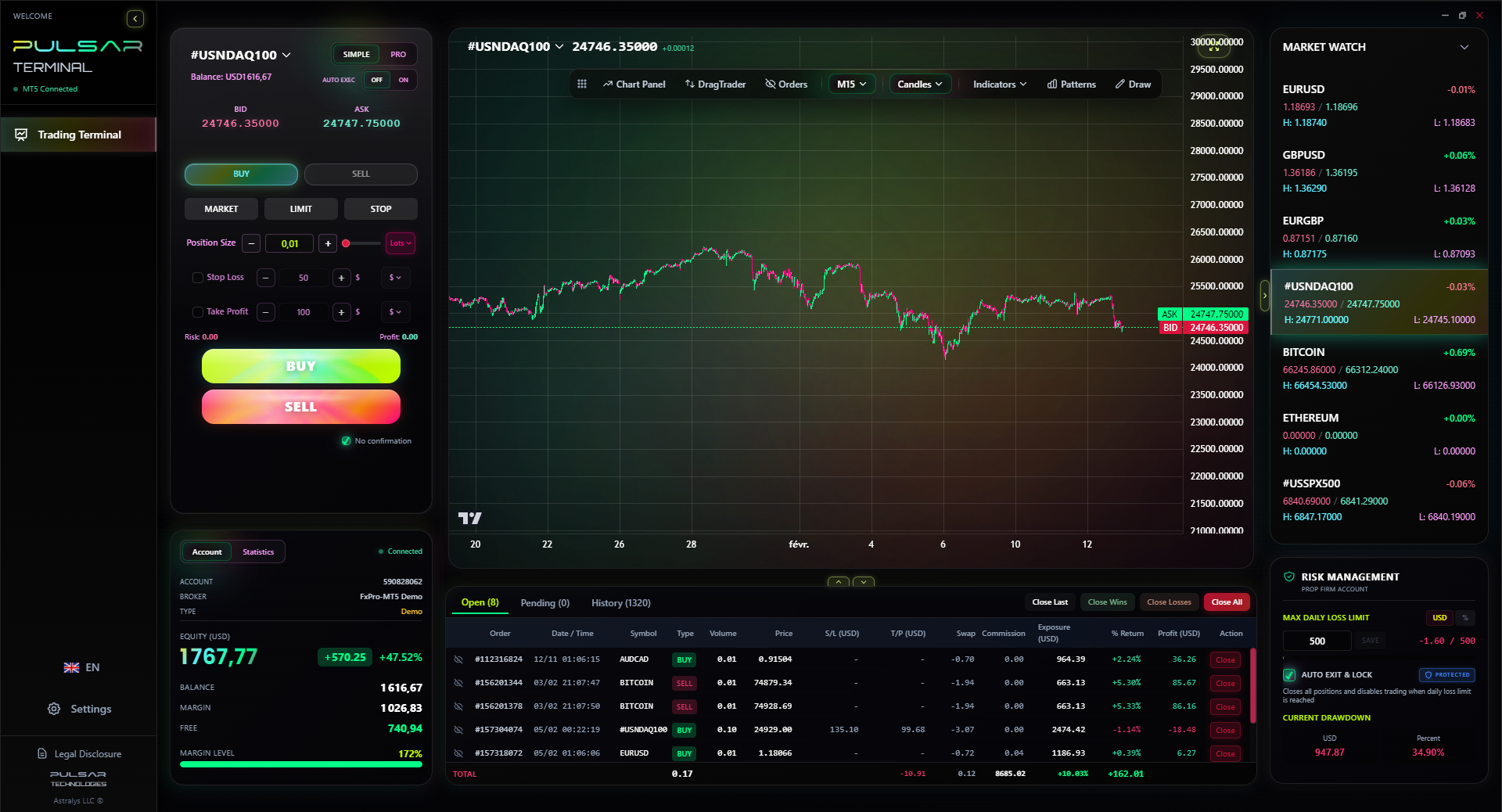
When you've used your forex clock to pinpoint a high-probability entry during the London session, tools like Pulsar Terminal let you manage the trade with precision, setting multiple take-profit levels and a trailing stop directly on your MT5 chart.
Pulsar Terminal
أداة MT5 الشاملة: أوامر سحب وإفلات، متعدد TP/SL، تريلينج ستوب، تداول الشبكة، Volume Profile وحماية البروب فيرم. يستخدمها أكثر من 1000 متداول يومياً.
Let's get real. Knowing about the clock and using it correctly are two different things.
Mistake 1: Trading the Sydney Open Like it's London. Early in my career, I'd see a nice little breakout on AUD/USD at 11 PM WAT and jump in with a full position. More often than not, it was a fakeout that reversed by the time Tokyo got going. The volume just wasn't there to sustain it. Now, if I trade the Sydney open, it's with a smaller position size.
Mistake 2: Ignoring the Friday Afternoon Dead Zone. The market starts shutting down early on Friday before the weekly close. The period after 4 PM WAT on a Friday is often devoid of real movement. I once held a trade over that weekend hoping for a Sunday gap in my favor. It gapped against me, triggered my stop, and rallied back. I was stopped out for a loss on pure weekend noise. Don't hold speculative positions over the weekend unless you have a very good reason.
Mistake 3: Not Accounting for Daylight Saving Time (DST). This is a huge one. London and New York switch to DST on different dates than we do (Nigeria doesn't observe DST). For half the year, London opens at 8 AM WAT. For the other half, it opens at 9 AM WAT. If your clock isn't updated, you'll be an hour early or late. I've missed entries because of this. Always double-check the session times in March and November.

Example: A 2-lot trade on EUR/USd with a 3-pip wider spread than usual (common in off-hours) costs you an extra $6 on entry and exit just in spread. That's $12 down before the price even moves. Over 100 trades, that's $1,200 vanished.

“The ultimate goal is to make the market's rhythm your own.”
You don't need to pay for this. Many free options are excellent.
Built-in Platform Tools: Most trading platforms like MetaTrader 4/5 have forex clock indicators you can download for free from their marketplaces. They're basic but get the job done.
Website Clocks: Sites like ForexFactory, Investing.com, and BabyPips have reliable session clocks on their homepage. I often keep ForexFactory open in a browser tab just for its clean clock and integrated economic calendar.
Mobile Apps: There are countless free forex clock apps. Find one that lets you set your home timezone to Lagos (GMT+1) and clearly shows the overlaps.
The best tool is the one you'll actually look at. Fancy animations don't matter. What matters is clear, accurate, real-time information on which markets are open right now. Test a few and stick with the one that fits your workflow.
Remember, the clock is a strategic guide, not a magic signal. It won't tell you whether to buy or sell. It tells you whether now is a good time to even be looking for a signal. Pair this strategic knowledge with a solid broker. For Nigerian traders, I've found Exness review and XM review offer local deposit options that make funding easier, which is just as important as timing your trades right.
💡 نصيحة وينستون
Treat the Friday after 4 PM WAT like a market holiday. Nothing good happens there. Close your screens and start your weekend.
Once you've mastered the daily clock, start observing the weekly clock. Mondays can be slow as the market finds its footing after the weekend. Volatility often picks up mid-week (Tuesday-Thursday). Fridays can be unpredictable - sometimes trending into the close, sometimes reversing as traders square up for the weekend.
There are also monthly flows to consider. Month-end and quarter-end often see portfolio rebalancing by large funds, which can cause specific, sometimes counter-intuitive, moves. The first Friday of every month is US Non-Farm Payrolls day - a guaranteed volatility bomb at 2 PM WAT.
Your forex clock is the micro view. Combine it with an awareness of these macro rhythms. For instance, entering a swing trading position on a Tuesday during the London session aligns multiple positive timing factors. Entering the same trade on a Friday afternoon during the dead zone aligns multiple negative ones. The choice is obvious when you see the whole picture.
The ultimate goal is to make the market's rhythm your own. Don't fight the quiet times. Use them to prepare. Then, when the clock hits your green light - when London comes online, when the overlap begins - that's when you switch from analyst to executor. That discipline, more than any indicator, is what separates consistent traders from the rest.
FAQ
Q1What is the best time to trade forex in Nigeria?
The absolute best time is the London and New York session overlap, from about 1 PM to 4 PM West Africa Time (WAT). This is when market liquidity and volatility peak, offering the best trading conditions for most strategies.
Q2Is it bad to trade forex at night in Nigeria?
Generally, yes. After the New York close (around 9-10 PM WAT), liquidity dries up significantly. Spreads widen, price action can be choppy and illiquid, and the risk of slippage increases. It's usually a time for analysis or sleep, not active trading.
Q3Do I need to pay for a good forex clock?
No. Many excellent and accurate forex clocks are available for free on major financial websites (like ForexFactory), as mobile apps, or as free indicators for your MetaTrader platform. Focus on clarity and accuracy, not fancy features.
Q4How does Daylight Saving Time (DST) affect my trading times in Nigeria?
This is critical. Nigeria does not observe DST, but London and New York do. For roughly half the year (e.g., late March to late October), London opens at 9 AM WAT instead of 8 AM, and New York opens at 2 PM WAT instead of 1 PM. Your forex clock must adjust for this.
Q5Can I make money trading only the Asian session from Nigeria?
It's possible, but harder. The Asian session (Tokyo) is typically lower volatility. You'd need to focus on specific currency pairs like AUD/JPY or USD/JPY and employ strategies suited to range-bound markets. The potential for large, trending moves is lower than during the London or overlap sessions.
Q6What's the biggest mistake traders make with the forex clock?
They ignore it and trade whenever they feel like it. Trying to force big moves during low-liquidity periods is a common account killer. The second biggest mistake is not adjusting for Daylight Saving Time changes, putting their entire schedule off by an hour.
درس البروفيسور وينستون
النقاط الرئيسية:
- ✓Trade the London/NY overlap (1-4 PM WAT) for peak action.
- ✓Avoid new trades after 9 PM WAT due to thin liquidity.
- ✓Always adjust your clock for foreign Daylight Saving Time.
- ✓Wider off-hour spreads can silently drain $1,200 per 100 trades.
ما مدى فائدة هذا المقال؟
انقر على نجمة للتقييم
رؤى التداول الأسبوعية
تحليلات واستراتيجيات أسبوعية مجانية. بدون رسائل مزعجة.
عن المؤلف
Olumide Adeyemi
رائد التداول في غرب أفريقيا
أحد أنشط معلمي تداول الفوركس في نيجيريا. 8 سنوات من الخبرة في التداول من لاغوس. متخصص في استراتيجيات رأس المال المنخفض وتحديات شركات البروب للمتداولين الأفارقة.
التعليقات
تحذير من المخاطر
ينطوي تداول الأدوات المالية على مخاطر كبيرة وقد لا يكون مناسبًا لجميع المستثمرين. الأداء السابق لا يضمن النتائج المستقبلية. هذا المحتوى لأغراض تعليمية فقط ولا ينبغي اعتباره نصيحة استثمارية. قم دائمًا بإجراء بحثك الخاص قبل التداول.
قد يعجبك أيضًا

Cara Trading Forex Sukses: 7 Prinsip dari Trader Profesional
Cara trading forex sukses dengan 7 prinsip trader pro: manajemen modal, disiplin, journal trading, backtest. Data nyata, bukan janji profit palsu.
Jam Trading Forex Terbaik untuk Trader Indonesia: Panduan Lengkap dengan Tabel Waktu
Panduan jam trading forex untuk trader Indonesia. Tabel 4 sesi dunia, jam emas 20:00-00:00, sesi mana yang harus dihindari. Data akurat + tips dari trader berpengalaman.
Top 5 Sàn Forex Uy Tín Nhất 2026: Review Jujur dari Trader Indonesia
Top 5 sàn forex uy tín 2026 untuk trader Indonesia. Review jujur: spread, deposit, withdraw, dukungan lokal. Exness, XM, IC Markets & lebih.
احصل على Pulsar Terminal
جميع هذه الحاسبات مدمجة في Pulsar Terminal مع بيانات حية من حساب MT5 الخاص بك.
احصل على Pulsar Terminal