


You're looking at the Forex.com minimum deposit of $100 and thinking, 'That's not bad, I can start with that.' Hold on.

David van der Merwe
متداول الأسواق الناشئة ·  South Africa
☕ 10 دقائق قراءة
ما ستتعلمه:
- 1The $100 Dollar Trap: What You're Really Signing Up For
- 2The Real Costs Beyond the Deposit
- 3FSCA Regulation & What It Actually Means For You
- 4Funding Your Account From SA: The Practical Guide
- 5Why 1:30 use is NOT Your Friend (At First)
- 6Which Account Type Should You Actually Choose?
- 7The SA Market Context in 2026: What's Changed
- 8Final Verdict: Is It Worth It For a South African?
You're looking at the Forex.com minimum deposit of $100 and thinking, 'That's not bad, I can start with that.' Hold on. I've been trading from South Africa for over a decade, and I can tell you that number is a trap for the unprepared. The real cost of starting isn't the deposit. It's understanding the currency conversion fees, the FSCA's new ODP rules, and why a $100 account is almost guaranteed to blow up. Let's talk about what that minimum deposit actually gets you, and what it really costs to trade properly from SA.
Forex.com says $100. That's about R1600. Sounds accessible, right? That's the point. It's a marketing tool designed to get you in the door with minimal friction. I made this mistake in 2015 with another broker. I deposited R1500, thrilled I could 'start trading.' Within two weeks, it was gone. Not because of one bad trade, but because the account size forced me into terrible habits.
With a $100 account and 1:30 use (the max Forex.com offers), your buying power is $3,000. That means a 3.3% move against you wipes you out. On a volatile pair like GBP/ZAR, that can happen before lunch. You're trading on a knife's edge, which pressures you into cutting winners short and letting losers run. It's psychological torture.

Warning: A $100 account isn't a trading account. It's a very expensive demo account. You will pay tuition to the market with that money.
Forex.com themselves know this. Their own recommended minimums tell the real story: $1,000 for a Standard account, $2,500 for a Commission account, $25,000 for their pro offering. The $100 minimum is the bare technical minimum to open the account, not a recommendation for capital adequacy. For proper position sizing and sane risk management, you need at least 10x that. My rule now? Never fund a live account with less than I'm willing to lose on a single weekend away. If R1600 is a meaningful sum to you, keep it in your pocket.

💡 نصيحة وينستون
The minimum deposit is the broker's price of admission. Your required trading capital is what you need to survive the first six months of real market volatility. They are never the same number.
The Hidden 0.5% Bite
This is the killer for South Africans. Forex.com does NOT accept ZAR accounts. You must fund in USD, EUR, or GBP. If you deposit from your South African bank account in Rand, they slap a 0.5% currency conversion fee on the transaction. Deposit R10,000? That's R50 gone before you place a trade. Withdraw R10,000? Another R50. This fee is often buried in the terms. It makes small, frequent deposits a terrible idea.
Spreads & Commissions: The Two Models
Forex.com has two main account structures, and your choice drastically affects your cost-per-trade.
| Account Type | Spread on EUR/USD | Commission | Best For... |
|---|---|---|---|
| Standard | From 0.7 pips | None | Beginners, low-frequency traders |
| Commission (Raw) | From 0.0 pips | $5 per 100k lot (round turn) | High-volume traders, scalpers |
I started on the Standard account. Seemed simpler. But on a quiet day, I'd watch the spread on EUR/USD sit at 1.2 pips. That's $12 cost on a standard lot before the trade even moves. I switched to the Raw account for my scalping strategy. The commission is clear: $5 to open, $5 to close. But with the spread often at 0.1, my total cost was $10.20, saving me nearly $2 per round turn. On 20 trades a week, that adds up.
The Platform Choice
You can use their Advanced Platform, MT4, or MT5. I use MT5 for the better backtesting and hedging capabilities. No extra cost, but it's a critical choice. If you're planning to use advanced tools or grid trading techniques, MT5 is the way to go.
“A $100 account isn't a trading account. It's a very expensive demo account.”
Here's the crucial update for 2026: Forex.com is now listed as FSCA regulated. A few years back, this wasn't the case. This matters. The FSCA isn't just a rubber stamp. Their new Over-the-Counter Derivatives Provider (ODP) regime is changing the game.
What does ODP regulation mean for you, the trader?
- Stricter Broker Capital Requirements: Forex.com has to hold more capital locally. This makes a broker collapse (like the old Sharekhan saga) less likely.
- Formalized Negative Balance Protection: They can't chase you for more money if your account goes negative. This was sometimes 'offered' as a courtesy before. Now it's a rule.
- Clear Risk Warnings & use Caps: The days of shady brokers offering 1:1000 use to SA clients are fading. Forex.com's 1:30 use is in line with this stricter environment.
Is it perfect? No. But it means when you send your money to Forex.com's FSCA-regulated entity, it's being handled under South African rules, with recourse through the South African ombud. Your funds are also segregated under CIMA rules. This is non-negotiable for me now. I only trade with brokers who have clear, top-tier regulation. It's the first filter. You can read our deep dive on their operations in our full Forex.com review.
💡 نصيحة وينستون
If you're calculating whether you can afford the 0.5% conversion fee, you can't afford to trade. Fees are just the cost of doing business. If they hurt, your position size is too big or your capital is too small.
You can't just EFT Rands. Here’s your playbook.
Step 1: Choose Your Base Currency. I use USD. Most commodities and major pairs are quoted in it. It simplifies my mental math.
Step 2: Use the Right Allowance. You have two options:
- Single Discretionary Allowance (SDA): Move up to R1 million per year offshore. No tax clearance needed. Use this first.
- Foreign Investment Allowance (FIA): For amounts over R1m, up to R10 million. You need a Tax Compliance Status (TCS) pin from SARS.
Step 3: Pick Your Payment Method.
- Credit/Debit Card (Visa/Mastercard): Fastest. Funds are usually available in minutes. The 0.5% fee applies. Good for initial deposits.
- Bank Wire: Slower (2-5 days), but better for larger amounts. Your local bank will charge an international transfer fee (around R200-R500). You still pay Forex.com's 0.5% conversion fee.
- E-Wallets (PayPal, Skrill, Neteller): Fast. Fees vary. Check if your e-wallet offers better ZAR to USD rates than your bank.

Pro Tip: Deposit in larger, less frequent chunks. That 0.5% fee hurts less on R50,000 once than on R5,000 ten times. Treat your trading account like a business capital account, not a wallet.
Withdrawals work the same way, in reverse. No fee from Forex.com, but your bank might take a slice. Plan for 2-7 days for the money to land back in your SA account.
“The 1:30 use is a ceiling, not a target. Start by pretending your maximum is 1:5.”
Forex.com offers up to 1:30 use. To a new trader, that sounds like a superpower. 'I can control $30,000 with just $1,000!' Let me be blunt: this is how you lose your $100 minimum deposit in under an hour.
use amplifies everything: your gains, and your losses. Here's a real example from my early days. I deposited $1,000. I saw a 'sure thing' setup on EUR/USD. With 1:30 use, I bought 3 mini lots (30,000 units). A move of just 33 pips against me would trigger a margin call. The trade went against me by 25 pips. I was down $75. Panic set in. I moved my stop loss further away, breaking every rule. It reversed and hit my new, wider stop. Loss: $210. 21% of my account gone in one emotionally-charged trade.
Contrast that with my approach now. On a $10,000 account, I might risk 1% ($100) on a trade. For a EUR/USD trade with a 20-pip stop, that allows me to trade 0.5 lots. That's using only 1:5 use on that position ($50,000 controlled / $10,000 capital). The use is there, but I'm using a fraction of it. It lets me breathe. It lets the trade work.
Start by pretending your maximum use is 1:5. Use a position size calculator religiously. Only when you're consistently profitable for 6 months should you even think about nudging that up. The 1:30 is a ceiling, not a target.
💡 نصيحة وينستون
use is a multiplier for your IQ. If you're a genius, it makes you a billionaire. If you're average, it makes you bankrupt faster. Most of us are average.
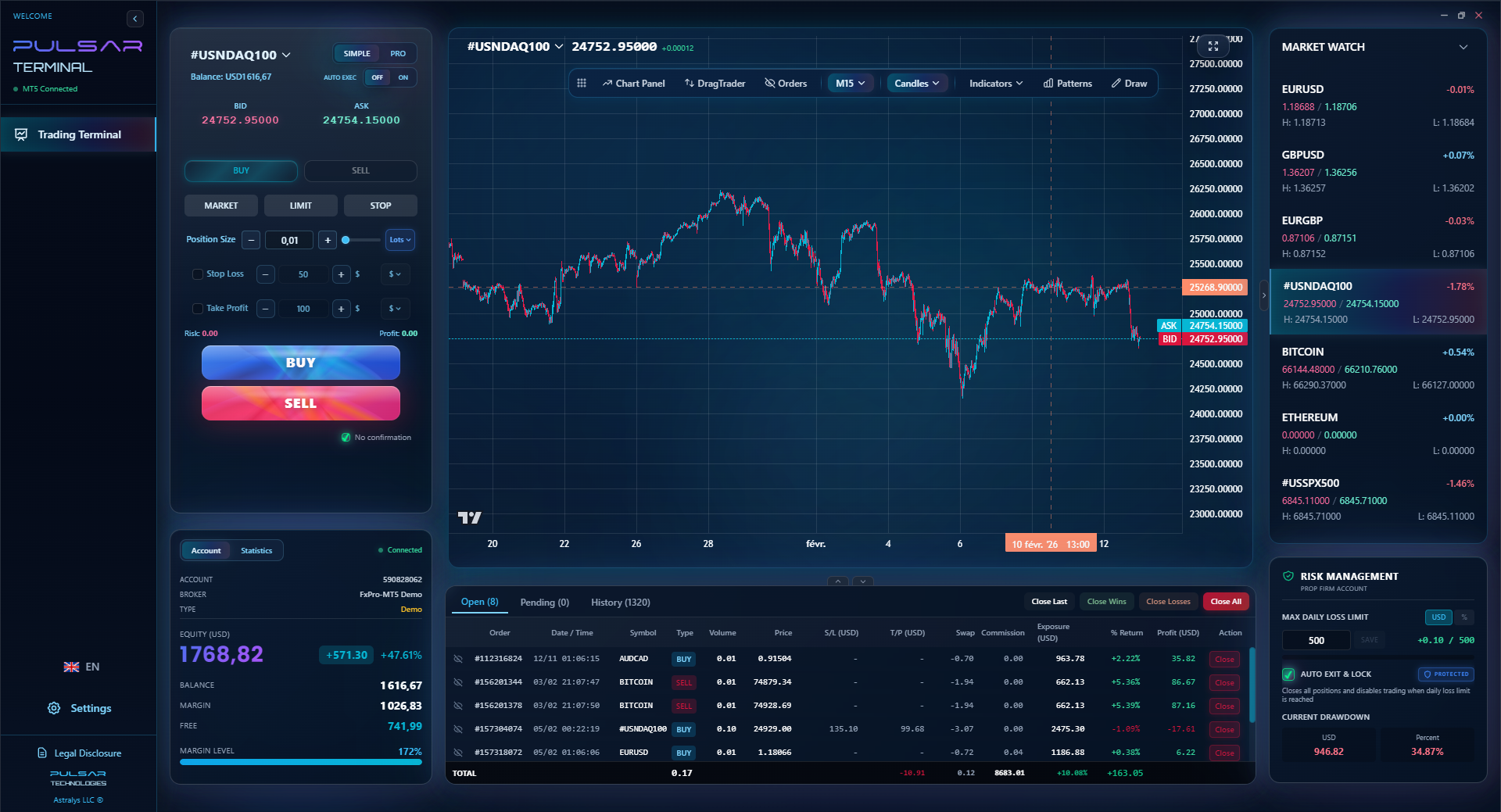
Managing risk with proper stop losses and take profits is non-negotiable, and a tool like Pulsar Terminal lets you set multi-level TP/SL and trailing stops directly on your MT5 charts with a single drag.
Pulsar Terminal
أداة MT5 الشاملة: أوامر سحب وإفلات، متعدد TP/SL، تريلينج ستوب، تداول الشبكة، Volume Profile وحماية البروب فيرم. يستخدمها أكثر من 1000 متداول يومياً.
Don't just click 'Standard' because it's first. Your trading style dictates this.
Choose the STANDARD Account if:
- You're a complete beginner placing fewer than 10 trades a week.
- You're trading longer-term swing trades where the spread is a smaller percentage of your target.
- The thought of paying a commission psychologically bothers you (even if it's cheaper overall).
Choose the COMMISSION (Raw Spread) Account if:
- You trade frequently (scalping or day trading).
- You trade around high-impact news events where spreads on Standard accounts can widen massively.
- You understand that a lower spread + fixed commission often results in lower total costs.
- You trade instruments like XAU/USD where the raw spread model is almost always cheaper.
My Path: I began on Standard. After 3 months and about 100 trades, I analyzed my statements. The average spread cost on EUR/USD was 1.1 pips ($11). I simulated those trades with Raw spreads (0.1 avg) + $10 commission. The Raw account would have saved me 8%. I switched and never looked back.
There's also the MT4/MT5 specific accounts. They're commission-free with variable spreads, similar to the Standard account but locked to the MetaTrader platform. Pick these if you're a dedicated MetaTrader user who doesn't want the broker's proprietary platform.
“The real investment isn't your deposit. It's in your education, your risk management, and your emotional control.”
Trading from South Africa isn't what it was in 2020. The landscape has evolved, and your strategy should too.
1. Commodities are King. The Rand is a commodity currency. In 2026, you can't just look at USD strength. You must watch gold, platinum, and coal prices. I have a separate watchlist for commodity CFDs. A major move in gold often precedes volatility in USD/ZAR. I once caught a 400-pip move in USD/ZAR by seeing a breakdown in iron ore prices first. It's connected.
2. Crypto is Getting Real. The FSCA is regulating crypto exchanges. This legitimacy is pushing more crypto CFDs onto platforms. The volatility is insane. If you trade these, size tiny. A 10% move in Bitcoin is normal. That will vaporize an over-leveraged account.
3. Tech is Everything. 'Digital payment networks expanded 45% in 2025.' This means faster, cheaper funding and withdrawal options are coming. E-wallets are becoming the norm. The old 5-day bank wire is dying.
4. MT5 is the Future. While MT4 is still everywhere, the smart money is on MT5 for its superior backtesting, economic calendar, and depth of market. If you're learning a platform fresh, learn MT5. Most new brokers, even big ones like IC Markets and Pepperstone, are pushing clients towards it. The tools for advanced order types and analysis are just better.
So, back to the original question. Is the Forex.com minimum deposit of $100 a good deal for a South African trader in 2026?
Yes, if:
- You understand the $100 is a technicality, and you're depositing at least $1,000 (R16k+) for serious trading.
- You're comfortable with the 0.5% ZAR conversion fee and will fund strategically.
- You value the security of FSCA + global regulation (CIMA, FCA).
- You're a trader who benefits from their specific account models (especially the Raw spread account for active trading).
No, if:
- You literally only have $100 to trade with. You will lose it.
- You want a ZAR-denominated account to avoid conversion fees (look at local brokers, but know their spreads are often wider).
- You need ultra-high use above 1:30 (but you shouldn't).
- You want the absolute lowest possible spreads on earth (some ECN-focused brokers like IC Markets might be fractionally cheaper).
My take? Forex.com is a solid, reputable broker for South Africans. Their $100 minimum deposit is a low barrier to entry, but that's all it is - an entry point. The real investment is in your education, your risk management, and your emotional control. Fund your account with enough capital to trade without fear, choose the right account type for your style, and always, always respect the use. That's how you move from being a customer paying the spread to being a trader.
FAQ
Q1What is the exact minimum deposit for Forex.com in South African Rands?
Forex.com's minimum deposit is $100 USD. As of mid-2025, this was approximately R1600 ZAR, but the exchange rate fluctuates. You cannot deposit in Rands directly; you must fund in USD, EUR, or GBP, and a 0.5% currency conversion fee will apply to your ZAR deposit.
Q2Does Forex.com accept South African Rand (ZAR) deposits?
No. Forex.com does not offer ZAR-denominated trading accounts or accept ZAR as a base currency. South African clients must deposit in USD, EUR, or GBP. When you transfer Rands from your SA bank account, Forex.com converts them at their rate and charges a 0.5% fee on the transaction.
Q3Is Forex.com regulated by the FSCA in South Africa?
Yes. As of 2025/2026, Forex.com is listed as being regulated by the Financial Sector Conduct Authority (FSCA). This is a significant development, meaning they operate under South Africa's ODP regulatory regime, which includes strict client fund segregation, negative balance protection, and use limits for your protection.
Q4What's better for a beginner: the Standard or Commission account?
For a true beginner placing very few trades, the Standard (commission-free) account is simpler to understand. You only see the spread. However, once you start trading more actively, the Commission (Raw Spread) account is often cheaper overall. The spread is near zero, but you pay a $5 commission per 100k lot. Do the math based on your trade frequency.
Q5How long do withdrawals to a South African bank account take?
Typically 2 to 7 business days. Forex.com doesn't charge a withdrawal fee, but your South African bank may charge an incoming international transfer fee. The funds will be converted from your account's base currency (USD/EUR/GBP) back to ZAR by the banking network.
Q6Can I use MT5 with Forex.com in South Africa?
Absolutely. Forex.com offers full MetaTrader 5 (MT5) support. You can open an MT5-specific account, which is commission-free with variable spreads, similar to their Standard account. MT5 is the more modern platform with better tools for advanced analysis and backtesting.
Q7Is 1:30 use enough for forex trading?
It's more than enough. In fact, it's a protective limit. New traders often mistake high use for opportunity, but it's the primary cause of rapid account blow-ups. Professional traders rarely use the maximum use available. With sound risk management, you should be using a fraction of 1:30. Start by thinking in terms of 1:5 or 1:10.
درس البروفيسور وينستون
النقاط الرئيسية:
- ✓The real minimum is 10x the advertised deposit.
- ✓The 0.5% ZAR conversion fee makes small deposits inefficient.
- ✓FSCA ODP regulation in 2026 provides critical local protection.
- ✓Choose Raw account if you make more than 10 trades a week.
- ✓1:30 use is a risk limiter, not a profit tool.
ما مدى فائدة هذا المقال؟
انقر على نجمة للتقييم
رؤى التداول الأسبوعية
تحليلات واستراتيجيات أسبوعية مجانية. بدون رسائل مزعجة.
عن المؤلف
David van der Merwe
متداول الأسواق الناشئة
متداول مقيم في جوهانسبرغ مع 11 عاماً في عملات الأسواق الناشئة. متخصص في أزواج ZAR والتداول المنظم من FSCA وتحليل السوق الجنوب إفريقي.
التعليقات
تحذير من المخاطر
ينطوي تداول الأدوات المالية على مخاطر كبيرة وقد لا يكون مناسبًا لجميع المستثمرين. الأداء السابق لا يضمن النتائج المستقبلية. هذا المحتوى لأغراض تعليمية فقط ولا ينبغي اعتباره نصيحة استثمارية. قم دائمًا بإجراء بحثك الخاص قبل التداول.
قد يعجبك أيضًا

Cara Trading Forex Sukses: 7 Prinsip dari Trader Profesional
Cara trading forex sukses dengan 7 prinsip trader pro: manajemen modal, disiplin, journal trading, backtest. Data nyata, bukan janji profit palsu.
Jam Trading Forex Terbaik untuk Trader Indonesia: Panduan Lengkap dengan Tabel Waktu
Panduan jam trading forex untuk trader Indonesia. Tabel 4 sesi dunia, jam emas 20:00-00:00, sesi mana yang harus dihindari. Data akurat + tips dari trader berpengalaman.
Top 5 Sàn Forex Uy Tín Nhất 2026: Review Jujur dari Trader Indonesia
Top 5 sàn forex uy tín 2026 untuk trader Indonesia. Review jujur: spread, deposit, withdraw, dukungan lokal. Exness, XM, IC Markets & lebih.
احصل على Pulsar Terminal
جميع هذه الحاسبات مدمجة في Pulsar Terminal مع بيانات حية من حساب MT5 الخاص بك.
احصل على Pulsar Terminal