


You're probably wondering which forex currency trading strategies are worth your time and which are just fancy ways to lose money.

Sarah Collins
استراتيجي تداول ·  Australia
☕ 11 دقائق قراءة
ما ستتعلمه:
- 1How ASIC Rules Change Your Strategy (Whether You Like It or Not)
- 2The Real Costs of Trading in Australia (It's Not Just the Spread)
- 3AUD Pairs Are a Different Beast (Trade Them Like One)
- 4Three Strategies That Survive the ASIC Test (And One That Doesn't)
- 5Tools You Actually Need vs. Distractions
- 6Putting It All Together: A Sample Week in the Trenches
- 7The Final Word: It's a Marathon, Not a Sprint
You're probably wondering which forex currency trading strategies are worth your time and which are just fancy ways to lose money. Good question. After 12 years and more blown accounts than I care to admit, I can tell you most of what's out there is garbage, especially if you're trading from Australia. Our market's different. ASIC's rules change the game, and trading the AUD isn't like playing with the Euro or Yen. This isn't theory. This is what I've done, what's cost me, and what's finally put money in my pocket consistently.
Forget what you read on international forums. Trading forex in Australia means playing by ASIC's book, and brother, it's a thick one. The 30:1 use cap on majors (like EUR/USD) that kicked in back in 2021 wasn't a suggestion. It was a brick wall for a lot of the high-octane, margin-heavy strategies that used to be popular.
I learned this the hard way. Back in 2019, I was running a aggressive scalping strategy on GBP/JPY with 100:1 use. A few quick pips, in and out. When the rules changed, my entire risk model exploded. The position size I was used to taking suddenly required three times the margin. My "small" 2% risk per trade became a 6% risk if I kept the same lot size. I didn't adjust fast enough and gave back a solid month's profits in a week.

Warning: If you're looking at a broker offering you 500:1 on AUD/USD, they are NOT regulated by ASIC. You're likely dealing with an offshore entity, and your money does not have the same protections. It's a huge red flag.
The positive? It forced discipline. You can't rely on crazy use to bail out a bad entry. Your analysis has to be sharper. The negative balance protection is a lifesaver for retail traders, but it also means brokers are ultra-cautious. Expect margin calls if your equity dips too close to your used margin. You need to understand margin call mechanics inside out.
Here’s the practical impact on your forex currency trading strategies:
| High-use Strategy (Pre-ASIC) | Post-ASIC Reality Check |
|---|---|
| 100:1 use on EUR/USD | Max 30:1 use. Requires 3.3x more margin for same position. |
| Martingale/Grid systems | Much harder to execute. Lower use means you need deeper pockets to average down. |
| Ultra-short term scalping | Still possible, but your cost (spread + commission) as a percentage of your target profit is now higher. |
| Swing trading | less affected. The lower use aligns better with holding trades over days. |
The segregated accounts rule is your best friend. Knowing your cash is sitting in a big-four bank and not funding the broker's office party lets you sleep at night. Use a position size calculator religiously, and set it for a max of 30:1 use to keep it real.

💡 نصيحة وينستون
Your first goal isn't to make money. It's to not lose money. Nail down rock-solid risk management for six months. The profits will follow the process.
“The 30:1 use cap isn't a restriction, it's a forced education in proper risk management.”
Everyone looks at the spread. That's rookie hour. The real cost of trading forex here is a three-headed beast: spreads, commissions, and the sneakiest one of all, currency conversion on your AUD account.
Let's talk numbers. On a good ECN account like Pepperstone's Razor, you might get EUR/USD at 0.12 pips. Sounds cheap, right? But they charge a commission per lot. For a standard lot (100,000 units), that's AUD $7 round turn. So your true cost is the spread (0.12 pips = $1.20) plus $7, totaling $8.20. If your target is only 10 pips ($100), you've just spent over 8% of your potential profit on costs before you even start.

Example: Trading AUD/USD with a 1.0 pip spread on a standard lot.
- Spread Cost: 1.0 pip = $10
- Commission (if applicable): Varies, let's say $5 per side ($10 round turn)
- Total Entry/Exit Cost: $20
- To break even on a 1-lot trade, price needs to move 2 pips in your favor JUST to cover costs.
Now, the silent killer: funding your account in AUD but trading USD pairs. Your broker does a conversion, often at a marked-up rate. I funded with AUD 10,000 once to trade USD/CHF. The broker's conversion rate skimmed about 0.7% off the top compared to the interbank rate I saw on my charts. That's $70 gone before I placed a single trade.
How this murders bad strategies: A strategy that aims for 5-pip scalps is mathematically doomed with these costs. A strategy that trades too frequently will see its profits evaporate as fees compound. This is why understanding the spread definition and the full fee schedule of your broker is non-negotiable. I made the switch from a "commission-free" broker with wide spreads to a true ECN broker like IC Markets and my profitability on swing trading setups improved immediately because my break-even point was closer.
“Trading the AUD successfully means respecting its fundamentals; it's a proxy for iron ore and Chinese demand.”
Trading AUD/USD, AUD/JPY, or EUR/AUD isn't just trading another pair. You're trading the Australian economy, Chinese commodity demand, and risk sentiment all at once. It's volatile, liquid, and frankly, where I've made and lost the most money.
The Commodity Link
AUD is a proxy for iron ore and coal. When China's economy hiccups, the AUD coughs. I got caught long AUD/JPY in early 2022 when China went into another lockdown. The pair dropped 500 pips in a week. My stop-loss was 200 pips away. Lesson: news matters more for AUD pairs. You need to watch more than just charts.
The Session Overlap
The sweet spot for AUD pairs is the Asian session overlap with London. That's when liquidity is highest for AUD/JPY and AUD/USD. Trying to trade them in the dead of the Sydney afternoon is like watching paint dry, with wider spreads to boot.
A Strategy That Works: Breakout Retests
Because of its commodity-driven nature, AUD/USD tends to make big, clean moves followed by prolonged trends. One of my most reliable forex currency trading strategies for it is the breakout retest.
I wait for a clear break of a key weekly or daily level (like 0.6700 or 0.7000 on AUD/USD). Then, I watch for the price to come back and "test" that broken level as new support/resistance. If it holds, I enter. In March 2023, AUD/USD broke below 0.6700. It rallied back to 0.6698 over two days, kissed the level, and fell. I entered short at 0.6695. Took half off at 150 pips down, let the rest run. That single trade paid for my quarterly trading costs.
It's not glamorous. It requires patience. But trading the AUD successfully means respecting its fundamentals. For a deep dive on another commodity-linked instrument, see my guide on XAU/USD guide, which shares some similar volatility traits.
“Trading the AUD successfully means respecting its fundamentals; it's a proxy for iron ore and Chinese demand.”
After the use cuts, a lot of strategies died. Here are three that adapted and one that's a guaranteed path to the poorhouse.
1. Price Action Swing Trading This is my bread and butter now. Lower use means you're not pressured to chase tiny moves. You can hold for 100-300 pip swings over several days. The key is identifying key support/resistance on the 4Hr and Daily charts. I use simple pin bars, engulfing candles, and false breakouts at these levels. The MACD indicator on the 4Hr helps confirm momentum. Because you're trading less frequently, costs are manageable. This aligns perfectly with ASIC's philosophy of reducing reckless, high-frequency speculation.
2. End-of-Day (EOD) Trend Following You check the charts once a day, after the London/NY close. Place your orders for the next day based on the clear daily trend. Use a trailing stop. The 30:1 use is plenty for this. It's boring. It's slow. But it works because it removes emotion. I turned a $5,000 account into $7,200 over 6 months doing just this on EUR/USD guide, adding only 1-2 positions a month.
3. Fundamental Catalyst Trading This is for AUD pairs around major data (CPI, Employment, RBA decisions). You don't predict the number. You trade the reaction. The strategy is simple: wait for the release, let the initial spike and volatility settle (about 15-30 minutes), then trade in the direction of the established new momentum. Requires tight stops and quick hands, but the moves can be substantial. I never risk more than 1% on these.
The Strategy That's Dead: Martingale/Grid Systems With capped use, you simply don't have the margin to keep averaging down on a losing position. A series of small losses will quickly eat your usable margin, leading to a margin call on the entire grid. I watched a friend try this on Exness review (an offshore broker with high use) and then try to replicate it here. He blew his ASIC-regulated account in two days. Don't be him.
💡 نصيحة وينستون
If you can't explain your trade setup in one simple sentence ('I'm selling because price rejected the weekly resistance'), you shouldn't be in the trade. Complexity is the enemy of execution.
“Most trading tools are distractions designed to make you think there's a secret. The secret is discipline.”
The trading software market is full of shiny objects. Most are distractions designed to make you think there's a secret. Here's my stripped-down kit.
Need:
- A Reliable MT5 Platform: It's the industry standard for a reason. Everything connects to it.
- A Good Charting Package: I use TradingView for analysis, but execute on MT5.
- Two or Three Trusted Indicators: I use the RSI indicator (for divergence) and Volume Profile. That's it. More than three and you're just creating confusion.
- An Economic Calendar: Know when the RBA speaks, and when US NFP is due.
Don't Need:
- Expensive "Signal" Services: If their system was so good, why are they selling it for $99/month instead of trading it?
- Every New Indicator: The 1000th moving average variant won't make you a better trader.
- Multiple Monitors Full of Noise: I trade from one laptop screen. More screens just mean more ways to talk yourself out of a good trade.
The real tool is your trading journal. Not a fancy app, a simple spreadsheet. Entry price, exit price, reason for entry, emotion, P/L. I review mine every Sunday. It's the most painful and productive hour of my week.

Pro Tip: Your broker's platform matters. Test their order execution during volatile times. Slippage on stop-losses can kill a good risk/reward. I've found Pepperstone review and XM review to be consistently reliable in this regard, which is why I keep accounts with both.
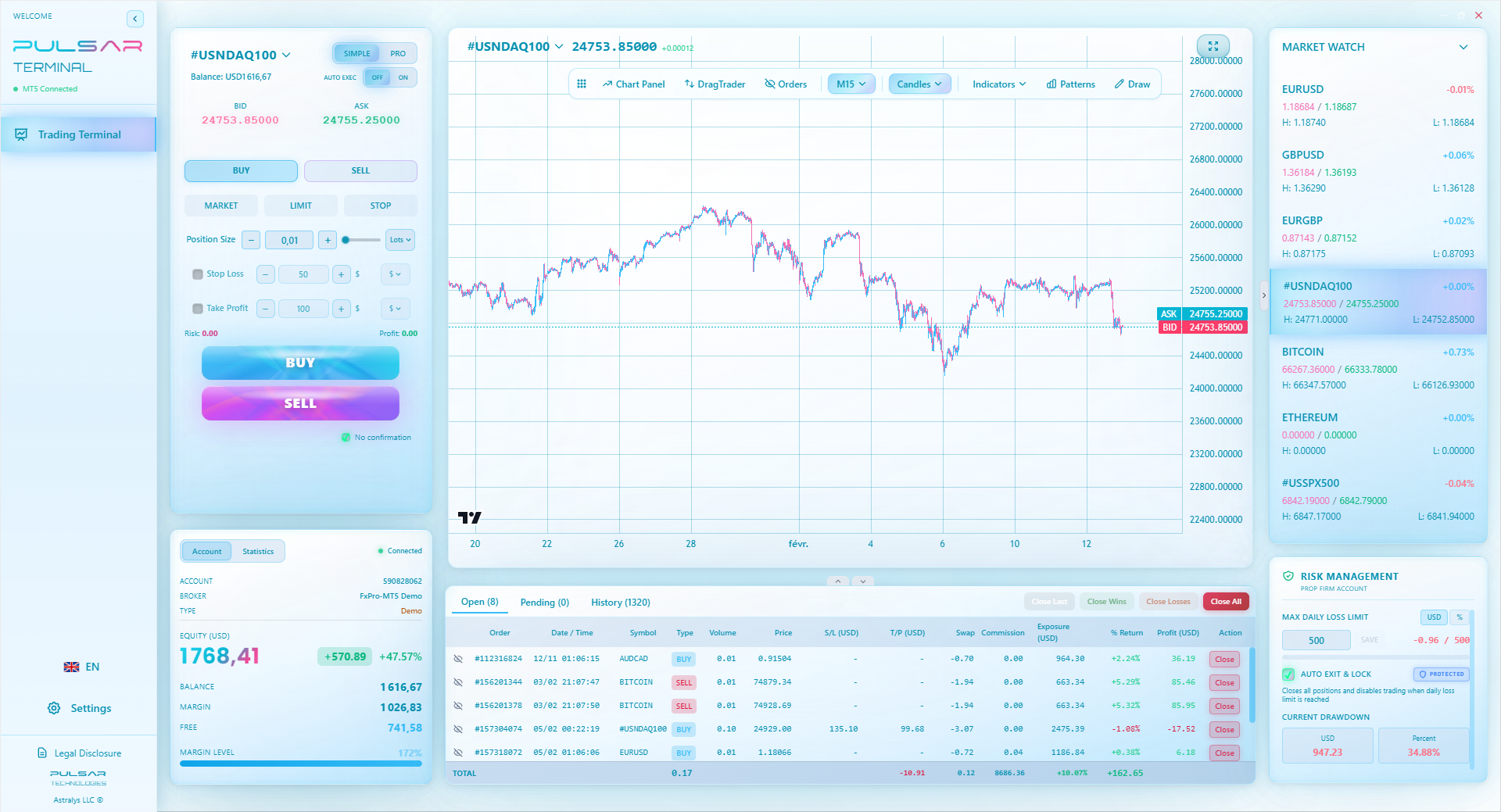
Managing multiple trades and complex orders is where most strategies fall apart, which is why a tool like Pulsar Terminal that simplifies this on MT5 is a game-saver.
Pulsar Terminal
أداة MT5 الشاملة: أوامر سحب وإفلات، متعدد TP/SL، تريلينج ستوب، تداول الشبكة، Volume Profile وحماية البروب فيرم. يستخدمها أكثر من 1000 متداول يومياً.
“Most trading tools are distractions designed to make you think there's a secret. The secret is discipline.”
Let's make this concrete. Here’s how these forex currency trading strategies might play out in a real week for an Aussie trader with a $10,000 account.
Monday: Asian Session. Check AUD/USD. It's been in a downtrend but is approaching a major weekly support at 0.6480. No trade yet. Just watching. EUR/USD is consolidating after last week's ECB move. Mark key resistance at 1.0850.
Tuesday: RBA Meeting Minutes released. AUD jumps 40 pips then fades. I'm not trading the news. I note the reaction: selling pressure emerged above 0.6550. That's a potential resistance level now.
Wednesday: AUD/USD rallies again to test 0.6550. It forms a clear bearish pin bar on the 4Hr chart. This is my swing trade setup. I enter short at 0.6548 after the pin bar closes. Stop loss at 0.6585 (37 pips). My position size? Using my position size calculator, I risk 1% of my account ($100). $100 / 37 pips = $2.70 per pip. That's a 0.27 lot position (27,000 units). My first target is the recent low at 0.6480 (68 pips away).
Thursday: Price moves in my favor, down to 0.6500. I move my stop to breakeven. This is critical psychology. The trade is now risk-free.
Friday: Price hits my first target at 0.6480. I close half my position (0.135 lots) for a profit of 68 pips * $2.70 = $183.60. I move my stop on the remaining half to lock in some profit and let it run. The week ends. One trade, one win. That's it. No frantic scalping, no over-leveraged madness. Just one planned swing based on price action at a key level. This is the discipline ASIC's environment enforces, and it's made me a better trader.
💡 نصيحة وينستون
Review your losing trades twice as much as your winners. The lessons are always in the losses. Your winners often just mean you got lucky and followed the trend.
“The traders who survive here are the patient ones. The ones who treat it like a business.”
If you're looking for a forex currency trading strategy to make you rich next month, close this tab and go buy a lottery ticket. The ASIC-regulated Australian market is built for sustainability, not gambling. That's a good thing.
The traders who survive here are the patient ones. The ones who treat it like a business. They track their P&L, they manage their risk first, and they understand that a 1% gain per week is a 50%+ return per year. Compounding is your most powerful tool, not use.
I've blown up. I've chased losses. I've broken every rule I now preach. The difference between then and now isn't a secret indicator. It's acceptance. Acceptance that you will have losing trades. Acceptance that you can't control the market, only your reaction to it. And acceptance that under ASIC's rules, the game is slower, harder, and , fairer.
Start small. Paper trade your strategy for three months minimum. Then trade with real money so small that a loss doesn't sting. Focus on the process, not the payout. The market will be here tomorrow. Make sure your account is too.
FAQ
Q1What's the best forex trading strategy for beginners in Australia?
Hands down, End-of-Day (EOD) trend following. It forces you to look at the bigger picture, removes the temptation to scalp constantly, and works with ASIC's use limits. Check the daily chart once a day, place an order in the direction of the trend with a sensible stop, and walk away. It teaches patience, which is the most important skill.
Q2Can I use automated trading robots (Expert Advisors) with ASIC brokers?
Technically, yes. MT5 supports EAs. But be incredibly wary. Most EAs are built for different regulatory environments with higher use. An EA that worked on a 500:1 offshore account will likely self-destruct on a 30:1 ASIC account because its risk parameters are all wrong. You must thoroughly backtest and forward-test any EA under ASIC-like conditions.
Q3How much money do I realistically need to start trading forex in Australia?
Realistically, at least $2,000 AUD. With a $2,000 account at 30:1 use, you have $60,000 in buying power. That sounds like a lot, but remember your risk. If you risk just 1% ($20) on a trade with a 20-pip stop, your position size is tiny. Starting with less than $1,000 makes proper position sizing nearly impossible and forces you to take on too much risk per trade just to see meaningful dollar gains.
Q4Is it better to trade AUD pairs or major pairs like EUR/USD?
Start with the majors, especially EUR/USD. It has the tightest spreads, highest liquidity, and most predictable behavior during core sessions. AUD pairs have an extra layer of complexity (commodity prices, China data). Get consistently profitable on EUR/USD first, then consider adding an AUD pair to your watchlist. Don't try to be an expert on everything at once.
Q5What time of day is best for trading forex from Australia?
The most active and ideal times are the session overlaps. The Asian/London overlap (approx. 4pm - 6pm AEST) is great for AUD and JPY pairs. The London/NY overlap (approx. 10pm - 2am AEST) is the most volatile and best for EUR, GBP, and USD pairs. Trading in the middle of the Sydney day is usually slow with wider spreads.
Q6Do I pay tax on my forex trading profits in Australia?
Yes. The ATO considers forex trading as either a business (if you're systematic and frequent) or an investment. Profits are generally treated as taxable income. You can also claim allowable expenses like platform fees, data subscriptions, and home office costs. Keep careful records from day one and consult a tax accountant who understands financial markets.
درس البروفيسور وينستون
النقاط الرئيسية:
- ✓ASIC's 30:1 use forces smarter position sizing.
- ✓True cost is Spread + Commission + Conversion.
- ✓AUD pairs trade on commodity and China news.
- ✓Swing trading aligns best with Aussie regulations.
- ✓Martingale systems are dead under ASIC rules.
ما مدى فائدة هذا المقال؟
انقر على نجمة للتقييم
رؤى التداول الأسبوعية
تحليلات واستراتيجيات أسبوعية مجانية. بدون رسائل مزعجة.
عن المؤلف
Sarah Collins
استراتيجي تداول
استراتيجية تداول مقيمة في لندن مع 12 عاماً من الخبرة في الأسواق المالية. محللة سابقة في شركة وساطة في حي المال بلندن. تغطي أزواج الجنيه الإسترليني والأسواق الأوروبية والتداول المنظم من FCA.
التعليقات
تحذير من المخاطر
ينطوي تداول الأدوات المالية على مخاطر كبيرة وقد لا يكون مناسبًا لجميع المستثمرين. الأداء السابق لا يضمن النتائج المستقبلية. هذا المحتوى لأغراض تعليمية فقط ولا ينبغي اعتباره نصيحة استثمارية. قم دائمًا بإجراء بحثك الخاص قبل التداول.
قد يعجبك أيضًا

Cara Trading Forex Sukses: 7 Prinsip dari Trader Profesional
Cara trading forex sukses dengan 7 prinsip trader pro: manajemen modal, disiplin, journal trading, backtest. Data nyata, bukan janji profit palsu.
Jam Trading Forex Terbaik untuk Trader Indonesia: Panduan Lengkap dengan Tabel Waktu
Panduan jam trading forex untuk trader Indonesia. Tabel 4 sesi dunia, jam emas 20:00-00:00, sesi mana yang harus dihindari. Data akurat + tips dari trader berpengalaman.
Top 5 Sàn Forex Uy Tín Nhất 2026: Review Jujur dari Trader Indonesia
Top 5 sàn forex uy tín 2026 untuk trader Indonesia. Review jujur: spread, deposit, withdraw, dukungan lokal. Exness, XM, IC Markets & lebih.
احصل على Pulsar Terminal
جميع هذه الحاسبات مدمجة في Pulsar Terminal مع بيانات حية من حساب MT5 الخاص بك.
احصل على Pulsar Terminal