


Let's cut through the noise: chasing a completely free forex data API is a rookie mistake that will cost you more money than it saves.

David van der Merwe
متداول الأسواق الناشئة ·  South Africa
☕ 10 دقائق قراءة
ما ستتعلمه:
Let's cut through the noise: chasing a completely free forex data API is a rookie mistake that will cost you more money than it saves. I see it all the time - traders, especially new ones here in SA, get obsessed with finding free tools, thinking they're being clever. They end up with delayed, unreliable data that blows up their trades. In this guide, I'll show you why the 'free' tag is a trap, what the FSCA-regulated landscape really offers, and the specific, affordable tools that give you a professional-grade data feed without breaking the bank.
You're not getting a bargain, you're getting leftovers. The core promise of a free forex data API is fundamentally at odds with what you need to trade profitably: speed, reliability, and depth.
Think about it. Real-time, tick-by-tick market data is expensive to collect, clean, and distribute. Companies aren't charities. When they offer something for free, you are the product. The limitations are brutal and designed to push you onto a paid plan. We're talking about rate limits that cut you off mid-session, updates every 10 minutes when you need seconds, and a complete lack of historical depth. I tried building a simple volatility scanner with a popular free API a few years back. The rate limit was 5 requests per minute. My script hit the limit in 10 seconds, froze, and by the time it reset, the EUR/USD move I was trying to catch was long gone. I missed a 35-pip swing. That's a R350 loss on a mini lot, all for trying to save $20 a month.
For a South African trader, this is doubly painful. Our internet infrastructure isn't always the most stable. Adding a shaky, rate-limited data feed on top of that is asking for trouble. You need data you can trust, especially when trading ZAR pairs like USD/ZAR, which can be notoriously volatile. A laggy or incomplete feed will have you entering trades based on prices that no longer exist.

Warning: Using a free API for live trading is like trying to race a Formula 1 car with a bicycle speedometer. The information is not just slow, it's dangerously inaccurate for the task at hand.
The real cost isn't the monthly fee you save, it's the losing trades you incur because your analysis was built on bad data. Your broker's platform already gives you a reliable feed. The question is, what do you need beyond that?

💡 نصيحة وينستون
A student once showed me a beautiful trading model built on free API data. I asked him to run it live with a paper trade. It failed instantly because the live market spread was three times wider than his historical data showed. The model was perfect, but its foundation was fiction.
“Chasing a completely free forex data API is a rookie mistake that will cost you more money than it saves.”
Forget 'free'. Let's talk about 'functional'. What does a serious retail trader in Cape Town or Johannesburg actually need? It's not about collecting every data point under the sun, it's about getting the right data, reliably.
The Non-Negotiables
First, you need real-time or near-real-time prices. A 10-minute delay, common with free tiers, is useless. In forex, that's a lifetime. Second, you need historical data. You can't backtest a scalping strategy or even a simple MACD indicator crossover without clean historical tick or candle data. Free APIs often give you a tiny, useless slice of history.
Third, you need depth of market (DOM) or Level II data if you're into order flow trading. This is almost never free. Fourth, you need stability and uptime. Your trading system fails if your data feed blinks out during a SARB interest rate announcement.
The South African Context
Your focus should align with the local market. You need solid data on major pairs (EUR/USD, GBP/USD), but crucially, you need reliable feeds for USD/ZAR, EUR/ZAR, and GBP/ZAR. Many international 'free' APIs treat ZAR as an exotic, providing poor coverage or wide spreads in their data. You also need to understand the local session overlaps and liquidity times. A data feed that's great for the US session might be sluggish when the JSE is open.
Here’s a brutal truth: if you're just starting out, you don't need an external API at all. Your FSCA-regulated broker's platform (MT4, MT5, cTrader) provides all the real-time data you need to learn. The desire for an external API usually means you're ready to automate or build custom analytics. That's when you graduate from 'free'.
“The real cost isn't the monthly fee you save, it's the losing trades you incur because your analysis was built on bad data.”
This is where many traders get confused. The FSCA regulates the brokers, not the data providers. Their job is to ensure your broker, like IC Markets or Pepperstone, operates fairly, segregates your funds, and provides a transparent trading environment.
However, this regulation indirectly protects your data quality. An FSCA-licensed broker is required to provide you with a fair and accurate representation of market prices. They can't feed you manipulated or consistently delayed quotes. So, the data you get directly on your MT5 platform from a regulated broker is inherently more trustworthy than a random free API from an unregulated source.
The FSCA doesn't certify APIs. So when you go outside your broker's environment, you're on your own. If your free API feed causes you to lose money, you have no recourse with the FSCA. You accepted the terms of a service that explicitly states it's not for trading purposes.
Also, remember South Africa's exchange controls. While they don't restrict data flow, they do restrict capital flow. If you find a 'free' API that somehow requires you to fund an offshore account, be extremely cautious. Stick to reputable providers. Your first line of defense for quality data is your regulated broker's infrastructure.
“The real cost isn't the monthly fee you save, it's the losing trades you incur because your analysis was built on bad data.”
Now for the useful bit. The closest thing to a 'free forex data api' that's actually worth your time comes from your broker itself. Many top brokers offer free API access as part of your funded trading account. This isn't a separate, limited service; it's a direct pipeline to their trading servers.
For example, FXCM offers its ForexConnect API for free. You get streaming prices and historical data. The catch? You need an account with them. Similarly, many brokers supporting cTrader or MetaTrader offer API access (like cTrader Automate or MT5's native API) that lets you pull data and execute trades programmatically. This data is the real deal - the same feed your charts see.
Here’s a comparison of what ‘free’ really means:
| Provider Type | Cost | Data Quality | Best For |
|---|---|---|---|
| Standalone 'Free' API | $0 / month | Delayed, rate-limited, patchy history. | Academic projects, non-critical apps. |
| Broker's Free API | $0, but requires funded account | Real-time, reliable, full history for your instruments. | Retail traders building custom indicators, basic automation. |
| Paid Professional API | $15 - $300+ / month | Institutional-grade, high-frequency, deep history. | Serious algorithmic traders, commercial systems. |
I used the cTrader API a while back to build a simple dashboard that monitored correlation between gold (XAU/USD) and USD/ZAR. Because it used my live account data feed, it was instant and accurate. That's the kind of 'free' access you should be looking for.

Pro Tip: Before searching for external APIs, log into your broker's client portal and check their 'Developer' or 'API' section. You might already have powerful, free access sitting right there.
💡 نصيحة وينستون
Your first R500 spent on trading should be on a single, high-quality history book about market cycles. Your second R500 should be on a reliable data feed. The former teaches you context, the latter gives you the facts. Most people do neither.
“Your data infrastructure must be built for your market. If it can't handle the ZAR's character, it's not fit for purpose.”
Let's build a practical, cost-effective data setup for a committed SA trader. This assumes you're past the beginner stage and want to level up your analysis.
Step 1: Anchor with Your Broker. Your primary, real-time data source must always be your broker's platform or their official API. This is non-negotiable for execution. It's your source of truth for bid/ask prices and spreads.
Step 2: Augment with a Low-Cost Professional Feed. For backtesting, advanced charting, or building a second opinion system, consider a low-tier paid API. For about $15-30 a month (roughly R275 - R550), you can get services that offer 10,000+ requests per day with 1-5 minute delays. This is perfect for end-of-day analysis or building swing trading models. It's a business expense. One good trade pays for a year's subscription.
Step 3: Use Specialized Tools for Specific Needs. Don't try to make one API do everything. Need sentiment data? Use a free news aggregator. Need economic calendars? Plenty of free websites have them. Need advanced charting with Volume Profile or pattern recognition? Consider a premium trading platform add-on that works directly with your MT5 data feed. This is often more efficient than trying to build it all yourself from raw API data.
Step 4: Mind Your ZAR Pairs. Whatever system you build, test it thoroughly on USD/ZAR. The spread dynamics and volatility are different from EUR/USD. If your data or model can't handle the ZAR's character, it's not fit for your purpose.
I once spent two months and over R2000 in lost trades trying to adapt a EUR/USD scalping bot to USD/ZAR using a mediocre data feed. The slippage and spread assumptions were all wrong. The lesson? Your data infrastructure must be built for your market.
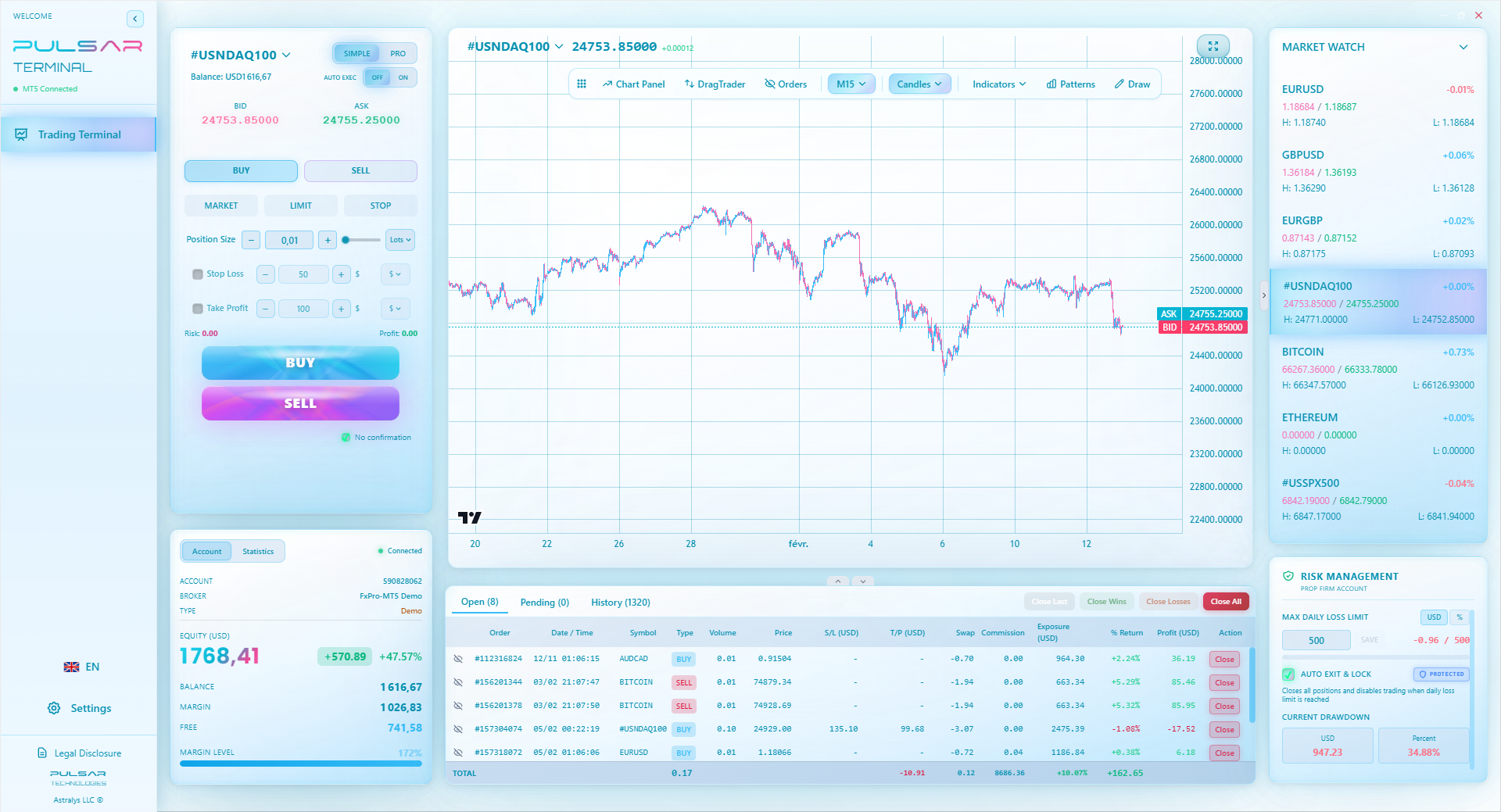
Once you have a reliable data feed, the next challenge is acting on it swiftly and precisely; tools like Pulsar Terminal give you advanced trade management and charting directly on your MT5 data.
Pulsar Terminal
أداة MT5 الشاملة: أوامر سحب وإفلات، متعدد TP/SL، تريلينج ستوب، تداول الشبكة، Volume Profile وحماية البروب فيرم. يستخدمها أكثر من 1000 متداول يومياً.
“Your data infrastructure must be built for your market. If it can't handle the ZAR's character, it's not fit for purpose.”
Let me save you some pain by listing the errors I've made or seen clients make repeatedly.
- Trading Live with a Delayed Feed: This is the cardinal sin. It seems obvious, but when you're excited about your new algorithm, you overlook the 5-minute delay setting. I did. It cost me 0.8% of my account in minutes.
- Ignoring Rate Limits: You build a beautiful app that polls data every second. It works for 5 minutes, then gets blocked for an hour. Always code with rate limits in mind, and assume free tier limits are tiny.
- Not Factoring in Costs of Failure: A free API goes down during a major news event. You miss a stop-loss or a take-profit. That loss could be hundreds of dollars. Was 'free' worth it? Use our position size calculator to see what a single failed trade can do to your account.
- Choosing an Unreliable Provider for ZAR Data: Many international APIs treat ZAR as a second-class citizen. The feed might be less stable or have more errors for USD/ZAR than for EUR/USD. Test extensively.
- Overcomplicating Too Early: If you're still figuring out how to use the RSI indicator effectively, you have no business messing with external APIs. Master the tools in front of you first. The quest for a 'free forex data api' is often a distraction from the hard work of learning to trade.

Example: A free API with a 100 requests/hour limit. If you monitor 10 currency pairs with a 1-minute chart, you need 10 requests per minute just for price updates. You'll exhaust your limit in 10 minutes. That's not a tool, that's a toy.
“In trading, you get what you pay for. Invest in quality data, because your decisions are only as good as the information they're based on.”
So, is there a usable free forex data API for a South African trader? The honest answer is no, not for anything resembling serious trading. The good news is you don't need to hunt for one.
Your path forward is clear:
- Beginners: Stop looking. Use the data and tools on your regulated broker's platform. Focus on understanding price action, pips, and risk management. Your data feed is fine.
- Intermediate Traders: If you're building systems, use the free API provided by your broker. It's the most reliable and relevant free option you'll get. Invest your time in learning to use it, not in searching for a mythical better free alternative.
- Advanced Traders: Allocate a portion of your trading capital to professional tools. A $30/month API is a trivial cost if your edge is real. View it as essential infrastructure, like a fast internet connection. Consider tools that enhance your existing platform, like advanced trade management terminals that help you avoid a margin call through better order control.
Stop chasing freebies. In trading, as in life, you get what you pay for. Invest in quality data, because your trading decisions are only as good as the information they're based on. Build your foundation on the rock-solid data from your FSCA broker, not the shifting sand of a 'free' API.
FAQ
Q1Is it illegal to use a free forex data API in South Africa?
No, it's not illegal. The FSCA regulates brokers, not data providers. However, it's often against the terms of service of the free API to use their data for live trading. The real risk isn't legal, it's financial - using unreliable data will lead to bad trades and losses.
Q2What is the best free API for USD/ZAR data?
The 'best' free API for USD/ZAR is the one provided by your FSCA-regulated broker through their platform or official API. Standalone free APIs consistently provide poor, delayed, or unreliable data for ZAR pairs. Your broker's feed is direct, real-time, and designed for trading.
Q3Can I use a free API for backtesting my trading strategy?
You can try, but you'll be severely limited. Free APIs rarely provide the depth of historical data (years of tick or 1-minute data) needed for strong backtesting. The data might also have gaps or errors. For proper backtesting, you're better off purchasing a one-off historical data set or using a platform that includes this data, like TradingView with a paid plan.
Q4How much does a decent paid forex data API cost?
A basic, usable paid API for a retail trader starts at around $15-$30 per month (roughly R275-R550). This typically gets you tens of thousands of requests per day with updates every 1-5 minutes. Professional-grade, real-time feeds can cost $100-$300+ per month.
Q5Do I need an API if I only trade on MetaTrader 5?
Probably not. MT5 has powerful built-in tools for analysis, backtesting, and even automated trading via Expert Advisors (EAs). You can access a vast amount of real-time and historical data directly in the platform. An external API is only necessary if you want to build a custom application outside of MT5 or aggregate data from multiple brokers.
Q6What should I look for in a paid API as a South African trader?
Prioritize: 1) Reliability and uptime, 2) Low latency, 3) complete coverage of ZAR currency pairs (USD/ZAR, EUR/ZAR, GBP/ZAR), 4) Sufficient historical data depth for your strategy, and 5) Clear, reasonable pricing without hidden fees. Test their demo feed on ZAR pairs specifically before paying.
Q7Are broker APIs really free?
Yes, but with a condition. Brokers like FXCM or those offering cTrader/MT5 API access provide the connection and data feed for free. However, you must have a funded trading account with them. You pay through the spreads and commissions on your trades, not a direct API fee.
درس البروفيسور وينستون
النقاط الرئيسية:
- ✓Free APIs have rate limits that cripple live trading.
- ✓Broker-provided APIs are the only useful 'free' tier.
- ✓Reliable ZAR pair data is rare in free feeds.
- ✓Budget R300-R550 monthly for a basic professional feed.
- ✓Test any data system thoroughly on USD/ZAR volatility.
ما مدى فائدة هذا المقال؟
انقر على نجمة للتقييم
رؤى التداول الأسبوعية
تحليلات واستراتيجيات أسبوعية مجانية. بدون رسائل مزعجة.
عن المؤلف
David van der Merwe
متداول الأسواق الناشئة
متداول مقيم في جوهانسبرغ مع 11 عاماً في عملات الأسواق الناشئة. متخصص في أزواج ZAR والتداول المنظم من FSCA وتحليل السوق الجنوب إفريقي.
التعليقات
تحذير من المخاطر
ينطوي تداول الأدوات المالية على مخاطر كبيرة وقد لا يكون مناسبًا لجميع المستثمرين. الأداء السابق لا يضمن النتائج المستقبلية. هذا المحتوى لأغراض تعليمية فقط ولا ينبغي اعتباره نصيحة استثمارية. قم دائمًا بإجراء بحثك الخاص قبل التداول.
قد يعجبك أيضًا

Cara Trading Forex Sukses: 7 Prinsip dari Trader Profesional
Cara trading forex sukses dengan 7 prinsip trader pro: manajemen modal, disiplin, journal trading, backtest. Data nyata, bukan janji profit palsu.
Jam Trading Forex Terbaik untuk Trader Indonesia: Panduan Lengkap dengan Tabel Waktu
Panduan jam trading forex untuk trader Indonesia. Tabel 4 sesi dunia, jam emas 20:00-00:00, sesi mana yang harus dihindari. Data akurat + tips dari trader berpengalaman.
Top 5 Sàn Forex Uy Tín Nhất 2026: Review Jujur dari Trader Indonesia
Top 5 sàn forex uy tín 2026 untuk trader Indonesia. Review jujur: spread, deposit, withdraw, dukungan lokal. Exness, XM, IC Markets & lebih.
احصل على Pulsar Terminal
جميع هذه الحاسبات مدمجة في Pulsar Terminal مع بيانات حية من حساب MT5 الخاص بك.
احصل على Pulsar Terminal