


Let me be blunt: 95% of the forex education courses sold in South Africa are overpriced garbage.

David van der Merwe
متداول الأسواق الناشئة ·  South Africa
☕ 8 دقائق قراءة
ما ستتعلمه:
- 1The South African Forex Education Scene: A Jungle of Gurus
- 2What a Real Forex Education Should Actually Cover
- 3Course Formats: What's Actually Worth Your Money?
- 4Red Flags and Scam Tactics to Avoid Like the Plague
- 5Building Your Own Education Plan (The Free & Paid Mix)
- 6The Final Verdict: Are Paid Forex Education Courses Worth It?
Let me be blunt: 95% of the forex education courses sold in South Africa are overpriced garbage. They're repackaged YouTube videos sold by guys who've never traded a live account with real pressure. I've seen it for over a decade. But that 5%? It can save you years of pain and thousands of Rands. This guide isn't about selling you a course. It's about teaching you how to spot the difference, so you don't fund some 'guru's' new BMW while your trading account bleeds out.
Walk into any trading expo in Sandton or Cape Town, and you'll be bombarded. Flashy suits, promises of 'financial freedom,' and screenshots of perfect trades. The local scene is dominated by personality-driven marketing, not proven pedagogy. A huge problem is the regulatory grey area. The FSCA regulates brokers, not educators. Anyone with a Facebook page and a rented Mercedes can call themselves a mentor. I've met 'mentors' who teach strategies that blatantly ignore the FSCA's 30:1 use cap, setting their students up for a margin call before they even understand why.
What you need to understand is the South African trader's unique context. We're trading from a volatile, often isolated market (the ZAR). We have specific tax implications from SARS. A generic course from the US or UK won't cover that. A good local course should address trading ZAR pairs, managing currency risk when your capital and living costs are in Rands, and the legalities of trading CFDs (which is how we legally speculate) versus actual forex.

Warning: Be supremely wary of any 'educator' who promises specific monthly returns (e.g., 'Make R50,000 a month!'). This is a classic red flag. Trading is about probabilities, not guarantees. If their strategy was that foolproof, they'd be using it to trade, not to sell courses.

💡 نصيحة وينستون
If a course sales page gives you an adrenaline rush, close it. You're being sold emotion, not education. Buy when you're thinking clearly, not when you're feeling FOMO.
Forget the hype. A proper curriculum builds from the ground up, like an apprenticeship. If the course jumps straight to 'secret indicators' without covering the basics, run.
The Non-Negotiable Foundation
First, rock-solid money and risk management. This isn't sexy, but it's what keeps you alive. Any course worth its salt must drill into you how to calculate your position size for every single trade, based on your account balance and a predefined risk percentage (I never risk more than 1-2% per trade). It should cover stop-loss placement as a strategic decision, not an afterthought.
Market Mechanics & Psychology
Next, how the market actually works. Not just what a pip is, but how liquidity, the spread, and news events move prices. Then, the most critical module: trader psychology. It's 80% of the game. A good course will force you to confront your own greed, fear, and ego. It should include exercises on journaling, dealing with loss (because you will lose), and maintaining discipline. My biggest early blow-up, a R15,000 loss in 2014, came from ignoring my own rules after three winning trades. No indicator could have saved me from myself.
A Complete, Testable Strategy
Finally, a complete, rules-based strategy. This includes clear entry conditions, exit rules (both take-profit and stop-loss), and the market context (trending vs. ranging) where it works best. It should be backtestable. The educator should show you their own historical backtest results, warts and all, not just a handful of hand-picked winners.
“My biggest early blow-up came from ignoring my own rules after three winning trades. No indicator could have saved me from myself.”
You've got options, from free to five-figure Rand 'masterminds.' Let's break down the value.
| Format | Typical Cost (ZAR) | Pros | Cons | My Verdict |
|---|---|---|---|---|
| Free (YouTube, Blogs) | R0 | Zero cost, diverse viewpoints. | Disorganized, no structure, often incomplete. | Essential starting point. Use it to learn terminology. Never trust a 'signal service' in the comments. |
| Self-Paced Online Course | R1,500 - R8,000 | Structured, can revisit. Good for fundamentals. | Lack of personal feedback. Easy to get stuck. | Best value for pure knowledge. Look for ones with quizzes or assignments. |
| Live Cohort/Webinar Series | R5,000 - R20,000 | Interactive, Q&A, community. | Expensive. Pace is set by the group. | Good if you need accountability. Ensure the 'live trading' is on a real, not demo, account. |
| 1-on-1 Mentorship | R20,000+ | Personalized feedback, direct access. | Very expensive. Quality depends 100% on the mentor. | Only for serious traders with a live account. Vet the mentor's REAL track record mercilessly. |
I paid R12,000 for a live webinar course in 2015. The content was decent, but the real value was the private Discord group. Watching others make the same mistakes I did was incredibly instructive. However, the mentor's 'live trades' always seemed to be on a different, magical account. That skepticism saved me from his even more expensive 'advanced' program.

Pro Tip: Before buying any paid course, exhaust the free material from reputable sources. Read the FSCA's warnings on trading scams. Understand the basics of a broker like IC Markets or Pepperstone platform. If you don't know what a stop-loss is, you're not ready to pay for education.
South Africa is fertile ground for trading scams. Here’s how to spot them.
The Lifestyle Pitch: If the sales page has more photos of luxury cars, watches, and beach houses than trading charts, it's selling a dream, not a skill. I've never met a consistently profitable trader who has time for all those photoshoots.
Vague or No Refund Policy: A legitimate educator stands by their product. A 7- or 14-day money-back guarantee is a reasonable ask. If it's 'all sales final,' your Rands are at high risk.
Pressure to Use a Specific 'Partner' Broker: This is a massive conflict of interest. They're often getting a kickback (rebate) for every lot you trade, which incentivizes them to get you overtrading. Learn on your own terms with a reputable, well-reviewed broker like XM or Exness.
The 'Prop Firm Challenge' Bypass: A new nasty one. They sell you a 'course' on how to pass a prop firm evaluation, often implying or offering a 'service' to do it for you. This is fraud. Prop firms like FTMO are wise to this, and you'll get banned, losing your challenge fee. Real education teaches you to trade, not to cheat a test.
My own embarrassing lesson? I once bought a R2,500 'algorithmic EA' from a local 'guru.' It was just a repackaged Moving Average crossover system. It blew a R5,000 demo account in two weeks during sideways markets. The education was in the loss: if it sounds too good to be true, it is.
💡 نصيحة وينستون
The most valuable part of any paid course is often the community or forum. That's where you see the real struggles and questions. If there isn't one, or it's dead, your money might be better spent elsewhere.
“If the sales page has more photos of luxury cars and beach houses than trading charts, it's selling a dream, not a skill.”
You don't need to break the bank. Here's a phased approach I wish I'd followed.
Phase 1: The Free University (Months 1-3)
- Goal: Understand the absolute basics without spending a cent.
- Action: Devour the educational sections on major broker websites. They have excellent primers on CFDs, use, and order types. Use Babypips.com's 'School of Pipsology' (it's free). Open a demo account and learn how to place trades, set stops, and calculate position size.
Phase 2: Strategic Foundation (Month 4)
- Goal: Choose one market (e.g., EUR/USD) and one core strategy.
- Action: This is where a well-chosen paid course can accelerate you. Invest in a course that deeply teaches one approach, like price action swing trading or a specific indicator methodology like the RSI or MACD. Practice it relentlessly on demo.
Phase 3: Live Application & Refinement (Months 5-6+)
- Goal: Transition to a small live account and develop mental discipline.
- Action: Fund a live account with money you can afford to lose (start with R2,000-R5,000). Your education now is in the live market. This is where a trading journal is your most important tool. Record every trade, your emotion, and the outcome. Consider a low-cost scalping course if that aligns with your personality, but only after mastering the basics.

Example: Your Phase 2 budget: R3,000 for a solid strategy course. Your Phase 3 live account: R3,000. Total initial investment: R6,000. That's smarter than spending R20,000 on a 'mastermind' upfront.
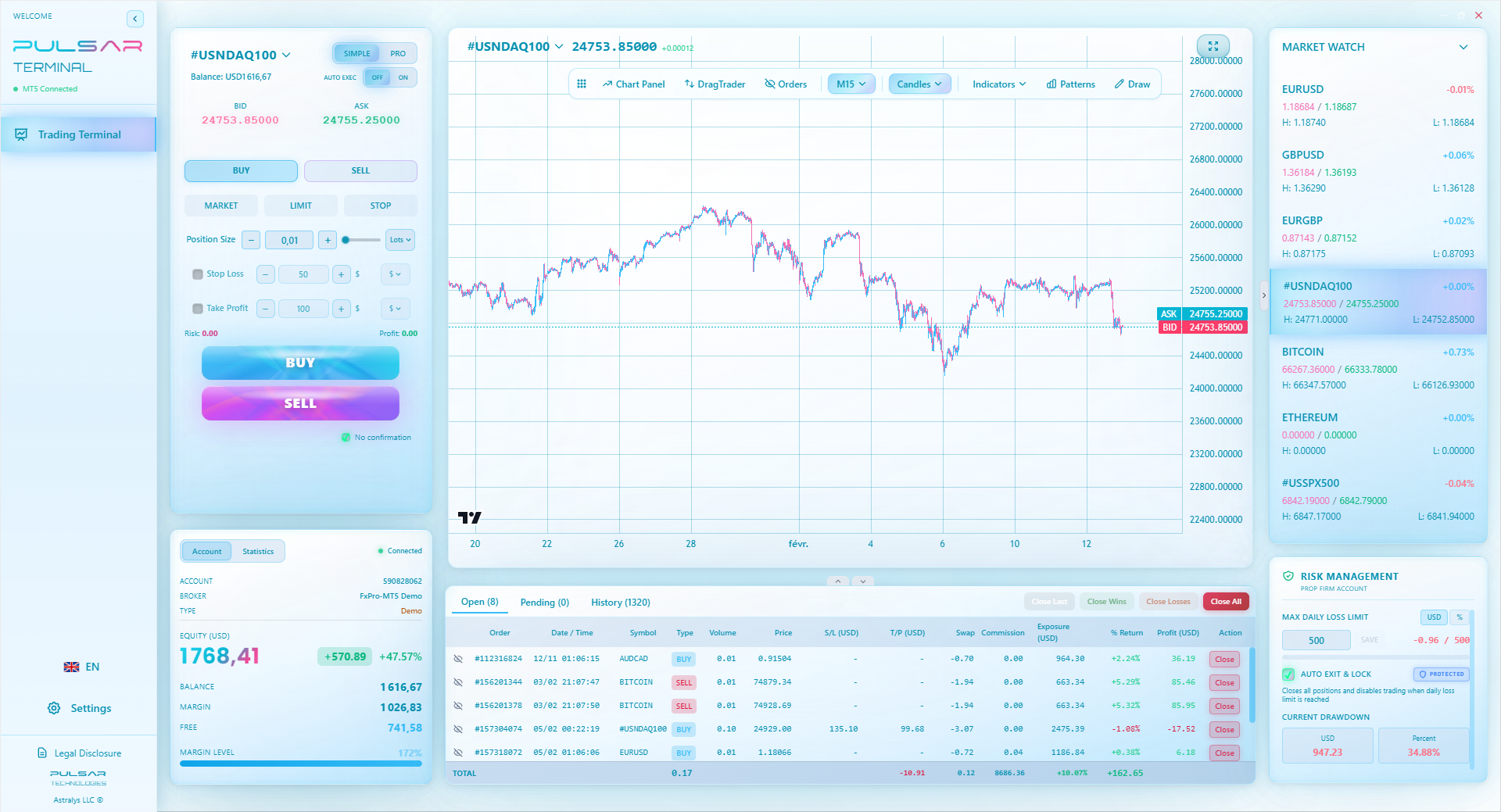
Once you move to a live account, managing multiple trades and strict risk rules becomes critical, which is where a tool like Pulsar Terminal automates those protections directly on your MT5 platform.
Pulsar Terminal
أداة MT5 الشاملة: أوامر سحب وإفلات، متعدد TP/SL، تريلينج ستوب، تداول الشبكة، Volume Profile وحماية البروب فيرم. يستخدمها أكثر من 1000 متداول يومياً.
Yes, but only under very specific conditions.
A paid course is worth it if: it provides a structured, complete curriculum you can't easily assemble for free; it focuses intensely on risk management and psychology; the educator is transparent about their own trading and doesn't make unrealistic promises; and it fits into your broader, phased education plan.
It's a waste of money if: you buy it looking for a 'secret' or a shortcut; you haven't first done the free basic work; it's sold with get-rich-quick hype; or you think buying it alone will make you a profitable trader. The course gives you the map and the tools. You still have to walk the path, face the storms, and carry the load yourself.
The best forex education courses in South Africa are the ones that make you feel uncomfortable. They force you to confront your weaknesses, to practice boring drills, and to accept that losing is part of the process. They don't sell champagne dreams; they sell hard hats and blueprints. Find one of those, and your Rands will be well spent. Otherwise, you're just buying a very expensive motivational poster.
FAQ
Q1What is the best forex trading course in South Africa?
There is no single 'best' course. The best one is the one that matches your learning style, budget, and current knowledge level, and that emphatically teaches risk management. Avoid any course marketed as the 'best' or 'number one.'
Q2Are free forex courses from brokers any good?
They are excellent for learning the absolute basics: platform navigation, what a CFD is, order types, and basic analysis. They are foundational and essential. However, they won't provide you with a complete, actionable trading strategy or deep psychological training. Use them as your starting block, not your finish line.
Q3How much should I pay for a forex course?
For a complete self-paced online course, between R1,500 and R8,000 is reasonable. For live coaching, expect R5,000 to R20,000. Never spend a huge percentage of your intended trading capital on education. If you have R10,000 to trade, a R15,000 course is a terrible allocation of resources.
Q4Can I become a profitable trader without buying a course?
Absolutely. It's harder and takes longer, as you have to curate and structure all the information yourself from books, free websites, and trial-and-error. A good course accelerates the process by providing a tested structure and (hopefully) saving you from costly mistakes. But the core work - screen time, journaling, and psychological control - is 100% on you, course or no course.
Q5What should I look for in a forex course mentor?
Look for verifiable transparency. Do they show real, recent statement snippets (not just P&L screenshots)? Do they trade live with students? Do they openly discuss their losses and mistakes? A true mentor's goal should be to make you independent, not keep you dependent on their weekly 'signals.'
Q6Is it legal to do forex trading courses in South Africa?
Yes, providing education is legal. However, the educator is not regulated by the FSCA in the same way a broker is. This means you have very little recourse if the course is fraudulent. Your protection is due diligence - checking reviews, asking for proof, and understanding the refund policy before you pay.
Q7Do I need a course for prop firm challenges?
You need trading skill and discipline, which a good course can help build. You do NOT need a course that promises to 'hack' or 'bypass' the challenge rules. Those are scams. The prop firm challenge is a test of your consistent risk management, which should be the core of any legitimate forex education.
درس البروفيسور وينستون
النقاط الرئيسية:
- ✓Risk management is 90% of the battle. Master it first.
- ✓Never risk more than 1-2% of your capital on a single trade.
- ✓Demo trade for at least 3 months before going live.
- ✓A trading journal is non-negotiable. Write everything down.
ما مدى فائدة هذا المقال؟
انقر على نجمة للتقييم
رؤى التداول الأسبوعية
تحليلات واستراتيجيات أسبوعية مجانية. بدون رسائل مزعجة.
عن المؤلف
David van der Merwe
متداول الأسواق الناشئة
متداول مقيم في جوهانسبرغ مع 11 عاماً في عملات الأسواق الناشئة. متخصص في أزواج ZAR والتداول المنظم من FSCA وتحليل السوق الجنوب إفريقي.
التعليقات
تحذير من المخاطر
ينطوي تداول الأدوات المالية على مخاطر كبيرة وقد لا يكون مناسبًا لجميع المستثمرين. الأداء السابق لا يضمن النتائج المستقبلية. هذا المحتوى لأغراض تعليمية فقط ولا ينبغي اعتباره نصيحة استثمارية. قم دائمًا بإجراء بحثك الخاص قبل التداول.
قد يعجبك أيضًا

Cara Trading Forex Sukses: 7 Prinsip dari Trader Profesional
Cara trading forex sukses dengan 7 prinsip trader pro: manajemen modal, disiplin, journal trading, backtest. Data nyata, bukan janji profit palsu.
Jam Trading Forex Terbaik untuk Trader Indonesia: Panduan Lengkap dengan Tabel Waktu
Panduan jam trading forex untuk trader Indonesia. Tabel 4 sesi dunia, jam emas 20:00-00:00, sesi mana yang harus dihindari. Data akurat + tips dari trader berpengalaman.
Top 5 Sàn Forex Uy Tín Nhất 2026: Review Jujur dari Trader Indonesia
Top 5 sàn forex uy tín 2026 untuk trader Indonesia. Review jujur: spread, deposit, withdraw, dukungan lokal. Exness, XM, IC Markets & lebih.
احصل على Pulsar Terminal
جميع هذه الحاسبات مدمجة في Pulsar Terminal مع بيانات حية من حساب MT5 الخاص بك.
احصل على Pulsar Terminal