


Here's the hard truth: 95% of the forex indicators you see on YouTube are useless noise designed to sell you a dream.

Olumide Adeyemi
رائد التداول في غرب أفريقيا ·  Nigeria
☕ 10 دقائق قراءة
ما ستتعلمه:
Here's the hard truth: 95% of the forex indicators you see on YouTube are useless noise designed to sell you a dream. In Nigeria, where market volatility can be extreme and capital is hard-earned, relying on the wrong tools is a fast track to a zero balance. I've watched traders pile five flashing indicators on a chart, convinced they've found a secret, only to get wiped out by a simple CBN announcement. This guide isn't about magic formulas. It's about evidence. I'll show you the three types of indicators that actually matter, how to combine them without creating chaos, and why your mindset is more important than any moving average.
Let's clear this up first. A forex indicator is just a mathematical calculation applied to price and/or volume data. It doesn't predict the future. It processes the past to give you a visual or numerical representation of what might be happening: Is the trend up or down? Is the move strong or weak? Is the market calm or chaotic?
Think of it like a speedometer in your car. It tells you how fast you're going (momentum) and whether you're accelerating or decelerating. It doesn't tell you where to drive or when to brake for a pothole you can't see. That's your job. The biggest mistake Nigerian traders make is treating indicators like a prophet. They're tools, not oracles.

Warning: No indicator will save you from poor risk management. A perfect RSI signal means nothing if your position size calculator is set to risk 10% of your account on one trade. That's a recipe for disaster, especially with the use offered by many brokers.
Indicators lag. They are derived from price, which means they are always playing catch-up. Your goal is to use them to add clarity to your analysis, not to replace your own judgment. When the CBN makes a surprise announcement, all those pretty lines on your chart can flip in an instant. The indicator will follow, but your stop-loss should have already been hit.

💡 نصيحة وينستون
A clean chart is a thinking chart. If you can't see the price candles clearly behind your indicators, you've already lost the plot.
“The biggest mistake Nigerian traders make is treating indicators like a prophet. They're tools, not oracles.”
Forget the hundreds of options. Every useful indicator falls into one of three jobs. Using more than one from the same category is usually redundant and creates confusion.
Trend-Following Indicators
These tell you the direction and strength of the prevailing market move. They work great in strong, sustained trends but give terrible signals in ranging markets (which is most of the time).
- Moving Averages (MA): The simplest and most effective. A 50-period and 200-period Exponential Moving Average (EMA) combo is a classic for identifying the broader trend. Price above the MAs = potential uptrend. Below = potential downtrend.
- MACD (Moving Average Convergence Divergence): This is more than a trend tool; it also shows momentum shifts. I use it to confirm trend strength and spot potential reversals when the MACD line crosses the signal line. You can read a deeper breakdown in our guide on the MACD indicator.
Momentum Indicators
These measure the speed of price movement. Is the buying or selling pressure increasing or decreasing? They help you spot when a trend might be running out of steam.
- RSI (Relative Strength Index): The king of momentum oscillators. It moves between 0 and 100. Readings above 70 suggest overbought conditions (but not necessarily a sell signal!), and below 30 suggest oversold. My personal rule? I only consider RSI signals that align with the broader trend. Don't short a strong uptrend just because RSI hits 75.
- Stochastic Oscillator: Similar to RSI, it identifies overbought/oversold levels. Some traders prefer it for faster signals, but I find it noisier.
Volatility Indicators
These measure how much the price is moving. In Nigeria, with our unique economic pressures, volatility can spike without warning. These indicators help you adjust your position size and stop-loss distances.
- Average True Range (ATR): This is non-negotiable for risk management. The ATR tells you the average trading range over a set period. If the ATR for EUR/USD is 100 pips, setting a 15-pip stop-loss is likely to get you stopped out by normal market noise. I use ATR to set dynamic stop-losses. For a detailed scalping strategy, a tight stop based on a low ATR period is crucial.

Pro Tip: Pick ONE from each category. My core setup for years has been: 200 EMA (trend), RSI (momentum), and ATR (volatility). That's it. Adding a 5th, 6th, or 7th indicator won't increase your accuracy. It will increase your paralysis.
“Adding a 5th, 6th, or 7th indicator won't increase your accuracy. It will increase your paralysis.”
I've made these mistakes. My friends have. Let me save you the tuition fee.
Mistake 1: Overcomplicating the Chart (Indicator Soup). This is the classic. The chart is so covered in lines, histograms, and clouds that you can't even see the price action. You get a buy signal from one indicator and a sell signal from another. You freeze. Then you watch the trade you didn't take rocket in the direction you originally thought. Simplicity wins.
Mistake 2: Using Default Settings on Everything. The default RSI period is 14. The default Stochastic is 14,3,3. These are arbitrary. The Nigerian market, particularly pairs like USD/NGN, can have different rhythms. You need to test and adjust. For a slower, more reliable RSI, try a period of 21 or 25. For a faster one suited to scalping, maybe 9 or 7. Backtest it.
Mistake 3: Ignoring the Higher Timeframe Trend. This is a capital destroyer. You're on the 15-minute chart, RSI is oversold, so you go long on GBP/USD. Meanwhile, on the 4-hour chart, price is crashing through the 200 EMA in a clear downtrend. You're trying to catch a falling knife. Always check the trend on a higher timeframe (like the 4H or Daily) before taking a signal from a lower one.
Mistake 4: Chasing Lagging Signals in a News-Driven Market. When major news hits - like CBN MPC decisions or US Non-Farm Payrolls - price moves first. Indicators will lag severely. By the time your moving average crossover gives a signal, the big move is often over. During high-impact news, price action and support/resistance levels are far more valuable than any indicator.
Here's a personal failure: In 2020, I was heavily reliant on a complex Bollinger Band squeeze strategy on gold (XAU/USD). The setup was perfect, the squeeze was tight. I entered long. What I ignored was that the squeeze was happening right under a massive, multi-year resistance level. The indicator said go, but the plain chart said 'danger.' Price hit resistance and reversed, taking out my stop. I lost 3% of my account on that one trade. The lesson? The chart itself is the primary indicator. Everything else is secondary. For more on trading gold, check our XAU/USD guide.
💡 نصيحة وينستون
The 200-period Moving Average isn't a trading signal. It's a referee. It tells you which team has the ball. Never argue with the referee.
“The chart itself is the primary indicator. Everything else is secondary.”
Let's build a rule-based system from the ground up. This is a template, not a holy grail. You must test and adapt it.
Step 1: Define the Trend (The Filter). Go to the 4-hour chart. Plot a 50-period EMA and a 200-period EMA.
- Rule: Only look for BUY signals if the price is above both the 50 and 200 EMA, and the 50 EMA is above the 200 EMA (a 'Golden Cross').
- Rule: Only look for SELL signals if the price is below both EMAs, and the 50 is below the 200 (a 'Death Cross'). This step filters out at least 50% of the noisy, low-probability trades.
Step 2: Find an Entry (The Trigger). Move to the 1-hour chart. Use your momentum indicator.
- For a BUY: Wait for price to pull back towards the rising 50 EMA on the 1H chart. Then, wait for the RSI (set to 21) to dip into oversold territory (below 30) and then cross back above 30.
- For a SELL: Wait for price to rally back towards the falling 50 EMA. Wait for RSI to go above 70 and then cross back below.
Step 3: Manage Your Risk (The Survival Kit). This is where you make or lose money.
- Position Size: Use your position size calculator. Never risk more than 1-2% of your account on a single trade.
- Stop-Loss: Place your stop-loss beyond the recent swing low (for buys) or swing high (for sells). Use the ATR to ensure it's not too tight. If the ATR(14) is 25 pips, a 10-pip stop will likely fail.
- Take Profit: Aim for a risk-to-reward ratio of at least 1:2. If you risk 50 pips, your target should be 100 pips away. You can use tools that allow for multiple take-profit levels to secure partial profits along the way.

Example: Your account is 500,000 NGN. Your 2% risk per trade is 10,000 NGN. You're trading EUR/USD, and your stop-loss distance is 50 pips. The pip value for your lot size needs to be such that 50 pips * loss = 10,000 NGN. That means your pip value must be 200 NGN. This math is non-negotiable.
Brokers like IC Markets or Pepperstone offer tight spreads, which is crucial because a wide spread immediately puts you at a disadvantage on these short-term setups.
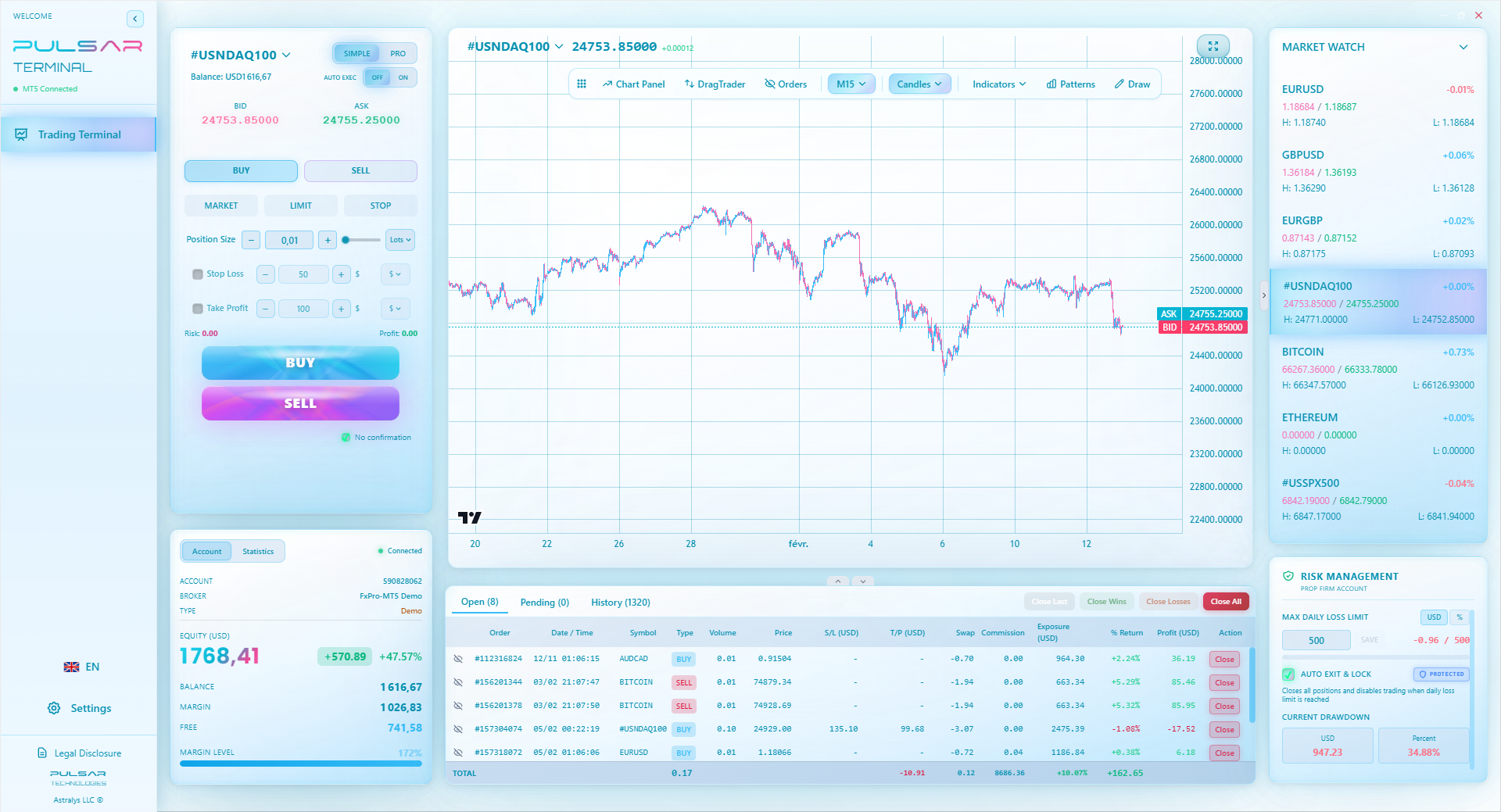
Managing multiple take-profit levels and dynamic stops based on ATR is manual and stressful, but tools like Pulsar Terminal automate this directly on your MT5 charts.
Pulsar Terminal
أداة MT5 الشاملة: أوامر سحب وإفلات، متعدد TP/SL، تريلينج ستوب، تداول الشبكة، Volume Profile وحماية البروب فيرم. يستخدمها أكثر من 1000 متداول يومياً.
“The chart itself is the primary indicator. Everything else is secondary.”
This is the great debate. Price action traders swear by naked charts - just candlesticks, support, and resistance. Indicator traders love their mathematical confirmations. Who's right?
Both are, and both are wrong if used exclusively.
Indicators are a summary of price action. They smooth out the noise. But in doing so, they remove detail. A pin bar reversal at a key support level is a powerful price action signal. Your RSI might still be mid-range, giving no signal. If you wait for the RSI to confirm, you might miss the best entry.
The smart approach is synthesis. Use price action to find your trade location (e.g., a bounce off a clear support level on the daily chart for EUR/USD). Then, use your indicators for timing and confirmation on a lower timeframe.
For example: USD/NGN is approaching a major historical support level on the weekly chart (price action). You want to buy. You drop to the 4H chart and see price is now above the 50 EMA (trend filter). You go to the 1H chart and wait for a bullish engulfing candle (price action) while the RSI is coming out of oversold territory (momentum confirmation). That's a high-probability confluence.
Ignoring price structure because an indicator gave a signal is how you get caught in false breakouts. Ignoring momentum because 'the level is there' is how you buy into a continuing crash.
💡 نصيحة وينستون
Backtest your indicator setup for at least 100 trades before risking one naira. If it didn't work in the past, it won't work tomorrow.
“Your indicators mean nothing if your broker has slippage during volatile CBN news times.”
- Clean Your Charts: Open your trading platform. Remove every single indicator. Start fresh.
- Pick Your Trio: Choose ONE trend indicator (I suggest the 200 EMA), ONE momentum indicator (start with RSI set to 21), and add the ATR. That's your new default template.
- Backtest Relentlessly: Don't use real money. Use the strategy from the 'Building a System' section on a demo account for at least 50 trades. Record every trade, the setup, and the outcome. Be brutally honest.
- Focus on Risk: Before you even look for a trade, decide your maximum loss. Use the calculator. Set your stop-loss. This habit alone will put you ahead of 80% of traders.
- Choose the Right Broker: Your indicators mean nothing if your broker has slippage, wide spreads, or slow execution during volatile CBN news times. Do your homework. Read reviews on brokers like Exness or XM to see how they perform for Nigerian clients, especially regarding deposit/withdrawal methods.
The path isn't about finding a better indicator. It's about becoming a better analyst of the ones you already have. The market doesn't care about your moving averages. It cares about your ability to manage risk and follow a plan. Start there.
FAQ
Q1What is the best forex indicator for beginners in Nigeria?
There isn't one 'best' indicator, but the most forgiving for a beginner is the Moving Average, specifically the 200-period Exponential Moving Average (EMA). It clearly shows the long-term trend on any chart. Pair it with the Average True Range (ATR) to learn about market volatility and setting proper stop-losses. This simple combo teaches you trend and risk management without the confusion of oscillators.
Q2How many indicators should I use on one chart?
As few as possible. Three is a solid maximum, and they should each serve a different purpose: one for trend, one for momentum, and one for volatility. Using more leads to 'analysis paralysis' where conflicting signals cause you to do nothing, or worse, you ignore clear price action because an obscure indicator says otherwise.
Q3Why do my indicators give false signals during CBN announcements?
Because all indicators are lagging. They calculate based on past price data. When a major news event like a CBN Monetary Policy Committee decision hits, new information floods the market, causing instant, sharp price moves. The indicator needs new price bars to form before it can adjust. During high-volatility news, price action and pre-defined support/resistance levels are more reliable than any indicator reading.
Q4Are paid or custom indicators better than free ones?
Almost never. The core mathematical principles behind the RSI, MACD, Moving Averages, and ATR are free and built into every platform. Paid indicators are usually just repackaged versions of these with fancy alerts. The seller's profit comes from marketing, not from a secret formula that breaks the market. Master the free, standard tools first.
Q5How do I know if my indicator settings are wrong?
Your settings are wrong if they don't align with the market's rhythm and cause you to enter trades too late or get stopped out constantly. If you're trading the 1-hour chart, a default RSI(14) might be too fast and noisy. Try a slower RSI(21). The only way to know is through backtesting. Apply your settings to historical data and see if they would have kept you in the main trend and out of choppy ranges.
Q6Can I make money trading forex in Nigeria with just indicators?
No. Indicators are just one component of a trading system. Making money depends overwhelmingly on your risk management (position sizing, stop-losses), psychology (discipline, patience), and understanding of fundamental drivers (like oil prices and CBN policy). A perfect indicator signal is worthless if you risk 10% of your account on the trade or panic-sell at a loss.
Q7What's more important for a Nigerian trader: indicators or understanding spreads/use?
Understanding spreads and use is infinitely more important for your survival. A poor understanding of how a spread works can turn a winning strategy into a loser. Not knowing how use amplifies your risk is the #1 cause of a margin call. Master your costs and your risk mechanics first. Then, and only then, should you worry about which RSI setting to use.
درس البروفيسور وينستون
النقاط الرئيسية:
- ✓Use max 3 indicators: trend, momentum, volatility.
- ✓Always filter trades with a higher timeframe trend.
- ✓Backtest any new setting for 50+ trades.
- ✓Risk management is 10x more important than your indicator choice.
ما مدى فائدة هذا المقال؟
انقر على نجمة للتقييم
رؤى التداول الأسبوعية
تحليلات واستراتيجيات أسبوعية مجانية. بدون رسائل مزعجة.
عن المؤلف
Olumide Adeyemi
رائد التداول في غرب أفريقيا
أحد أنشط معلمي تداول الفوركس في نيجيريا. 8 سنوات من الخبرة في التداول من لاغوس. متخصص في استراتيجيات رأس المال المنخفض وتحديات شركات البروب للمتداولين الأفارقة.
التعليقات
تحذير من المخاطر
ينطوي تداول الأدوات المالية على مخاطر كبيرة وقد لا يكون مناسبًا لجميع المستثمرين. الأداء السابق لا يضمن النتائج المستقبلية. هذا المحتوى لأغراض تعليمية فقط ولا ينبغي اعتباره نصيحة استثمارية. قم دائمًا بإجراء بحثك الخاص قبل التداول.
قد يعجبك أيضًا

Cara Trading Forex Sukses: 7 Prinsip dari Trader Profesional
Cara trading forex sukses dengan 7 prinsip trader pro: manajemen modal, disiplin, journal trading, backtest. Data nyata, bukan janji profit palsu.
Jam Trading Forex Terbaik untuk Trader Indonesia: Panduan Lengkap dengan Tabel Waktu
Panduan jam trading forex untuk trader Indonesia. Tabel 4 sesi dunia, jam emas 20:00-00:00, sesi mana yang harus dihindari. Data akurat + tips dari trader berpengalaman.
Top 5 Sàn Forex Uy Tín Nhất 2026: Review Jujur dari Trader Indonesia
Top 5 sàn forex uy tín 2026 untuk trader Indonesia. Review jujur: spread, deposit, withdraw, dukungan lokal. Exness, XM, IC Markets & lebih.
احصل على Pulsar Terminal
جميع هذه الحاسبات مدمجة في Pulsar Terminal مع بيانات حية من حساب MT5 الخاص بك.
احصل على Pulsar Terminal