


Let me be straight with you: 95% of the 'forex internships' advertised to South Africans are glorified sales jobs or outright scams.

David van der Merwe
متداول الأسواق الناشئة ·  South Africa
☕ 10 دقائق قراءة
ما ستتعلمه:
- 1What Is a Forex Internship, Really?
- 2The South African Regulatory Landscape (Why It Matters)
- 3How to Spot a Scam (Or Just a Bad Deal)
- 4Legitimate Paths to Learn Forex Trading in SA
- 5What to Look For in a Real Opportunity
- 6Skills You Need to Develop (With or Without an Internship)
- 7First Steps to Take Today
Let me be straight with you: 95% of the 'forex internships' advertised to South Africans are glorified sales jobs or outright scams. They promise you'll learn to trade, but you'll end up cold-calling people to deposit money into a shady broker's account. I've seen it too many times. But that doesn't mean real opportunities don't exist. In this guide, I'll show you the difference, how to spot the fakes, and where to find the genuine paths that can actually launch your career in the markets. I'll prove that the right kind of internship isn't about making calls, it's about learning to read the charts.
When you hear 'forex internship,' you probably picture sitting next to a pro, watching them execute trades on EUR/USD or XAU/USD, and learning the ropes. In the legitimate financial world, that's sometimes true. A real internship at an asset management firm, a bank's treasury desk, or a regulated brokerage might give you exposure to currency markets.
But here in SA, the term has been hijacked. Most ads you see on Gumtree or Facebook are for 'trainee dealer' positions. The job description is vague, talking about 'market analysis' and 'client portfolio management.' What they don't tell you upfront is that your primary KPI will be the number of new client deposits you bring in. You're not interning to trade; you're interning to sell. I fell for one of these early in my career. Spent two weeks in a noisy office in Sandton being taught sales scripts, not chart patterns. I left when I realized my 'training' was on how to bypass a client's objections, not how to identify a bullish divergence on the RSI indicator.
A real educational experience focuses on the mechanics: understanding pip values, how spreads work, risk management, and market analysis. A sales internship focuses on lead generation and conversion. Knowing the difference will save you months of your life.

Warning: If the internship listing emphasizes 'uncapped commission' and 'sales targets' more than 'market education' or 'mentorship,' it's a sales job. Run.
“95% of the 'forex internships' advertised to South Africans are glorified sales jobs or outright scams.”
This is the most important filter for any opportunity. The Financial Sector Conduct Authority (FSCA) is our watchdog. Any firm offering legitimate financial services, including training that leads to trading, should ideally be on their radar.
FSCA-Licensed vs. Everything Else
A company holding an FSP (Financial Services Provider) license from the FSCA has met certain standards. They have capital requirements, must segregate client funds, and follow conduct rules. If an 'internship' is with an FSCA-licensed broker or asset manager, it's automatically more credible. You can check any company's status on the FSCA's website. I always do this before even replying to an ad.
The scary part? Many of these 'trainee dealer' operations are run by marketing companies, not licensed financial entities. They're just lead generators for offshore brokers. You have zero regulatory protection, and the 'training' is often dangerous, encouraging high-risk behavior like over-leveraging. Remember, the FSCA caps use for retail traders at 30:1 for a reason. These unregulated 'academies' often teach strategies that would blow up a 30:1 account in a week.
What About Prop Firms?
Trading prop firms have become a hybrid path. They're not traditional internships, but they function as a kind of performance-based gateway. You pass a challenge by hitting profit targets without breaching loss limits, and they give you a funded account to trade. This is closer to real trading education than any sales internship. The key is to pick a reputable firm with clear, fair rules. Managing the daily loss limit on a prop account is a serious skill, one that tools like Pulsar Terminal can help automate, but the discipline has to come from you first.

💡 نصيحة وينستون
An internship that teaches you to sell trading is teaching you to sell a dream. An education that teaches you to manage risk is teaching you to build a reality. Seek the latter.
“You should never pay for a legitimate internship. If they ask for a 'training fee,' it's a scam. Full stop.”
Let's get practical. Here are the red flags I've learned to watch for, often the hard way.
The Interview Process: If they offer you the 'job' after a single, easy interview that feels more like a pep rally, be wary. A real firm will want to know about your analytical skills, your understanding of economics, maybe even test your math. A sales operation just wants to see if you're confident and hungry (for commission).
The Fee Structure: This is the biggest giveaway. You should never pay for a legitimate internship. If they ask for a 'training fee,' 'software license fee,' or a 'deposit' to access a 'practice account' that you'll later use to attract clients, it's a scam. Full stop. I once interviewed at a place that wanted R5,000 upfront for 'proprietary trading software.' It was just a skinned version of MT4.
The Promises: 'Earn R50,000 in your first month!' 'Be your own boss!' 'Financial freedom!' This is the language of multi-level marketing, not finance. Real trading is a grind. A real internship would teach you about margin calls and drawdowns, not just profits.
The 'Training' Content: Ask for a syllabus. If it's heavy on 'mindset,' 'psychology,' and 'sales techniques' and light on technical analysis, fundamental analysis, and risk management, you know what you're getting into. A good test is to ask how they teach position sizing. If they can't explain a position size calculator or the concept of risking 1-2% per trade, walk away.

Pro Tip: Ask them, 'What percentage of your past interns have moved into actual, non-sales trading roles within the company?' Silence or a vague answer tells you everything.
“You should never pay for a legitimate internship. If they ask for a 'training fee,' it's a scam. Full stop.”
So if the typical 'internship' is a dead end, how do you actually break in? Here are the real routes.
1. The Academic & Corporate Route: This is the traditional path. Get a degree in finance, economics, or financial engineering. Apply for graduate programs or internships at major banks (Standard Bank, FirstRand, Absa), large asset managers, or the treasury departments of multinational corporations. These are competitive, but they offer structured learning and exposure to real institutional forex operations. The work might start with analysis and reporting, not live trading, but it's a solid foundation.
2. The Reputable Broker Route: Some established, international brokers with FSCA licenses, like IC Markets or Pepperstone, occasionally have entry-level roles in their South African offices. These might be in client support, operations, or marketing. While not a trading internship per se, being inside a real brokerage gives you unparalleled insight into how the industry works, access to real traders, and often, internal training resources. You learn the business from the ground up.
3. The Prop Firm Challenge: As mentioned, this is the modern 'do-it-yourself' internship. You pay a one-time fee for a challenge (e.g., turn $10,000 into $10,500 in a month without hitting a $500 daily loss). It forces you to learn real risk management. Passing a challenge proves you have basic discipline. Trading a funded account is your 'internship.' The profit split is your 'stipend.' It's merit-based and brutally honest.
4. The Self-Directed Apprenticeship: This is what I did after leaving that sales job. I treated it like a university course. I used a demo account from a broker like XM or Exness for two years. I paper-traded every strategy I could find, from scalping to swing trading. I kept a detailed journal. I spent Rands on books and select online courses from credible educators (not gurus). I networked with other serious traders online. It's the hardest path because you need extreme self-discipline, but it's also the purest.
💡 نصيحة وينستون
Your first 100 trades should be about preserving capital, not proving genius. If your 'internship' doesn't grade you on loss control, you're at the wrong school.
“A real educational experience focuses on the mechanics of trading. A sales internship focuses on lead generation.”
When you find something that seems genuine, vet it with this checklist.
- Mentorship: Is there a named, experienced trader who will be your guide? Can you speak to them before committing?
- Hands-On Experience: Will you get to work with real trading software (MT4/MT5, TradingView), analyze live markets, or help with trade analysis? Even running backtests counts.
- Risk-First Focus: Does the program start with capital preservation? Do they teach you how to set stop-losses before they teach you how to spot entries?
- Transparent Outcomes: What have previous participants gone on to do? Real examples are a good sign.
- No Client Funding Pressure: Your performance should not be tied to bringing in new depositors. Your performance should be tied to your understanding of the markets or your simulated trading results.
A great example: I once consulted for a small, FSCA-licensed fund manager in Cape Town. He took on one intern a year. That intern's job was to prepare the morning market report, track economic calendars, and help analyze the fund's trade history. They were paid a small stipend and learned an incredible amount about institutional swing trading processes. That's the gold standard.

Example: A real learning task: 'This week, analyze the correlation between USD/ZAR and the gold price (XAU/USD). Present three historical instances where this relationship broke down and hypothesize why.' A sales task: 'This week, make 200 calls from this lead list and book 10 consultations.'
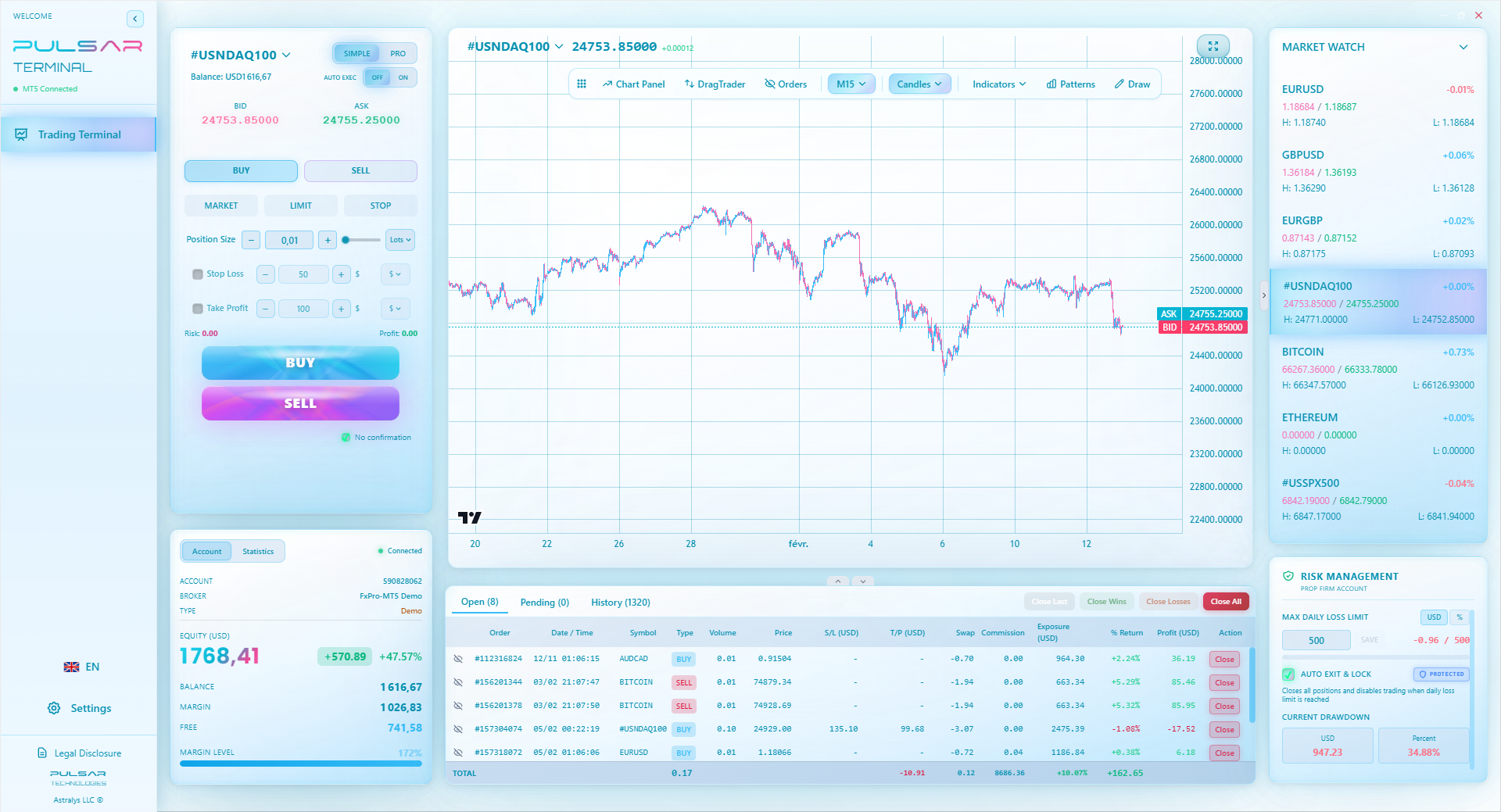
Managing the complex rules of a prop firm challenge, like daily loss limits, is a perfect job for automation, which is exactly what Pulsar Terminal's prop firm protection features are built for on MT5.
Pulsar Terminal
أداة MT5 الشاملة: أوامر سحب وإفلات، متعدد TP/SL، تريلينج ستوب، تداول الشبكة، Volume Profile وحماية البروب فيرم. يستخدمها أكثر من 1000 متداول يومياً.
“A real educational experience focuses on the mechanics of trading. A sales internship focuses on lead generation.”
Whether you land a dream internship or go the self-taught route, these are the non-negotiable skills you must build. No one will hand them to you.
Technical Analysis Proficiency: Don't just know indicators, understand what they're calculating. Know the difference between a lagging indicator like the MACD indicator and a momentum oscillator like the RSI. Learn to read price action and structure. This is your bread and butter.
Risk & Money Management: This is what separates gamblers from traders. You must be able to calculate your position size for any given trade based on your account size and stop-loss distance. It should be second nature. If you're risking more than 2% of your capital on a single idea, you're not a trader, you're a punter.
Psychological Discipline: This is the hardest part. You need to follow your plan when you're down R1,000 and when you're up R1,000. You need to handle boredom, fear, and greed. A journal is critical. Write down every trade, your rationale, and your emotional state.
Basic Understanding of Fundamentals: You don't need a PhD, but you should know what the SARB interest rate decision means for the Rand, or how US non-farm payrolls data impacts the Dollar. Follow local and global financial news.
Here’s a personal failure: In 2019, I had a solid scalping strategy on EUR/USD. My analysis was good. But I didn't standardize my position size. One day, after two wins, I tripled my usual size on a 'sure thing.' A surprise news spike hit, my stop was too tight, and I lost 12% of my account in 90 seconds. That was a R9,600 lesson in the absolute necessity of fixed fractional position sizing. An internship that doesn't hammer this home is useless.
💡 نصيحة وينستون
The market charges tuition every day. A demo account is a scholarship. Use it until your journal shows 3 consecutive months of disciplined, rule-based profitability. Only then consider it an internship.
“Your performance should not be tied to bringing in new depositors. It should be tied to your understanding of the markets.”
Stop scrolling through dodgy job ads. Start here instead.
- Open a Demo Account: Go to the website of a well-reviewed, internationally regulated broker (like those we review) and open a free demo account. Give yourself R100,000 or $10,000 in virtual money. This is your laboratory.
- Pick One Pair: Start with a major pair like EUR/USD. It has tight spreads and tons of analysis available. Learn everything about its behavior. Don't jump around.
- Learn One Strategy: Pick a simple strategy based on support/resistance or a single indicator. Trade it on your demo account for 100 trades. Record every single one in a spreadsheet: entry, exit, profit/loss in pips, and reason.
- Study the FSCA Website: Spend an afternoon on www.fsca.co.za. Use their search tool to look up any company that contacts you. Understand what their warnings list looks like.
- Network Intelligently: Join serious online trading communities or local investment clubs (like those at universities). Avoid Telegram groups promising '100% signals.' Look for groups that discuss analysis and risk.
- Consider the Prop Route: If you have some savings, research a reputable prop firm. The fee for their challenge is your tuition. Treat it with the seriousness of a final exam.
The path is there. It's just not labeled 'forex internship' on Gumtree. It's labeled self-discipline, continuous learning, and a relentless focus on risk. That's the only internship that truly matters in the long run.
FAQ
Q1Are forex internships in South Africa paid?
Legitimate internships at banks or asset managers usually offer a stipend or salary. The scammy 'trainee dealer' sales jobs typically work on commission-only, meaning you only earn if you convince people to deposit money. You should never have to pay a fee to join an internship.
Q2Can I get a forex internship with no experience?
For a real analytical internship, some basic knowledge of finance or economics is expected. For the sales-type 'internships,' they specifically target people with no experience because they're easier to mould with sales tactics. Your goal should be to gain real knowledge via a demo account and self-study first, making you a candidate for the real opportunities.
Q3What is the best alternative to a forex internship?
A prop firm trading challenge is the most direct alternative. It tests and trains your actual trading skills. Alternatively, a self-directed apprenticeship using a demo account, a detailed trading journal, and courses from credible sources is a powerful way to build a foundation without relying on a potentially exploitative 'internship.'
Q4Is forex trading a good career in South Africa?
It can be, but it's extremely difficult and high-risk. Very few people succeed as full-time retail traders. A more stable career path is to work within the financial industry (at a bank, broker, or fund) where you get a salary and learn about forex as part of your role. Trading your own capital should be treated as a serious business venture, not a casual career starter.
Q5How do I know if a forex 'training program' is legitimate?
Check if the provider is FSCA-licensed. Look for transparent pricing with no hidden fees. Be wary of unrealistic promises of income. Legitimate education focuses on risk management and psychology, not 'secret indicators' or 'guaranteed wins.' Ask for detailed curriculum and proof of past student success (like verified track records, not just testimonials).
Q6What qualifications do I need for a real trading job?
For institutional roles, a degree in Finance, Economics, Mathematics, or Engineering is typically the baseline. For prop trading, your proven track record (via a challenge or your own audited results) is your primary qualification. Certifications like the Certified Financial Technician (CFTe) can also add credibility.
درس البروفيسور وينستون
النقاط الرئيسية:
- ✓Verify FSCA licensing for any company offering training.
- ✓Never pay an upfront fee for a trading 'internship'.
- ✓Real programs teach risk management first, entries second.
- ✓A prop firm challenge is a valid modern alternative.
- ✓Develop skills with a demo account before risking capital.
ما مدى فائدة هذا المقال؟
انقر على نجمة للتقييم
رؤى التداول الأسبوعية
تحليلات واستراتيجيات أسبوعية مجانية. بدون رسائل مزعجة.
عن المؤلف
David van der Merwe
متداول الأسواق الناشئة
متداول مقيم في جوهانسبرغ مع 11 عاماً في عملات الأسواق الناشئة. متخصص في أزواج ZAR والتداول المنظم من FSCA وتحليل السوق الجنوب إفريقي.
التعليقات
تحذير من المخاطر
ينطوي تداول الأدوات المالية على مخاطر كبيرة وقد لا يكون مناسبًا لجميع المستثمرين. الأداء السابق لا يضمن النتائج المستقبلية. هذا المحتوى لأغراض تعليمية فقط ولا ينبغي اعتباره نصيحة استثمارية. قم دائمًا بإجراء بحثك الخاص قبل التداول.
قد يعجبك أيضًا

Cara Trading Forex Sukses: 7 Prinsip dari Trader Profesional
Cara trading forex sukses dengan 7 prinsip trader pro: manajemen modal, disiplin, journal trading, backtest. Data nyata, bukan janji profit palsu.
Jam Trading Forex Terbaik untuk Trader Indonesia: Panduan Lengkap dengan Tabel Waktu
Panduan jam trading forex untuk trader Indonesia. Tabel 4 sesi dunia, jam emas 20:00-00:00, sesi mana yang harus dihindari. Data akurat + tips dari trader berpengalaman.
Top 5 Sàn Forex Uy Tín Nhất 2026: Review Jujur dari Trader Indonesia
Top 5 sàn forex uy tín 2026 untuk trader Indonesia. Review jujur: spread, deposit, withdraw, dukungan lokal. Exness, XM, IC Markets & lebih.
احصل على Pulsar Terminal
جميع هذه الحاسبات مدمجة في Pulsar Terminal مع بيانات حية من حساب MT5 الخاص بك.
احصل على Pulsar Terminal