


My screen was a sea of red on March 15, 2025.

Olumide Adeyemi
رائد التداول في غرب أفريقيا ·  Nigeria
☕ 11 دقائق قراءة
ما ستتعلمه:
- 1What 'Live Forex Trading' Really Means in Nigeria Now
- 2The Legal & Tax Setup Every Nigerian Trader Must Know
- 3Brokers, Real Costs & Local Payment Methods That Work
- 4Trading USD/NGN & Other Pairs Live: A Practical Guide
- 55 Common Mistakes Nigerian Traders Make in Live Markets
- 6Building Your Live Trading Routine: From Setup to Shutdown
- 7The Future of Live Forex Trading in Nigeria
My screen was a sea of red on March 15, 2025. The USD/NGN pair had just spiked to ₦1,450 on the official EFEMS platform, and my phone was buzzing with alerts from three different broker terminals. That moment, watching the Central Bank of Nigeria's new electronic matching system in real-time, taught me more about trading the forex market live than any textbook ever could. It wasn't just about charts; it was about understanding how new Nigerian regulations, local liquidity, and global sentiment collide in seconds. If you're trying to make sense of trading live markets from Lagos, Abuja, or Port Harcourt, I've been where you are. Let's break down what actually works.
When we say 'forex market live' in Nigeria today, we're talking about two parallel worlds. There's the global market for pairs like EUR/USD that runs 24/5, and then there's our local USD/NGN market that operates within CBN guidelines on the Electronic Foreign Exchange Matching System (EFEMS). The big change? Since the Investments and Securities Act (ISA) 2025 kicked in, every platform offering live trading to Nigerians must be registered with the SEC. That's huge for consumer protection.
Trading live means reacting to data the moment it hits. I remember sitting through a CBN monetary policy announcement in late 2024 when they hiked rates to 27.5%. The USD/NGN moved 80 pips in under three minutes on my Exness terminal. That's the adrenaline rush, but it's also where people blow accounts. The 'live' part isn't just about speed; it's about context. You need to know if liquidity is drying up during Lagos lunch hours (it often does) or when Nigerian banks are squaring positions ahead of CBN reporting windows.

Warning: That 1:2000 use you see advertised? It's a trap for live traders. I used it once on a GBP/USD scalp during London open. Made $300 in minutes, felt like a genius. Then price reversed before I could blink, and I got a margin call that wiped out two weeks of profits. High use amplifies every live market hiccup.
The real skill in live trading isn't prediction; it's observation. Watching how the USD/NGN rate on the official CBN window influences sentiment on EUR/USD among local traders. Seeing if Pepperstone's liquidity pool thins out at 3 PM WAT. That's the game.

💡 نصيحة وينستون
The market's job is to find your personal pain threshold and push you past it. Your job is to build your trading plan so solidly that the market never gets the chance.
“High use doesn't amplify your skill; it amplifies every live market hiccup.”
Let's get the boring but crucial stuff out of the way first. According to the 2025 ISA, it's completely legal for you to trade your own capital on registered international platforms. The illegal part is if you start pooling money from your friends and family to trade for them without an SEC license. I've seen two guys in my trading group get into serious hot water for that.
The 10% Tax Rule
This one catches everyone off guard. You owe a 10% capital gains tax on your gross forex profits. Gross means total profits before any deductions. It doesn't matter if your broker is based in Cyprus, your money is in a USD domiciliary account, or you're withdrawing to your Opay wallet. If you're a Nigerian resident and you're making money, the taxman wants his share. I learned this the hard way in 2024 after a great quarter trading gold (XAU/USD guide). I set aside tax on my net profit, but my accountant corrected me: it's on the gross. That mistake cost me.
Choosing a Compliant Broker
Your broker must be registered with the SEC to operate here now. Many top international brands are working on it. When you're checking out a broker like IC Markets or XM, look for clear statements about their Nigerian registration status. Don't just rely on their FCA or ASIC license anymore. The local regulation is for your protection - it means there's a path for dispute resolution here in Nigeria.

Pro Tip: Open a separate savings pot for your tax liability. Every time you close a winning trade, immediately calculate 10% of the profit and mentally 'lock it away'. I use a simple spreadsheet, but a dedicated sub-account works too. It prevents a nasty surprise at year-end.
“Trading the Naira pair is less about technical perfection and more about policy and liquidity flows.”
The broker landscape here is competitive, which is good for us. But 'low cost' can be misleading. You need to look at the total cost of a trade: spread + commission + any payment processing fees.
Here’s a quick comparison of what you’re really paying per standard lot (100,000 units):
| Broker | Typical Commission (per lot) | Typical EUR/USD Spread | Best For |
|---|---|---|---|
| IC Markets | $3.50 | 0.1 pips | Raw ECN spreads, great execution speed for scalping. |
| Pepperstone | $3.50 | 0.0 pips (Razor) | Tight spreads during volatile news events. |
| Exness | $0 (on Standard Acct) | 0.7 pips | Beginners who want simple, commission-free pricing. |
| XM | $0 | 0.1 pips (Ultra Low) | Traders who value their massive library of educational resources. |
Funding Your Account
This is where Nigeria shines. We have more deposit options than most countries.
- Bank Transfer/USSD: The old reliable. It can take 1-3 business days for international brokers. Some, like HFM, offer instant NGN deposits with no minimum.
- Debit Cards: Your Verve, Mastercard, or Visa card works instantly. I use this for Exness all the time. Just watch for your bank's international transaction fees (usually 1-2%).
- E-Wallets: OPay and Paga are instant life-savers for local broker deposits. For international brokers, Skrill and Neteller are universal. Neteller has slightly better Naira conversion rates in my experience.
- Crypto (USDT): Growing fast. You convert NGN to USDT on a local exchange, send it to your broker's crypto wallet, and you're funded in minutes. The beauty? It bypasses traditional banking bottlenecks entirely. I used this during the cash crunch last year when nothing else worked.
Remember, the 'minimum deposit' is just to open the account. Your real trading capital should be based on your risk management, not the broker's requirement. Always use a position size calculator before you enter a live trade.
“Trading the Naira pair is less about technical perfection and more about policy and liquidity flows.”
Trading the Naira pair is a different beast from trading EUR/USD. It's less about technical perfection and more about policy and liquidity flows.
The official rate is set on the CBN's EFEMS platform. Authorized dealers (banks) have to report transactions within 10 minutes. As retail traders, we don't trade directly on that system, but our brokers' quoted USD/NGN rate shadows it. The key is watching for dislocation. When the parallel market rate gaps significantly wider than the official EFEMS rate, it creates pressure. That's often when you'll see sharp, volatile moves on your broker's platform as they manage their risk.
For global pairs like EUR/USD, your edge as a Nigerian trader comes from understanding session overlaps. The London session (8 AM - 4 PM WAT) is king for liquidity. But the sweet spot for many Nigerian traders is the overlap between London open and when local banks are active (9 AM - 12 PM WAT). That's when you get clean, high-volume moves.
I once tried trading the Asian session (2 AM - 6 AM WAT) from Lagos. It was a disaster. The spreads were wide, the moves were erratic, and I was sleep-deprived. I lost $150 over two weeks trying to force it. My lesson? Trade when the market is alive, not when you're forcing yourself to be awake.
Tools for the Live Session
- Economic Calendar: Mark CBN MPC dates, FAAC disbursement days, and Nigerian inflation data releases. These are Naira-movers.
- Volume Indicator: Don't just look at price. If price is rising but volume on your MT5 platform is falling, that rally is suspect. It might just be a local liquidity squeeze, not genuine demand.
- Multiple Time Frame Analysis: I use the 1-hour chart for trend direction, the 15-minute for entry timing, and the 5-minute to fine-tune my entry. Jumping straight to the 1-minute chart is a surefire way to get 'noise-traded' out of your position.
💡 نصيحة وينستون
In Nigeria, your first profit target should always be 'preserve capital during a power outage.' Your trading setup is only as strong as its weakest infrastructure link.
“Success in live markets is 30% analysis and 70% routine.”
I've made most of these myself, so no judgment here.
- Chasing 'Too-Good-To-Be-True' Bonuses: A 100% deposit bonus sounds great until you read the 40x trading volume withdrawal requirement. That bonus isn't capital; it's a leash. I got locked into one for months, overtrading just to hit the target.
- Ignoring Internet Reliability: You're in a perfect trade, then 'GoTV is showing...' Your internet drops for 30 seconds. That's all it takes. Have a mobile data hotspot ready as a backup, always. I use two different providers (MTN and Airtel).
- Trading Around Power Outages: If you know 'NEPA' is about to take light, don't open a new position. Even with an inverter, the switchover can cause a router reboot and disconnect you from your broker's server. Close your trades or set wide stops before the expected outage.
- Mistaking Local News for Global Impact: Just because there's political news on Channels TV doesn't mean the Euro is going to budge. I wasted so much energy early on trying to link every local headline to GBP/USD. Focus your analysis on the market your pair cares about.
- Not Accounting for Payment Delays: You see a perfect setup, but your withdrawal from your broker to your bank hasn't arrived yet, so you can't fund your trading account. You miss the move. Plan your capital transfers during calm market periods, not when you're in a trading frenzy.

Example: Let's say you have a ₦500,000 account. A common mistake is risking ₦50,000 (10%) on one EUR/USD trade because you're 'sure'. Use a calculator. With a 20-pip stop loss, that risk means a position size of 2.5 standard lots! That's enormous volatility for a retail account. A sane risk would be 1% (₦5,000), leading to a position size of 0.25 lots.
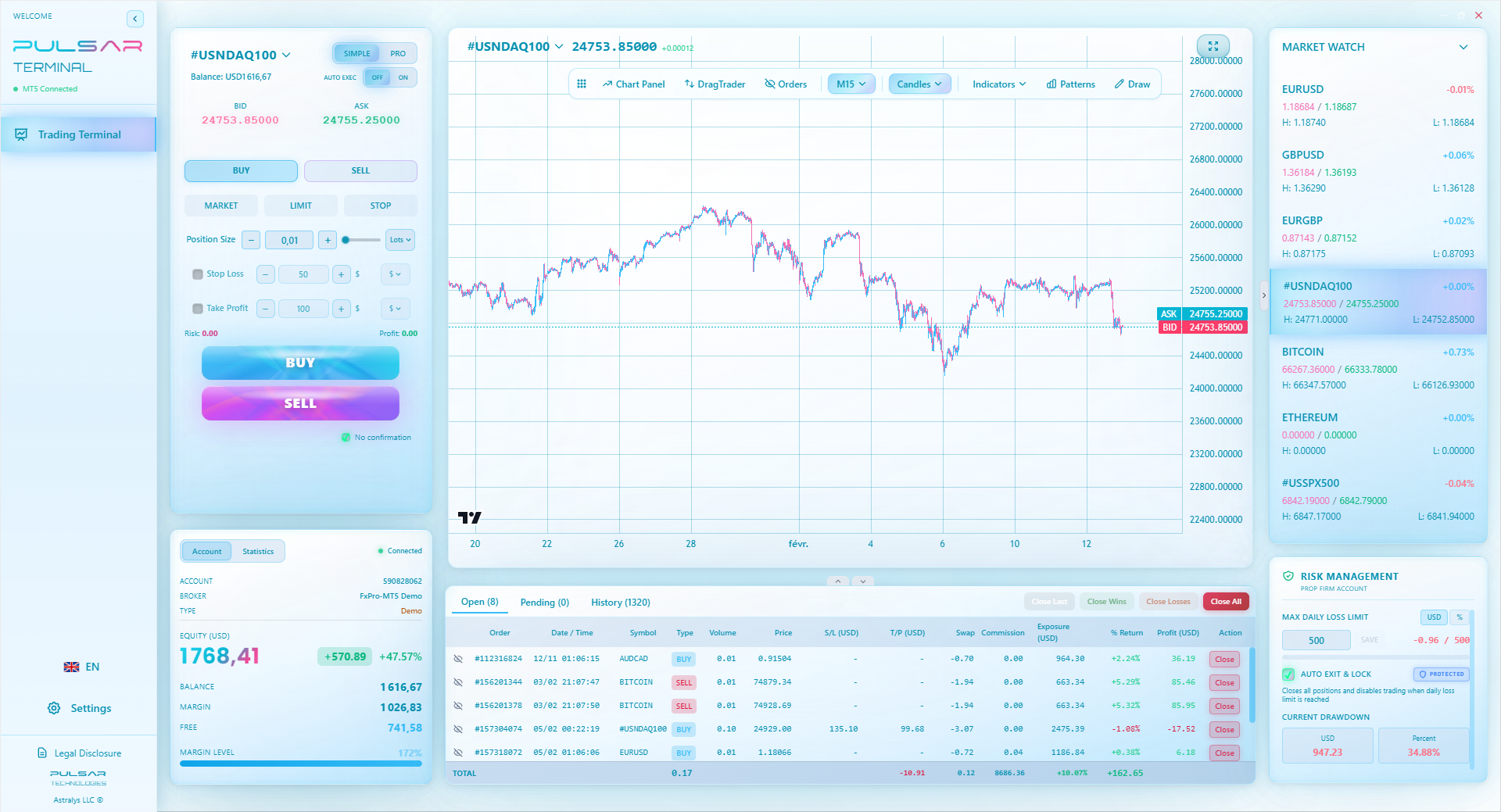
When trading live, managing multiple trades and protecting profits manually is nearly impossible, which is why tools like Pulsar Terminal automate trailing stops and partial closures directly on your MT5 platform.
Pulsar Terminal
أداة MT5 الشاملة: أوامر سحب وإفلات، متعدد TP/SL، تريلينج ستوب، تداول الشبكة، Volume Profile وحماية البروب فيرم. يستخدمها أكثر من 1000 متداول يومياً.
“Success in live markets is 30% analysis and 70% routine.”
Success in live markets is 30% analysis and 70% routine. Here's mine, refined over years of mistakes.
Pre-Market (7:30 AM WAT):
- Check the CBN's official NFEM rate from the previous day. Any major shift from my broker's closing rate?
- Scan the global economic calendar. High-impact news due today? I mark those times in red on my chart.
- Review my open positions (if any). Do my stop losses and take profits still make sense with the new context?
- I run a quick internet speed test. Latency over 100ms? I might avoid ultra-fast scalping that day.
Live Market Hours (8 AM - 4 PM WAT Focus):
- First hour (8-9 AM): I just watch. London is opening, liquidity is building. I don't trade. I'm looking for the day's initial range.
- I have my core tools open: MT5 for execution, TradingView for cleaner charting, and a simple notepad to jot down my trade rationale before I click 'buy' or 'sell'. If I can't write down a clear reason, I don't take the trade.
- I use the RSI indicator and MACD indicator not for signals, but for context. Is there a divergence forming on the 1-hour chart while the 15-minute is overbought? That's a warning, not a trigger.
Post-Market (After 4 PM WAT):
- I journal every trade. Entry, exit, P&L, screenshot of the chart, and most importantly, my emotional state. Was I nervous? Greedy? Bored?
- I reconcile my account balance with my journal. This is how I caught a sneaky overnight swap fee discrepancy once.
- I plan the next day. No analysis, just planning. What time will I be at my desk? What will I review?
The goal is to make the process so mechanical that your emotions can't hijack your live trading session. The market is chaotic enough; your desk shouldn't be.
💡 نصيحة وينستون
That 10% tax isn't a penalty; it's a receipt. It's proof you're in the profitable minority. Frame your first tax bill, don't resent it.
“The goal isn't to win every live trade. It's to live to trade another day.”
The direction is clear: more regulation, more transparency, and hopefully, more sophistication. The SEC's new powers under the ISA 2025 mean the wild west days of unregulated platforms are ending. This is good. It will weed out the scam brokers and force legitimate ones to offer better client protection.
The CBN's EFEMS is a step towards a deeper, more liquid official market. As that market deepens, the volatility between the official and parallel rates should reduce, making the USD/NGN a more 'normal' currency pair to trade, less driven by arbitrage and more by fundamentals.
For us as traders, I think we'll see:
- More NGN-denominated accounts: Brokers like HFM already offer them. This removes the currency conversion risk from your profits and losses.
- Integration of local data: Imagine your trading platform having a direct feed for Nigerian FX reserves data or FAAC allocations. That's coming.
- Stricter use limits: The global trend is towards lower use for retail traders. While 1:2000 exists now, don't be surprised if the SEC, following other regulators, caps it for registered platforms. Learn to trade with lower use now; it's a better skill anyway.
The live forex market in Nigeria is growing up. Turnover hit $8.6 billion in 2025, up 56% from 2024. That's serious money flowing. By understanding the rules, managing your risks, and building a disciplined routine, you can be part of that growth without being a casualty of it. Remember, the goal isn't to win every live trade. It's to live to trade another day.
FAQ
Q1Is forex trading legal in Nigeria in 2026?
Yes, trading your own money on registered platforms is completely legal. The new Investments and Securities Act (ISA) 2025 made it illegal for platforms to operate without SEC registration, which actually strengthens consumer protection. What's illegal is raising funds from others to trade for them without a proper license.
Q2How much tax do I pay on forex profits in Nigeria?
You pay a 10% Capital Gains Tax on your gross trading profits. Gross means your total profits before any deductions for losses or expenses. This applies regardless of where your broker is based or where your money is held.
Q3What is the best time to trade forex in Nigeria?
The most liquid and optimal time is during the London session overlap with local banking hours, roughly from 8 AM to 12 PM West Africa Time (WAT). This is when the EUR/USD and GBP/USD pairs are most active. Avoid the Asian session (middle of the night in Nigeria) as spreads are wider and moves can be erratic.
Q4Can I trade the USD/NGN pair directly?
As a retail trader, you don't trade directly on the CBN's official EFEMS platform. However, many international brokers offer USD/NGN as a CFD or spot pair. Their quoted rate closely shadows the official market rate, but expect it to be less liquid and more volatile than major pairs like EUR/USD.
Q5What is the safest way to fund my forex trading account from Nigeria?
There's no single safest way, but using debit/credit cards (Verve, Mastercard, Visa) for instant funding or trusted e-wallets like Opay, Paga, Skrill, or Neteller is very reliable. For larger amounts, a bank transfer to a broker that offers a local NGN account (like HFM) avoids international transfer fees.
Q6Why do I keep getting disconnected from my trading platform?
This is often due to unstable internet or power fluctuations. Always have a backup mobile data hotspot from a different provider. If you use an inverter/generator, ensure your router is on a circuit that doesn't reboot during the power switchover. Also, choose a broker like IC Markets or Pepperstone known for stable server connections.
Q7What's a realistic starting capital for live trading in Nigeria?
You can start with as little as $50 or ₦50,000, but manage your expectations. With proper risk management (risking 1% per trade), that's for learning, not earning a living. A more practical starter amount that allows for sensible position sizing is between $500 and $1000. Never start with money you can't afford to lose.
درس البروفيسور وينستون
النقاط الرئيسية:
- ✓Trade the London overlap (8 AM-12 PM WAT) for cleanest moves.
- ✓Always calculate tax on gross profits, not net (it's 10%).
- ✓Have two internet providers: MTN for primary, Airtel for backup.
- ✓If you can't write down your trade reason, don't take it.
- ✓A 1% risk per trade lets you survive 100 losing trades in a row.
ما مدى فائدة هذا المقال؟
انقر على نجمة للتقييم
رؤى التداول الأسبوعية
تحليلات واستراتيجيات أسبوعية مجانية. بدون رسائل مزعجة.
عن المؤلف
Olumide Adeyemi
رائد التداول في غرب أفريقيا
أحد أنشط معلمي تداول الفوركس في نيجيريا. 8 سنوات من الخبرة في التداول من لاغوس. متخصص في استراتيجيات رأس المال المنخفض وتحديات شركات البروب للمتداولين الأفارقة.
التعليقات
تحذير من المخاطر
ينطوي تداول الأدوات المالية على مخاطر كبيرة وقد لا يكون مناسبًا لجميع المستثمرين. الأداء السابق لا يضمن النتائج المستقبلية. هذا المحتوى لأغراض تعليمية فقط ولا ينبغي اعتباره نصيحة استثمارية. قم دائمًا بإجراء بحثك الخاص قبل التداول.
قد يعجبك أيضًا

Cara Trading Forex Sukses: 7 Prinsip dari Trader Profesional
Cara trading forex sukses dengan 7 prinsip trader pro: manajemen modal, disiplin, journal trading, backtest. Data nyata, bukan janji profit palsu.
Jam Trading Forex Terbaik untuk Trader Indonesia: Panduan Lengkap dengan Tabel Waktu
Panduan jam trading forex untuk trader Indonesia. Tabel 4 sesi dunia, jam emas 20:00-00:00, sesi mana yang harus dihindari. Data akurat + tips dari trader berpengalaman.
Top 5 Sàn Forex Uy Tín Nhất 2026: Review Jujur dari Trader Indonesia
Top 5 sàn forex uy tín 2026 untuk trader Indonesia. Review jujur: spread, deposit, withdraw, dukungan lokal. Exness, XM, IC Markets & lebih.
احصل على Pulsar Terminal
جميع هذه الحاسبات مدمجة في Pulsar Terminal مع بيانات حية من حساب MT5 الخاص بك.
احصل على Pulsar Terminal