


Think you know what moves the markets? Most traders are obsessed with price, but they're only seeing half the picture.

David van der Merwe
متداول الأسواق الناشئة ·  South Africa
☕ 8 دقائق قراءة
ما ستتعلمه:
Think you know what moves the markets? Most traders are obsessed with price, but they're only seeing half the picture. The real story is told by forex market volume. In South Africa, where over R120 billion in ZAR trades hands daily, understanding volume isn't just smart, it's a survival skill. I've watched too many traders get stopped out on fake moves because they ignored the volume data screaming at them. Let's fix that.
Forex market volume is the total number of currency units traded in a given period. It's the raw fuel behind every price move. Unlike the stock market, there's no single central exchange shouting out the numbers. We have to piece it together from broker data, futures markets, and tick volume.
Here’s the blunt truth: a price move on high volume is an army marching. A price move on low volume is a few scouts wandering off. One has conviction, the other is noise. If you're not checking which is which, you're gambling.

Example: Let's say EUR/USD breaks above a key resistance level at 1.0850. If the breakout happens with volume 40% higher than the 20-period average, that's a strong signal. If it creeps above on whisper-thin volume, it's a trap waiting to snap back. I've been caught in that trap more times than I'd like to admit, buying a 'breakout' that had no real backing.
Most retail platforms show 'tick volume' - the number of price changes. It's not perfect, but it's a reliable proxy. When tick volume spikes, it means a lot of transactions are happening, which usually means the big players are active. Ignoring this is like trying to drive from Joburg to Cape Town without checking your fuel gauge.
Trading USD/ZAR or EUR/ZAR? You're playing in a different sandbox. The Rand makes up about 1% of global forex volume. That sounds small, but it translates to over $80 billion (roughly R1.5 trillion at current rates) traded every single day.
Why This Matters for You
This volume isn't spread evenly. It clusters around key times: the Johannesburg Stock Exchange (JSE) open (9:00 SAST), London open (11:00 SAST), and when major South African economic data drops - CPI, SARB interest rate decisions, budget speeches. A 50-pip move in USD/ZAR at 3 AM SAST on low volume is meaningless. The same move at 11:05 SAST? That's the real deal.
I learned this the hard way. Early in my career, I set a stop-loss 30 pips away on a USD/ZAR position overnight. Some thin, off-hour volatility triggered it, and the price immediately snapped back to where it was. I was out of a good trade for no good reason. Now, I use a position size calculator to account for this inherent volatility and widen my stops when I know volume is typically low.

Warning: Offshore brokers often offer insane use on ZAR pairs - 200:1 or more. The FSCA caps it at 30:1 for a reason. High use plus the Rand's natural volatility on low off-peak volume is a recipe for a margin call. Stick with FSCA-regulated brokers like those we've reviewed (Exness review, IC Markets review) that adhere to local rules.

💡 نصيحة وينستون
A mentor once told me, 'Price is the 'what,' volume is the 'why.' Stop looking at charts with the volume indicator hidden. It's your most honest friend in the market.'
“I've watched too many traders get stopped out on fake moves because they ignored the volume data screaming at them.”
Forget complex theories. Volume analysis comes down to a few powerful, simple concepts. Look for these relationships between price and volume.
| Price Action | Volume | What It Typically Means |
|---|---|---|
| Strong Up Move | Above Average | Bullish conviction. Buyers are in control. |
| Strong Down Move | Above Average | Bearish conviction. Sellers are in control. |
| Up Move | Below Average | Weakness. Likely to fail or reverse. |
| Down Move | Below Average | Weak selling. A bounce may be coming. |
| Price Stalls/Ranges | Drying Up | Indecision. A big move is brewing. |
Volume and Classic Chart Patterns
This is where volume becomes a cheat code. A breakout from a triangle or a head and shoulders pattern needs volume to confirm it's valid. No volume? It's probably fake.
Let me give you a real example from last quarter. GBP/ZAR had been in a tight consolidation around R23.00 for days. Volume was dead. Then, a false spike to R23.20 happened on no volume - I ignored it. The real move came two days later: a surge down to R22.70 on the highest volume I'd seen in weeks. That was the signal. I entered short and rode it for over 400 pips. The volume told me which breakout to trust.
Combine volume with an oscillator like the RSI indicator or MACD indicator for even better signals. If price makes a new high but the RSI doesn't (divergence) AND volume is weak, that's a triple-confirmation that the trend is exhausted.
Theory is fine, but how do you use this? Here are two concrete strategies that work with South African market hours.
1. The JSE/London Open Surge (For Scalpers) This is a classic scalping strategy. Between 10:55 and 11:15 SAST, watch EUR/USD or GBP/USD. Place a buy order and a sell order just outside the current range (a pending order bracket). Whichever side gets taken out by the initial surge, you ride for 10-15 pips. The key filter? Only take the trade if the 1-minute volume bar on the breakout is the largest of the last 10 bars. It catches the initial liquidity rush. I've made consistent R500-R1000 trades using this method, but you have to be quick and disciplined.
2. Volume-Confirmed Swing Trade (For Patient Traders) This suits swing trading ZAR pairs. Wait for USD/ZAR to pull back to a major support level (like a 200-day moving average or previous swing low). Don't buy immediately. Wait for price to touch the level and then start to bounce. The buy signal is a strong bullish candle that closes above the open, where the volume on that candle is at least 150% of the previous day's average volume. It shows the buyers have officially stepped in. This requires patience but offers higher-probability, longer-term trades.

Pro Tip: Don't just look at raw volume numbers. Add a 20-period simple moving average (SMA) of volume to your chart. This instantly shows you what 'above average' and 'below average' look like for that specific instrument right now. It's your baseline.
💡 نصيحة وينستون
If you're [swing trading](/en/strategies/swing-trading), always check the weekly and daily volume on your entry candle. A swing point confirmed by a volume spike has a higher chance of becoming a major turning point.
“High use plus the Rand's natural volatility on low off-peak volume is a recipe for a margin call.”
Let's save you some money and frustration. Here are the volume blunders that cost traders real rands.
Mistake 1: Chasing Low-Volume Breakouts. This is the #1 killer. You see USD/ZAR blast through R19.00 on a news headline at 6 PM SAST. Volume is pathetic. You FOMO in. Ten minutes later, it's back at R18.90 and your stop is hit. The fix? Have a volume indicator open. No confirmation, no trade. It's that simple.
Mistake 2: Ignoring Volume in a Range. When the market is choppy and directionless, volume often contracts. This isn't boring, it's informational. It tells you the big money is waiting. The explosive move that follows the range will almost always start on a volume spike. I used to trade these choppy ranges and get chopped up. Now, I wait for the volume to tell me the range is breaking.
Mistake 3: Misreading ZAR Pair Volume. Remember, USD/ZAR volume is seasonal and time-sensitive. A quiet day in global markets might still see Rand volatility due to local politics. Don't assume low global volume means low ZAR volume. Always check the specific pair's activity. A tool like the Volume Profile in advanced platforms can show you exactly where most trading happened at which prices, cutting through the noise.
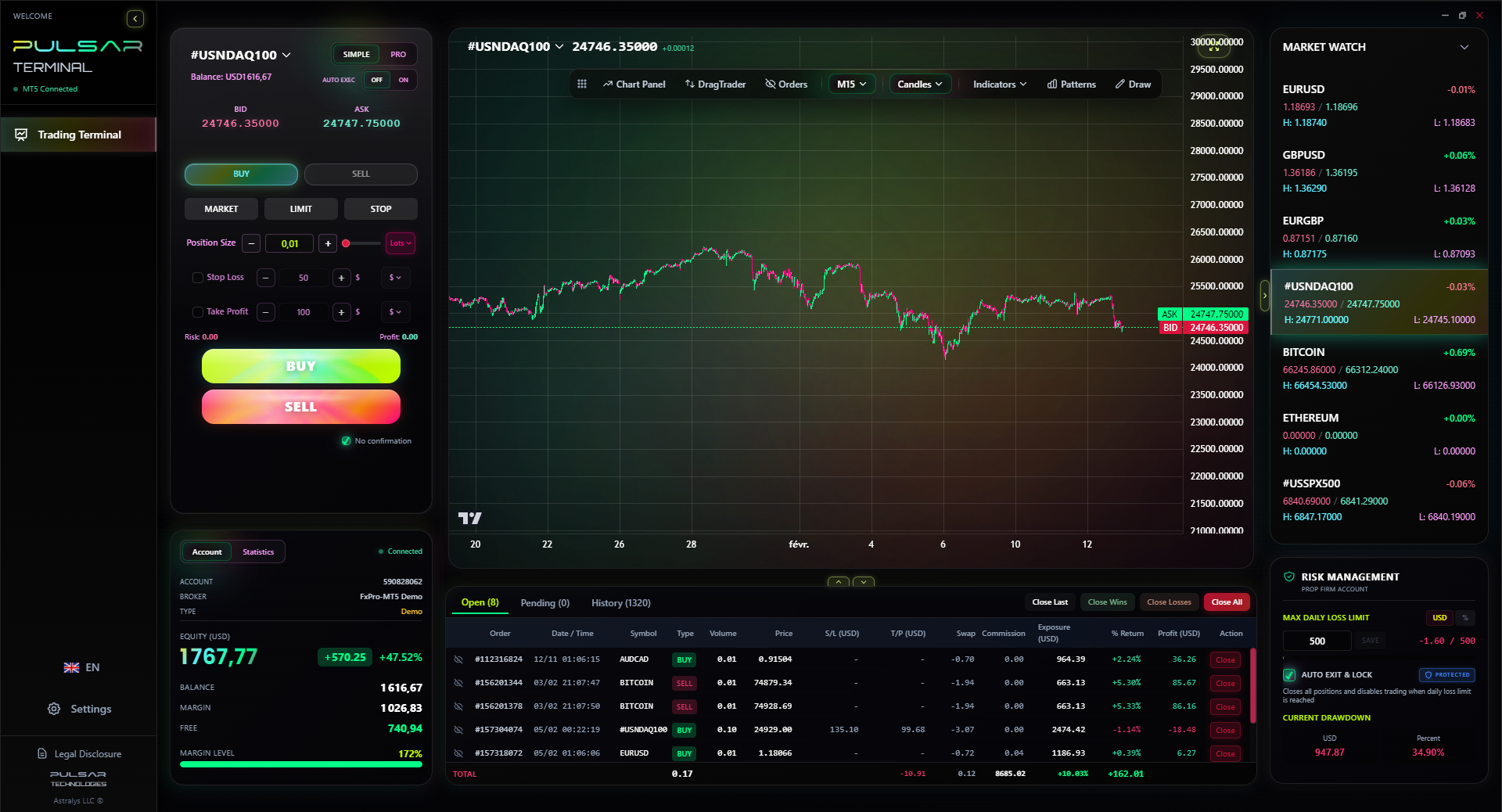
Manually managing trades across volatile, volume-driven breakouts is stressful, which is why tools like Pulsar Terminal automate advanced order types like trailing stops and multi-TP/SL directly on your MT5 charts.
Pulsar Terminal
أداة MT5 الشاملة: أوامر سحب وإفلات، متعدد TP/SL، تريلينج ستوب، تداول الشبكة، Volume Profile وحماية البروب فيرم. يستخدمها أكثر من 1000 متداول يومياً.
You can't trade what you can't see. Here’s where to find decent volume data without spending a fortune.
Your MT4/MT5 Platform: The tick volume is under your nose. It's in the 'Volumes' indicator. It's not perfect, but for spotting relative spikes and divergences, it's 90% of what you need. For more advanced order management on MT5, many pros use companion tools.
Futures Data: The CME (Chicago Mercantile Exchange) offers real futures volume for major currencies (like the 6E contract for EUR/USD). This is actual traded volume, not tick data. You can view it on TradingView or through a data feed. This is the gold standard for confirming moves in majors like EUR/USD or GBP/USD. Our EUR/USD guide dives deeper into using this.
Broker-Specific Volume: Some brokers, like Pepperstone (see our Pepperstone review), provide better volume data feeds than others through their platforms or plugins. It's worth asking about.
The bottom line? You don't need expensive Bloomberg terminals. Start with your platform's tick volume, learn to read it, and then consider upgrading to CME futures data for your core pairs. For trading gold, which often moves on its own volume dynamics, check our XAU/USD guide.
FAQ
Q1Is forex market volume the same as stock market volume?
No, and this is a critical difference. Stock volume is exact shares traded on a central exchange. Forex is decentralized, so the 'volume' you see (usually tick volume) is an estimate based on price changes from your broker's liquidity pool. It's a proxy, but a highly reliable one for measuring relative activity.
Q2Why is volume so important for breakout trading?
A breakout without volume is like a car revving its engine but with the handbrake on. It suggests a lack of institutional participation. High-volume breakouts show that big money is committing to the new direction, making the move far more likely to sustain itself and not immediately reverse.
Q3What is a good volume indicator for MT4/MT5?
Start with the built-in 'Volumes' indicator. For more nuance, the 'Volume Rate of Change (VROC)' can show you the speed of volume increase/decrease. The 'Volume Profile' indicator, which shows volume at specific price levels, is incredibly powerful but often requires a separate plugin or advanced platform.
Q4How does SARB policy affect forex volume in ZAR pairs?
Massively. In the hours before and after a SARB interest rate announcement or MPC statement, volume in USD/ZAR can dry up completely as traders wait, then explode 10-20 times the normal average in the minutes after the news. Trading during these events without understanding volume is extremely dangerous.
Q5Can I use volume for crypto trading?
Yes, the same principles apply, but be even more cautious. Crypto volume data can be fragmented across exchanges and is sometimes subject to 'wash trading' (fake volume). Look for volume on major, reputable exchanges as your primary guide.
Q6As a South African, should I focus more on volume for ZAR pairs or major pairs?
You need to understand it for both, but for different reasons. For majors like EUR/USD, volume confirms pure technical breaks. For ZAR pairs, volume tells you when international liquidity is present vs. when it's just local flows, which is key for judging the staying power of a move.
درس البروفيسور وينستون
النقاط الرئيسية:
- ✓Volume confirms the truth behind a price move.
- ✓ZAR pair volume is highly time-sensitive; trade the JSE/London overlap.
- ✓Never trust a breakout without a volume spike.
- ✓Use a volume SMA to instantly see 'above average' activity.
ما مدى فائدة هذا المقال؟
انقر على نجمة للتقييم
رؤى التداول الأسبوعية
تحليلات واستراتيجيات أسبوعية مجانية. بدون رسائل مزعجة.
عن المؤلف
David van der Merwe
متداول الأسواق الناشئة
متداول مقيم في جوهانسبرغ مع 11 عاماً في عملات الأسواق الناشئة. متخصص في أزواج ZAR والتداول المنظم من FSCA وتحليل السوق الجنوب إفريقي.
التعليقات
تحذير من المخاطر
ينطوي تداول الأدوات المالية على مخاطر كبيرة وقد لا يكون مناسبًا لجميع المستثمرين. الأداء السابق لا يضمن النتائج المستقبلية. هذا المحتوى لأغراض تعليمية فقط ولا ينبغي اعتباره نصيحة استثمارية. قم دائمًا بإجراء بحثك الخاص قبل التداول.
قد يعجبك أيضًا

Cara Trading Forex Sukses: 7 Prinsip dari Trader Profesional
Cara trading forex sukses dengan 7 prinsip trader pro: manajemen modal, disiplin, journal trading, backtest. Data nyata, bukan janji profit palsu.
Jam Trading Forex Terbaik untuk Trader Indonesia: Panduan Lengkap dengan Tabel Waktu
Panduan jam trading forex untuk trader Indonesia. Tabel 4 sesi dunia, jam emas 20:00-00:00, sesi mana yang harus dihindari. Data akurat + tips dari trader berpengalaman.
Top 5 Sàn Forex Uy Tín Nhất 2026: Review Jujur dari Trader Indonesia
Top 5 sàn forex uy tín 2026 untuk trader Indonesia. Review jujur: spread, deposit, withdraw, dukungan lokal. Exness, XM, IC Markets & lebih.
احصل على Pulsar Terminal
جميع هذه الحاسبات مدمجة في Pulsar Terminal مع بيانات حية من حساب MT5 الخاص بك.
احصل على Pulsar Terminal