


Let's get one thing straight: most South Africans who try forex option trading are just buying expensive lottery tickets.

David van der Merwe
متداول الأسواق الناشئة ·  South Africa
☕ 13 دقائق قراءة
ما ستتعلمه:
- 1What Are Forex Options, Really?
- 2The South African Landscape: FSCA Rules & Who to Trust
- 3The Real Costs & Risks Nobody Talks About
- 4Practical Strategies That Actually Work for SA Traders
- 5Getting Started: Your First Trade Checklist
- 6The Graveyard of Common Mistakes
- 7Final Verdict: Should You Trade Forex Options?
Let's get one thing straight: most South Africans who try forex option trading are just buying expensive lottery tickets. They see the 'unlimited profit, limited risk' tagline and ignore the fact that over 80% of retail traders lose money on derivatives. I've watched R50,000 accounts vanish in a month because someone didn't understand what they were really buying. This isn't about scaring you off. It's about showing you exactly how this market works under FSCA rules, what the real numbers look like, and who actually makes money. If you're going to trade options on the Rand or any other pair, you need to know the game you're playing.
A forex option gives you the right, but not the obligation, to buy or sell a currency pair at a specific price (the strike price) before a certain date (the expiry). You pay a premium for this right. That's the textbook definition. Here's what it means in practice: you're buying time and probability.
Think of it like insurance. If you're long the USD/ZAR and worried about a South African Reserve Bank announcement, you might buy a put option as a hedge. The premium is your insurance cost. The problem? Most retail traders use options as pure speculation, not insurance. They buy cheap, out-of-the-money options hoping for a big move, and 90% of the time, that premium expires worthless.
There are two main types:
- Call Option: Right to BUY the base currency.
- Put Option: Right to SELL the base currency.
And two styles:
- American: Can be exercised any time before expiry. (More common with forex options offered by South African brokers).
- European: Can only be exercised at expiry.
The critical thing most beginners miss is time decay. An option's value erodes every single day, accelerating as you get closer to expiry. Buy a one-month option on EUR/USD and you're not just betting on direction, you're betting on the move happening soon. I learned this the hard way in 2019. I bought a ZAR/JPY call option, paid a R1,200 premium. The pair eventually went my way, but it took three weeks. By the time it moved, time decay had eaten 70% of the option's value. I barely broke even. The underlying trade was 'right,' but the option trade was mediocre.

Warning: Don't confuse forex options with binary options. Binary options are banned by the FSCA for a reason - they're practically gambling. A genuine forex option has a continuously changing premium based on the underlying price, time, and volatility.
“Most South Africans who try forex option trading are just buying expensive lottery tickets.”
Trading forex options in South Africa is legal, but it's tightly wrapped in FSCA red tape - and that's a good thing. The Financial Sector Conduct Authority doesn't mess around. They're the ones who banned binary options and cracked down on unlicensed CFD providers. For options, the key regulatory development is the Over-the-Counter Derivative Provider (ODP) licence. This is what separates the legitimate operators from the backyard shops.
A broker like Khwezi Trade getting an ODP licence means they're authorized to create and sell these complex derivatives directly to you, the client, under strict rules. This includes capital adequacy requirements (they must hold enough money) and client fund segregation. Your money should be in a separate bank account, not mixed with the broker's operating funds.
Broker Reality Check
Many brokers advertised for South Africans offer CFDs on forex. Far fewer offer true forex options. You need to look specifically for it.
| Broker | FSCA Regulated? | Offers Forex Options? | Key Point for South Africans |
|---|---|---|---|
| AvaTrade | Yes | Yes (via AvaOptions platform) | One of the few with a dedicated options platform. Local presence. |
| IG | Was, but shifting* | Yes | Serving SA clients via global entities now. Still a major player. |
| Khwezi Trade | Yes (ODP Licence) | Likely (as ODP) | Local broker, Rand-based accounts. ODP licence is a big plus. |
| Exness | Yes | No (Primarily CFDs) | Popular for forex, but not for options trading. |
| XM | Yes | No (Primarily CFDs) | Low minimum deposit, but not an options shop. |
*Note: As of 2026, IG has largely moved its South African client onboarding to its globally regulated entities, which still maintain high standards.
The minimum deposit tells a story. You can start with $5 at XM, but that's for CFDs. For a proper options account where you need to manage premium risk, brokers typically ask for more. Khwezi Trade's minimum is around R500, which is more realistic. Don't think you can seriously trade options with R100. The premiums and position size calculator will laugh at you.

Pro Tip: Always check the FSCA's official register. Type in the broker's name and confirm their licence number and status. If they're not on there, walk away. No exceptions.

💡 نصيحة وينستون
If you can't explain the Greeks (Delta, Gamma, Theta, Vega) and how they affect your option's price over a weekend, you have no business trading them with real money on Monday.
“An option is a wasting asset. If the market sits still, you lose money. Every. Single. Day.”
Your broker's website will talk about 'competitive spreads' and 'no commissions.' For forex options, that's often a half-truth. The costs are baked into the premium in less obvious ways.
- The Bid-Ask Spread on the Option Itself: This is the hidden killer. Let's say you want to buy a USD/ZAR call option. The market might show a 'price' of $150. In reality, the bid is $140, the ask is $160. You buy at $160. The underlying pair needs to move just for you to break even on the premium, not even to make a profit. This spread is often much wider than the spot forex spread definition.
- Time Decay (Theta): I mentioned it before, but it needs its own headline. An option is a wasting asset. If the market sits still, you lose money. Every. Single. Day. This makes buying short-term options a terrible strategy for beginners, yet it's the most common trade I see.
- Volatility Crush: You buy an option before a major event (like a SARB interest rate decision). The premium is high because expected volatility is high. The news hits, the market moves, but not as wildly as predicted. The volatility component of the option's price collapses. You can have the right direction and still lose money because the 'fear premium' evaporated. I got caught in this on a GBP/USD option around the Brexit vote. Nasty lesson.
- Liquidity Risk: Some exotic pairs or far-out expiry dates have terrible liquidity. You might struggle to sell your option back at a fair price. You're stuck holding it to expiry.
Here's a real example from my trading log: I sold a EUR/USD put option (a more advanced strategy) in Q1 2023. I collected a $425 premium. My risk was theoretically large if EUR/USD crashed, but I had a hedge in place with the spot forex. The pair traded sideways for a month, and the option expired worthless. I kept the $425. The key? I was the one collecting time decay, not paying it. Most beginners only know how to buy options, which puts time decay against them from the start.
The use is insane. You can control a $100,000 position with a $1,000 premium. That's 100:1 use. This magnifies gains, but it makes proper position size calculator use non-negotiable. A 1% move against you can wipe out your entire premium.
“An option is a wasting asset. If the market sits still, you lose money. Every. Single. Day.”
Forget the get-rich-quick YouTube strategies. In the South African context, with ZAR volatility, you need a methodical approach.
1. The Hedging Strategy (The Smartest Move)
This is where options shine. You have a core spot forex position - say, you're long AUD/ZAR in your swing trading account. You're worried about short-term Rand strength from a political event. Instead of closing your trade, you buy a short-term ZAR call (or AUD put) option. You're spending a defined premium (your max loss on the option) to protect a much larger position. If the event blows over, you lose the premium but your main trade continues. If ZAR spikes, the option's profit offsets some of your spot loss.
2. Selling Options for Income (Advanced)
This is for experienced traders with a solid view on range-bound markets. If you think USD/ZAR will trade between R18.50 and R19.00 for the next month, you can sell a call option at R19.00 and a put option at R18.50 (a 'short strangle'). You collect two premiums. Your profit is maxed out if the pair stays in that range. The risk? If it breaks out violently, your losses can be large. You need strict stop-losses on the option position itself. This isn't a 'set and forget' trade.
3. The Long Volatility Play
Sometimes, you don't know the direction, but you know a big move is coming (e.g., national budget speech). Instead of guessing up or down, you can buy both a call and a put (a 'long straddle'). It's expensive (you pay two premiums), but if the move is big enough in either direction, you profit. The key is that the implied move priced into the options must be smaller than the actual move. This requires a good sense of market expectations.

Example: Before the 2024 elections, USD/ZAR implied volatility for one-week options jumped. A straddle might have cost a R2,000 premium. If post-election, USD/ZAR moved 3% (say, from R18.80 to R19.36), the call option side would have gained enough value to cover the cost of both premiums and then some.
Most South Africans should start with Concept 1: using options as insurance. It transforms them from a speculative toy into a professional risk management tool. Your first ten option trades shouldn't be about making money. They should be about learning how the premium moves relative to the spot price. Paper trade this relationship first.
💡 نصيحة وينستون
Your first ten live option trades should be so small that a 100% loss feels like a parking ticket, not a car crash. The goal is data collection, not profit.
“Your first ten option trades shouldn't be about making money. They should be about learning how the premium moves.”
If you've read this far and still want in, here's your action plan. Skip a step, and you're increasing your odds of failure.
- Education Before Deposit: Don't even look at a broker website yet. Understand Black-Scholes basics (you don't need the formula, just know what inputs affect price: spot price, strike, time, volatility, interest rates). Know what delta, theta, and vega mean.
- Choose the Right FSCA Broker: Pick one from the table above that explicitly offers forex options. Open a demo account. Not a CFD demo - an options demo. AvaTrade's AvaOptions platform has a good demo. Play with it for a minimum of one month.
- Start with Your 'Why': Define the purpose of your first real trade. Is it to hedge an existing spot position? Is it a defined, speculative bet on a high-probability setup? Write it down. 'I feel like the Rand will weaken' is not a plan.
- Size Tiny: Your first real-money premium should be an amount you are 100% comfortable losing. I'm talking R500 or less. This is a tuition fee, not an investment. The goal is to learn the mechanics of placing, managing, and closing the option trade.
- Plan the Exit Before Entry:
- Profit Target: Will you take profit at 50% premium gain? 100%?
- Stop Loss: Will you exit if the option loses 50% of its value? This is crucial. Unlike a spot forex trade that can linger, options have an expiry date. You can't just 'hold and hope' forever.
- Expiry Action: Will you close it before expiry, or let it expire? (Hint: Almost always close it before expiry to capture any remaining time value).
Platforms matter. You'll likely use MetaTrader 5 for spot analysis and a proprietary platform like AvaOptions for the options themselves. Juggling two screens is common. You need to watch the underlying pair's MACD indicator or RSI indicator on MT5 while managing your option's premium on the other screen.
Funding is straightforward with local brokers. EFT into a South African bank account in Rand. With international brokers, you might use a credit card or international transfer, watching those forex conversion fees. Withdrawals can take 1-3 business days. Keep records for tax purposes - SARS wants its share if you're profitable.
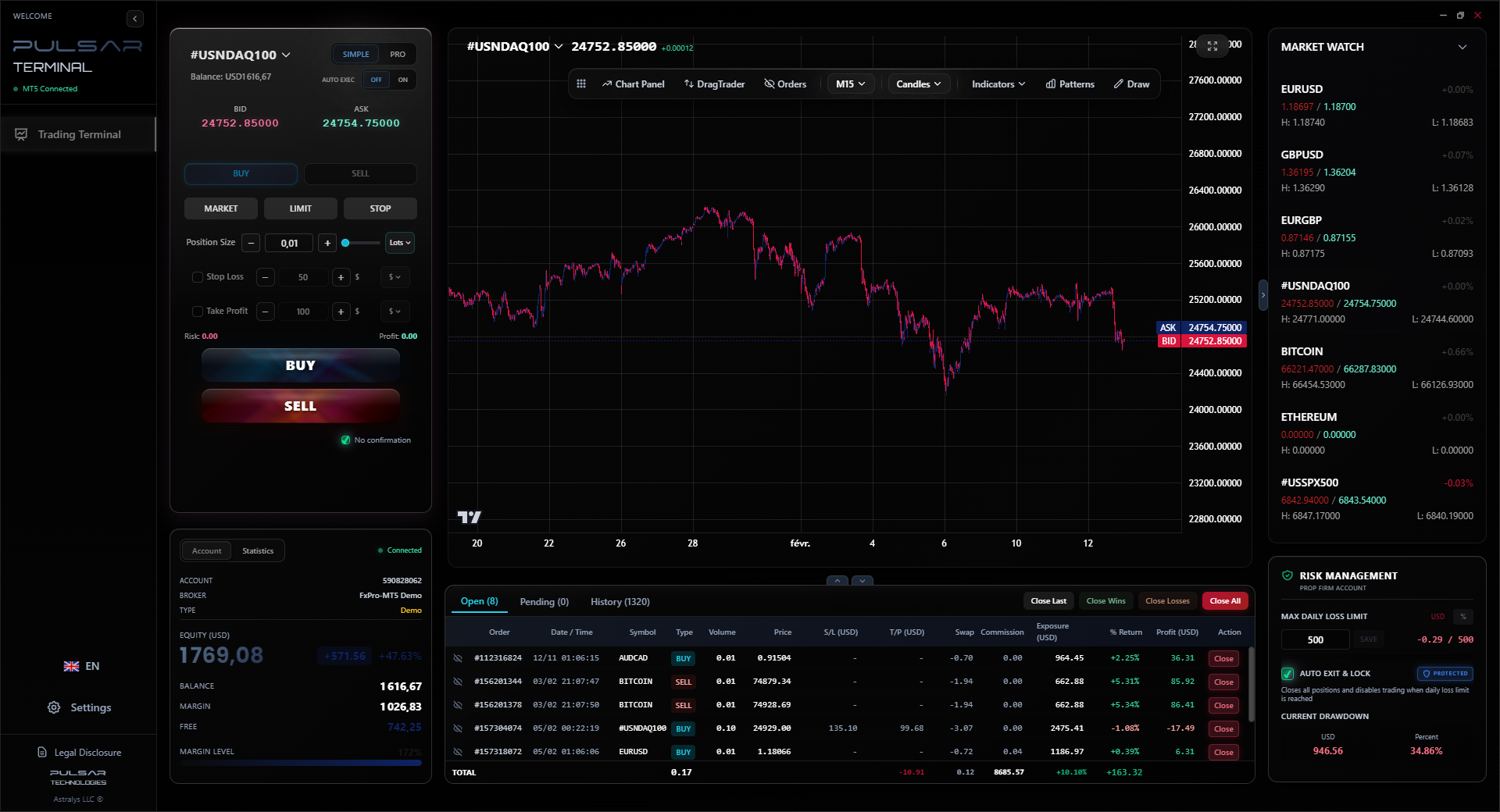
Juggling spot forex charts on MT5 while managing complex option positions is a headache; Pulsar Terminal's advanced charting and multi-window layout lets you monitor the underlying pair and your option's Greeks side-by-side on a single screen.
Pulsar Terminal
أداة MT5 الشاملة: أوامر سحب وإفلات، متعدد TP/SL، تريلينج ستوب، تداول الشبكة، Volume Profile وحماية البروب فيرم. يستخدمها أكثر من 1000 متداول يومياً.
“Your first ten option trades shouldn't be about making money. They should be about learning how the premium moves.”
Let's tour the wreckage. I've made some of these myself. Learn from us.
- Buying Cheap, Out-of-the-Money Options: The R200 lottery ticket. The strike price is so far away it needs a miracle. The probability of expiring worthless is 80%+. It's seductive because it's 'cheap,' but it's cheap for a reason.
- Ignoring Volatility: Buying options when volatility is sky-high (like after a crisis headline). You're paying top dollar for fear. Wait for volatility to settle unless you have a rock-solid view.
- No Exit Plan: 'I'll just hold it.' Then time decay eats the position alive. You need a mechanical exit rule.
- Using Options for Scalping Strategy: Just don't. The wide bid-ask spread will destroy you on short timeframes. Options are not for 5-minute charts.
- Over-leveraging: That R5,000 premium controlling a R500,000 notional value feels powerful. One bad news spike can trigger a margin call on your entire account if you're not careful.
- Confusing CFD Options with Real Options: Some brokers offer 'CFD options.' These are CFDs on the price of an option. They introduce another layer of counterparty risk and may have different financing costs. Stick to the real thing if you can.
The biggest mistake? Thinking forex option trading is a shortcut. It's not. It's a more complex, more nuanced path that requires more discipline, not less. If you can't make money trading spot EUR/USD guide or XAU/USD guide, adding options will only make you lose money faster and in more creative ways.
💡 نصيحة وينستون
The best option trade you'll ever make is sometimes the one you don't take. When in doubt, sit out. The market will always offer another opportunity, but your capital is finite.
“If you can't make money trading spot forex, adding options will only make you lose money faster and in more creative ways.”
Here's my blunt assessment.
You should AVOID forex option trading if:
- You have less than two years of consistent, profitable spot forex trading.
- You're looking for a 'cheap' way to make a big score.
- You don't enjoy studying financial mechanics and probabilities.
- Your risk management on spot trades is still shaky.
You might be READY to explore forex option trading if:
- You have a profitable spot forex strategy and want to learn advanced hedging.
- You understand that your first year will be about education, not income.
- You're fascinated by the mechanics of derivatives and have the patience to paper trade extensively.
- You have trading capital where losing R10,000 on learning wouldn't affect your lifestyle.
For 95% of South African traders starting out, your focus should be on mastering the spot market with a reputable FSCA regulated broker. Learn to read price action, manage a trade, and control your emotions. Build that foundation.
Forex options are a powerful tool in the arsenal of a mature trader. They're not the arsenal itself. They're the precision scalpel, not the machete. Most people walk into this arena holding the scalpel by the blade. Don't be that person. Start with the basics, prove you can survive, then - and only then - consider adding this layer of complexity. The market isn't going anywhere. The opportunity will still be there when you're truly ready.
FAQ
Q1Is forex option trading legal and safe in South Africa?
It's legal and regulated by the FSCA, which makes it safer than unregulated markets. 'Safe' is relative, though. The product itself is high-risk. Your safety comes from using an FSCA-licensed broker (preferably with an ODP licence), understanding the risks fully, and never trading with money you can't afford to lose.
Q2What is the minimum amount needed to start trading forex options in SA?
While some CFD brokers have very low minimums, for a dedicated options account, expect a minimum deposit of around R500 to R2,000. More important than the deposit is the premium size. Your individual trade premiums should be a tiny fraction of your account - think 1-2%. Starting with R500 and buying a R500 option is a guaranteed way to blow up.
Q3What's the difference between a forex option and a CFD?
A forex option is a contract giving you a right to buy/sell at a set price. You risk only the premium paid. A CFD (Contract for Difference) is an agreement to exchange the difference in price of an asset from when you open to when you close. With a CFD, your losses can exceed your deposit if you don't use a stop-loss. Options have defined risk (the premium), CFDs have potentially unlimited risk.
Q4Which South African brokers offer real forex options, not just CFDs?
AvaTrade (via its AvaOptions platform) is the most prominent. Brokers with an FSCA ODP licence, like Khwezi Trade, are also authorized to offer them. Many other popular brokers like Exness, XM, and Pepperstone primarily offer CFDs on forex, not true options. Always check the instrument list on the broker's website.
Q5How are profits from forex options taxed in South Africa?
SARS treats trading profits as income if you're deemed to be trading regularly (a trader), or as capital gains if it's more incidental (an investor). Most active retail traders fall into the 'trader' category, meaning profits are added to your other income and taxed at your marginal rate. Keep detailed records of all trades, including premiums paid and received. Consult a tax professional familiar with trading.
Q6Can I trade options on the South African Rand (ZAR) pairs?
Yes, but liquidity and availability depend on the broker. Major pairs like USD/ZAR and EUR/ZAR are more likely to have options available than exotic crosses. The bid-ask spread will generally be wider on ZAR pairs compared to something like EUR/USD due to lower liquidity. Check your broker's specific offering.
Q7What is the single biggest mistake new option traders make?
Buying short-term, out-of-the-money options because they're 'cheap.' They're cheap because they have a very low probability of finishing in-the-money. It's the equivalent of betting on a 100/1 horse every race. You might get lucky once, but over time, the math guarantees you'll lose.
درس البروفيسور وينستون
النقاط الرئيسية:
- ✓Options are for hedging & income, not lottery tickets.
- ✓Time decay is your enemy as a buyer, your friend as a seller.
- ✓Start with 1% of account risk per option trade.
- ✓Master spot trading before touching options.
- ✓Always check FSCA registration first.
ما مدى فائدة هذا المقال؟
انقر على نجمة للتقييم
رؤى التداول الأسبوعية
تحليلات واستراتيجيات أسبوعية مجانية. بدون رسائل مزعجة.
عن المؤلف
David van der Merwe
متداول الأسواق الناشئة
متداول مقيم في جوهانسبرغ مع 11 عاماً في عملات الأسواق الناشئة. متخصص في أزواج ZAR والتداول المنظم من FSCA وتحليل السوق الجنوب إفريقي.
التعليقات
تحذير من المخاطر
ينطوي تداول الأدوات المالية على مخاطر كبيرة وقد لا يكون مناسبًا لجميع المستثمرين. الأداء السابق لا يضمن النتائج المستقبلية. هذا المحتوى لأغراض تعليمية فقط ولا ينبغي اعتباره نصيحة استثمارية. قم دائمًا بإجراء بحثك الخاص قبل التداول.
قد يعجبك أيضًا

Cara Trading Forex Sukses: 7 Prinsip dari Trader Profesional
Cara trading forex sukses dengan 7 prinsip trader pro: manajemen modal, disiplin, journal trading, backtest. Data nyata, bukan janji profit palsu.
Jam Trading Forex Terbaik untuk Trader Indonesia: Panduan Lengkap dengan Tabel Waktu
Panduan jam trading forex untuk trader Indonesia. Tabel 4 sesi dunia, jam emas 20:00-00:00, sesi mana yang harus dihindari. Data akurat + tips dari trader berpengalaman.
Top 5 Sàn Forex Uy Tín Nhất 2026: Review Jujur dari Trader Indonesia
Top 5 sàn forex uy tín 2026 untuk trader Indonesia. Review jujur: spread, deposit, withdraw, dukungan lokal. Exness, XM, IC Markets & lebih.
احصل على Pulsar Terminal
جميع هذه الحاسبات مدمجة في Pulsar Terminal مع بيانات حية من حساب MT5 الخاص بك.
احصل على Pulsar Terminal