


Here's the biggest myth about forex schools in South Africa: that paying R20,000 for a course guarantees you'll make money.

David van der Merwe
متداول الأسواق الناشئة ·  South Africa
☕ 8 دقائق قراءة
ما ستتعلمه:
Here's the biggest myth about forex schools in South Africa: that paying R20,000 for a course guarantees you'll make money. It's nonsense. I've seen traders blow their entire tuition fee on one bad trade because the 'school' taught them a fancy strategy but skipped the psychology and risk management. This guide isn't about listing course providers. It's about showing you how to actually learn to trade in South Africa, what's worth paying for, and how to spot the predators dressed as mentors. Let's set the record straight.
When you hear 'forex school,' you probably picture a classroom. Forget that. In South Africa, it's almost always an online operation run by one trader or a small team. They sell courses, signals, mentorship, or all three. The FSCA regulates brokers, not educators. This creates a wild west where anyone with a YouTube channel and a few profitable screenshots can call themselves a school.
There's a spectrum. On one end, you have legitimate educators focusing on core concepts - like how a spread works, or why the FSCA's 30:1 use cap matters. On the other, you have 'gurus' selling the dream of quitting your job in 90 days. The latter often charge premium prices (R15,000 to R50,000+) for repackaged information you can find for free.
I made this mistake early on. I paid R8,500 for a 'professional scalping course' from a local 'guru.' The content was decent, but it was just a compilation of basic scalping strategy principles I later found in a R300 book. The real value, which he didn't provide, would have been live feedback on my trades. That's the key differentiator: ongoing support versus a static video library.
Don't judge a program by its sales page. Judge it by what it doesn't promise.
The Green Flags
Look for educators who talk more about risk than reward. A good program will hammer home position sizing before it ever mentions an entry strategy. They should force you to use a position size calculator religiously. They'll be transparent about their own trading history, including drawdowns. Their curriculum should cover the boring stuff: South African tax implications on trading profits, the pros/cons of local vs. international brokers like Exness or IC Markets, and how to handle loadshedding during a trade.
The Red Flags
Run if you see:
- Guaranteed Profits: This is illegal. The FSCA would shut down a broker for this, but 'schools' get away with it.
- Overemphasis on 'Secret Indicators': There are no secrets. If they're selling a 'proprietary' indicator for an extra fee, it's likely a repainted moving average.
- No Discussion of Losses: If every chart shows a perfect win, they're cherry-picking. Trading is about managing losers.

Warning: A common trap is the 'free webinar' that ends with a R25,000 'limited-time offer.' The pressure is a sales tactic, not an educational strategy. A legitimate educator will let you think about it.
The best local mentors I've seen integrate practical tools. They might show you how to set a multi-level exit strategy on a platform, which is a feature that tools like Pulsar Terminal bring to MT5. The focus is on execution, not magic.

💡 نصيحة وينستون
If a course's sales page gives you a feeling of FOMO (Fear Of Missing Out), you're not being educated, you're being marketed to. Real education feels challenging, not exciting.
“You're not buying profits. You're buying structured information and accountability.”
Let's talk numbers. Your education budget has multiple parts, and the course fee is just one.
1. The Course/Mentorship Fee:
- Beginner Basics (R500 - R5,000): Online video courses. Good for absolute fundamentals. Don't expect personalized help.
- Structured Programs (R5,000 - R20,000): Often include modules, some community access, maybe a few live Q&As. This is the sweet spot for serious beginners.
- 'High-Ticket' Mentorship (R20,000 - R100,000+): Promises one-on-one time. Vet this obsessively. Ask for verifiable proof of the mentor's trading, not just their students' testimonials (which can be faked).
2. The Trading Capital: This is separate. You need money to practice. Never use money you need for bills. A realistic starting demo is R50,000 virtual capital. When moving to live, start small - R2,000 to R5,000 is enough to feel the real psychological pressure.
3. The Tool Budget: You'll need a good charting platform. Some brokers like Pepperstone offer free advanced charting. You might pay for additional data or trade journaling software (R200 - R800/month).

Example: A realistic first-year budget for a serious trader:
- Education Course: R12,000
- Starting Live Capital: R5,000
- Tool Subscriptions: R2,400/year
- Total: ~R19,400
Notice the capital is less than the course fee. That's intentional. Your first goal is to not lose the R5,000, not to double it.
You don't have to pay a 'school.' I know traders making consistent profits who never paid for a course. Their university was YouTube, books, and demo accounts. Here's a structured self-education plan:
Phase 1: Foundations (Months 1-2) Learn the absolute basics: what is a pip, how use can cause a margin call, bid/ask spread. Use the FSCA website as a resource to understand your rights. Pick one major pair like EUR/USD and one commodity like XAU/USD to focus on.
Phase 2: Strategy & Backtesting (Months 3-6) Pick ONE simple strategy. Maybe a moving average crossover, or support/resistance. Learn one indicator inside out, like the RSI indicator or MACD indicator. Then, backtest it on 200+ past trades. Write down every result. This is boring, but it's what separates the serious from the dreamers.
Phase 3: Demo Trading (Months 6-9) Trade your strategy on demo with real emotional discipline. Pretend it's real money. Your goal isn't profit, it's consistency in following your plan.
The downside? It's lonely. You have no one to ask when you're confused. You'll waste time on bad information. A good course accelerates this by providing a vetted curriculum and a community. But if you're disciplined, the free path is viable.
💡 نصيحة وينستون
Your first R10,000 is better spent on live trading capital (and potentially losing it) than on an advanced course. You learn more from one real loss than from 100 hours of theory.
“A simple strategy with iron-clad discipline will beat a brilliant strategy with poor psychology every single time.”
Many forex schools in South Africa now bundle their courses with 'guidance' for passing prop firm challenges. Here's the truth: the prop firm challenge is the ultimate test of everything a good course should teach you.
These challenges have strict rules: a maximum daily loss, a maximum overall loss, and a profit target. They force the discipline that most retail traders lack. If a school is preparing you for this, they're probably teaching solid risk management.
For example, passing a R20,000 challenge requires careful position size calculator use. You can't afford a single reckless trade. A good mentor will drill this into you. They'll teach you how to set hard stops and maybe even use a trailing stop to lock in profits - execution features that become critical.
But be wary of schools that guarantee you'll pass if you buy their specific 'prop firm strategy.' The strategy is usually just tight risk management. The real work is in your head. I used a very simple swing trading approach to pass my first challenge, not a secret method. The school's value was in keeping me psychologically steady during the drawdown period.
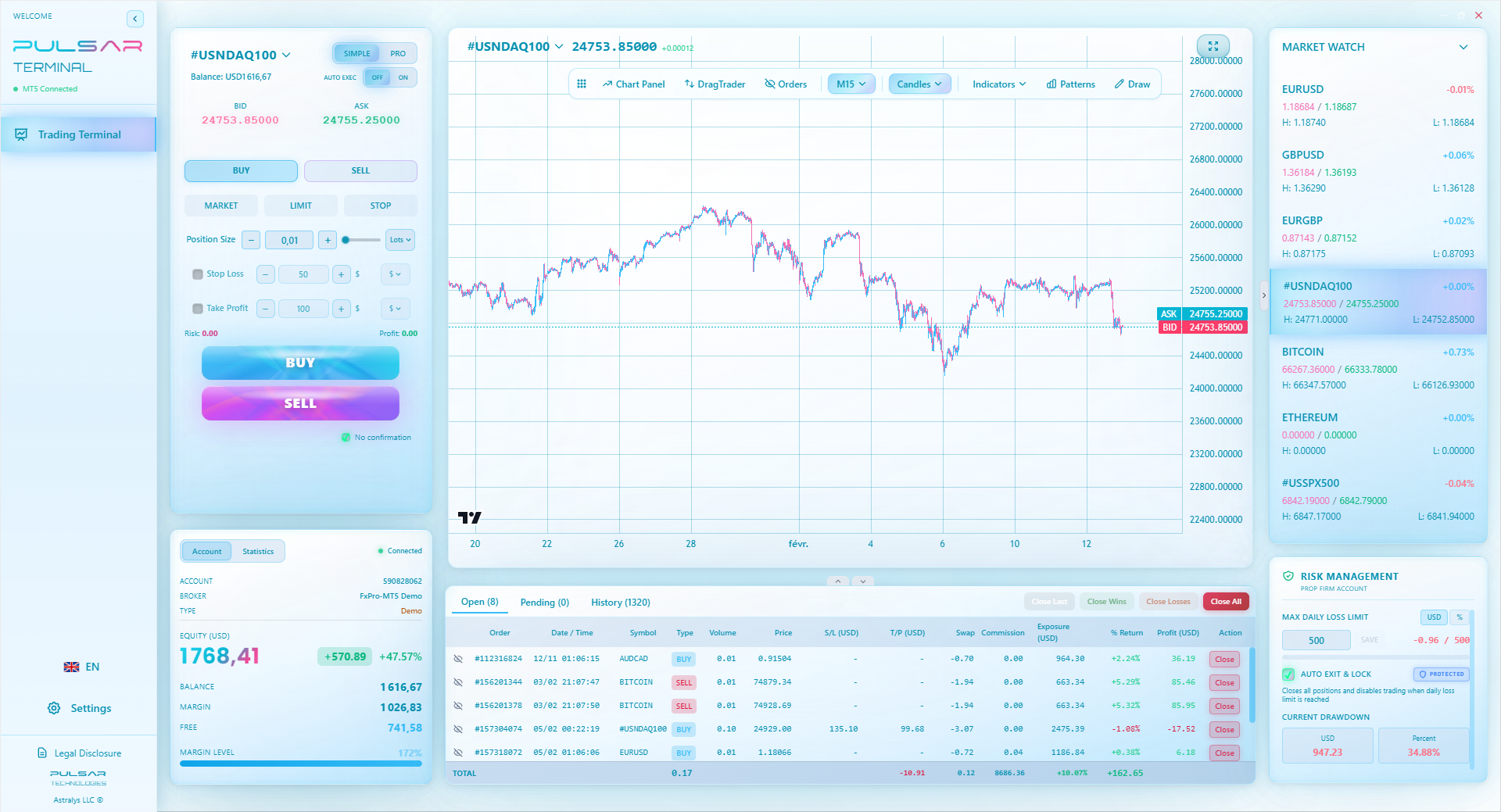
Managing the strict daily loss limits of a prop firm challenge is a huge psychological burden, which is why automating your risk rules with a tool like Pulsar Terminal can be the difference between passing and failing.
Pulsar Terminal
أداة MT5 الشاملة: أوامر سحب وإفلات، متعدد TP/SL، تريلينج ستوب، تداول الشبكة، Volume Profile وحماية البروب فيرم. يستخدمها أكثر من 1000 متداول يومياً.
Before you type in your credit card details, do this due diligence checklist:
- Demand Transparency: Ask the educator for a verified MyFxBook or similar statement of their live trading (not demo) over at least 12 months. Look for consistency, not just high profit.
- Talk to Alumni: Get in touch with past students, not just the ones featured on the website. Ask them: "What was the ONE thing this course didn't prepare you for?"
- Analyze the Content: Does the syllabus include psychology, risk management, and journaling? Or is it just 20 modules on entry patterns?
- Test the Support: Email them with a specific, technical question about trading. See how long they take to respond and how helpful they are.
- Check Broker Affiliations: Some 'schools' are just fancy introducers for a specific broker. There's a conflict of interest if they're getting a kickback on your losses (through rebates).
Remember, you're not buying profits. You're buying structured information and accountability. The former you can get for free. The latter is what you might pay for. I value accountability so highly that I still have a trading peer I pay to review my journal monthly. That specific, ongoing feedback is worth more than any 100-hour video course I ever bought.
💡 نصيحة وينستون
The most valuable thing a mentor can give you is not a signal, but the courage to stick to your stop-loss when everything in your gut is screaming to move it.
“The prop firm challenge is the ultimate test of everything a good course should teach you.”
Stop looking for the perfect school. Start doing these things today:
- Open a Demo Account: Do it right now. With XM or any other major broker. Don't trade yet. Just click around the platform. Place a fake trade and see how the P&L moves.
- Read One Book: I recommend 'Trading in the Zone' by Mark Douglas. It's about psychology, not strategy. It will save you thousands in future mistakes.
- Follow the FSCA: Bookmark the FSCA's warning list and broker register. Make checking a broker's license a habit.
- Start a Journal: Use a Google Sheet. Every day, write your market observation, your emotional state, and later, your trade plans. This habit alone will put you ahead of 80% of newcomers.
After 30 days of doing this, you'll have much better questions. You'll know if you even like the feel of trading. Then, if you still want a course, you'll be a smarter consumer. You'll be able to spot the salesman from the teacher. And that's the most important trade you'll ever make.
FAQ
Q1Are forex schools in South Africa regulated by the FSCA?
No, not directly. The FSCA regulates financial service providers (brokers, insurers). Forex schools operate as general businesses or educational institutions. This means there's no official FSCA 'seal of approval' for a course, so due diligence is 100% your responsibility.
Q2What is a reasonable price for a good forex trading course in South Africa?
For a complete beginner-to-intermediate program with community access and some live support, expect to pay between R8,000 and R20,000. Anything significantly higher needs to offer exceptional, verifiable one-on-one mentorship. Anything under R2,000 is likely a basic video library with little to no support.
Q3Can I learn forex trading for free in South Africa?
Absolutely. The core information is all available for free online and in libraries. The challenge is structuring it, filtering out bad advice, and staying disciplined without guidance. The free path is longer, more difficult, and requires high self-motivation, but it's entirely possible.
Q4How do I know if a forex school or mentor is a scam?
Major red flags: guaranteed profits, pressure to sign up with 'limited-time' discounts, reluctance to share verifiable long-term trading results, and an overemphasis on selling you additional 'secret' tools or signals. Legitimate educators focus on teaching you to fish, not selling you a daily fish.
Q5Should I choose a South African forex school or an international one?
A local school has advantages: they understand SARB regulations, local tax, loadshedding challenges, and can advise on FSCA-regulated brokers. An international school might have a larger community and different perspectives. The best choice depends on the specific educator's quality, not their location.
Q6Is passing a prop firm challenge a good way to learn?
It's an excellent test of your skills, but a terrible primary learning method. The challenges are expensive (entry fees) and high-pressure. You should only attempt one after months of consistent demo trading. Think of it as your final exam, not your textbook.
Q7What's more important, the trading strategy or the psychology taught?
Psychology, 100%. A simple strategy with iron-clad discipline will beat a brilliant strategy with poor psychology every single time. Any school that spends less than 30% of its time on mindset, risk tolerance, and journaling is teaching you to drive a Ferrari without brakes.
درس البروفيسور وينستون
النقاط الرئيسية:
- ✓The FSCA regulates brokers, not schools. Vet educators yourself.
- ✓A realistic first-year budget is ~R19,400 (course, capital, tools).
- ✓Psychology and risk management are 80% of the game.
- ✓Use a demo account for at least 3-6 months before going live.
- ✓Prop firm challenges are a test, not a learning tool.
ما مدى فائدة هذا المقال؟
انقر على نجمة للتقييم
رؤى التداول الأسبوعية
تحليلات واستراتيجيات أسبوعية مجانية. بدون رسائل مزعجة.
عن المؤلف
David van der Merwe
متداول الأسواق الناشئة
متداول مقيم في جوهانسبرغ مع 11 عاماً في عملات الأسواق الناشئة. متخصص في أزواج ZAR والتداول المنظم من FSCA وتحليل السوق الجنوب إفريقي.
التعليقات
تحذير من المخاطر
ينطوي تداول الأدوات المالية على مخاطر كبيرة وقد لا يكون مناسبًا لجميع المستثمرين. الأداء السابق لا يضمن النتائج المستقبلية. هذا المحتوى لأغراض تعليمية فقط ولا ينبغي اعتباره نصيحة استثمارية. قم دائمًا بإجراء بحثك الخاص قبل التداول.
قد يعجبك أيضًا

Cara Trading Forex Sukses: 7 Prinsip dari Trader Profesional
Cara trading forex sukses dengan 7 prinsip trader pro: manajemen modal, disiplin, journal trading, backtest. Data nyata, bukan janji profit palsu.
Jam Trading Forex Terbaik untuk Trader Indonesia: Panduan Lengkap dengan Tabel Waktu
Panduan jam trading forex untuk trader Indonesia. Tabel 4 sesi dunia, jam emas 20:00-00:00, sesi mana yang harus dihindari. Data akurat + tips dari trader berpengalaman.
Top 5 Sàn Forex Uy Tín Nhất 2026: Review Jujur dari Trader Indonesia
Top 5 sàn forex uy tín 2026 untuk trader Indonesia. Review jujur: spread, deposit, withdraw, dukungan lokal. Exness, XM, IC Markets & lebih.
احصل على Pulsar Terminal
جميع هذه الحاسبات مدمجة في Pulsar Terminal مع بيانات حية من حساب MT5 الخاص بك.
احصل على Pulsar Terminal