


I lost $1,200 on a USD/NGN trade in late 2024 because I ignored the sentiment.

Olumide Adeyemi
رائد التداول في غرب أفريقيا ·  Nigeria
☕ 10 دقائق قراءة
ما ستتعلمه:
- 1What Exactly Is Forex Sentiment (And Why It's Different Here)
- 2The Tools: How to Gauge the Market's Mood
- 3The CBN: Nigeria's Ultimate Sentiment Engine
- 4The Contrarian Play: When to Bet Against the Crowd
- 5Where to Get Your Sentiment Intel (Forget Bloomberg for This)
- 6Putting It All Together: A Sentiment-Aware Trading Plan
- 7Mistakes I've Made (So You Don't Have To)
I lost $1,200 on a USD/NGN trade in late 2024 because I ignored the sentiment. The charts looked perfect for a naira short. Price was at a key resistance, the RSI was overbought, and the fundamentals seemed weak. I went all in. What I missed was the overwhelming bullish sentiment brewing from new CBN policies. The market didn't care about my technicals. It was flooded with optimism, and my stop-loss got obliterated in a 48-hour rally. That loss taught me that in Nigeria, sentiment isn't just a side note, it's the main event.
Forex sentiment is the collective mood or bias of all market participants. It's the gut feeling of the crowd, the prevailing optimism or pessimism that drives price action before the fundamentals are fully priced in. Think of it as the market's psychology.
In most markets, you look at economic data and central bank statements. Here, you have to add a thick layer of local reality. The sentiment around the Naira isn't just about interest rates or inflation (though those matter). It's about fuel queues, the latest CBN circular hitting Twitter, the whispers about dollar liquidity at the BDCs, and whether your uncle in Lagos can get cash for his business trip. It's hyper-local and incredibly powerful.

Warning: Sentiment can make a fundamentally weak currency strong, and a strong one weak, for longer than you can stay solvent. My failed USD/NGN trade is proof. Never fight a strong sentiment trend with just a chart pattern.
This local mood swings violently with policy changes. When the CBN re-admitted BDCs in February 2026 with new rules, the immediate sentiment wasn't just about the policy details. It was a signal. The market read it as 'liquidity is coming,' and that hopeful feeling moved the market faster than any economic report.

💡 نصيحة وينستون
Sentiment is the wind. Your trading plan is the sail. You can't control the wind, but you can adjust your sail. Never set a course that ignores which way the wind is blowing.
“In Nigeria, sentiment isn't just a side note, it's the main event.”
You can't measure a feeling with one tool. You need a dashboard. Here's what I use, from the simple to the complex.
The COT Report (For the Big Players)
The Commitments of Traders (COT) report shows you what the big institutional guys (commercials, hedge funds) are doing in the futures market. It's a lagging indicator, coming out every Friday, but it shows you if the 'smart money' is leaning heavily one way. If commercials are massively net long the USD against the Naira, it tells you something about longer-term expectations for dollar demand.
Retail Trader Positioning
This is the 'dumb money' indicator, and it's often contrarian. Most brokers publish data showing the percentage of their clients long or short a currency pair. If 80% of retail traders are short the Naira, be very cautious about joining them. The crowd is often wrong at extremes. I check this data on my broker's site weekly; it saved me from another bad Naira short in Q1 2025.
Fear & Greed in the News
Headlines matter. Create a simple scoring system. Count the number of bullish Naira headlines (e.g., 'Reserves Rise,' 'CBN Attracts Inflows') versus bearish ones ('Dollar Scarcity Bites,' 'Parallel Market Gap Widens') in major local papers like BusinessDay and Punch over a week. The ratio gives you a crude but effective sentiment score. In March 2024, the bullish headline count went parabolic just as the Naira started its rally from N1,600+ levels.

Example: In my trading journal for October 2025, I noted: "Bullish Headlines: 12 (Reserves up, EFEMS volume high). Bearish: 3 (Oil price dip). Score: Strongly Bullish. Aligns with COT data showing reduced speculative Naira shorts. Bias: Look for Naira strength setups on pullbacks."
For analyzing these data points on your charts, a platform with clean visualization is key. Many traders I know use advanced tools within MT5 platforms or external terminals to plot sentiment data alongside price action.
“The CBN doesn't just change rules with its policies; it changes the market's entire psychology.”
If you learn nothing else, learn this: The Central Bank of Nigeria is the most important sentiment driver in the local forex market. Their statements and policies don't just change rules, they change minds.
Let's talk about recent history. The unification and float of the Naira in 2023 was a massive sentiment shock. Overnight, the official rate jumped from N460 to N760. The immediate sentiment was panic and uncertainty. But for traders, the sentiment shift that followed was key: this was a move towards a transparent, market-driven rate. That long-term optimism began to build, even as short-term pain was intense.
Fast forward to 2026. Look at two major moves:
- Re-admitting BDCs (Feb 2026): The policy itself added liquidity. But the sentiment impact was bigger: "The CBN is engaging all players, restoring confidence in the formal market." That's a positive mood shift.
- Lifting FX restrictions on oil proceeds (Mar 2026): Allowing IOCs to repatriate 100% of earnings immediately signaled "we are open for business and trust the market." That improves foreign investor sentiment directly.
Your job is to interpret the sentiment behind the policy, not just the policy mechanics. A policy that boosts long-term confidence (like the EFEMS transparency system) can create a bullish sentiment that outweighs a temporarily weak economic number. This is why combining sentiment with a solid swing trading approach can be so effective, as it allows these broader mood shifts to play out.
“The CBN doesn't just change rules with its policies; it changes the market's entire psychology.”
This is where you make real money, and also where you can get destroyed. Going against extreme sentiment is a high-risk, high-reward strategy.
Here's my rule: I only consider a contrarian trade when retail positioning hits an extreme (like over 80% on one side) AND I have a technical signal at a major support or resistance level. And my position size is always half my usual.
I remember in late 2025, everyone was euphoric about the Naira. Net forex inflows were up 12.3%, reserves touched $43 billion. The sentiment was overwhelmingly positive. Retail trader data showed 85% were long Naira against the dollar. Then, on the weekly chart, USD/NGN formed a clear bullish divergence on the RSI indicator. Price was making lower lows, but the RSI was making higher lows. The crowd was all-in on one side, and the momentum was secretly waning.
I took a small, scary long USD/NGN position near N1,420. I felt completely alone. But within two weeks, profit-taking and a slight reserve drawdown sparked a correction. The pair moved back to N1,470. I took 50% off and trailed the rest. That 500-pip move on a half-position paid better than most of my "conviction" trades. The key was using the extreme sentiment as a signal, not the sole reason. Always wait for price to confirm. Never just short because 'everyone is long.'
Managing such a tense trade requires precision. Setting multiple take-profit levels and a trailing stop is essential to capture the move without being shaken out. This is where having a tool that automates multi-TP/SL with partial closures can turn a stressful contrarian bet into a systematic plan.
💡 نصيحة وينستون
When everyone in the market is shouting the same thing, whisper your trade. But only if your chart agrees. Contrarian for the sake of it is just arrogance.
“Going against extreme sentiment is a high-risk, high-reward strategy. I only do it with half a position and a confirmed price signal.”
International news is fine for EUR/USD. For Naira sentiment, you need local sources.
- Financial Newspapers: BusinessDay, The Guardian (Business), Punch (Business). Don't just read the articles. Read the editorials and the letters to the editor. They capture the emotional temperature.
- CBN's Website: It's dry, but vital. Read the circulars and press releases yourself. Don't rely on a journalist's summary. The wording matters for sentiment.
- Social Media (Used Carefully): Follow credible economists, finance journalists, and analysts on Twitter (X). The real-time discussion around a policy announcement is pure, unfiltered sentiment. But filter out the noise and panic-mongers.
- The 'Parallel Market' Pulse: This isn't about trading there. It's about monitoring the gap between the official NAFEM rate and the parallel rate. A widening gap signals distrust and negative sentiment in the street. A narrowing gap signals growing confidence in the formal system. It's a brilliant, real-time sentiment gauge.
I have a morning routine: Check NAFEM vs. parallel rate on Naijabdcs.com. Skim BusinessDay headlines. Check my broker's retail positioning. Then I look at my charts. That 15-minute routine gives me a sentiment edge.
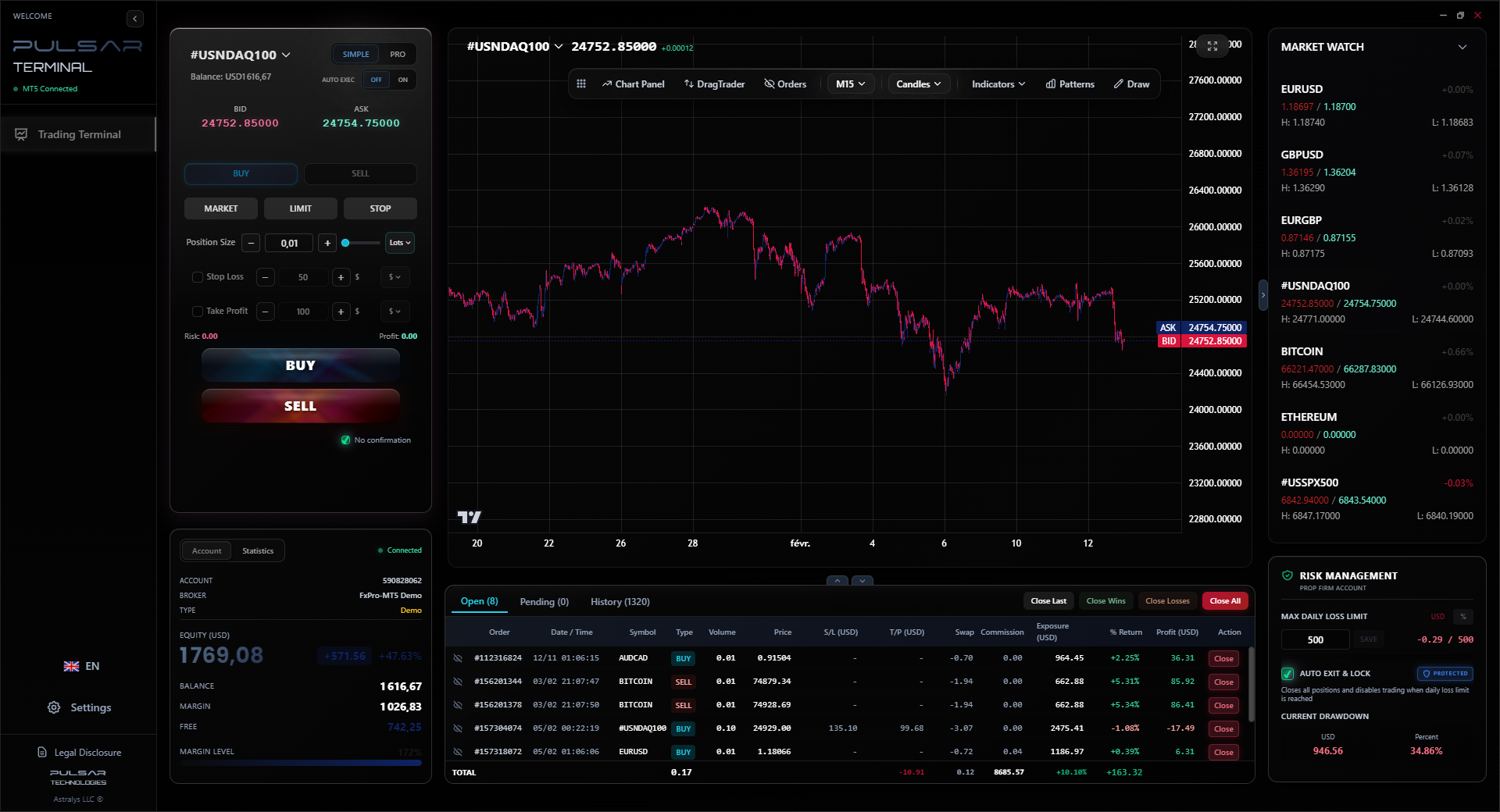
Managing the high volatility of sentiment-driven Naira trades requires precise order tools, which Pulsar Terminal provides directly on your MT5 platform.
Pulsar Terminal
أداة MT5 الشاملة: أوامر سحب وإفلات، متعدد TP/SL، تريلينج ستوب، تداول الشبكة، Volume Profile وحماية البروب فيرم. يستخدمها أكثر من 1000 متداول يومياً.
“Going against extreme sentiment is a high-risk, high-reward strategy. I only do it with half a position and a confirmed price signal.”
Sentiment isn't a standalone system. It's a filter for your existing strategy.
Here’s how I integrate it:
-
Determine the Dominant Sentiment: Before the London open, I ask: What's the mood? Bullish Naira? Bearish? Neutral/Uncertain? I use my local sources and tools to decide.
-
Align Your Bias: If the dominant sentiment is strongly bullish Naira, I will primarily look for long Naira (short USD/NGN) setups. I might ignore or use much smaller sizes on long USD/NGN setups, no matter how good the chart looks. This keeps you from fighting the tide.
-
Use Technicals for Timing: Sentiment gives you direction. Your MACD indicator, support/resistance, and candlestick patterns give you the entry and exit. Only enter when sentiment and your technical setup agree.
-
Position Size Based on Conviction: My position size slider moves based on sentiment clarity.
- Strong sentiment + Strong technicals = Full position size (as per my position size calculator).
- Strong sentiment + Weak technicals = No trade.
- Conflicting sentiment + Strong technicals = Half position size.
- Know Your Exit: Sentiment can flip fast on a new CBN circular. Have a tight trailing stop or a clear technical exit level. Never fall in love with a trade because 'the sentiment is right.' Price is the final truth.
For example, my main pairs are EUR/USD and XAU/USD, but I always check how the prevailing global sentiment (risk-on/risk-off) might interact with local Naira sentiment. Sometimes, a global dollar sell-off can amplify a local bullish Naira sentiment, creating a powerful trend. You can learn more about trading these major pairs in our EUR/USD guide and XAU/USD guide.
💡 نصيحة وينستون
The difference between the official and parallel rate isn't just a number. It's the market's confidence index. Watch it closer than any oscillator.
“A widening gap between official and parallel rates signals distrust. It's a brilliant, real-time sentiment gauge.”
Let me be brutally honest about where I've gone wrong with sentiment.
- Mistaking News for Sentiment: Just because a bullish news item comes out doesn't mean sentiment is instantly bullish. The market might see it as 'too little, too late' or already have it priced in. I bought Naira on the EFEMS launch news, only to watch it dip for three more days as the market waited for actual volume data.
- Ignoring Extreme Readings: That 85% retail long reading I mentioned earlier? I saw it a week before I acted. I was scared to go against the crowd. By the time I entered, half the move was done. Fear cost me pips.
- Letting Sentiment Override Risk Management: In my initial disaster trade, sentiment was so against me that my stop was way too tight for the resulting volatility. I didn't respect that a sentiment-driven move can be explosive. Now, if I'm trading against an extreme, I widen my stop by 1.5x and reduce my lot size accordingly. It's about surviving the initial spike.
- Forgetting the Tax Man: This is a practical Nigerian mistake. You get euphoric about a big win from a perfect sentiment call. Remember, that 10% capital gains tax on gross profits applies. Always set aside that tax liability immediately after closing a winning trade. A 100-pip win feels less sweet when you forget the CGT. Factor it into your profit targets from the start.

Pro Tip: Keep a 'sentiment journal.' Note down the dominant mood each Monday, key news, and how your trades performed. Over time, you'll see patterns in how sentiment actually impacts price in the Nigerian context. It's more valuable than any indicator.
FAQ
Q1Is forex sentiment trading legal in Nigeria?
Yes, trading forex based on any analysis, including sentiment, is legal for individuals using their personal funds. The key legal point is you cannot source your trading capital from official CBN windows. You must use the autonomous market (NAFEM) or other permissible channels. Always ensure your broker is reputable, like those we review such as Exness or Pepperstone.
Q2What's the most important sentiment indicator for the Naira?
For the Naira, the single most important gauge is the spread between the official NAFEM rate and the parallel market rate. A narrowing spread indicates positive sentiment and growing trust in the formal system. A widening spread shows fear, distrust, and negative sentiment. Monitor this daily.
Q3How quickly can sentiment change in the Nigerian forex market?
Faster than in most markets. A single CBN circular or a major monthly external reserves report can flip sentiment within hours. This is why risk management is non-negotiable. Always use a stop-loss to protect yourself from a sudden sentiment reversal, or you risk a margin call.
Q4Can I use sentiment for scalping the Naira?
It's very difficult. Sentiment is a broader, slower-moving force. Scalping strategies rely on tiny price movements over minutes. By the time a sentiment shift filters down to the 1-minute chart, the move is often over. Sentiment is better suited for swing trading or position trading where you hold for days or weeks.
Q5Do international brokers provide sentiment tools for Nigerian traders?
Most provide general sentiment tools like retail client positioning, which is useful. However, the hyper-local Nigerian sentiment (CBN policy mood, parallel market gap) you'll need to source yourself. Some advanced trading platforms offer customizable news feeds where you can add local Nigerian financial news sources.
Q6How does the 10% capital gains tax affect my sentiment-based trades?
It directly impacts your profit calculation and should influence your position sizing. If you have a strong sentiment-based conviction for a 200-pip move, you need to factor in that 10% of your gross profit will go to tax. This means you might need to aim for a slightly larger move or adjust your lot size to ensure your net profit meets your target after tax.
درس البروفيسور وينستون
النقاط الرئيسية:
- ✓Use the NAFEM/Parallel spread as your primary Naira sentiment gauge.
- ✓Only trade against extreme crowd sentiment with a 50% reduced position size.
- ✓Always filter CBN policy through a sentiment lens, not just a rulebook.
- ✓Factor the 10% capital gains tax into every profit target from the start.
ما مدى فائدة هذا المقال؟
انقر على نجمة للتقييم
رؤى التداول الأسبوعية
تحليلات واستراتيجيات أسبوعية مجانية. بدون رسائل مزعجة.
عن المؤلف
Olumide Adeyemi
رائد التداول في غرب أفريقيا
أحد أنشط معلمي تداول الفوركس في نيجيريا. 8 سنوات من الخبرة في التداول من لاغوس. متخصص في استراتيجيات رأس المال المنخفض وتحديات شركات البروب للمتداولين الأفارقة.
التعليقات
تحذير من المخاطر
ينطوي تداول الأدوات المالية على مخاطر كبيرة وقد لا يكون مناسبًا لجميع المستثمرين. الأداء السابق لا يضمن النتائج المستقبلية. هذا المحتوى لأغراض تعليمية فقط ولا ينبغي اعتباره نصيحة استثمارية. قم دائمًا بإجراء بحثك الخاص قبل التداول.
قد يعجبك أيضًا

Cara Trading Forex Sukses: 7 Prinsip dari Trader Profesional
Cara trading forex sukses dengan 7 prinsip trader pro: manajemen modal, disiplin, journal trading, backtest. Data nyata, bukan janji profit palsu.
Jam Trading Forex Terbaik untuk Trader Indonesia: Panduan Lengkap dengan Tabel Waktu
Panduan jam trading forex untuk trader Indonesia. Tabel 4 sesi dunia, jam emas 20:00-00:00, sesi mana yang harus dihindari. Data akurat + tips dari trader berpengalaman.
Top 5 Sàn Forex Uy Tín Nhất 2026: Review Jujur dari Trader Indonesia
Top 5 sàn forex uy tín 2026 untuk trader Indonesia. Review jujur: spread, deposit, withdraw, dukungan lokal. Exness, XM, IC Markets & lebih.
احصل على Pulsar Terminal
جميع هذه الحاسبات مدمجة في Pulsar Terminal مع بيانات حية من حساب MT5 الخاص بك.
احصل على Pulsar Terminal