


Most guides on forex trading brokers in South Africa read like a broker's sales brochure.

David van der Merwe
متداول الأسواق الناشئة ·  South Africa
☕ 10 دقائق قراءة
ما ستتعلمه:
Most guides on forex trading brokers in South Africa read like a broker's sales brochure. They'll tell you to look for 'tight spreads' and 'good platforms,' missing the real issues that burn local traders. The truth is, your choice of broker is the single biggest factor in whether you get a fair shot at this game. I've seen too many talented traders fail because they picked a broker that worked against them. Let's set the record straight on what actually matters for a South African trader in 2026.
This is where most people get it wrong. They think 'regulated' means safe. In South Africa, it's not that simple. You have two main players: the Financial Sector Conduct Authority (FSCA) and international bodies like CySEC or ASIC.
Brokers with an FSCA license (like some local operations) are legally allowed to operate here. That's the baseline. But here's the kicker: an FSCA license doesn't automatically mean better protection for your trading. Their mandate is broad, covering the entire financial sector. Their specific oversight of forex margin trading can be... let's call it evolving.
Many of the top global brokers serving South Africans, like IC Markets or Pepperstone, hold primary licenses from stricter jurisdictions (ASIC in Australia, for example). They then offer their services here under what's called a 'cross-border' provision. This is perfectly legal and common.
So, which is better? I'm bluntly honest: for the serious retail trader, a top-tier international broker with a strong global license often provides more strong operational standards and technology. However, using a locally FSCA-licensed broker can simplify things like ZAR deposits and withdrawals. There's no perfect answer, but you must know what you're buying.

Warning: Be extremely wary of brokers offering 'registration' in offshore havens like St. Vincent or the Marshall Islands as their primary regulation. This is often a red flag for lower standards of client fund segregation and dispute resolution.
This is the daily reality check. You get paid in Rands, but you trade in USD, EUR, or GBP. How you bridge that gap will eat into your profits faster than a bad trade.
The Bank Transfer Trap
Direct international bank transfers from your South African account are a profit killer. Your bank will give you a terrible exchange rate and slap on a fee of around R200 or more. On a R10,000 deposit, you could lose 3-4% before you even place a trade. I learned this the hard way in my first year, burning nearly R800 on a single deposit. Never again.
The Smart Local Payment Options
This is non-negotiable. You must use a broker that offers local ZAR payment gateways. Look for:
- Instant EFT: Services like Ozow, PayFast, or SiD. Funds reflect in minutes.
- Credit/Debit Card: Visa/Mastercard deposits are usually instant. Withdrawals back to the card are common.
- Other Local Methods: Some brokers offer specific partnerships with South African payment processors.
These methods convert your Rands at the broker's interbank rate, which is miles better than your bank's tourist rate. The fee is often absorbed by the broker or is a tiny flat fee.
The Withdrawal Reality
Always check the withdrawal policy. How long does it take? Is it free back to your local method? A good broker processes withdrawals to ZAR accounts in 1-3 business days. If it takes weeks, that's a major operational red flag. Your position size calculator is useless if you can't access your profits efficiently.

💡 نصيحة وينستون
A broker is a utility, not a partner. Your loyalty should be to your own profitability, not their brand. If their service degrades, be ready to move.
“Your use setting is not a target. Dial it down. Use a fraction of what's offered.”
Brokers make money from you in two ways: the spread (difference between buy/sell price) or a commission + raw spread. South Africans often fixate on 'zero spread' accounts, which is a marketing gimmick that can be more expensive.
Let's use a real example from my own trading log. I compared two brokers on the same EUR/USD trade:
- Broker A ("Zero Spread" Account): Advertised 0.0 pip spread. They charged a commission of $7 per standard lot (100k units). The actual raw spread was 0.1 pips. Total cost on a 1-lot trade: $7 + (0.1 pip * $10) = $8.
- Broker B (Raw Spread Account): Raw spread of 0.2 pips. Commission of $6 per standard lot. Total cost: $6 + (0.2 * $10) = $8.
Same cost. The 'zero spread' was just packaging. The key metric is total cost per round turn.
For major pairs like EUR/USD, aim for a total cost under $8 per standard lot. For exotic pairs involving the ZAR (like USD/ZAR), spreads will be much wider - 50-100 pips is normal due to lower liquidity. You can't scalp these pairs effectively; they're for longer-term swing trading views.

Example: Trading USD/ZAR? A 75-pip spread means the pair needs to move 75 pips just for you to break even. Your trade thesis needs to account for that massive initial hurdle.
You need a stable platform that doesn't freeze during the SARB interest rate announcement. Full stop. MetaTrader 4 (MT4) is the old reliable, but MetaTrader 5 (MT5) is the future and what I use exclusively now. More instruments, better backtesting, and more timeframes.
Every major broker for forex trading brokers in South Africa will offer MT4/MT5. The differentiator is in the execution and the tools they bolt on.
Execution Type Matters:
- Market Maker (Dealing Desk): The broker takes the other side of your trade. Can lead to conflicts of interest, especially during high volatility. I avoid these.
- STP/ECN (No Dealing Desk): Your order is routed directly to liquidity providers (banks, funds). This typically means faster execution, less requoting, and transparent pricing. This is what you want. Brokers like Exness and XM offer strong STP/ECN models.
Beyond the base platform, check if the broker offers quality add-ons. Do they have a decent economic calendar? Reliable VPS hosting for expert advisors? These are the small things that add up to a professional environment.
A clean, fast platform is more important than one with 100 confusing indicators. Learn to use core tools like the RSI indicator and MACD indicator properly on a stable system first.
💡 نصيحة وينستون
The 'zero spread' marketing is a magician's trick. Always calculate the total cost: spread + commission. That's the only number that matters.
“The 1:30 use cap is one of the best things to happen to new South African traders. It forces discipline.”
South African brokers, under FSCA guidance, have a use cap of 1:30 for major forex pairs. This is a hard rule for locally licensed entities. International brokers serving SA clients often offer higher use, like 1:500 or even 1:1000.
Here's my blunt take: the 1:30 cap is one of the best things to happen to new South African traders. It forces discipline. High use is a double-edged sword that most beginners swing directly into their own account.
Let me show you why. Say you have R20,000. At 1:30 use, your maximum buying power is R600,000. At 1:500, it's R10,000,000. A mere 1% move against you at 1:500 wipes out half your capital. At 1:30, that same move is a 3.3% loss. It lets you survive to learn.
I used to chase high use, thinking it was the key to bigger profits. It's the key to bigger losses. My worst blow-up, a R15,000 loss in a day back in 2017, was directly due to over-leveraging on a volatile GBP news event. I ignored my own margin call warnings. Now, I rarely use more than 1:10, even when it's available. Use the cap as a training tool, not a limitation to circumvent.

Pro Tip: Your use setting is not a target. Dial it down. Use a fraction of what's offered. Your primary risk tool should be your position size, not your use slider. Always use a position size calculator based on your account risk, not your account balance.
Trading with a prop firm's capital is a huge topic here. It's attractive: you pass a challenge, they give you a larger account, you take a profit split. For a South African with limited starting capital, it can seem like a golden ticket.
The catch? The rules are brutal, and most brokers' standard platforms aren't built for them. The challenge phases have strict daily and overall loss limits. A single bad hour can disqualify you.
This is where your broker's platform and tools become critical. You need to manage risk with surgical precision. Can you set hard daily stop-outs easily? Can you automate trailing stops to lock in profits and protect against a sudden reversal? Most prop firm traders fail because of poor risk management during the funded period, not the challenge.
If you go this route, you need a broker that offers MT5 and supports advanced trade management tools or third-party solutions that can enforce these rules automatically. Manually watching your daily loss limit is a recipe for disaster.
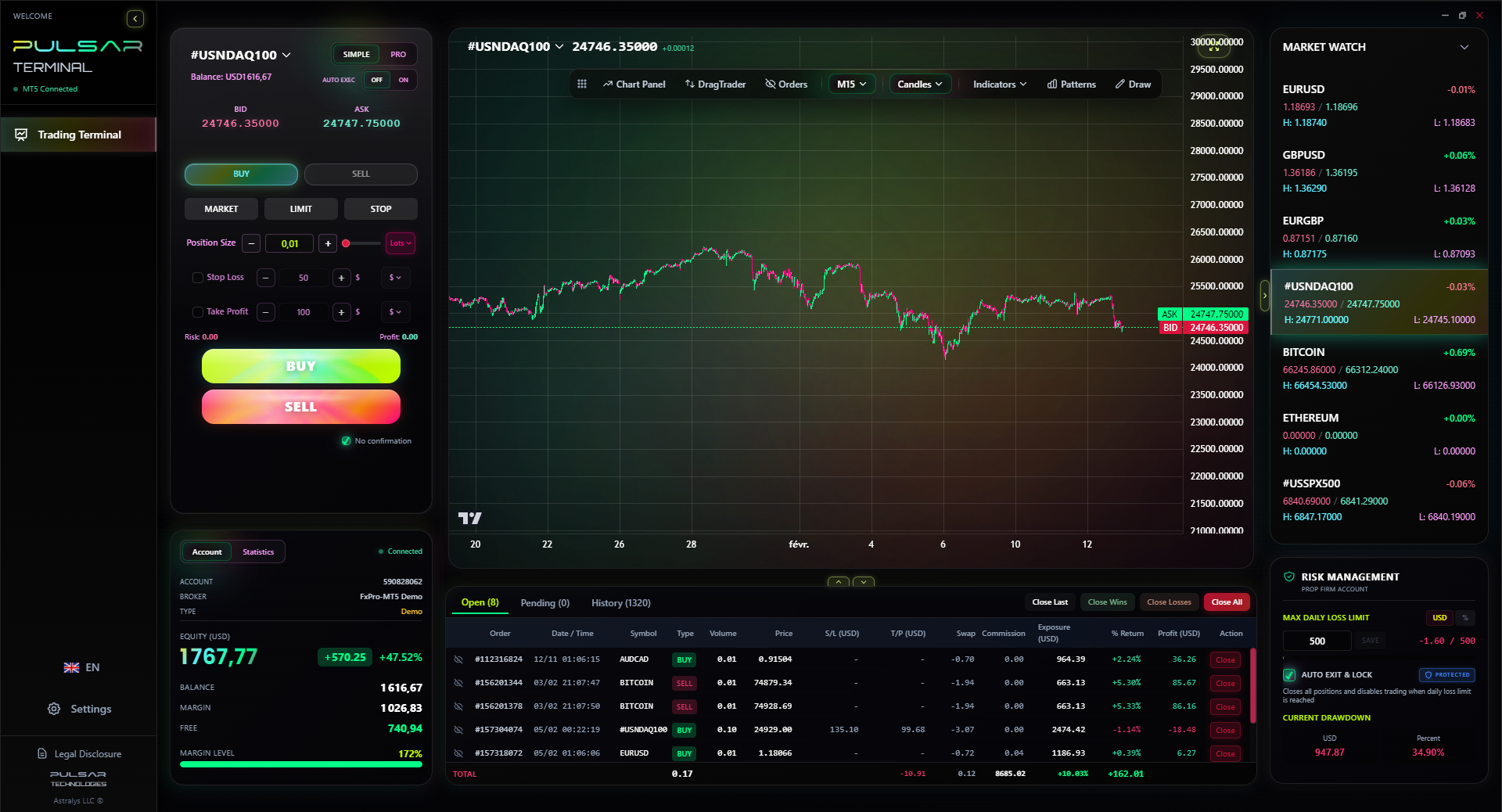
Managing a prop firm challenge requires iron-clad discipline on daily loss limits, which is exactly what Pulsar Terminal's automated risk management tools are built for.
Pulsar Terminal
أداة MT5 الشاملة: أوامر سحب وإفلات، متعدد TP/SL، تريلينج ستوب، تداول الشبكة، Volume Profile وحماية البروب فيرم. يستخدمها أكثر من 1000 متداول يومياً.
“Choosing a broker is the most important partnership in your trading career. Get it right.”
I've funded accounts with over a dozen brokers from my base in Cape Town. Here are two real experiences that shaped my views.
The Good: In 2023, I was trading Gold (XAU/USD) during the US banking crisis. Volatility was insane. My broker (an international ECN) had zero requotes, execution was within 0.5 seconds on 5-lot orders, and the raw spread on XAU/USD stayed under 15 cents. I took 3 trades for a total gain of $4,200. Withdrawals hit my South African bank account via the local payment gateway in 48 hours, with a total fee of about R50. That's how it should work.
The Bad: Earlier, with a different 'market maker' broker, I tried to short the EUR/USD on a clear bearish ECB signal. The platform froze for 90 seconds. When it came back, the price had shot past my entry and my stop-loss was filled 12 pips worse than where I set it. I lost R1,800 on a trade that should have been a small winner. Their support blamed 'market volatility.' I blamed poor infrastructure and a conflict of interest.
Based on execution, costs, and local accessibility, my shortlist for a serious South African trader right now includes IC Markets (for raw ECN pricing), Pepperstone (excellent all-rounder), and Exness (great for local payment variety). But you must test their demo with your specific strategy first.
💡 نصيحة وينستون
Test withdrawals before you make a large deposit. If they can't handle R500 efficiently, they'll be a nightmare with R50,000.
Don't just take a broker's word for it. Do this:
- Test the Demo: Trade their demo for two weeks. Is it stable during London open and US news? Check execution speeds.
- Verify Local Payments: Make a tiny real deposit, like R500, using their instant EFT. Then immediately request a withdrawal of R400 back to your bank. Does it work? How long does it take? This R100 test is the best due diligence you can do.
- Read the Fine Print: Find their legal docs. What's their policy on negative balance protection? Where are client funds held?
- Contact Support: Ask a technical question via live chat. Are they responsive and knowledgeable, or just salespeople?
- Check the Spreads Live: Don't look at the advertised 'from' spreads. Look at the live spreads on the platform at 10 AM, 3 PM, and 8 PM SA time. That's your real cost.
Choosing a broker isn't about finding the 'best' one globally. It's about finding the best one for you, sitting in Johannesburg or Durban, trading with Rands. It's the most important partnership in your trading career. Get it right.
FAQ
Q1Is forex trading legal in South Africa?
Yes, absolutely. Forex trading is legal for South African residents. You must use a broker that is either licensed by the local Financial Sector Conduct Authority (FSCA) or is a reputable international broker legally offering services on a cross-border basis.
Q2What is the best use for a beginner in South Africa?
Start with the FSCA-mandated maximum of 1:30, or even lower. I recommend beginners use no more than 1:10. High use amplifies losses faster than it creates profits. It's a risk tool, not a profit accelerator.
Q3How do I avoid high fees on ZAR deposits?
Never use a direct international bank transfer from your SA bank account. Always use the broker's dedicated local payment methods like Instant EFT (Ozow, PayFast) or credit/debit card deposits. These use far better exchange rates and have minimal fees.
Q4Can I trade the South African Rand (ZAR) as a South African?
Yes, pairs like USD/ZAR and EUR/ZAR are available. Be warned: spreads are very wide (often 50-100 pips) due to lower liquidity compared to majors like EUR/USD. This makes them unsuitable for short-term trading and requires a much larger anticipated price move to be profitable.
Q5What is the minimum deposit for forex trading in South Africa?
It varies widely. Some international brokers allow you to start with as little as $10 (roughly R180). More serious ECN brokers might have a $200 (R3,600+) minimum. I advise starting with at least R5,000-R10,000 to allow for proper position sizing and to withstand normal market fluctuations without being wiped out by a single trade.
Q6Are international brokers like IC Markets or Pepperstone safe for South Africans?
Reputable international brokers with top-tier global regulation (like ASIC for Australia or FCA for the UK) are generally considered safe. They operate under strict client money protection rules. The key is to ensure they have reliable local deposit/withdrawal methods for ZAR. Always verify their regulatory status directly on the regulator's website.
Q7Do I pay tax on forex trading profits in South Africa?
Yes. The South African Revenue Service (SARS) views forex trading profits as income if you're trading frequently (seen as a revenue-generating activity). You are liable for income tax on your net profits. Keep detailed records of all trades, deposits, and withdrawals. Consult a tax professional familiar with trading.
درس البروفيسور وينستون
النقاط الرئيسية:
- ✓Prioritize brokers with reliable ZAR Instant EFT deposits.
- ✓Calculate total cost (spread + commission), not just advertised spreads.
- ✓Use use of 1:10 or less, even if 1:500 is offered.
- ✓Test a small deposit and withdrawal before committing serious capital.
ما مدى فائدة هذا المقال؟
انقر على نجمة للتقييم
رؤى التداول الأسبوعية
تحليلات واستراتيجيات أسبوعية مجانية. بدون رسائل مزعجة.
عن المؤلف
David van der Merwe
متداول الأسواق الناشئة
متداول مقيم في جوهانسبرغ مع 11 عاماً في عملات الأسواق الناشئة. متخصص في أزواج ZAR والتداول المنظم من FSCA وتحليل السوق الجنوب إفريقي.
التعليقات
تحذير من المخاطر
ينطوي تداول الأدوات المالية على مخاطر كبيرة وقد لا يكون مناسبًا لجميع المستثمرين. الأداء السابق لا يضمن النتائج المستقبلية. هذا المحتوى لأغراض تعليمية فقط ولا ينبغي اعتباره نصيحة استثمارية. قم دائمًا بإجراء بحثك الخاص قبل التداول.
قد يعجبك أيضًا

Cara Trading Forex Sukses: 7 Prinsip dari Trader Profesional
Cara trading forex sukses dengan 7 prinsip trader pro: manajemen modal, disiplin, journal trading, backtest. Data nyata, bukan janji profit palsu.
Jam Trading Forex Terbaik untuk Trader Indonesia: Panduan Lengkap dengan Tabel Waktu
Panduan jam trading forex untuk trader Indonesia. Tabel 4 sesi dunia, jam emas 20:00-00:00, sesi mana yang harus dihindari. Data akurat + tips dari trader berpengalaman.
Top 5 Sàn Forex Uy Tín Nhất 2026: Review Jujur dari Trader Indonesia
Top 5 sàn forex uy tín 2026 untuk trader Indonesia. Review jujur: spread, deposit, withdraw, dukungan lokal. Exness, XM, IC Markets & lebih.
احصل على Pulsar Terminal
جميع هذه الحاسبات مدمجة في Pulsar Terminal مع بيانات حية من حساب MT5 الخاص بك.
احصل على Pulsar Terminal