


You've seen the ads.

Olumide Adeyemi
رائد التداول في غرب أفريقيا ·  Nigeria
☕ 9 دقائق قراءة
ما ستتعلمه:
- 1What Exactly Is a Forex Trading Contest?
- 2The Nigerian Context: Rules, Brokers, and Real Numbers
- 3The Killer Psychology: Why Contests Make You a Worse Trader
- 4Prize Structures & The Hidden Costs Nobody Talks About
- 5Should You Enter? A Strategic Guide (Not a Pep Talk)
- 6Better Alternatives: How to Actually Prove Your Skill
You've seen the ads. A flashy banner promising a $10,000 prize for the 'top trader.' It looks like free money, a shortcut to fame and fortune. I'm here to tell you that's a dangerous fantasy. In my 12 years, I've seen more traders destroyed by contest psychology than helped. This isn't about discouraging you. It's about giving you the unvarnished truth so you can decide if entering a forex trading contest is a strategic move or a financial suicide mission. Let's set the record straight.
At its core, a forex trading contest is a competition where traders compete over a set period - a week, a month, a quarter - to achieve the highest percentage return on a starting balance. The top performers win cash prizes, sometimes gadgets, or even funded trading accounts. They come in two main flavors: demo contests and live contests.
Demo contests use virtual money. You trade a simulated account, and the winner is the one who grows it the most. The XM Demo Trading Contest, for instance, has a huge $100,000 prize pool. Sounds risk-free, right? The danger is it trains you to be reckless. With no real money on the line, you'll take insane risks you'd never take with your own capital. Winning a demo contest often creates the worst possible habits for live trading.
Live contests are the real deal. You trade your own real money. The HFM Traders Awards, for example, requires a minimum $500 balance in a Live Premium Account and gives $1,000 monthly to the trader with the greatest gain. The stakes are real, and so are the losses. Your entry fee is often just having an account funded to a certain level, like the $20 minimum for the FXCL Markets Live Contest.

Warning: Winning a demo contest is often a curse. It inflates your ego and makes you believe your high-risk, lottery-ticket strategy is genius. It's not. It's luck, and it will bankrupt you when real money is involved.
“Winning a demo contest is often a curse. It trains you to be reckless.”
Forex trading is legal here, regulated by the SEC and CBN. While there's no specific law for contests, the general rules apply. Always check if your broker is on the SEC's Capital Markets Operator list or holds a solid international license (like the FSCA in South Africa). That's your first line of defense against scams.
Let's talk real numbers. The market is huge: over 300,000 retail traders in Nigeria as of 2021, and turnover hit $8.6 billion in 2025. Contests are tapping into this energy.
Broker Specifics for Contest Traders
You need a broker that offers these contests and has conditions that won't kill your strategy. Look at spreads and minimum deposits.
| Broker | Min. Deposit (NGN/USD) | Avg. EUR/USD Spread | Contest Example |
|---|---|---|---|
| HFM | 0 NGN / $100 (Pro) | Varies | Traders Awards ($1,000 monthly prize) |
| Exness | Low | 0.1-0.2 pips (Raw) | Various promotions |
| XM | Low | Varies | $100,000 Demo Contest |
| InstaForex | ~$1 | Varies | Weekly "Sniper" Contest ($1,500 pool) |
| Pepperstone | $0 | Tight on Razor | Occasional challenges |
Notice something? The brokers with the tightest spreads, like those offering raw ECN accounts around 0.1 pips, are crucial for a strategy like scalping, which is common in contests. A 2-pip spread on a broker like AvaTrade (0.93 avg) eats your profit margin before you even start.
Payment methods are key. You need to fund and withdraw easily. Most brokers here accept bank transfers, cards, and local processors. HFM even offers Naira-denominated accounts, which simplifies things.

Pro Tip: Before you enter any contest, open a demo account with that broker and test their platform for a week. Are the executions fast? Do spreads widen violently during news? This due diligence is non-negotiable.

💡 نصيحة وينستون
A contest is a marketing funnel for your broker, not a career path for you. They profit from your activity, win or lose. Trade accordingly.
“You are not competing against the market anymore. You're competing against 500 other traders who are all trying to get the highest return.”
This is the most important section. Contest structure actively incentivizes the exact behavior that destroys accounts. It's a psychological trap.
You're not competing against the market anymore. You're competing against 500 other traders who are all trying to get the highest return. The leaderboard is public. You see "Trader_XYZ" up 45% in two days. Your sensible 3% monthly target looks pathetic. So what do you do? You abandon your plan.
You start chasing. You size up massively on a hope and a prayer. You hold losing trades because "a comeback is possible." You avoid taking profits on small wins because they won't move you up the ranks. You are no longer trading to preserve and grow capital. You are gambling for a leaderboard position.
I learned this the hard way early in my career. I entered a month-long contest. I was up a respectable 8% in the first week, sitting around 50th place. The leader was up 120%. I felt like a failure. So I took my entire account and put it on a single USD/JPY trade based on a shaky news rumor. It went my way initially, and I was in the top 20. I didn't exit. The news reversed. I lost 60% of my account in 15 minutes. I didn't just lose the contest; I blew up half my capital trying to win it.
The constant comparison, the time pressure, the glory of winning - it all corrupts your judgment. A good trader's mindset is calm, patient, and disciplined. A contest trader's mindset is frantic, greedy, and desperate. They are opposites.

Example: Imagine two traders in a contest. Trader A uses a solid swing trading strategy, risks 1% per trade, and finishes the month up 5%. Trader B risks 10% per trade on volatile exotic pairs, gets lucky, and finishes up 80%. Trader B wins the $500 prize. Trader A is the better, more sustainable trader, but the contest rewards the reckless gambler. Which model do you want to follow?
“For every one trader who wins a $200 prize, there might be 100 who lost a combined $10,000 of their own capital trying.”
Let's break down the prizes with clear eyes. Yes, the TradingPRO Tradestorm Africa Contest offers $500 for first place. The FXCL contest shares $750 among 11 winners. But you have to ask: what did it cost to try and win that?
First, there's the opportunity cost. The mental energy and focus you pour into the contest could have been used to consistently grow your main trading account with your proven strategy.
Second, there's the direct financial cost. To compete seriously, you often need a larger account. If the contest requires a $500 minimum balance (like HFM's), that's $500 of your capital you're exposing to high-risk, contest-driven trading. The average spread and commission costs on all those frantic trades add up. If you're making 50 trades a day instead of 5, you're paying 10 times the transaction costs.
Third, and most sinister, is the winner's curse. The few who win big often attribute it to skill, not luck. They believe their contest strategy is repeatable. They then use that aggressive, high-risk approach on their main account... and lose everything. The prize money becomes a down payment on their future losses.
The math rarely adds up. For every one trader who wins a $200 prize, there might be 100 who lost a combined $10,000 of their own capital trying. The broker always wins. They get your commission, your spread, and sometimes your entire deposit when you get a margin call. The contest is just a marketing cost for them.
I once calculated my costs after a contest. I traded 10x my normal volume. My spread and commission costs were over $180 for the month. I finished 23rd. No prize. I effectively paid $180 for the privilege of stressing myself out and distorting my trading.
💡 نصيحة وينستون
If you must enter, define your 'contest capital' as money you'd be comfortable setting on fire. That's the only mindset that protects your real wealth.
“For every one trader who wins a $200 prize, there might be 100 who lost a combined $10,000 of their own capital trying.”
I'm not saying never enter. I'm saying enter with your eyes wide open and a plan that protects you from yourself. Here’s a framework.
Only consider it if:
- You have a separate, dedicated "contest account" capital you are 100% willing to lose. This is gambling money, not investment money.
- You have a written, mechanical trading plan with strict rules for entries, exits, and position size that you will NOT deviate from, no matter what the leaderboard says.
- You are using it purely as a paid exercise in discipline. The goal is to stick to your plan under pressure, not to win.
- You choose contests with rules that align with your style. A one-day sprint favors scalpers; a three-month contest might suit a swing trader.
Run for the hills if:
- You plan to change your strategy to "catch up."
- You're using money from your main trading account or, worse, borrowed money.
- You find yourself checking the leaderboard every hour.
- The contest requires you to take a minimum number of trades (forcing action is always bad).
If you do enter, use technology to enforce your rules. This is where tools that lock in your discipline are worth their weight in gold. For instance, setting a hard maximum daily loss limit is critical, something many prop firm challenges require.
Pro Tip: Treat any prize money as pure profit. Withdraw it immediately. Do not add it to your trading capital. It's a bonus, not a justification for bigger bets. This mentally separates the contest from your real trading business.
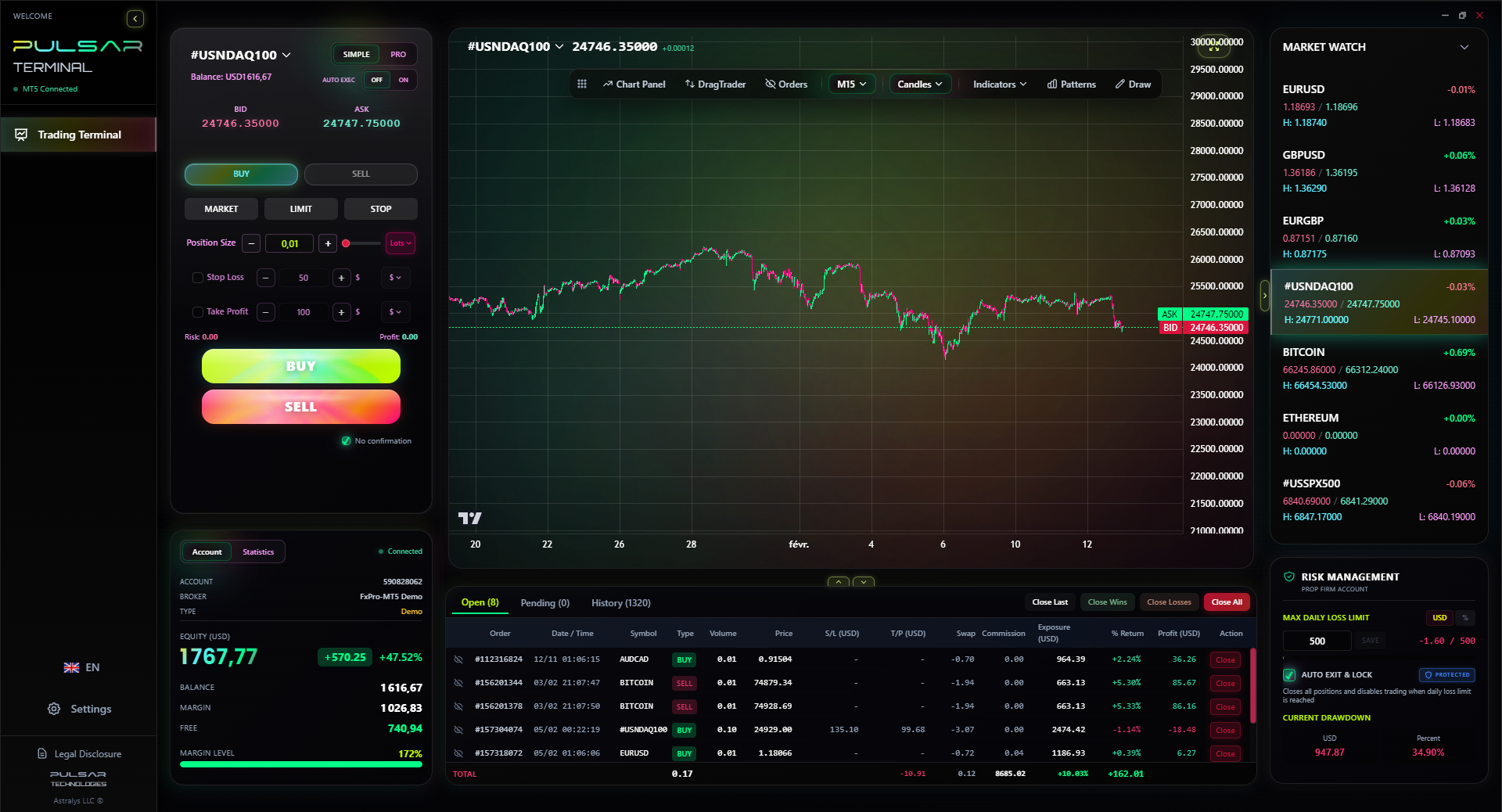
Sticking to a plan under contest pressure is nearly impossible manually, which is why tools that automate risk rules, like Pulsar Terminal's prop firm daily loss protection, are essential for serious traders.
Pulsar Terminal
أداة MT5 الشاملة: أوامر سحب وإفلات، متعدد TP/SL، تريلينج ستوب، تداول الشبكة، Volume Profile وحماية البروب فيرم. يستخدمها أكثر من 1000 متداول يومياً.
“Building a real track record teaches you to compete against your own past performance. That's the only competition that matters.”
If your goal is to validate your skills or get funded, there are smarter paths than public contests.
- The Prop Firm Route: This is a structured, high-stakes test, but with clearer rules. You pay a fee for a challenge account. You have to hit a profit target while respecting strict drawdown limits. If you pass, you get a funded account. The pressure is intense, but it's a test of risk management, not just raw returns. The daily loss limits force the discipline that contests destroy.
- The Personal Track Record: This is the most powerful proof. Use a platform like Myfxbook or FX Blue to create a verified, live track record of your trading over 12+ months. Show consistent returns with controlled drawdowns. This is what serious investors look for. It's boring, it's slow, and it's the real deal.
- Paper Trading a Specific Goal: Instead of a demo contest, give yourself a private challenge. "Grow this $10,000 demo account by 20% in 6 months with a max drawdown of 5%." Record every trade and review your psychology. No prize, just proof of concept.
Building a real track record teaches you to compete against your own past performance and your own psychology. That's the only competition that matters in the long run. Chasing a spot on a broker's leaderboard is a distraction from the real work of becoming a professional. Focus on your process, not a podium. Your bank balance will thank you.
💡 نصيحة وينستون
The only leaderboard that matters is your own equity curve over 100+ trades. Focus on making it smooth, not spiky.
FAQ
Q1Are forex trading contests legal in Nigeria?
Yes, forex trading itself is legal and regulated by the SEC and CBN. While there's no specific law for contests, they operate under the general financial market regulations. The key is to use a broker that is properly registered with the SEC or holds a reputable international license.
Q2What's the difference between a demo and a live trading contest?
A demo contest uses virtual money with no real financial risk. A live contest requires you to trade your own real capital. Demo contests can breed bad habits, while live contests put your actual money at risk under intense psychological pressure. Prizes from demo contests (like XM's $100k pool) are real, but winning is often more about luck than sustainable skill.
Q3How much money do I need to enter a typical contest?
It varies wildly. Some, like the TradingPRO Tradestorm contest, have a $10 minimum deposit. Others, like HFM's Traders Awards, require a $500 minimum account balance. Always read the fine print. The entry 'fee' is often just the required minimum deposit you must have in your live account.
Q4Can I really win a funded account from a contest?
Some contests offer funded accounts as prizes, but they are rare. It's more common to win cash. Remember, even if you win a funded account, you'll likely be required to trade it under very strict risk rules. The track record needed to keep that account is the real challenge.
Q5What's the biggest mistake traders make in contests?
Abandoning their proven trading plan to chase the leaderboard. They increase position sizes to dangerous levels, ignore stop-losses, and trade instruments they don't understand, all to get a higher return. This contest-specific behavior is the direct cause of most catastrophic losses.
Q6Is the prize money from a contest taxable in Nigeria?
Yes. Under the Personal Income Tax Act (PITA), prize winnings are generally considered taxable income. You are responsible for declaring this income and paying the appropriate tax. Keep all contest statements and prize payment records.
Q7What should I look for in a contest's rules before entering?
Look for: 1) Minimum/maximum number of trades (avoid minimums), 2) Allowable instruments (stick to what you know), 3) The ranking metric (is it pure profit, or profit relative to drawdown?), and 4) The spread/commission conditions. If the broker has wide spreads, you're at a disadvantage before you start.
درس البروفيسور وينستون
النقاط الرئيسية:
- ✓Contest psychology incentivizes account-destroying behavior.
- ✓Real prize pools are small vs. collective participant losses.
- ✓Always use separate "contest capital" you can afford to lose.
- ✓A verified 12-month track record beats any contest win.
ما مدى فائدة هذا المقال؟
انقر على نجمة للتقييم
رؤى التداول الأسبوعية
تحليلات واستراتيجيات أسبوعية مجانية. بدون رسائل مزعجة.
عن المؤلف
Olumide Adeyemi
رائد التداول في غرب أفريقيا
أحد أنشط معلمي تداول الفوركس في نيجيريا. 8 سنوات من الخبرة في التداول من لاغوس. متخصص في استراتيجيات رأس المال المنخفض وتحديات شركات البروب للمتداولين الأفارقة.
التعليقات
تحذير من المخاطر
ينطوي تداول الأدوات المالية على مخاطر كبيرة وقد لا يكون مناسبًا لجميع المستثمرين. الأداء السابق لا يضمن النتائج المستقبلية. هذا المحتوى لأغراض تعليمية فقط ولا ينبغي اعتباره نصيحة استثمارية. قم دائمًا بإجراء بحثك الخاص قبل التداول.
قد يعجبك أيضًا

Cara Trading Forex Sukses: 7 Prinsip dari Trader Profesional
Cara trading forex sukses dengan 7 prinsip trader pro: manajemen modal, disiplin, journal trading, backtest. Data nyata, bukan janji profit palsu.
Jam Trading Forex Terbaik untuk Trader Indonesia: Panduan Lengkap dengan Tabel Waktu
Panduan jam trading forex untuk trader Indonesia. Tabel 4 sesi dunia, jam emas 20:00-00:00, sesi mana yang harus dihindari. Data akurat + tips dari trader berpengalaman.
Top 5 Sàn Forex Uy Tín Nhất 2026: Review Jujur dari Trader Indonesia
Top 5 sàn forex uy tín 2026 untuk trader Indonesia. Review jujur: spread, deposit, withdraw, dukungan lokal. Exness, XM, IC Markets & lebih.
احصل على Pulsar Terminal
جميع هذه الحاسبات مدمجة في Pulsar Terminal مع بيانات حية من حساب MT5 الخاص بك.
احصل على Pulsar Terminal