


Let's cut through the noise.
Sarah Collins
استراتيجي تداول ·  United Kingdom
☕ 10 دقائق قراءة
ما ستتعلمه:
- 1Is Forex Trading Haram in Islam? It's About Principles, Not Just Pips
- 2How to Trade Forex Halal in the UK: Accounts, Brokers & The Real Cost
- 3The Real Reason Most Traders Blow Up (It's Not About Haram vs Halal)
- 4UK Regulations & The Quiet Boom in Islamic Finance
- 5Building a Halal Trading Plan That Actually Works
- 6Common Pitfalls Muslim Traders Face (Beyond the Account Type)
- 7Final Verdict: Is Forex Trading For You?
Let's cut through the noise. The statement 'forex trading is haram' is both true and false, and most people arguing about it online are missing the point entirely. The real issue isn't just about swap fees or overnight interest. It's about the structural, psychological, and financial traps built into retail trading that guarantee failure for the unprepared. I've seen traders obsess over finding a Sharia-compliant broker while simultaneously risking 10% of their account on a single, poorly-researched trade. That's the real haram - the guaranteed financial self-harm. In this guide, I'll break down the Islamic finance principles, show you how to trade compliantly in the UK, and, more importantly, explain why the standard trading model is designed for you to lose.
The question isn't as simple as a yes or no. It hinges on four core Islamic finance principles, and honestly, conventional retail trading violates most of them by default.
First, Riba (interest). This is the big one everyone knows. If you hold a standard forex position overnight, you pay or receive a swap fee. That's interest, full stop. It's prohibited. I used to ignore swaps, thinking a few pips didn't matter. Then I got caught in a long-term GBP/JPY short. The negative swaps slowly bled £200 from my account over three weeks. It was a quiet, expensive lesson in a principle I'd overlooked.
Second, Gharar (excessive uncertainty). Think about it. Are you trading with clear terms? Do you fully understand the broker's spread definition, all their fees, and the true cost of that 500:1 use? Most don't. That ambiguity is Gharar.
Third, Maisir (gambling). This is where most retail traders fail, Muslim or not. Placing a trade based on a 'gut feeling' or a random signal from a YouTube guru? That's speculation, not investment. It's rolling the dice. When you use extreme use - like putting £1,000 to control £50,000 - you're amplifying the gamble. The FCA itself warns that 74-89% of retail CFD traders lose money. That statistic screams Maisir.
Finally, Bai al-Sarf (immediate settlement). Currency exchange should be 'hand-to-hand'. The spot forex market's T+2 settlement is a technicality, but it's why some scholars insist on immediate physical delivery, which retail CFD trading doesn't provide.

Warning: Don't just look for a 'swap-free' label and think you're done. If your strategy is pure gambling (Maisir) with massive use, you're still violating the spirit of the law, regardless of the account type.
So, can you trade forex in a halal manner in the UK? Yes, but it requires intentionality. The primary tool is the Islamic or swap-free account. These accounts remove overnight swap fees (Riba). But here's the catch brokers don't highlight: they often recover that cost elsewhere.
You'll typically face wider spreads or a fixed daily administrative fee on open positions. For example, Pepperstone's Standard Islamic account lists a minimum spread of 1.0 pip on the EUR/USD, compared to as low as 0.0 on their Razor account (plus commission). That extra spread is your 'cost of compliance'.
Finding a UK Broker with Islamic Accounts
Thankfully, the UK market is competitive. Most major FCA-regulated brokers offer this option. Here’s a quick comparison of minimum deposits for Islamic accounts (as of 2026):
| Broker | Typical Min. Deposit (Islamic Account) | Key Platform |
|---|---|---|
| XM | $5 | MT4, MT5 |
| ActivTrades | $0 | Proprietary, MT4 |
| Vantage | $50 | MT4, MT5, [Proprietary] |
| Pepperstone | $200 | MT4, MT5, cTrader |
| eToro | $1,000 | Proprietary (Social) |
Always check the specific terms. Request the Islamic account agreement and see exactly how they structure fees. True transparency reduces Gharar.
The Non-Negotiable: A Real Strategy
Opening an Islamic account is step one. Step two is adopting a strategy that avoids Maisir. This means ditching the lottery-ticket mentality. It means using a verified scalping strategy or a disciplined swing trading plan with strict risk management. Your trades should be based on analysis, not hope. I learned this after blowing a £2,500 account in 2018. I had an Islamic account with a reputable broker, but I was chasing losses on GBP news events. The account type was halal; my behaviour was absolutely haram.

💡 نصيحة وينستون
A 'swap-free' label is just the entry ticket. The real test is your trade log. If it looks like a casino receipt, your mindset is the problem, not your account type.
“The real haram isn't the swap fee; it's the guaranteed financial self-harm of trading without a plan.”
Let's get brutally honest. The debate about whether forex trading is haram often masks the fundamental reason people fail: they treat trading like a get-rich-quick scheme, not a skilled profession.
The FCA's warning that up to 89% lose money isn't an accident. It's the outcome of a system where:
- use is a double-edged sword. It's sold as 'increasing your potential profit'. What it really does is increase your potential loss faster than you can say 'margin call'. A 2-pip move against you on a highly leveraged position can trigger a stop-out.
- Emotion overrides logic. Greed makes you let losses run. Fear makes you cut profits short. This is the essence of gambling (Maisir).
- Poor position sizing. This is the silent account killer. Betting 5% or 10% per trade is a recipe for disaster. You need a position size calculator, not guesswork. I once risked 8% on a 'sure thing' in the EUR/USD guide. The trade went 70% in my favour, then reversed. I lost £600 in an hour because my stop was too wide for my account size. My risk was haram, regardless of my account type.

Pro Tip: Your maximum risk per trade should be 1-2% of your account balance. No exceptions. If a trade requires a wider stop-loss to be valid, your position size must be smaller. This single rule does more to prevent gambling than any account label.
The brokers aren't evil; they provide a service. But their incentive is your activity, not your profitability. It's your job to protect your capital. Failing to do so, in my view, is where the real ethical and financial transgression lies.
The UK is a global hub for finance, and Islamic finance is a growing part of that. The sector here is worth over £6 billion and is projected to double. The London Stock Exchange lists about 40% of the world's hard-currency sukuk (Islamic bonds).
The regulator, the Financial Conduct Authority (FCA), doesn't have specific 'Sharia law' rules. Instead, they regulate the firms under the Financial Services and Markets Act. The key for you is that an FCA-regulated broker offering an Islamic account has had its structures reviewed for compliance. It's your safest bet.
Recent government moves show a commitment to growing this space. The 2024-25 Finance Bill introduced tax changes to support alternative finance, and there are even plans for Sharia-compliant student loans. This isn't a niche market anymore; it's mainstream.
For you, the trader, this means two things. First, you have legitimate, well-regulated options like Pepperstone review or XM review that offer Islamic accounts. Second, the regulatory environment is stable. You're not operating in a grey area. Your challenge isn't legality; it's competency.
💡 نصيحة وينستون
The FCA's 89% loss rate isn't a warning about forex; it's a diagnosis of poor risk management. Your first study shouldn't be candlesticks, it should be position sizing.
“An Islamic account removes Riba, but only your discipline can remove Maisir - the gambling mindset.”
A halal trading plan goes beyond the account type. It's a holistic system that respects your capital and your faith.
1. The Foundation: Risk Management. This is your primary shield against Maisir. Decide your risk-per-trade (e.g., 1%). Use a stop-loss on EVERY trade. Know your maximum daily and weekly loss limit (e.g., 5% and 15%) and STOP when you hit it. This is non-negotiable discipline.
2. The Strategy: Based on Analysis, Not Speculation. Choose a method. Will you use price action? Follow trends with the MACD indicator? Look for reversals with the RSI indicator? Backtest it. Paper trade it. Your edge must come from analysis, not luck. My most consistent profits have come from simple support/resistance plays on XAU/USD guide, not from complex indicators.
3. The Record: Your Trading Journal. Log every trade. Entry, exit, pip definition gain/loss, reason for entry, emotional state. Review it weekly. This turns gambling into a process you can improve. I still have my journal from 2019 where I noted 'felt FOMO after missing morning move' before taking a terrible trade. That lesson was worth thousands.
4. The Mindset: Patience and Acceptance. The market doesn't owe you anything. Wait for your setup. Accept that losses are part of the cost of doing business. This mindset alone will put you ahead of 90% of traders.

Example: You have a £5,000 account. Your risk-per-trade is 1% (£50). You're buying EUR/USD at 1.0850 with a stop-loss at 1.0820 (30 pips risk). Your position size? £50 / (30 pips * £1 per pip on a standard lot) = 1.66 mini lots. You'd round down to 1.5 lots. This precise calculation removes guesswork (Gharar) and reckless betting (Maisir).
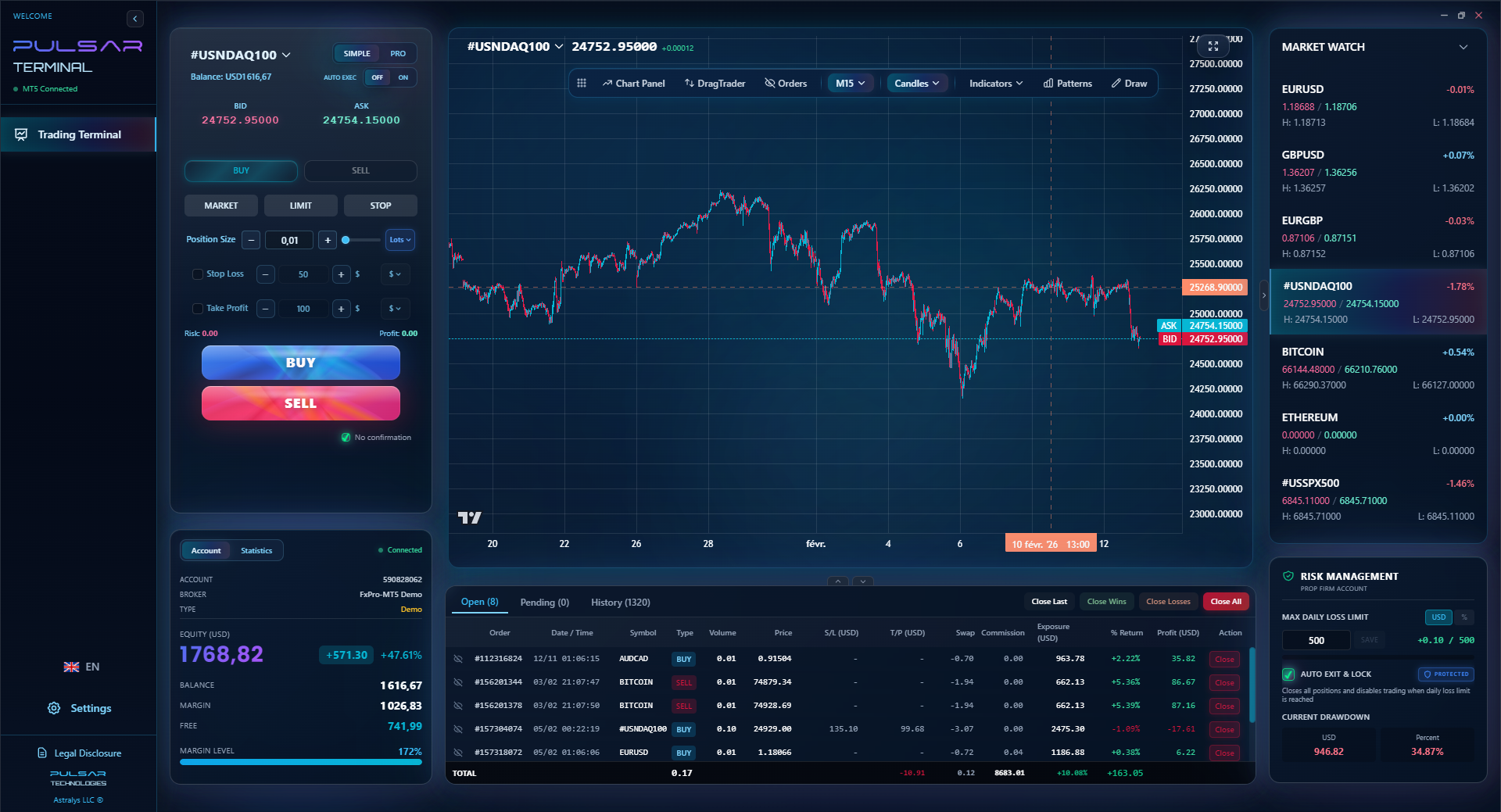
Sticking to a strict risk management plan is the core of halal trading, and Pulsar Terminal automates this with features like one-click multi-TP/SL orders and daily loss protection for prop firm challenges.
Pulsar Terminal
أداة MT5 الشاملة: أوامر سحب وإفلات، متعدد TP/SL، تريلينج ستوب، تداول الشبكة، Volume Profile وحماية البروب فيرم. يستخدمها أكثر من 1000 متداول يومياً.
I've mentored traders from our community for years. The pitfalls are remarkably consistent.
Pitfall 1: The 'Halal Account, Haram Mindset' Trap. This is the most common. Traders secure an Islamic account from a broker like IC Markets review or Exness review and then proceed to trade 10 micro lots on a £500 account. The tool is halal, but the usage is pure gambling. The account type doesn't absolve you of poor discipline.
Pitfall 2: Ignoring All Other Fees. You avoid swap, but what about the spread? The commission? The currency conversion fee on your GBP account when you trade USD pairs? OANDA, for instance, adds a 0.5% markup on conversions. These hidden costs eat profits and introduce Gharar if you're not aware.
Pitfall 3: Seeking a 'Fatwa' Instead of an Edge. Some traders spend more time looking for a scholar to 'bless' their trading than they do learning how to read a chart. Religious guidance is crucial for the principles, but no Imam can give you a profitable trading edge. That comes from study, practice, and screen time.
Pitfall 4: Trading During Prayer Times. It sounds simple, but I've seen it cause massive errors. A trade moves quickly during Salah, and you come back to a disaster. Either close your positions before prayer, use long-term trades that don't need monitoring, or accept that you will miss some moves. Your faith comes first.
💡 نصيحة وينستون
Seeking a scholar's approval for your trading plan is wise. Expecting them to approve your lack of a plan is foolish. Do your homework first.
“Up to 89% lose money. That statistic isn't about market evil; it's a measure of collective trader failure.”
So, is forex trading haram? Conventional, swap-charging, high-use, speculative trading? Yes, it likely is, as it violates multiple principles.
Can forex trading be structured in a halal way? Yes, through swap-free accounts, immediate execution, full transparency, and - most critically - a disciplined, analytical approach that removes gambling from the equation.
But here's the final, unvarnished truth. The biggest risk isn't the permissibility of the instrument. It's you. The markets are a mirror. They reflect your discipline, your patience, and your emotional control. If you lack those, you will lose money, halal account or not.
The path is clear:
- Choose a reputable FCA broker with a transparent Islamic account.
- Learn a real strategy. Backtest it.
- Ruthlessly enforce 1-2% risk management.
- Keep a journal.
- Consult your religious advisor for personal guidance on your final setup.
Forex isn't a shortcut. It's a skilled profession with a brutal learning curve. Approach it with the seriousness it demands, both financially and ethically, and you give yourself a fighting chance. Anything less is, frankly, a waste of your time and money.
FAQ
Q1Do all UK forex brokers offer Islamic accounts?
No, not all. However, most major FCA-regulated brokers do, including Pepperstone, XM, AvaTrade, and FXTM. You must specifically request to open an Islamic or swap-free account when signing up, as it's usually not the default option. Always check the broker's website or contact support to confirm.
Q2If Islamic accounts have no swap, how do brokers make money?
Brokers typically compensate by widening the spreads (the difference between buy and sell price) or by charging a fixed daily or weekly administrative fee on open positions. For example, a standard account might have a 0.8 pip spread on EUR/USD, while the Islamic version might have a 1.2 pip spread. You're still paying, just in a different way that avoids Riba.
Q3Is high use automatically considered Maisir (gambling)?
Not automatically, but it massively increases the risk of it. use amplifies both gains and losses. Using extreme use (like 500:1) on a small account often leads to gambling-like behaviour, as a few pips can wipe you out or create huge wins. Most scholars advise against excessive use because it introduces unacceptable levels of risk and uncertainty (Gharar), which aligns with gambling principles.
Q4Can I trade cryptocurrencies with an Islamic account?
This is a complex and debated area. Some brokers may extend swap-free status to crypto CFDs. However, the permissibility of trading cryptocurrencies themselves under Sharia law is a separate question many scholars are still examining, due to their volatility, speculative nature, and lack of intrinsic value. You must seek specific guidance on this asset class from a qualified Islamic scholar.
Q5What's more important: a halal account or a good strategy?
You need both, but a good strategy is what protects your wealth. A halal account ensures you're not dealing with Riba. But without a solid, back-tested strategy and strict risk management, you will lose money through gambling (Maisir). Think of the halal account as the foundation, and the strategy as the house you build on it. A foundation alone won't keep you dry in the rain.
Q6Are profits from halal forex trading considered halal income?
If all conditions are met - using a genuine swap-free account, trades are executed immediately (spot), the activity is based on analysis and not speculation/gambling, and all terms are transparent - then many scholars consider the profit to be halal. It is viewed as a profit from a legitimate trade (Bai'), not from interest. However, final personal rulings should come from your trusted scholar.
درس البروفيسور وينستون
النقاط الرئيسية:
- ✓Swap fees = Riba. Use a verified Islamic account.
- ✓use over 10:1 massively increases gambling risk.
- ✓Never risk more than 2% of your capital on a single trade.
- ✓A trading journal is your shield against self-deception.
ما مدى فائدة هذا المقال؟
انقر على نجمة للتقييم
رؤى التداول الأسبوعية
تحليلات واستراتيجيات أسبوعية مجانية. بدون رسائل مزعجة.
عن المؤلف
Sarah Collins
استراتيجي تداول
استراتيجية تداول مقيمة في لندن مع 12 عاماً من الخبرة في الأسواق المالية. محللة سابقة في شركة وساطة في حي المال بلندن. تغطي أزواج الجنيه الإسترليني والأسواق الأوروبية والتداول المنظم من FCA.
التعليقات
تحذير من المخاطر
ينطوي تداول الأدوات المالية على مخاطر كبيرة وقد لا يكون مناسبًا لجميع المستثمرين. الأداء السابق لا يضمن النتائج المستقبلية. هذا المحتوى لأغراض تعليمية فقط ولا ينبغي اعتباره نصيحة استثمارية. قم دائمًا بإجراء بحثك الخاص قبل التداول.
قد يعجبك أيضًا

Cara Trading Forex Sukses: 7 Prinsip dari Trader Profesional
Cara trading forex sukses dengan 7 prinsip trader pro: manajemen modal, disiplin, journal trading, backtest. Data nyata, bukan janji profit palsu.
Jam Trading Forex Terbaik untuk Trader Indonesia: Panduan Lengkap dengan Tabel Waktu
Panduan jam trading forex untuk trader Indonesia. Tabel 4 sesi dunia, jam emas 20:00-00:00, sesi mana yang harus dihindari. Data akurat + tips dari trader berpengalaman.
Top 5 Sàn Forex Uy Tín Nhất 2026: Review Jujur dari Trader Indonesia
Top 5 sàn forex uy tín 2026 untuk trader Indonesia. Review jujur: spread, deposit, withdraw, dukungan lokal. Exness, XM, IC Markets & lebih.
احصل على Pulsar Terminal
جميع هذه الحاسبات مدمجة في Pulsar Terminal مع بيانات حية من حساب MT5 الخاص بك.
احصل على Pulsar Terminal