


I lost R47,200 in three days in 2018.

David van der Merwe
متداول الأسواق الناشئة ·  South Africa
☕ 12 دقائق قراءة
ما ستتعلمه:
- 1Why Your Trading Notes Matter More Than Your Strategy
- 2What to Record in Your Forex Trading Notes (Every. Single. Time.)
- 3The South African-Specific Stuff You Can't Afford to Miss
- 4Format & Tools: From Notebooks to Apps (And How to Review Them)
- 5The 5 Biggest Mistakes South African Traders Make (And How Notes Fix Them)
- 6Turning Notes Into Profitable, Tax-Ready Habits
I lost R47,200 in three days in 2018. Not on one bad trade, but on a series of small, stupid ones that felt justified in the moment. I was trading USD/ZAR, convinced the rand was overbought. My first entry was fine, but then I added to the losing position twice because my 'gut' said it would turn. I didn't have a rule against averaging down. Worse, I had no record of my previous disasters with that exact move. My trading notes back then were a few scribbled prices on a notepad. That R47k lesson bought me one thing: the unshakeable belief that disciplined, detailed forex trading notes are the single biggest difference between a pro and a gambler in South Africa.
Most traders spend 90% of their time hunting for the perfect entry signal and 10% on everything else. That's backwards. Your strategy gets you in the door. Your trading notes keep you from getting thrown out of the window. Think about it: you can have a strategy with a 60% win rate, but if your losing trades are three times the size of your winners, you're still broke. Notes are your forensic audit.
In South Africa, there's another layer. The South African Revenue Service (SARS) doesn't care about your gut feeling. They care about records. If you can't prove your income, deductions, and trading history, you're in for a world of pain. I've seen traders get massive tax bills because they couldn't separate business expenses (like a trading course or a new monitor) from personal ones. Your notes are your first line of defence.

Warning: The FSCA's use cap of 30:1 for retail traders is there for a reason. Your notes should scream at you when you're using too much margin on a single trade. Without a journal, you'll only realise you've over-leveraged when you get the margin call email.
The real magic of notes isn't recording wins. It's brutally dissecting losses. Why did you ignore your stop-loss? What news did you miss? Were you tired, angry, or overconfident? I once reviewed six months of notes and found 80% of my biggest losses happened on trades entered after 10 PM. My late-night 'genius' ideas were actually sleep-deprived recklessness. That pattern was invisible until I wrote it down.
“Your strategy gets you in the door. Your trading notes keep you from getting thrown out of the window.”
A good trading note isn't a novel. It's a structured data entry. Miss one piece, and the puzzle is incomplete. Here’s the non-negotiable checklist for every trade, whether it's a 5-minute scalp on EUR/USD or a weekly swing on GBP/ZAR.
The Hard Data (The What)
This is the objective stuff. No opinions allowed.
- Instrument: e.g., USD/ZAR, EUR/USD.
- Date & Time (SAST): Critical for matching with news events and market sessions.
- Direction: Long or Short.
- Entry Price: Exact price, including the spread you paid.
- Stop-Loss Price: Where you promised yourself you'd get out.
- Take-Profit Price(s): Your target(s).
- Position Size: In lots or units, and the rand value. Use a position size calculator to get this right every time.
- Exit Price(s): Did you close all at once? Use partial closes? This is where you track your actual execution versus your plan.
- P&L in Rands: The final score. Include any swap/rollover fees, especially important for ZAR pairs which can have significant carry costs.
The Context & Psychology (The Why)
This is where you become your own therapist.
- Setup/Strategy Name: Was this a MACD indicator crossover? A support bounce? Naming it forces you to trade your plan.
- Chart Timeframe: Did the signal come from the 1-hour or the daily chart?
- Market Condition: Range-bound, trending, volatile? Note the ATR or other volatility measures.
- News/Event Impact: Was there a SARB interest rate decision? US NFP? Note if you traded into news (and survived).
- Emotional State: Be honest. "Confident," "Frustrated from previous loss," "Impatient," "Greedy."
- Reason for Entry: "Price rejected the 50-day MA" is good. "Felt like it was going up" is a red flag.
- Reason for Exit: Did you hit your TP? Did you panic and close early? Did you move your stop-loss and turn a winner into a loser?

Example:
- Trade: Short USD/ZAR
- Entry: R18.4520 | SL: R18.5100 (58 pips) | TP: R18.3800 (72 pips)
- Size: 0.5 lots | Risk: R1,450 (1% of R145k account)
- Exit: Closed at R18.3785 (Profit: R1,835)
- Notes: Short after double top on H4, confirmed bearish RSI indicator divergence. SARB was dovish yesterday. Held through minor bounce at R18.42. Felt patient. Good trade.
This level of detail turns a random trade into a reproducible experiment.

💡 نصيحة وينستون
Your trading notes are a mirror, not a trophy. Spend 10x more time analysing your losses than admiring your wins. The losses write the rulebook.
“The ghost losses - the trades you don't record - are the ones that haunt you and distort your true performance.”
Trading from SA isn't the same as trading from London or New York. Your notes need to reflect our unique landscape.
1. ZAR Pairs & Liquidity: Trading USD/ZAR or EUR/ZAR? Your notes must highlight the spread you traded at. A 5-pip spread vs. a 15-pip spread changes your risk/reward math instantly. Exotic pairs like these can gap wildly on local political news or commodity price swings (platinum, gold). Note any major SA news – a cabinet reshuffle, an Eskom announcement – that was active during your trade. I learned this the hard way shorting USD/ZAR during a sudden Moody's downgrade review. The 200-pip spike against me was in my notes forever.
2. The Tax Man (SARS) is Watching: This is serious. Since around March 2026, SARS has gotten much sharper. Your trading notes are the bedrock of your tax return. You need to track:
- Total Profit/Loss per tax year (March to February).
- Detailed records of all deposits and withdrawals to/from your broker, both local (like your FNB account) and offshore.
- Proof of deductible expenses. Bought a Pepperstone review subscription for market analysis? That's potentially deductible. New computer monitor primarily for trading charts? Note it with the invoice. Keep a separate log for these costs.
- Classification: Are you a speculative trader (income tax) or an occasional investor (CGT)? Your trading frequency and method, documented in your notes, will help your accountant argue your case. Trading 20 times a day looks like income. Trading twice a month looks like capital gains.
3. Broker & Platform Notes: Which FSCA-regulated broker are you using? Does their platform reliably execute stops during local load-shedding? I once used a broker whose mobile app would freeze for 10 seconds on reconnection after loadshedding. I lost R800 on a EUR/USD trade because of it. That went in the journal, and I changed my execution habits (and eventually my broker). Note deposit/withdrawal times and fees in Rands.
4. Time Zone & Session Impact: Your 4 PM (SAST) might be London's 2 PM and New York's 10 AM. Note which global market session was dominant when you entered. A scalping strategy might work in the London-New York overlap but fail miserably in the dead Asian session. Your notes will reveal these patterns.
“A trading note isn't a novel. It's a structured data entry. Miss one piece, and the puzzle is incomplete.”
The best format is the one you'll actually use consistently. Let's break down the options.
| Method | Pros | Cons | Best For... |
|---|---|---|---|
| Physical Notebook | Tactile, no distractions. Easy to sketch charts. | Hard to search/analyse. Easy to lose. A SARS nightmare. | The beginner needing discipline. |
| Spreadsheet (Google Sheets/Excel) | Free, customizable, calculable. Easy to sort/filter. Can generate P&L graphs. | Manual entry can be tedious. | The analytical trader who loves data. |
| Dedicated Trading Journal App | Automated trade imports from some brokers. Pre-built analytics & psychology metrics. | Monthly/yearly cost. May not support all brokers. | The active trader wanting efficiency and insights. |
| Trading Platform Notes Field | Attached directly to the trade in MT4/5. Immediate. | Limited space. Hard to review collectively. | A supplementary note, not a primary journal. |
I use a hybrid system: A spreadsheet is my source of truth for numbers and SARS. I also use the journal feature in my trading terminal to jot down quick emotional context right after execution.
The Weekly Review: Where the Gold Is
Writing notes is step one. Reviewing them is where you get paid. Every Sunday, I block one hour.
The Analytical Review:
- Filter all trades by instrument. Am I profitable on USD/ZAR but a disaster on Gold (XAU/USD guide)? Maybe I should stop trading gold.
- Filter by win rate vs. average win/loss size. This tells you if you're a sniper (high win rate, small wins) or a hunter (low win rate, big wins). Are you sticking to your style?
- Calculate your maximum consecutive losses and drawdown. Is your risk per trade small enough to survive that streak?
The Psychological Review:
- Read the 'Emotional State' and 'Reason for Exit' columns. See a pattern? "Closed early due to fear" appears after two losing trades in a row. That's a rule: after two losses, walk away for the day.
- Look for revenge trades. Did you jump into a scalping strategy right after a big loss to 'make it back'? Highlight those in red.
This process turned my trading around. I saw I was forcing trades on quiet Tuesday afternoons just to 'be in the market.' Now, if there's no A+ setup, I'm done. My notes told me to stop.
💡 نصيحة وينستون
For SARS, think like an auditor. If you can't point to a line in your notes that justifies a deduction in 30 seconds, you don't have a record, you have a wish.
“A trading note isn't a novel. It's a structured data entry. Miss one piece, and the puzzle is incomplete.”
-
Not Recording the Failed Trades (The 'Ghost Losses'). We've all done it. That quick 0.1 lot trade that blew through your stop-loss? You ignore it, pretend it didn't happen. But your account balance knows. Your notes must include EVERY trade, especially the embarrassing ones. The ghost losses are the ones that haunt you and distort your true performance stats.
-
Being Vague. "Market felt heavy." What does that mean? Was the order book thin? Was price failing at a key level? Be specific. "Price made three consecutive lower highs on the 5-min chart while volume declined" is actionable. Vagueness is useless.
-
Only Reviewing When You're Losing. This is a huge one. When you're on a winning streak, you think you're invincible. That's when your notes are most valuable. What are you doing right? Is it repeatable, or are you just getting lucky? I had a 12-trade winning streak once. My review showed 9 of those wins were from one specific swing trading setup on GBP/JPY. That defined my edge.
-
Ignoring the 'Why' for Exits. You bagged a R2,000 profit. Great. Did you exit because your target was hit, or because you got scared it would reverse? If it's the latter, you've just punished a correct trade. Your notes need to reinforce good behaviour, even if the outcome was a smaller win.
-
No Dedicated Time. You'll never do it if it's an afterthought. Schedule it like a business meeting. My rule: No new trade can be placed until the previous trade's notes are logged. It takes 90 seconds. This one habit prevents impulsive re-entries and forces clarity.

Pro Tip: Use your notes to backtest your broker's execution. Note your requested stop-loss price and the price you were actually filled at during a fast market. If slippage is consistently large, it might be time to check out brokers known for better execution, like IC Markets review or others with true ECN models.
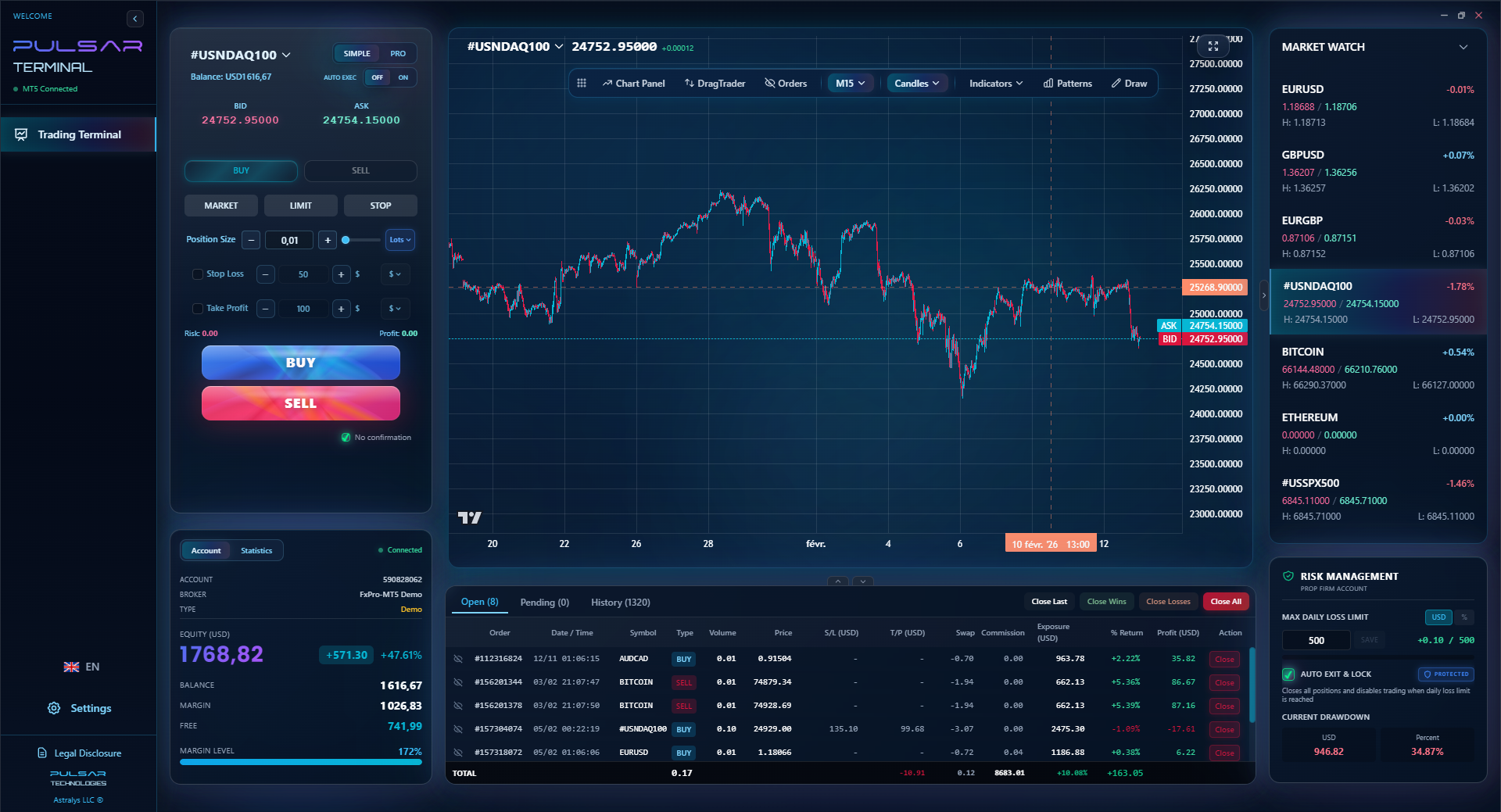
Manually logging every partial close and adjusted stop is tedious; Pulsar Terminal automates this record-keeping directly on your MT5 chart, making your trade notes accurate and effortless.
Pulsar Terminal
أداة MT5 الشاملة: أوامر سحب وإفلات، متعدد TP/SL، تريلينج ستوب، تداول الشبكة، Volume Profile وحماية البروب فيرم. يستخدمها أكثر من 1000 متداول يومياً.
“When you're in a drawdown, your mind lies to you. Your trading notes are the cold, hard data.”
After a few months of disciplined note-taking, something shifts. You stop seeing charts and start seeing your own behavioural patterns superimposed on them. You begin to trade not just the market, but your own proven statistical profile.
Building Your Personal Trading Manual: This is the end goal. Extract rules from your notes.
- Rule 1: No trading USD/ZAR within 2 hours of a major SA political announcement. (Source: 3 losing trades in notes).
- Rule 2: Maximum position size is 1.5% of account equity. (Source: Drawdown analysis showed 2% risk led to emotional damage).
- Rule 3: After two consecutive losses, shut down for the day. (Source: Psychological review showed revenge trading).
This manual evolves. It's your constitution.
For SARS: The Annual Compilation. Come February, your note-taking pays its taxes. From your master spreadsheet or journal:
- Export a full trade history for the tax year.
- Summarise total net profit/loss.
- Compile a separate list of all business expenses with invoices/receipts.
- List all capital injections (deposits) and withdrawals.
Hand this to your accountant. It's clean, professional, and defensible. Trying to reconstruct this from bank statements and fragmented broker reports is a recipe for an audit and penalties.
The Ultimate Benefit: Objectivity. When you're in a drawdown, your mind lies to you. It says you've lost your touch, the market is rigged, your strategy is broken. Your trading notes are the cold, hard data. They can show you that this 8-trade losing streak is within the historical variance of your system, which has a 35% win rate but a strong risk/reward. They tell you to stick to the process. Without them, you're just guessing in the dark, and in the forex market, guessing is just a slower way to lose money.
The most valuable line in my trading notes isn't a big win. It's from a losing trade last year: "Ignored Rule #3. Traded while angry about work. Took a setup that was a B- at best. Lost 1.2%. Stupid. Cost: R1,440. Lesson fee paid." That R1,440 bought more discipline than any R14,400 win ever could.
FAQ
Q1Is forex trading legal in South Africa, and do my notes help with regulation?
Yes, it's completely legal if you use an FSCA-regulated broker. Your notes don't directly help with FSCA compliance, but they are critical for managing the use limits (30:1 for retail) responsibly. They prove you're applying risk management, which is what the regulator intends.
Q2What's the minimum I should record for SARS purposes?
At an absolute minimum: date, instrument, profit/loss in Rands, and a record of all deposits and withdrawals. However, this bare minimum won't help you improve. For both tax and performance, record entry/exit prices, position size, and the reason for the trade.
Q3I trade on my phone. How can I keep good notes?
Use a cloud-based spreadsheet app (like Google Sheets) or a mobile-friendly trading journal app. Many link directly to your broker's API. The key is to log the trade immediately after execution, while the context is fresh. Don't wait until the end of the day.
Q4How do I note the spread and commissions for ZAR pairs?
Your trading platform's trade history usually shows the exact execution price. Compare your requested entry price to the filled price - the difference is the slippage/spread. For commissions, check your broker's statement. Note the total cost in Rands in your 'P&L' calculation. High spreads on exotics like EUR/ZAR can be a major cost.
Q5Can my trading notes be used against me by SARS?
If you're audited, SARS can request any records related to your income. Clear, honest notes that show a genuine trading business are far better than having no records. Notes showing consistent losses can also substantiate your claims. Inconsistency or evidence of hiding profits is what gets you in trouble.
Q6How long should I keep my forex trading notes?
SARS can audit you for up to 5 years after the submission of a return. Keep all records, including your detailed notes, for a minimum of 5 years. Store them digitally and back them up.
Q7Do I need to note every single tiny trade, even a 1-minute scalp?
Yes. Absolutely. Every trade affects your account balance, your psychology, and your tax liability. If it's not worth recording, it's not worth taking. The aggregate of those 'tiny' trades is often where leaks in discipline happen.
درس البروفيسور وينستون
النقاط الرئيسية:
- ✓Note every trade, especially the losers. Ghost losses kill accounts.
- ✓Record the 'why' for exits. Psychology reveals your real edge.
- ✓Weekly reviews find fatal patterns. Do them without fail.
- ✓Build a personal rulebook from your notes. It's your trading constitution.
- ✓Your notes are your primary SARS defence. Keep them for 5+ years.
ما مدى فائدة هذا المقال؟
انقر على نجمة للتقييم
رؤى التداول الأسبوعية
تحليلات واستراتيجيات أسبوعية مجانية. بدون رسائل مزعجة.
عن المؤلف
David van der Merwe
متداول الأسواق الناشئة
متداول مقيم في جوهانسبرغ مع 11 عاماً في عملات الأسواق الناشئة. متخصص في أزواج ZAR والتداول المنظم من FSCA وتحليل السوق الجنوب إفريقي.
التعليقات
تحذير من المخاطر
ينطوي تداول الأدوات المالية على مخاطر كبيرة وقد لا يكون مناسبًا لجميع المستثمرين. الأداء السابق لا يضمن النتائج المستقبلية. هذا المحتوى لأغراض تعليمية فقط ولا ينبغي اعتباره نصيحة استثمارية. قم دائمًا بإجراء بحثك الخاص قبل التداول.
قد يعجبك أيضًا

Cara Trading Forex Sukses: 7 Prinsip dari Trader Profesional
Cara trading forex sukses dengan 7 prinsip trader pro: manajemen modal, disiplin, journal trading, backtest. Data nyata, bukan janji profit palsu.
Jam Trading Forex Terbaik untuk Trader Indonesia: Panduan Lengkap dengan Tabel Waktu
Panduan jam trading forex untuk trader Indonesia. Tabel 4 sesi dunia, jam emas 20:00-00:00, sesi mana yang harus dihindari. Data akurat + tips dari trader berpengalaman.
Top 5 Sàn Forex Uy Tín Nhất 2026: Review Jujur dari Trader Indonesia
Top 5 sàn forex uy tín 2026 untuk trader Indonesia. Review jujur: spread, deposit, withdraw, dukungan lokal. Exness, XM, IC Markets & lebih.
احصل على Pulsar Terminal
جميع هذه الحاسبات مدمجة في Pulsar Terminal مع بيانات حية من حساب MT5 الخاص بك.
احصل على Pulsar Terminal