


It was 2:15 PM on a Tuesday in early March.
Sarah Collins
استراتيجي تداول ·  United Kingdom
☕ 12 دقائق قراءة
ما ستتعلمه:
- 1Why Your Watch Matters More Than Your Chart
- 2The Global Sessions: A UK Trader's View
- 3The Golden Hours: The London-New York Overlap
- 4Building Your Personal UK Trading Routine
- 5Matching Pairs to Sessions (And What to Avoid)
- 6Weekends, Gaps, and the Sunday Night Scramble
- 7Putting It All Together: A Sample Week
It was 2:15 PM on a Tuesday in early March. I was short EUR/GBP, convinced the pair was rolling over. The chart looked perfect - until it didn't. The London session was winding down, New York was getting its coffee, and out of nowhere, a 40-pip spike ripped through my stop loss. The culprit? A surprise comment from an ECB official, released right in the dead zone between major economic data. That £420 loss wasn't about analysis; it was about timing. I was trading when I should have been watching. The forex market never sleeps, but your trading shouldn't be a 24/7 grind. Here's how to match your activity to the market's real rhythm.
Most traders obsess over indicators and entries. I get it - I spent years perfecting a 7-indicator setup that looked brilliant in backtests. The real edge, though, isn't hidden in a lagging oscillator. It's printed on the clock. The forex market's 24-hour cycle creates predictable patterns of liquidity and volatility. Trade during the wrong window, and you're fighting against thin volume, wild spreads, and news releases that move markets for no apparent reason. Trade during the right one, and the market's natural flow can work with you. Think of it like surfing. You can have the best board and technique, but if you paddle out when the tide's dead flat, you're not catching anything. The schedule tells you when the waves are coming. For UK traders, this is especially critical. Our 8 AM to 5 PM local session is the engine room of the global market, but its power ebbs and flows as other financial centres wake up and sleep. Ignoring this is like trying to drive the M25 at 5 PM on a Friday and expecting no traffic.
“The forex market never sleeps, but your trading shouldn't be a 24/7 grind.”
Let's break down the four main sessions, not by their generic names, but by what they actually mean for someone sitting in London, Manchester, or Edinburgh. All times are in UK local time year-round (GMT in winter, BST in summer).
The Sydney Session (Opens ~11 PM Sunday, Closes ~8 AM Monday)
This is the market's soft open. Volume is light, dominated by banks and institutions in Australia and New Zealand adjusting their books. For you and me? It's mostly noise. Spreads on major pairs like EUR/USD can be slightly wider. I made the mistake early on of trying to scalping strategy the AUD/USD moves at 3 AM. The result was getting whipsawed by insignificant moves that reversed the moment Tokyo came online. It's not a trading session; it's a pre-game show.
The Tokyo Session (Asia) (Opens ~12 AM, Closes ~9 AM)
Now we get some real action. Japanese banks, hedge funds, and later Singapore and Hong Kong enter the fray. This session sets the tone for the Asian region. Pairs like USD/JPY, AUD/USD, and NZD/USD see their most reliable moves here. If you're trading these, this is your window. A lesson I learned the hard way: don't hold a USD/JPY position from the Asian session into the London open unless you have a very wide stop. The momentum often doesn't translate.
The London Session (Opens 8 AM, Closes 5 PM)
This is our home game. London handles roughly 38% of all global FX volume. This is when the market comes alive for European pairs. EUR/USD, GBP/USD, EUR/GBP - this is their playground. Economic data from the Eurozone and the UK drops here, causing real, sustained moves. The liquidity is deep, meaning spreads are usually at their tightest. If you're only going to trade one session, make it this one. The first two hours (8 AM - 10 AM) are often the most volatile as the market digests overnight moves and new European data.
The New York Session (Opens 1 PM, Closes 10 PM)
The US session brings its own flavour. It often continues momentum from London, but can also reverse it if US data contradicts the European narrative. The first hour (1 PM - 2 PM) is critical. I've seen many a tidy profit from a London trade evaporate in those 60 minutes when US traders hit their desks. Pairs like USD/CAD become particularly active with oil prices and Canadian data in the mix.

Warning: The period between 5 PM and 1 PM (London close to New York open) is a notorious twilight zone. Volume dries up significantly. This is when a single moderate-sized order can cause a disproportionate spike, like the one that took my EUR/GBP trade out. Avoid setting new trades in this window unless you're specifically trading the Sydney open.

💡 نصيحة وينستون
Your most important trading tool is a clock, not an indicator. If you wouldn't open a shop on a deserted high street at 3 AM, don't trade during the Sydney session.
“Trade during the wrong window, and you're fighting against thin volume, wild spreads, and news releases that move markets for no apparent reason.”
If there's a holy grail in the forex trading schedule, it's the overlap between the London and New York sessions. From 1 PM to 5 PM UK time, both of the world's largest financial centres are open for business. This four-hour window accounts for the majority of the day's real volume and often its biggest, cleanest trends.
Why is it so powerful? You have European banks squaring off positions against American hedge funds, asset managers, and corporations. The liquidity is enormous. This means two things for you: 1) spreads are razor-thin, and 2) breakouts tend to be more legitimate and sustained. False breaks are less common because it takes genuine volume to move the market against such deep liquidity.
My most consistent profits have come from this window. For example, on a Wednesday last October, I entered a long position on GBP/USD at 1.2085 at 1:30 PM, just as the US session was finding its feet. The pair had been consolidating all morning. The breakout, fueled by combined London and New York volume, carried it to 1.2160 within two hours. That was a 75-pip move on a clear, high-volume trend. I used a simple position size calculator to risk just 0.5% of my account, netting a clean 1.5% gain. The strategy wasn't complex; I was just trading when the market was most likely to trend.

Pro Tip: Don't just trade blindly during the overlap. The first 90 minutes (1 PM - 2:30 PM) are often the most explosive as New York reacts to the London session's setup. After 4 PM, volume starts to taper off as London traders log off. Plan your main trades for the front half of this window.
“If there's a holy grail in the forex trading schedule, it's the overlap between the London and New York sessions.”
You know the sessions. Now, how do you build a life around them without burning out? The key is specialization and discipline. You cannot be effective across all pairs and all sessions. Here’s a sample framework based on common trader profiles.
The Part-Time Professional (After Work): Your window is likely 6 PM - 10 PM. This is late New York session. Focus is key. Avoid the messy Asian crosses. Instead, look at USD pairs (USD/JPY, USD/CAD) or the tail end of a EUR/USD move that started in London. Your edge here is patience - wait for the New York session to establish a clear direction after the post-London volatility settles down.
The Morning Trader: You trade from 7 AM to 11 AM. This is the London open and early session. This is prime time for reacting to UK and EU data. Have your watchlists ready for EUR/USD, GBP/USD, and EUR/GBP. Be prepared for volatility at 8:30 AM when UK data often drops. I used to trade this session exclusively, and my journal shows 70% of my trades were placed between 8 AM and 10:30 AM.
The Full-Time Strategist: You have the luxury of picking your battles. A potent routine could be:
- 7:55 AM - 8:30 AM: Prep. Review overnight moves, set alerts, plan for European data.
- 8:30 AM - 12:00 PM: Active trading on London-driven moves.
- 12:00 PM - 1:00 PM: Review, manage positions, plan for US overlap.
- 1:00 PM - 4:00 PM: Active trading during the London-New York overlap.
- After 4:00 PM: Wind down. Close discretionary trades, set stop losses on swing trading positions, review the day.
The most important rule? When your chosen session is over, walk away. Checking charts at midnight "just to see" is a path to overtrading and revenge trading bad decisions.

Example: Let's quantify a bad routine. You trade EUR/USD at 9 AM (good), then again at 11 PM (bad). The spread at 9 AM might be 0.7 pips. At 11 PM, it could widen to 2.5 pips due to lower liquidity. On a standard lot, that's an extra £18 cost before your trade even starts. You're immediately £18 in the hole.
💡 نصيحة وينستون
The market pays you for patience, not persistence. Waiting for the London-New York overlap is not missing out; it's letting the amateurs clear the minefield for you.
“If there's a holy grail in the forex trading schedule, it's the overlap between the London and New York sessions.”
Not all pairs are created equal across the clock. Trading AUD/JPY during the London session is often a frustrating exercise in sideways chop. Here’s a practical guide:
| Currency Pair | Best Session(s) | Why | Worst Session |
|---|---|---|---|
| EUR/USD | London, London-NY Overlap | Maximum liquidity & volume during European/US hours. | Sydney Session (Thin, erratic) |
| GBP/USD | London (esp. 8:30-10 AM) | Driven by UK data and London bank flow. | Late NY / Asian (Directionless) |
| USD/JPY | Tokyo, London-NY Overlap | Active during Asian hours, then again with US yields. | Sydney (Just a warm-up) |
| AUD/USD | Tokyo, Sydney-Tokyo Overlap | Reacts to Chinese data & Aus commodity prices. | Late London (Momentum fades) |
| EUR/GBP | London | A purely European cross. Illiquid outside this window. | Any other session (Wide spreads) |
| USD/CAD | New York, Overlap | Tied to oil (WTI) and US data, both NY-centric. | Tokyo (No catalyst) |
The Major Trap: Trading Exotics on a Whim I once decided to trade USD/TRY (US Dollar/Turkish Lira) during the London session because I saw a "sure thing" setup. The spread was 45 pips. Forty-five. My analysis needed to be correct by nearly half a percent just to break even. The trade moved 20 pips in my favour then reversed. I lost not because I was wrong on direction, but because I ignored the cost of trading an illiquid pair at the wrong time. Stick to majors and minors during their active sessions.
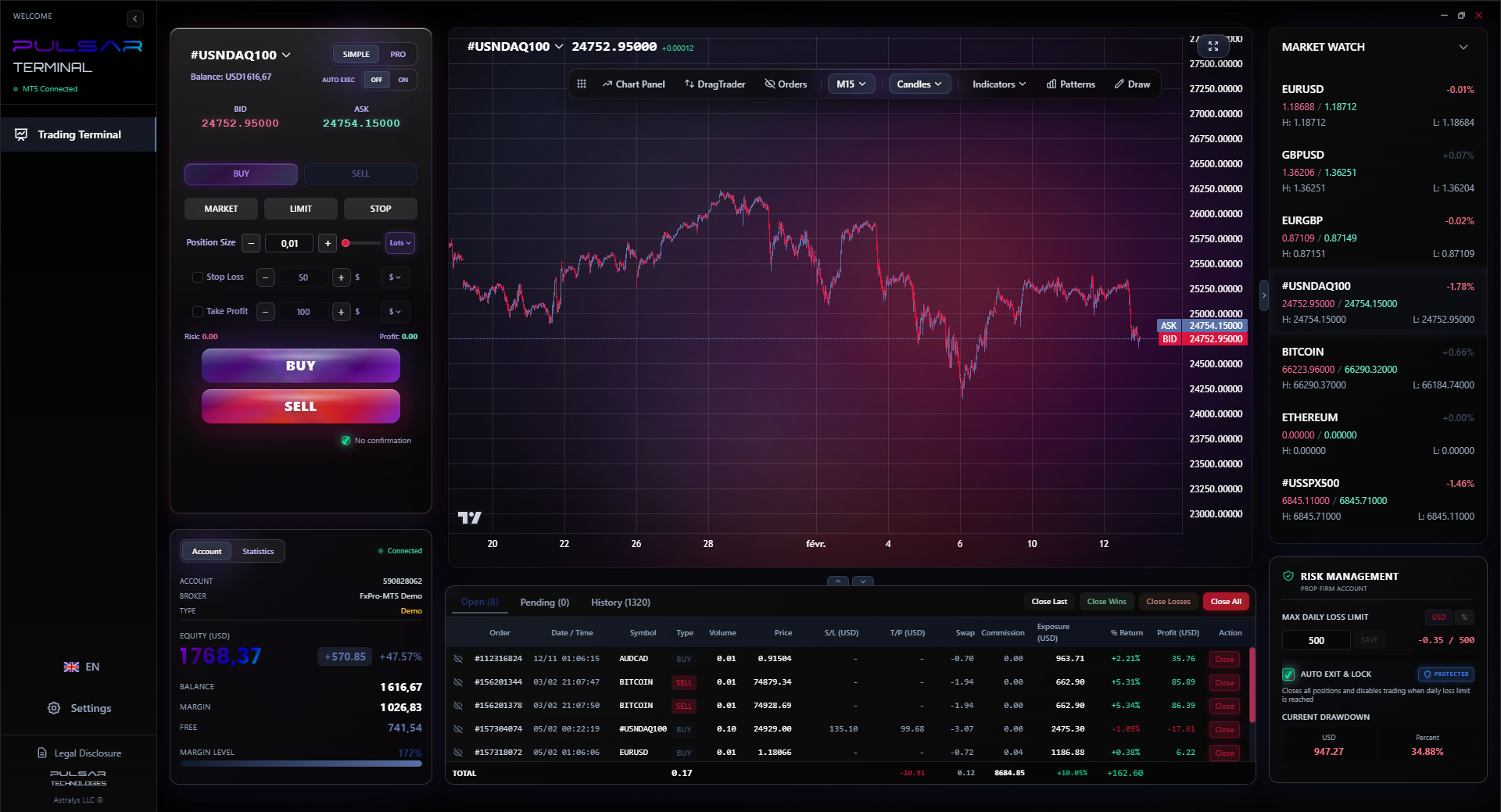
This discipline in pairing instruments with time is where tools that help you manage risk efficiently become useful. For instance, if you're trading the volatile London open, having a platform that lets you set a multi-level exit strategy - like taking partial profit at 1.5x risk and letting the rest run - can lock in gains during fast moves. Automating part of your exit means you're not glued to the screen during the most frantic period.
Managing fast-moving trades during volatile sessions like the London open is easier with tools that let you set complex exit strategies with a single click, directly on your MT5 chart.
Pulsar Terminal
أداة MT5 الشاملة: أوامر سحب وإفلات، متعدد TP/SL، تريلينج ستوب، تداول الشبكة، Volume Profile وحماية البروب فيرم. يستخدمها أكثر من 1000 متداول يومياً.
“You cannot be effective across all pairs and all sessions. Specialization is survival.”
The market closes on Friday at 10 PM UK time and reopens Sunday at 11 PM. That 49-hour break is where risk accumulates unseen. Geopolitical events, central bank comments, or unexpected economic data can cause prices to "gap" up or down at the Sunday open.
My rule is simple: I do not hold significant, unprotected positions over the weekend. The potential reward is never worth the existential risk of a market opening 2% against you on a Sunday night. If I have a profitable swing trading position I want to keep, I'll move my stop loss to breakeven or better before Friday's close.
The Sunday night open (11 PM) itself is treacherous. It's the Sydney session, so volume is low. Gaps can get filled quickly, or they can extend. I treat the first two hours of the week as observation only. It's about gathering information - seeing where the gaps are, how the market is reacting - not taking action. Trying to "fade the gap" (trade against it) on Sunday night is a classic amateur move that blows up more accounts than it helps.
Economic Calendar Alignment Your trading schedule must be married to the economic calendar. A high-volatility session like the London-New York overlap becomes a minefield if you don't know that US CPI data is due at 1:30 PM. Always know what's scheduled for the session you're trading. I mark high-impact events (red) on my calendar and simply do not trade that pair for 15 minutes before and after the release. The spread widening and random volatility isn't trading; it's gambling.
💡 نصيحة وينستون
Friday after 4 PM is for moving stops to breakeven, not for hero trades. A weekend gap has zero respect for your brilliant Friday afternoon analysis.
“When your chosen session is over, walk away. Checking charts at midnight is a path to revenge trading.”
Let's make this concrete. Here’s what a disciplined week might look like for a UK trader focusing on EUR/USD and GBP/USD.
Monday:
- 11 PM Sunday - 8 AM Monday: Market reopens. Observe any gaps, but no trading.
- 8 AM - 10 AM: Watch initial London reaction to weekend news. Look for a clear direction on EUR/USD. Potential first trade.
- 1 PM - 4 PM: Trade the London-NY overlap, focusing on continuation or reversal of the morning trend.
Tuesday:
- 8:30 AM: UK Unemployment/Average Earnings data. High volatility on GBP pairs. Either trade the breakout with tight risk or stand aside.
- 1:30 PM: US Retail Sales data. Major mover for USD pairs. Again, trade the clear breakout or avoid.
Wednesday:
- 2 PM: FOMC Meeting Minutes (if scheduled). The entire afternoon session revolves around this. No new trades before 2 PM. After the release, the market often establishes a trend for the next 24 hours.
Thursday:
- 1:30 PM: US Jobless Claims, PPI. Another US data point that can set the tone for the NY session.
- 7:45 AM / 8:30 AM: European Central Bank (ECB) statements or Eurozone data. Key for EUR/USD.
Friday:
- 1:30 PM: US PCE Inflation (Key Fed gauge). Huge volatility.
- After 4 PM: Start winding down. Close any discretionary trades. Adjust stops on longer-term holds to protect profits ahead of the weekend close at 10 PM.
This isn't about trading every session. It's about identifying the 2-3 highest-probability windows each day where your edge - preparation, understanding of the session's dynamics, and risk management - is greatest. The rest of the time, you're analysing, planning, and living your life. That's the real secret of the forex trading schedule: it tells you when to work, and more importantly, when to stop.
FAQ
Q1What is the best time to trade forex in the UK?
For most retail traders, the best time is the London session (8 AM - 5 PM) and specifically the London-New York overlap (1 PM - 5 PM). This period has the highest liquidity and most reliable trends for major pairs like EUR/USD and GBP/USD. The volatile first two hours of London (8 AM - 10 AM) also offer strong opportunities if you can handle the pace.
Q2Can I trade forex 24 hours a day from the UK?
Technically, yes - the market is open 24/5. But you absolutely shouldn't. Trading during low-volume sessions (like late New York or the Sydney session) means wider spreads, erratic price action, and a higher chance of getting stopped out by meaningless noise. Professional traders specialise in specific sessions; they don't marathon trade.
Q3Is the forex market open on weekends in the UK?
No, the spot forex market is closed from Friday 10 PM until Sunday 11 PM UK time. Some brokers may offer limited CFD trading on weekends, but liquidity is extremely thin and spreads are massive. It's not a real market and should be avoided.
Q4What time does the London forex session open?
The London forex session opens at 8 AM UK local time and closes at 5 PM, year-round. This consistency makes planning easy for UK traders. Remember, 8:30 AM is a key time as major UK economic data is often released then.
Q5Should I trade during news releases?
Unless you are a highly experienced news trader with direct, low-latency access, it's generally wise to avoid opening new positions 15 minutes before and after a high-impact news release (like US Non-Farm Payrolls or CPI). The spreads widen enormously, and price can spike violently in both directions. It's often smarter to wait for the initial panic to subside and trade the established direction.
Q6How does British Summer Time (BST) affect forex trading times?
For a UK trader, it doesn't in a practical sense. Your trading platform and broker will display times in your local time zone. The London session will always show as 8 AM - 5 PM on your chart, whether it's GMT or BST. The global session times shift relative to GMT, but your local schedule remains constant.
Q7What's the most volatile forex trading session?
The first two hours of the London session (8 AM - 10 AM UK time) and the first hour of the London-New York overlap (1 PM - 2 PM) are typically the most volatile. This is when the highest volume of economic data is released and the largest pools of liquidity interact, creating strong directional moves.
درس البروفيسور وينستون
النقاط الرئيسية:
- ✓Trade the London-NY overlap (1-5 PM) for the cleanest trends.
- ✓Avoid the 5 PM - 1 PM window; it's a liquidity desert.
- ✓Never hold unhedged positions over the weekend.
- ✓Match your pair to its active session (e.g., GBP/USD loves 8:30 AM).
- ✓Wider than 2-pip spread? You're probably trading at the wrong time.
ما مدى فائدة هذا المقال؟
انقر على نجمة للتقييم
رؤى التداول الأسبوعية
تحليلات واستراتيجيات أسبوعية مجانية. بدون رسائل مزعجة.
عن المؤلف
Sarah Collins
استراتيجي تداول
استراتيجية تداول مقيمة في لندن مع 12 عاماً من الخبرة في الأسواق المالية. محللة سابقة في شركة وساطة في حي المال بلندن. تغطي أزواج الجنيه الإسترليني والأسواق الأوروبية والتداول المنظم من FCA.
التعليقات
تحذير من المخاطر
ينطوي تداول الأدوات المالية على مخاطر كبيرة وقد لا يكون مناسبًا لجميع المستثمرين. الأداء السابق لا يضمن النتائج المستقبلية. هذا المحتوى لأغراض تعليمية فقط ولا ينبغي اعتباره نصيحة استثمارية. قم دائمًا بإجراء بحثك الخاص قبل التداول.
قد يعجبك أيضًا

Cara Trading Forex Sukses: 7 Prinsip dari Trader Profesional
Cara trading forex sukses dengan 7 prinsip trader pro: manajemen modal, disiplin, journal trading, backtest. Data nyata, bukan janji profit palsu.
Jam Trading Forex Terbaik untuk Trader Indonesia: Panduan Lengkap dengan Tabel Waktu
Panduan jam trading forex untuk trader Indonesia. Tabel 4 sesi dunia, jam emas 20:00-00:00, sesi mana yang harus dihindari. Data akurat + tips dari trader berpengalaman.
Top 5 Sàn Forex Uy Tín Nhất 2026: Review Jujur dari Trader Indonesia
Top 5 sàn forex uy tín 2026 untuk trader Indonesia. Review jujur: spread, deposit, withdraw, dukungan lokal. Exness, XM, IC Markets & lebih.
احصل على Pulsar Terminal
جميع هذه الحاسبات مدمجة في Pulsar Terminal مع بيانات حية من حساب MT5 الخاص بك.
احصل على Pulsar Terminal