


I remember staring at my screen in 2019, my withdrawal request stuck on 'Pending Verification' for the third day.

David van der Merwe
متداول الأسواق الناشئة ·  South Africa
☕ 12 دقائق قراءة
ما ستتعلمه:
- 1What Forex Verification Actually Is (And Isn't)
- 2The FSCA and FICA: Your Trading Bodyguards
- 3The Step-by-Step Verification Process
- 4The Real Costs: Spreads, Commissions, and Hidden Fees
- 5How to Choose a Broker That's Actually Verified
- 6Common Pitfalls and How to Avoid Them
- 7How Verification Ties Into Your Trading Strategy
- 8Ongoing Compliance: It Doesn't End at Sign-Up
I remember staring at my screen in 2019, my withdrawal request stuck on 'Pending Verification' for the third day. I'd made a clean R8,500 profit on USD/ZAR shorts, but the broker wanted more documents. A utility bill, they said. My frustration was real, but that experience taught me more about the importance of forex verification than any textbook ever could. In South Africa, this isn't just red tape. It's your first line of defense. Let me walk you through what it really means, why the FSCA and FICA matter to your trading, and how to get it right the first time.
Forex verification, or KYC (Know Your Customer), is the process where a broker confirms you are who you say you are. In South Africa, it's not optional. It's the law, enforced by the Financial Sector Conduct Authority (FSCA) under the Financial Intelligence Centre Act (FICA).
Many new traders see it as a hassle, a barrier between them and the markets. I did too. But flip that perspective. A broker that doesn't verify you properly is a massive red flag. It means they're not regulated here, and your funds are not protected under South African law. The verification process is their commitment to operating legally and your assurance that you're not dealing with a bucket shop.
The core of it is simple: prove your identity and your address. This usually means a clear copy of your South African ID or passport, and a recent document like a utility bill or bank statement showing your name and physical address. Some brokers, especially for larger deposits, might ask about your source of funds. This isn't them being nosy. It's a FICA requirement to prevent money laundering.

Warning: If a broker lets you deposit and trade large amounts with zero verification, run. That's a classic sign of an unregulated offshore operation. Your money is likely gone if you try to withdraw.
I learned this lesson with a small, test deposit of R1,000 on an unregulated platform years ago. The trades went fine. The withdrawal? Never happened. The 'support' just vanished. That R1,000 was my cheapest lesson in why forex verification matters.

💡 نصيحة وينستون
Verification isn't bureaucracy. It's the market's immune system. A broker that skips it is the virus.
Let's talk about the two acronyms that should be your best friends: FSCA and FICA.
The Financial Sector Conduct Authority (FSCA) is our main financial watchdog. Think of them as the referees. Any broker offering services to South Africans must be authorized by them. This authorization means the broker must keep client funds in segregated accounts (your money is separate from the company's money), adhere to fair practice rules, and submit to regular audits. Before you deposit a single cent, check the broker's website for their FSP number (Financial Service Provider number). Then, go to the FSCA's website and verify it yourself. Don't just take their word for it.
The Financial Intelligence Centre Act (FICA) is the rulebook the referees use. It mandates the KYC process. Its purpose is to combat financial crime, pure and simple. By forcing brokers to verify you, it makes the entire system more secure for legitimate traders like us.
Why This Protects You
When a broker is FSCA-regulated and follows FICA, you have recourse. If something goes wrong - a platform issue, an unfair margin call, a withdrawal delay - you can lodge a formal complaint with the FSCA. I've never had to go that far, but knowing the option exists changes how you choose a broker. I primarily use brokers like IC Markets and Pepperstone because their local entities are properly regulated here. The peace of mind is worth a slightly tighter spread.
Their verification process was straightforward. ID, proof of address, done. My accounts were live within a day. Contrast that with the shady outfits that operate in the shadows. The difference is night and day.
“Knowing your exact cost per pip is non-negotiable.”
Here’s exactly what to expect, based on my experience with half a dozen FSCA-regulated brokers.
- Sign Up: You fill in your personal details: full name (must match your ID), date of birth, SA ID number, physical residential address, and tax number.
- Submit Documents: You’ll upload scans or clear photos.
- Proof of Identity: A colour copy of your South African ID (both sides) or passport photo page.
- Proof of Residence: A document not older than 3 months. A municipal bill (electricity, water), a bank statement, or a SARS document works perfectly. It must show your name and the same address you registered with.
- Optional but Common: A proof of payment if you’ve already deposited. Sometimes a selfie holding your ID.
- Review & Approval: The broker's compliance team checks everything. This usually takes 24-48 business hours. If there’s an issue (blurry photo, expired document), they’ll email you.
- Trading Enabled: Once approved, any deposit or trading limits are lifted, and you’re fully verified.

Pro Tip: Prepare your documents before you sign up. Have a clear JPG or PDF of your ID and a recent utility bill ready on your computer. This cuts the setup time from days to hours.
A mistake I made early on was using a PDF bank statement where my address was on page 2. The reviewer missed it, and it delayed my approval by two days. Now, I always highlight my address in yellow if it’s not immediately obvious.

Verification itself is free. But the broker you verify with determines your trading costs. Let's break down the numbers you'll actually see in South Africa.
| Cost Type | What It Is | Typical Range in SA (ZAR Accounts) | My Note |
|---|---|---|---|
| Spread | Difference between buy/sell price | 0.0 - 1.5 pips on EUR/USD (ECN) | This is your main cost. A "zero spread" account usually has a commission. |
| Commission | Fee per lot traded | R50 - R120 per standard lot (round turn) | Common on ECN accounts. Always calculate this + the spread for true cost. |
| Swap/Overnight Fee | Cost/credit for holding past 5pm NY time | Varies by pair & direction | Crucial for swing trading. Can eat profits or add to them. |
| Withdrawal Fee | Fee to get your money out | R0 - R200+ | Many FSCA brokers offer 1 free withdrawal/month. Always check! |
| Inactivity Fee | Fee for not trading | ~R100 per month after 3-6 months | If you're taking a break, close the account to avoid this. |
Here’s a real example from a trade I took last month on XAU/USD:

Example: I bought gold at $2,158.40 on an ECN account. The spread was 0.2 pips ($0.02). My commission was $3.50 per lot (R65 at the time). My total entry cost for one mini lot (0.1) was just $0.35 in commission + $0.20 in spread = $0.55. Knowing your exact cost per pip is non-negotiable. I use a position size calculator for every single trade to factor this in.
A hidden cost? Currency conversion. If you fund a USD account with ZAR, your bank or payment gateway adds a fee, often 1-3%. That’s why many local brokers offer ZAR-denominated accounts. The spreads might be slightly wider to cover their conversion, but it’s usually cheaper than your bank's terrible rates.
💡 نصيحة وينستون
Your first trade isn't a buy or sell order. It's the trade of your personal details for security. Make sure you're getting good value.
“Trading without regulation is like driving without insurance. You might be fine, until you're not.”
Finding a broker is easy. Finding a good, properly regulated broker takes work. Here’s my checklist.
1. FSCA Authorization is Non-Negotiable. Search the FSCA public register. The broker's local entity (e.g., "IC Markets (SA) Pty Ltd") should be listed. Don't be fooled by other licenses (CySEC, ASIC). For you, in SA, the FSCA license is the one that matters.
2. Examine the Verification Process. A good broker will guide you clearly. If their website is vague on what documents they need, that's a bad sign. Look for a dedicated 'Verification' section in your client portal.
3. Test the Support. Before depositing, ask their support a specific question. I always ask, "What is your FSCA FSP number, and are client funds segregated with a local bank?" Their speed and clarity in answering tells you everything.
4. Check the Practical Details.
- Deposit/Withdrawal: Do they offer instant EFT, Ozow, or SID? How long do withdrawals take? (24-48 hours is standard).
- Platform: Is it MT4/MT5? I won't trade on a proprietary platform. MT5, especially with tools like Pulsar Terminal, is my environment.
- Account Types: Do they offer a ZAR account? What’s the minimum deposit? (R0 - R500 is common).
I’ve had positive experiences with the local arms of Exness and XM for their ease of use and local payment integration. But I do my heavy analysis and scalping on platforms connected to my main broker, where I know the spread and execution are rock-solid.
Remember, you're not marrying the broker. You can have a verified account with more than one. I have two: one for day-to-day trading and one as a backup with a different institution.

I've messed up so you don't have to. Here are the classic errors in forex verification.
Pitfall 1: Rushing the Document Upload. A blurry, cropped, or glare-ridden photo of your ID will get rejected. Use a scanner or a well-lit photo against a dark background. Make sure all four corners are visible.
Pitfall 2: Address Mismatch. You live in Johannesburg but your bank statement still has your old Durban address. Update your official documents first. The address on your proof of residence must match the address you gave the broker exactly.
Pitfall 3: Ignoring the Source of Funds Query. If you deposit R50,000 from a savings account, no problem. If you deposit R50,000 from a cousin's account or a business where you're not listed as a director, they will ask. Have a simple, truthful explanation ready. "Personal savings from my Standard Bank cheque account" is fine.
Pitfall 4: Assuming Verification is a One-Time Thing. It's not. Under FICA, brokers must keep your details updated. If you move house, you need to submit new proof of address. I learned this when my withdrawal was held up because my 2-year-old utility bill was no longer valid. It was my fault.
Pitfall 5: Trading Before Verification is Complete. Most brokers allow a small deposit (like R500) and limited trading before full verification. Don't get carried away. If you hit a big win before you're fully verified, withdrawing that profit will be a nightmare. Be patient. Get the green tick first.
The biggest pitfall of all? Thinking regulation is a barrier. It's the opposite. It's the gate that keeps the wolves out. Trading without it is like driving without insurance. You might be fine, until you're not.
“See compliance as part of your trading business's overhead. The cost is a little time and paperwork.”
This might seem abstract, but hear me out. A smooth, professional verification process is the first indicator of a broker's operational integrity. And that directly impacts your strategy's success.
Think about execution. A regulated, compliant broker invests in good technology. That means faster order execution with less slippage. When I'm entering a scalping trade based on a MACD crossover on the 5-minute chart, a 100ms delay can be the difference between a 5-pip win and a 2-pip loss. My broker's reliability is part of my edge.
Then there's peace of mind. When you know your broker is solid, you can focus 100% on your charts and your psychology. You're not worried about whether your R20,000 profit will be paid out. This is huge. I can't tell you how many trades I botched in my early days because I was emotionally tangled up with a dodgy broker. Fear of not being paid makes you close winners too early and let losers run.
Finally, tools. Proper brokers offer proper platforms. My entire workflow on MT5, using the RSI indicator alongside volume profile and custom scripts, depends on a stable environment. An unregulated broker's janky platform will crash at the worst possible time. Guaranteed.
Your trading plan should start with "Step 1: Secure a regulated broker." Everything else - your EUR/USD analysis, your risk management, your journaling - builds on that foundation. A weak foundation collapses under pressure. And the market provides nothing but pressure.
💡 نصيحة وينستون
A clean, verified account is like a sharp pencil. It doesn't make you a better trader, but it removes excuses when your lines are messy.
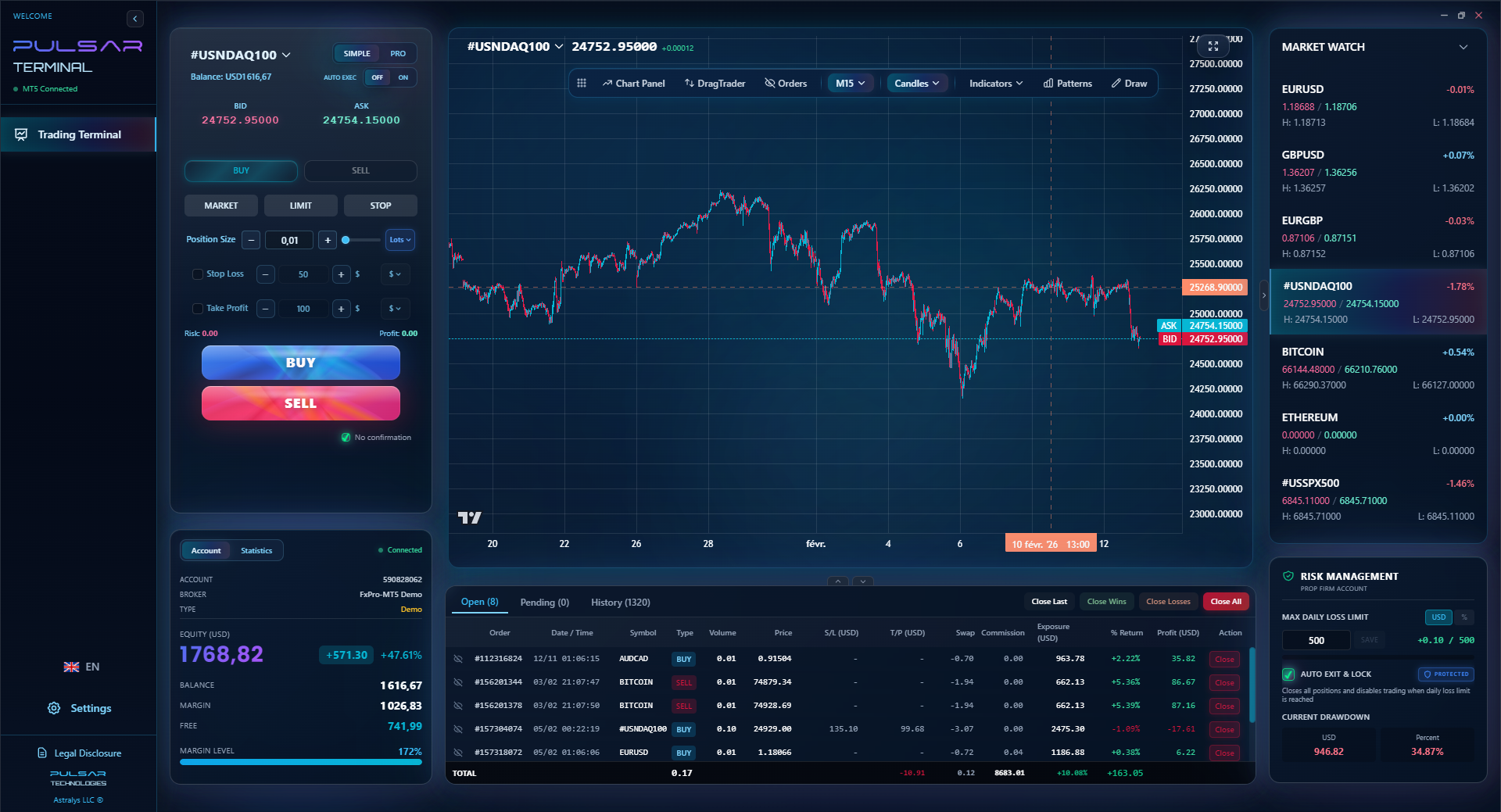
Managing complex trades and staying disciplined is easier with tools that automate risk management, letting you focus on strategy over paperwork.
Pulsar Terminal
أداة MT5 الشاملة: أوامر سحب وإفلات، متعدد TP/SL، تريلينج ستوب، تداول الشبكة، Volume Profile وحماية البروب فيرم. يستخدمها أكثر من 1000 متداول يومياً.
Forex verification isn't a box you tick once. The FSCA and FICA require ongoing monitoring. This isn't the broker being annoying. It's the system working.
What does this mean for you?
- Updated Documents: If your ID expires or you move, you need to provide new docs. Set a calendar reminder to check your client portal every 6 months.
- Unusual Activity: If your trading pattern changes dramatically (e.g., you normally trade 0.1 lots and suddenly start trading 5.0 lots), the broker's system might flag it. They may ask for confirmation or updated financial info. This is normal.
- Tax Compliance: SARS is getting smarter. Profits from trading are taxable. A regulated broker will provide you with a detailed trade history statement at tax time. This is a benefit, not a burden. It makes your life easier.
- Staying Informed: Regulations evolve. Follow the FSCA's news releases. In 2024-2026, the focus is on digital verification and even tighter fund security. Being aware helps you stay ahead.
I treat my relationship with my broker like a professional partnership. I keep my details current, I understand their rules (like their specific margin call policy), and I communicate clearly. This proactive approach has saved me countless headaches. When I needed a large withdrawal last year for a family emergency, it was processed in 4 hours because my file was complete and up-to-date.
The bottom line? See compliance as part of your trading business's overhead. The cost is a little time and paperwork. The return is security, stability, and the freedom to focus on what matters: making good trades.
FAQ
Q1How long does forex verification take in South Africa?
With a proper FSCA-regulated broker, it usually takes 24 to 48 business hours if you submit clear, correct documents. If your documents are blurry or don't match, it can take up to a week with back-and-forth emails. The fastest I've ever been verified was 3 hours with a broker that used automated digital ID checks.
Q2Can I trade forex in South Africa without verification?
Legally, no. Any broker offering this is operating outside of FSCA regulations and FICA law. You might be able to deposit and trade on an unregulated offshore platform, but you will have zero protection. Withdrawing your profits will be extremely difficult, if not impossible. It's the single biggest risk you can take.
Q3What is the best proof of residence for forex verification?
A municipal electricity or water bill (not older than 3 months) is the gold standard. A bank statement or a formal SARS document (like an assessment) is also perfect. A cellphone bill is often not accepted. Make sure your name and physical address (not a P.O. Box) are clearly visible.
Q4Do I pay tax on my forex trading profits in South Africa?
Yes. Profits from trading are considered income and are subject to tax under normal income tax rules. You must declare it to SARS. A major benefit of using an FSCA-regulated broker is they provide you with detailed, official statements for your tax return.
Q5What happens if my forex verification is rejected?
The broker will email you explaining why. Common reasons: an unclear ID photo, an expired document, or an address mismatch. Fix the issue they highlight and resubmit. If you're struggling, call their support. A good broker will guide you through it.
Q6Is my money safe with an FSCA-regulated broker?
It is significantly safer. FSCA regulation requires client funds to be held in segregated accounts with reputable banks. This means your money cannot be used for the broker's business expenses. If the broker goes bankrupt, your funds are separate and should be returned to you. This is not a guarantee against all loss, but it's the strongest protection available locally.
Q7Can I use a forex broker that is not FSCA-regulated but has other licenses?
You can, but you shouldn't. While brokers with ASIC (Australia) or FCA (UK) licenses are reputable globally, if they are not specifically authorized by the FSCA to operate in South Africa, you fall outside of local legal protections. The FSCA may not be able to assist you if you have a dispute. For a South African resident, the FSCA license is paramount.
درس البروفيسور وينستون
النقاط الرئيسية:
- ✓FSCA authorization is your non-negotiable first check.
- ✓Clear document photos prevent 90% of verification delays.
- ✓Always calculate true cost: spread + commission + conversion.
- ✓Ongoing compliance is as important as the initial sign-up.
ما مدى فائدة هذا المقال؟
انقر على نجمة للتقييم
رؤى التداول الأسبوعية
تحليلات واستراتيجيات أسبوعية مجانية. بدون رسائل مزعجة.
عن المؤلف
David van der Merwe
متداول الأسواق الناشئة
متداول مقيم في جوهانسبرغ مع 11 عاماً في عملات الأسواق الناشئة. متخصص في أزواج ZAR والتداول المنظم من FSCA وتحليل السوق الجنوب إفريقي.
التعليقات
تحذير من المخاطر
ينطوي تداول الأدوات المالية على مخاطر كبيرة وقد لا يكون مناسبًا لجميع المستثمرين. الأداء السابق لا يضمن النتائج المستقبلية. هذا المحتوى لأغراض تعليمية فقط ولا ينبغي اعتباره نصيحة استثمارية. قم دائمًا بإجراء بحثك الخاص قبل التداول.
قد يعجبك أيضًا

Cara Trading Forex Sukses: 7 Prinsip dari Trader Profesional
Cara trading forex sukses dengan 7 prinsip trader pro: manajemen modal, disiplin, journal trading, backtest. Data nyata, bukan janji profit palsu.
Jam Trading Forex Terbaik untuk Trader Indonesia: Panduan Lengkap dengan Tabel Waktu
Panduan jam trading forex untuk trader Indonesia. Tabel 4 sesi dunia, jam emas 20:00-00:00, sesi mana yang harus dihindari. Data akurat + tips dari trader berpengalaman.
Top 5 Sàn Forex Uy Tín Nhất 2026: Review Jujur dari Trader Indonesia
Top 5 sàn forex uy tín 2026 untuk trader Indonesia. Review jujur: spread, deposit, withdraw, dukungan lokal. Exness, XM, IC Markets & lebih.
احصل على Pulsar Terminal
جميع هذه الحاسبات مدمجة في Pulsar Terminal مع بيانات حية من حساب MT5 الخاص بك.
احصل على Pulsar Terminal