


Here's a number that should make you pause: over 90% of the 'free' forex signals you find online are either complete garbage or outright scams designed to move the market against you.
James Mitchell
محلل تداول أول
☕ 8 دقائق قراءة
ما ستتعلمه:
- 1What Are Free Forex Signals, Really?
- 2Where Do These Signals Actually Come From? (Hint: It's Not Genius)
- 3Spotting a Scam: The Unmistakable Red Flags
- 4How a Pro Actually Uses Free Signals (The Right Way)
- 5The Only Signal You Can Trust: Building Your Own Edge
- 6Risk Management: Your Lifeline When Using External Ideas
- 7Better Than Signals: Free Resources That Actually Make You Smarter

Here's a number that should make you pause: over 90% of the 'free' forex signals you find online are either complete garbage or outright scams designed to move the market against you. I've lost count of the traders I've seen blow accounts chasing promises of easy money from a Telegram channel. But here's the counterintuitive part. Used correctly, free signals can be a legitimate tool in your arsenal. The trick isn't finding the perfect signal; it's knowing how to filter the noise and integrate the rare useful tip into your own, disciplined strategy. Let's strip away the hype.
At their core, free forex signals are just trade suggestions someone else gives you. They'll typically include the currency pair (like EUR/USD), an action (buy or sell), an entry price, and suggested stop-loss and take-profit levels. They get blasted out via Telegram, Discord, email, or shady websites.
The promise is seductive: let the 'experts' do the analysis while you just click and collect profits. It's the trading equivalent of a get-rich-quick scheme, and it hooks people because it appeals to our laziest instincts. I fell for it early in my career, subscribing to three different services convinced I'd found a shortcut. Spoiler: I hadn't.

Warning: The very fact a signal is free should be your first red flag. In this business, valuable information is rarely given away. The provider is getting paid somehow, and often that 'payment' comes from your losses via a shady broker partnership or a pump-and-dump scheme.
Understanding the source kills the magic, and that's a good thing. Most free signals originate from one of three places, and none involve a trading savant working for free.
The Affiliate Marketer
This is the most common. A marketer with zero live trading experience uses a simple script or copies signals from elsewhere. Their goal isn't your success; it's getting you to sign up with a specific broker using their affiliate link. They get a commission on your deposit and on every pip you lose. Your failure is literally their business model. I once tracked a signal from one of these guys to a forum where it had been posted 12 hours earlier by someone else.
The Bot or Indicator
Many signals are just automated outputs from a standard indicator like an RSI or MACD crossing a certain level. There's no discretion, no market feel. You can generate these yourself for free on your own platform. Relying on these alone is a great way to get chopped up in a ranging market.
The Pump-and-Dump Operator
This is the dark side. A group with a large following will issue a signal to buy a thinly-traded exotic pair. Their followers pile in, creating a small pump. The operators then sell into that artificial strength, leaving the followers holding the bag as the price collapses. It's illegal in regulated markets, but rampant in the unregulated corners of forex.

💡 نصيحة وينستون
The most expensive thing you can get for free is a trading signal. It costs you your capital and your education.

“The provider's goal isn't your success; it's getting you to sign up with a specific broker. Your failure is literally their business model.”
After a while, you can smell these from a mile away. Here’s what to run from.
- Guaranteed Profits or Crazy Win Rates: Anyone claiming 90%+ win rates is lying. Full stop. The best discretionary traders in the world struggle to maintain 60-65% over time. I once saw a service advertising a 97% win rate. A quick backtest of their published signals showed a real rate closer to 48%, with massive losers wiping out a dozen small winners.
- No Track Record or Verified MyFxBook: Real traders are proud of their history. A transparent, verified, and live MyFxBook or FXBlue statement is the bare minimum. If they only show screenshots of trades or a spreadsheet they made in Excel, laugh and close the tab.
- Pressure to Use a Specific 'Partner' Broker: This is the ultimate tell. If they push you hard to sign up with Broker XYZ via their link, they are an affiliate. That broker is often chosen for its poor execution or high spreads, making it harder for you to win. Your success is not their concern.
- Vague or Missing Risk Disclosure: No mention of position size, risk per trade (e.g., 1% of account), or past drawdowns. They just say 'BUY GBP/USD' without context. This is irresponsible and shows they don't actually manage money.

Pro Tip: The best test? Ask them for the logic behind a specific signal. A real trader can explain the confluence of factors (e.g., "price at daily support, bullish RSI divergence on the 4H, and a break of a minor trendline"). A scammer will give you a vague answer or block you.

Okay, so most are trash. But I do glance at a couple of sources. Not to follow blindly, but as a contrarian indicator or a sentiment gauge. Here's my method.
I might see a popular free signal service screaming 'SELL USD/JPY' with 10,000 followers. Instead of joining them, I ask: is this trade already overcrowded? If price is at a key level and everyone is already on one side, the slightest shift can cause a violent squeeze in the other direction. That signal becomes a warning, not an invitation.
More constructively, a signal can serve as a news alert. If a respected analyst I follow (and whose methodology I understand) issues a signal, it prompts me to go look at that chart myself. I do my own analysis from scratch. Sometimes I reach the same conclusion, which adds conviction. Often, I don't, and I pass. The signal didn't make the decision for me; it just directed my attention.
The key is integration. You must have your own framework first - a set of rules for entries, exits, and, crucially, position size calculator. The signal is just one piece of external data to be filtered through your system. Without your own system, you're just a passenger, and passengers get car-sick on volatile roads.
💡 نصيحة وينستون
When you see a signal, immediately check the opposite side of the trade. Who's taking the other side, and why might they be right?
“The key is integration. You must have your own framework first. The signal is just one piece of external data to be filtered through your system.”
This is the hard truth you need to embrace. Lasting success comes from becoming self-sufficient. Free signals are a crutch; you need to learn to walk.
Start by learning one setup inside and out. Maybe it's a simple swing trading strategy based on support and resistance. Paper trade it for months. Track every entry, exit, and your emotional state. This process builds your internal 'signal generator.'
Use free signals as a homework assignment. When you see one, pull up the chart. Mark their suggested entry, stop, and target. Now, do your own analysis. Would you take this trade? Why or why not? What's the fundamental backdrop? Is there major news due? This practice is infinitely more valuable than blindly copying the trade.
I learned this after a brutal lesson in 2017. I was following signals from a seemingly smart guy while also trading my own system. My own trades were profitable. The signals I followed were net losers. I was literally paying two different brokers - one with my profits, and one with the losses from following someone else's ideas. The moment I turned off the noise and focused solely on my own charts was the moment my consistency improved. Tools like a good MACD indicator setup can become part of your system, not someone else's black box.

If you do decide to act on an external signal, your risk management must be ironclad. This is non-negotiable.
First, always recalculate the position size. The signal provider doesn't know your account size or risk tolerance. If they say "buy 1 lot," that could be a 10% risk for you, which is suicidal. Use your standard risk percentage (e.g., 1%) and the distance to their stop-loss to calculate your correct lot size. Never let someone else's suggestion override your money management rules.
Second, be prepared for worse execution. Free signals are often delayed, or sent to thousands at once. By the time you get it, the entry price may be gone, or the market may have already moved. Chasing it is a recipe for a terrible risk/reward. Have a rule: if you miss the suggested entry by more than X pips, you skip the trade. Period.
Finally, monitor for correlation. If you're taking multiple signals from the same source or similar sources, you might be piling into the same market bias (e.g., all USD shorts). This isn't diversification; it's concentrated risk. One wrong move wipes out all your trades. Always know your net exposure. This is where a clear understanding of margin call mechanics is vital, as over-leveraging on correlated ideas is the fastest path to one.
💡 نصيحة وينستون
Your best defense against signal scams is a well-defined personal trading plan. If a signal doesn't fit your plan's criteria, it's just noise.
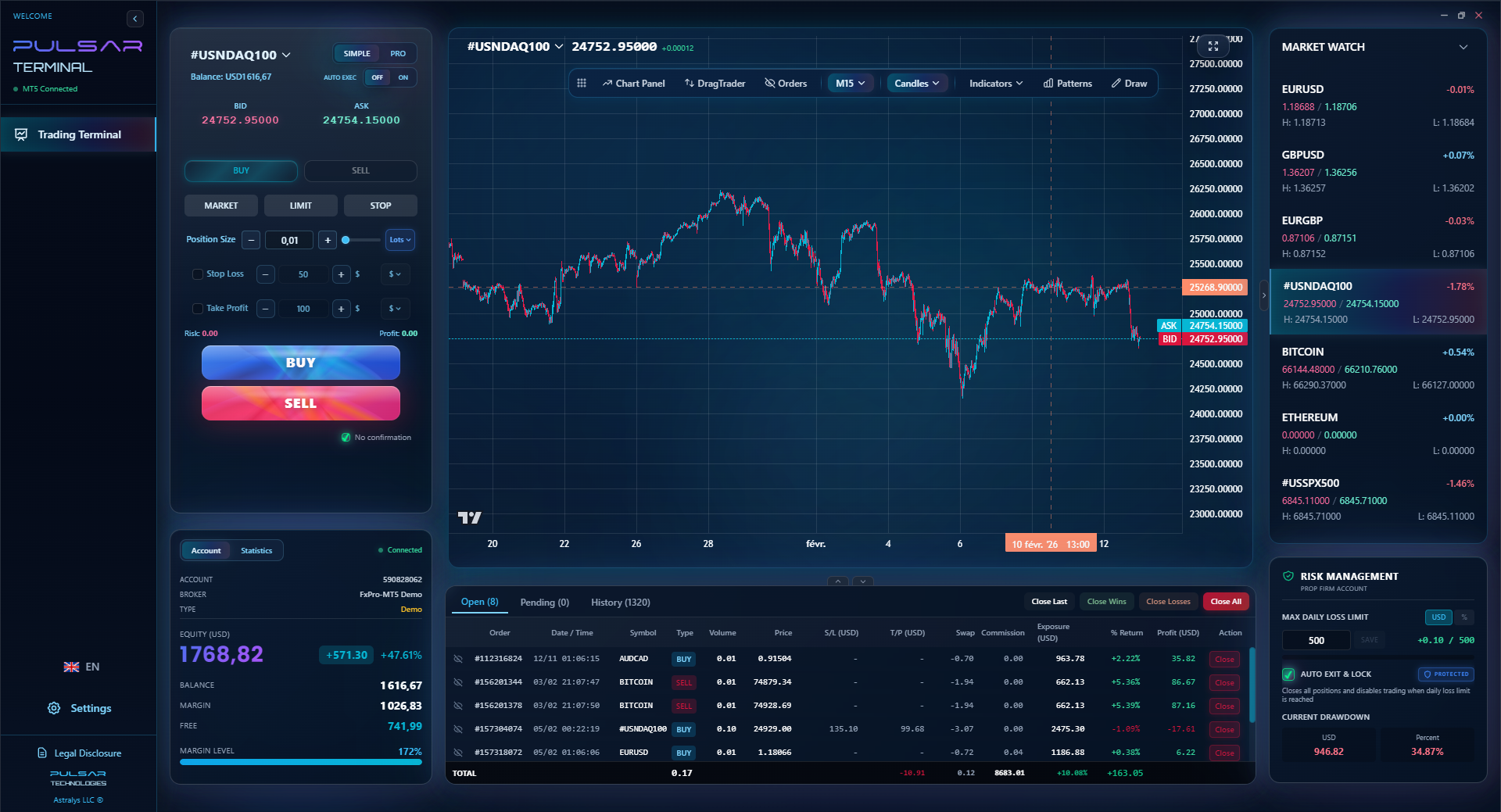
When testing external signals or your own ideas, precise order management is critical, and Pulsar Terminal's drag-and-drop orders and multi-TP/SL tools on MT5 let you execute complex risk plans instantly.
Pulsar Terminal
أداة MT5 الشاملة: أوامر سحب وإفلات، متعدد TP/SL، تريلينج ستوب، تداول الشبكة، Volume Profile وحماية البروب فيرم. يستخدمها أكثر من 1000 متداول يومياً.
“One hour spent understanding *why* a currency pair moves is worth 100 hours of waiting for the next signal alert.”
Stop looking for trade recommendations and start looking for education. These resources build your skills permanently.
- Central Bank Calendars & Statements: The Fed, ECB, and BOJ websites are free. Their statements and meeting minutes tell you what really moves currencies. Reading them is painful but profitable.
- Economic Calendars: Sites like Forex Factory offer these for free. Learn to anticipate volatility around events like NFP, not just react to it.
- Broker Research: Some top-tier brokers like Pepperstone or IC Markets provide high-quality, free market analysis and webinars from actual analysts. It's context, not just a buy/sell arrow.
- Charting Platform Practice: Spend time learning to read price action on a demo account. Draw your own trendlines, identify support/resistance. This skill is yours forever. For mastering a specific instrument, a deep dive like our XAU/USD guide is more valuable than 100 gold signals.
The shift here is from passive consumer to active student. One hour spent understanding why a currency pair moves is worth 100 hours of waiting for the next signal alert.

FAQ
Q1Are any free forex signal services actually legitimate?
Legitimate in terms of providing consistently profitable, free trade ideas? Almost none. However, some reputable analysts or brokers offer free 'trade ideas' or 'analysis' as a marketing sample of their paid research. The value is in the reasoning they provide, not in blindly following the trade. Always verify their track record independently.
Q2What's the biggest risk of using free signals?
Beyond losing money on bad trades, the biggest risk is stunting your development as a trader. You become dependent on an external crutch and never learn to analyze the market yourself. When the signal source eventually fails (and it will), you're left with no skills and a depleted account.
Q3How can I verify a signal provider's track record?
Demand a live, verified performance statement from a third-party site like MyFxBook or FXBlue. It must be 'live' (not demo or backtested) and 'verified' (the platform connects to the broker to confirm trades). Screenshots and Excel files are worthless and easy to fake.
Q4Is it okay to use signals if I'm a complete beginner?
It's the worst thing you can do. Beginners lack the context and risk management skills to evaluate signals. You'll likely over-use, chase losses, and blame the signal instead of learning. Start on a demo account, learn the basics of a pip definition and spread definition, and build from there.
Q5Can I use free signals for scalping?
This is especially dangerous. Scalping strategy requires ultra-fast execution and precision. A free signal delivered with a lag will be completely useless, and the rapid-fire nature of scalping will amplify losses from bad signals exponentially. Scalping demands your own skills, not an external feed.
Q6What should I look for in a signal if I choose to use one?
Look for the rationale, not just the entry. A good signal will explain the technical levels, fundamental catalyst, and market context. It will include a clear risk/reward ratio and suggest a position size relative to a percentage of your capital. If it's just "BUY EURUSD @ 1.0850," it's junk.
درس البروفيسور وينستون
النقاط الرئيسية:
- ✓Over 90% of free signals are garbage or scams.
- ✓Real traders have verified, live track records.
- ✓Use signals as a news alert, not a command.
- ✓Your own risk management rules override any signal.
- ✓Building your own analysis skill is the only true edge.
ما مدى فائدة هذا المقال؟
انقر على نجمة للتقييم
رؤى التداول الأسبوعية
تحليلات واستراتيجيات أسبوعية مجانية. بدون رسائل مزعجة.
عن المؤلف
James Mitchell
محلل تداول أول
يقيم في نيويورك ولديه أكثر من 9 سنوات من الخبرة في التداول. يركز على أزواج الدولار الرئيسية وتحديات شركات البروب وبيئة التنظيم الأمريكية.
التعليقات
تحذير من المخاطر
ينطوي تداول الأدوات المالية على مخاطر كبيرة وقد لا يكون مناسبًا لجميع المستثمرين. الأداء السابق لا يضمن النتائج المستقبلية. هذا المحتوى لأغراض تعليمية فقط ولا ينبغي اعتباره نصيحة استثمارية. قم دائمًا بإجراء بحثك الخاص قبل التداول.
قد يعجبك أيضًا

Cara Trading Forex Sukses: 7 Prinsip dari Trader Profesional
Cara trading forex sukses dengan 7 prinsip trader pro: manajemen modal, disiplin, journal trading, backtest. Data nyata, bukan janji profit palsu.
Jam Trading Forex Terbaik untuk Trader Indonesia: Panduan Lengkap dengan Tabel Waktu
Panduan jam trading forex untuk trader Indonesia. Tabel 4 sesi dunia, jam emas 20:00-00:00, sesi mana yang harus dihindari. Data akurat + tips dari trader berpengalaman.
Top 5 Sàn Forex Uy Tín Nhất 2026: Review Jujur dari Trader Indonesia
Top 5 sàn forex uy tín 2026 untuk trader Indonesia. Review jujur: spread, deposit, withdraw, dukungan lokal. Exness, XM, IC Markets & lebih.
احصل على Pulsar Terminal
جميع هذه الحاسبات مدمجة في Pulsar Terminal مع بيانات حية من حساب MT5 الخاص بك.
احصل على Pulsar Terminal