


Most new traders look at a gold chart and just see a squiggly line.

Rajesh Sharma
محلل فوركس أول ·  India
India
☕ 10 دقائق قراءة
ما ستتعلمه:
- 1Why Gold Charts Are Different
- 2Setting Up Your First Chart
- 3Reading Price Action: The Candlesticks Tell a Story
- 4Finding Key Levels: Support and Resistance
- 5Adding Indicators (The Smart Way)
- 6The Timeframe Symphony: From Big Picture to Entry
- 7Common Chart Patterns in Gold
- 8Putting It All Together: A Live Trade Example

Most new traders look at a gold chart and just see a squiggly line. They miss the story. The truth is, gold (XAU/USD) has a personality. It respects certain levels with an almost stubborn consistency that other markets don't. I've watched it bounce off the $1800 level more times than I can count. If you learn to read its chart, it can become one of your most reliable trading partners. Let's break down what you're actually looking at.
Trading gold isn't like trading a stock or even most currency pairs. It's a global fear gauge, an inflation hedge, and a currency all rolled into one. Its chart reflects that unique psychology.
When global uncertainty spikes, money flows into gold. You'll see sharp, impulsive moves upward that can break through technical levels that would normally hold. Conversely, when everyone's feeling bullish about stocks and the economy, gold can drift lower for weeks, grinding down even the most patient bulls.
I learned this the hard way early on. I shorted gold at $1920 in 2020, thinking the rally was overdone. A few geopolitical headlines later, and it was at $1950, then $2000. My stop-loss was vaporized. That trade taught me that with gold, you always need to know what story the broader market is telling. The chart gives you the 'how' and 'where,' but you need the news for the 'why.'

Warning: Never trade a gold chart in isolation. A key support level might hold for months, then shatter in minutes on a major central bank announcement. Always have an economic calendar open.
Before you analyze anything, you need a clean workspace. Clutter is the enemy of good analysis.
Choosing Your Platform
Most brokers like Exness, IC Markets, or Pepperstone offer MetaTrader 4 or 5. MT5 is generally better for commodities as it has more timeframes. Start there. Your chart symbol will be XAU/USD, which means the price of one ounce of gold in US dollars.
The Basic Layout
Keep it simple. I use a white background (easier on the eyes during long sessions) with a candlestick chart. My template has just three things on it:
- Price Action: Plain candlesticks. No Heikin-Ashi or renko bars to start.
- Key Levels: I manually draw horizontal lines for the previous day's high and low, and the weekly opening price.
- One Moving Average: A 50-period Exponential Moving Average (EMA) on the 1-hour chart. It acts as a dynamic support/resistance line and trend filter.
That's it. No other indicators at first. You'd be surprised how much you can see when you're not distracted by 10 flashing lines. This clean setup forces you to learn pure price action, which is the foundation of every good gold trading chart analysis.

“Gold's chart isn't just a price history; it's a ledger of global fear and greed.”
Candlesticks are your first clue to market sentiment. In gold, certain patterns repeat with high reliability.
The Key Patterns for Gold:
- Long wicks (shadows): These are rejection signals. A long wick to the top of a candle after a rally shows sellers stepped in aggressively. A long wick to the bottom after a drop shows buyers defended that level. I look for clusters of these wicks at the same price - it's a strong sign of a turning point.
- Engulfing patterns: These are powerful. A bullish engulfing pattern (a green candle that completely 'engulfs' the body of the previous red candle) at a known support level is a great long signal. The reverse is true for bearish engulfing at resistance.
- Inside bars: These small candles contained within the previous candle's range signal consolidation. In gold, a series of inside bars often precedes a big breakout. The trick is waiting for the breakout candle to close outside the range before you jump in.
A Real Example: In late 2023, gold was consolidating around $1815. I saw three consecutive daily candles with long lower wicks, all bouncing off $1808. That was the market screaming 'BUYERS ARE HERE.' I went long at $1812. The next week, it ran to $1850. The candles told the story before the big move even started.

Pro Tip: Don't just look at the candle's color. A green (bullish) candle with a tiny body and a huge upper wick is actually a sign of weakness, not strength. It shows the rally failed. Always interpret the entire candle.
This is the most important skill in chart reading. Gold loves round numbers and old turning points. I'm talking about levels like $1800, $1850, $1900. Price will dance around them for days.
How to Find Them:
- Swing Highs/Lows: Look left on your chart. Mark the most recent peaks (swing highs) and troughs (swing lows). The more times price has reacted to a level, the stronger it is.
- Psychological Numbers: Round numbers are magnets. $1900 isn't just a number; it's a mental barrier for traders worldwide.
- The Previous Day's Range: The high and low from the prior trading session are immediate, relevant levels for the current day. It's the first thing I draw every morning.
Gold has a funny habit of 'testing' these levels. It might poke above a resistance level by just a few dollars, tricking breakout traders, then slam back down. This is called a 'false breakout' or stop hunt. To avoid this, I wait for a daily candle to close decisively above or below the level before I consider the breakout valid. This one rule has saved me thousands.
These levels aren't just for entries. They're your guide for setting stop-losses and take-profits. If you're buying near $1820 support, your stop should be below the next clear support, maybe at $1805. Your first take-profit target? The next resistance level up, perhaps at $1840. This creates a clear risk/reward ratio you can calculate with a position size calculator.

💡 نصيحة وينستون
The market's memory is long. A price level that was important six months ago can suddenly become relevant again today. Always scroll back.

“The most reliable indicator on your gold chart is a horizontal line at a price the market has remembered.”
Indicators should confirm what the price action is already suggesting, not give you conflicting signals. I use only two or three.
My Go-To Toolkit:
- RSI (Relative Strength Index): Set to 14 periods. On the 4-hour or daily chart, I look for divergence. If gold makes a new high but the RSI makes a lower high, that's bearish divergence and a warning the uptrend is weakening. It's more reliable than just looking for overbought/oversold lines. You can learn more about this in our guide to the RSI indicator.
- MACD (Moving Average Convergence Divergence): I use it for one thing: the histogram. When the histogram bars are getting taller above the zero line, momentum is increasing. When they start shrinking, momentum is fading, even if price is still rising. It's a great early warning sign. Check out the MACD indicator for a deeper dive.
- Volume: While spot forex/gold doesn't have centralized volume, MT5 shows 'tick volume' (number of price changes). A breakout from a key level on high tick volume is more likely to be genuine than one on low volume.
Here’s a mistake I made for years: I'd have RSI, MACD, Stochastic, and Bollinger Bands all on one chart. When they all aligned, great. But most of the time, one said buy, one said sell, and I was paralyzed. Simplify. Start with price and levels, then add one indicator at a time to see how it complements your analysis.
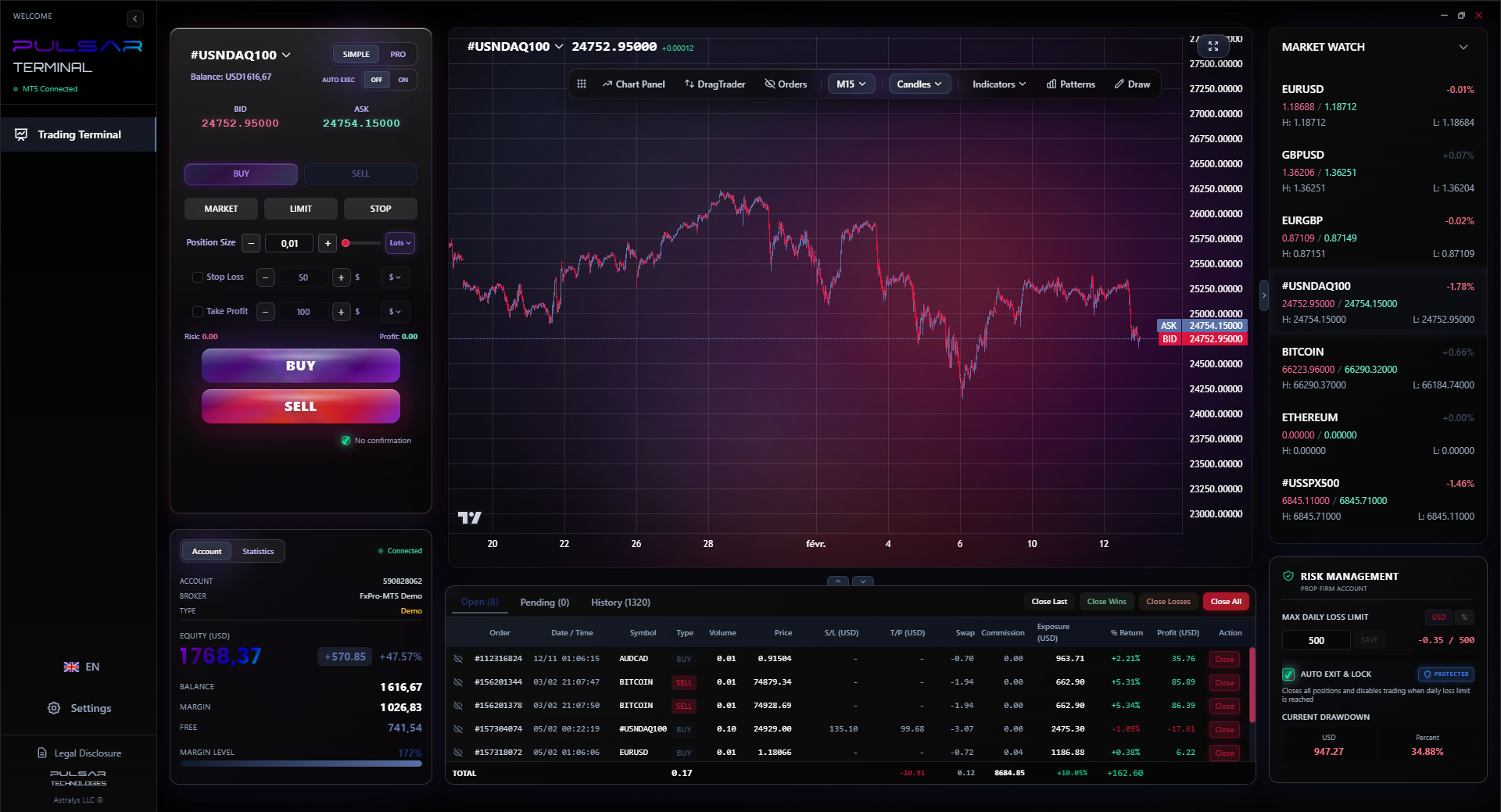
Managing multiple take-profit levels on a volatile gold trade is much easier with a tool that lets you set them all with a single drag-and-drop.
Pulsar Terminal
أداة MT5 الشاملة: أوامر سحب وإفلات، متعدد TP/SL، تريلينج ستوب، تداول الشبكة، Volume Profile وحماية البروب فيرم. يستخدمها أكثر من 1000 متداول يومياً.
You can't trade gold effectively by staring at just one chart. You need a top-down approach.
My 3-Chart Process:
- The Conductor (Daily Chart): This sets the major trend. Are we in a clear uptrend (making higher highs and higher lows)? Or are we ranging? I won't take a long-term trade against the daily trend. This chart shows me the war.
- The Section Leader (4-Hour Chart): This shows the battle within the war. It helps me identify the current swing and finer support/resistance levels within the daily trend. Most of my planning happens here.
- The Soloist (1-Hour or 15-Minute Chart): This is for timing my entry. I wait for the smaller timeframe to align with the direction of the higher timeframe. For example, if the daily is up and the 4-hour pulls back to support, I'll use the 1-hour chart to spot a bullish reversal candlestick pattern to enter.
Let's say the daily chart shows an uptrend. Price pulls back on the 4-hour chart to a key moving average. I switch to the 1-hour chart and see a bullish engulfing pattern forming right on that MA. That's a high-probability, aligned entry. This method keeps you from getting whipsawed by minor noise. It's the core of my swing trading approach for gold.
💡 نصيحة وينستون
A clean chart is a smart chart. If you can't explain what every line on your screen means in 10 seconds, you have too many lines.
“A false breakout isn't the market lying to you; it's showing you where everyone's stops are clustered.”
Gold forms some patterns more often than others. Recognizing them is like recognizing an old friend's face in a crowd.
| Pattern | What It Looks Like | What It Usually Means |
|---|---|---|
| Bull Flag / Bear Flag | A sharp move (flagpole), then a small, sloping consolidation (the flag). | Continuation. The pause before the trend resumes. Very reliable in gold trends. |
| Double Top / Double Bottom | Two distinct peaks (top) or troughs (bottom) at roughly the same price. | Reversal pattern. A double top at a major resistance (like $2070) is a classic sell signal. |
| Rising / Falling Wedge | Price consolidates between two converging, sloping trendlines. | Can be reversal or continuation. A falling wedge in an uptrend often breaks upward. |
A Trade I Missed: In 2022, gold formed a massive double bottom around $1615. The second bounce was explosive. I saw the pattern but doubted it because of the strong US dollar narrative. I waited for a 'confirmation' that never came in the form of a pullback. The price just went vertical. The chart was right; my overthinking was wrong. Sometimes, the pattern is the signal.
Patterns give you a projected target. The height of the flagpole is often projected from the breakout point of the flag. This isn't a guarantee, but it gives you a logical profit target to aim for, helping you manage the trade.
Let's walk through a recent, real scenario from my journal.
The Setup (Early March 2024):
- Daily Chart: Strong uptrend. Price was consolidating just below the all-time high of around $2070.
- 4-Hour Chart: Showed a clear range between $2030 and $2050. Price was hugging the top of the range.
- Key Level: $2050 was the obvious resistance to break.
The Trigger: I watched as a 4-hour candle approached $2050. It poked above to $2052, then retreated, leaving a long upper wick - a rejection. This was a potential false breakout. I didn't act yet.
The next 4-hour candle opened and closed below $2050, forming a small bearish engulfing pattern right at the resistance. The RSI on the 4-hour chart showed bearish divergence (price made a higher high, RSI made a lower high).
The Trade:
- Entry: Short at $2047 (after the engulfing candle closed).
- Stop-Loss: Placed at $2058, just above the false breakout wick.
- Take-Profit 1: $2035 (mid-range support).
- Take-Profit 2: $2030 (range low).
The Result: Price drifted down over the next 24 hours, hit my first TP at $2035, and I moved my stop to breakeven. It eventually tagged $2030, hitting my second TP for a full win. Risk was 11 points ($2058 - $2047), reward was 17+ points. A clean 1.5:1 risk/reward trade based purely on chart reading.
The chart gave me the level ($2050), the rejection signal (wick + engulfing), and the momentum warning (RSI divergence). All I had to do was listen and execute. This is the power of a well-read gold trading chart.

FAQ
Q1What is the best timeframe for trading gold?
There's no single 'best' timeframe. It depends on your style. For swing trading (holding trades for days), use the 4-hour and daily charts for analysis and the 1-hour for entry. For day trading or scalping, you might use the 15-minute and 1-hour charts. Always start with a higher timeframe to know the trend.
Q2Why does gold sometimes ignore technical analysis?
It rarely truly ignores it. What happens is that a fundamental driver (like a surprise Fed decision or major war) overwhelms the technical picture in the short term. The technical levels then reassert themselves later, often acting as support or resistance for the new move. Always check the economic calendar.
Q3How do I avoid false breakouts on gold charts?
Two rules: 1) Wait for the candle to close beyond the key level (a daily close is strongest). 2) Look for a 'follow-through' candle in the same direction. If price breaks $1900 but the next candle closes back below it, it's likely a false breakout. Patience is key.
Q4Is trading gold (XAU/USD) good for beginners?
It can be, but with a caveat. Gold's trends can be clearer than some forex pairs, which is good. However, its volatility can be high, and spreads are usually wider than on major pairs like EUR/USD. Start with a micro lot, use a strict stop-loss, and practice on a demo account first to understand its rhythm.
Q5What's the difference between XAU/USD and physical gold trading?
XAU/USD is a CFD or forex pair where you're speculating on the price movement of gold against the USD. You never own the metal. It's highly leveraged and traded 24/5. Physical gold involves buying bars or coins, paying for storage/insurance, and is a long-term investment. Trading the chart is only relevant to XAU/USD.
Q6How important is the US Dollar Index (DXY) when looking at a gold chart?
Extremely important. Gold is priced in USD, so they generally have an inverse relationship. A strong dollar (rising DXY) often pushes gold down, and vice versa. I always have a DXY chart open next to my gold chart. If gold is rising but the DXY is also rising strongly, that's an unusual divergence worth investigating.
درس البروفيسور وينستون
النقاط الرئيسية:
- ✓Master price action before adding indicators.
- ✓Always trade with at least two timeframes in alignment.
- ✓Round numbers ($1800, $1900) are powerful magnets for price.
- ✓Wait for a daily close beyond a key level to confirm a breakout.
- ✓Use the 50 EMA on the 1-hour chart as a dynamic trend filter.
ما مدى فائدة هذا المقال؟
انقر على نجمة للتقييم
رؤى التداول الأسبوعية
تحليلات واستراتيجيات أسبوعية مجانية. بدون رسائل مزعجة.
عن المؤلف
Rajesh Sharma
محلل فوركس أول
أكثر من 10 سنوات في تداول الأسواق الهندية وجنوب آسيا. بدأ بالمشتقات النقدية في NSE قبل الانتقال إلى الفوركس الدولي. متخصص في USD/INR وأزواج الأسواق الناشئة.
التعليقات
تحذير من المخاطر
ينطوي تداول الأدوات المالية على مخاطر كبيرة وقد لا يكون مناسبًا لجميع المستثمرين. الأداء السابق لا يضمن النتائج المستقبلية. هذا المحتوى لأغراض تعليمية فقط ولا ينبغي اعتباره نصيحة استثمارية. قم دائمًا بإجراء بحثك الخاص قبل التداول.
قد يعجبك أيضًا

Cara Trading Forex Sukses: 7 Prinsip dari Trader Profesional
Cara trading forex sukses dengan 7 prinsip trader pro: manajemen modal, disiplin, journal trading, backtest. Data nyata, bukan janji profit palsu.
Jam Trading Forex Terbaik untuk Trader Indonesia: Panduan Lengkap dengan Tabel Waktu
Panduan jam trading forex untuk trader Indonesia. Tabel 4 sesi dunia, jam emas 20:00-00:00, sesi mana yang harus dihindari. Data akurat + tips dari trader berpengalaman.
Top 5 Sàn Forex Uy Tín Nhất 2026: Review Jujur dari Trader Indonesia
Top 5 sàn forex uy tín 2026 untuk trader Indonesia. Review jujur: spread, deposit, withdraw, dukungan lokal. Exness, XM, IC Markets & lebih.
احصل على Pulsar Terminal
جميع هذه الحاسبات مدمجة في Pulsar Terminal مع بيانات حية من حساب MT5 الخاص بك.
احصل على Pulsar Terminal