


Let's be honest, most chart patterns are rubbish.

Olumide Adeyemi
رائد التداول في غرب أفريقيا ·  Nigeria
☕ 10 دقائق قراءة
ما ستتعلمه:
- 1What Exactly Is a Heads and Shoulders Pattern?
- 2The Psychology: Why This Pattern Works
- 3How to Spot a Valid Pattern (Nigerian Market Context)
- 4Trading It: Entry, Stop Loss, and Take Profit
- 5The Inverse Pattern: For Trading Reversals Up
- 6Common Mistakes That Will Cost You Money
- 7Boosting Your Edge: Combine with Other Tools
- 8Practicalities for Nigeria: Brokers and Execution

Let's be honest, most chart patterns are rubbish. You squint at your screen, convince yourself you see a triangle, and then the market does the exact opposite. But the heads and shoulders pattern? That's different. It's one of the few setups that has stood the test of time, not because it's magic, but because it taps into real market psychology. The problem is, 90% of traders get it wrong. They enter too late, place their stop loss in the wrong spot, or trade a pattern that isn't even valid. I've blown up a portion of my own account making those exact mistakes. This guide will cut through the noise and show you how to trade the heads and shoulders forex pattern properly, with a focus on what works for us here in Nigeria.
Forget the fancy textbook definitions. A heads and shoulders pattern is simply the market's way of showing a major shift from buyers being in charge to sellers taking over. It's a reversal pattern that forms at the end of an uptrend.
Think of it like this: the market makes a high (left shoulder), pulls back, then makes an even higher high (the head), pulls back again, and then struggles to make a new high, forming a lower high (right shoulder). The key is the neckline – a support level drawn by connecting the two low points of the pullbacks. When price breaks below this neckline, the party's over for the bulls.

Warning: The most common mistake is calling every little squiggle a heads and shoulders. A true pattern needs clear, distinct peaks and a clean, horizontal or slightly sloping neckline. If it looks messy, it probably is.
I remember trading a supposed head and shoulders on GBP/JPY back in 2019. The right shoulder was sloppy, more of a rounded hump. I entered the short anyway. Price broke the neckline, dipped 15 pips, then rocketed back up, taking out my stop loss and continuing for another 200 pips. That trade cost me about $420. The lesson? Quality over quantity. Wait for the clean, obvious patterns.

This pattern works because it tells a story everyone in the market can understand.
The Left Shoulder: The uptrend is strong. Buyers are confident, pushing price to a new high. Profit-taking sets in, causing a pullback. No alarm bells yet.
The Head: The bulls muster one final, powerful push. They break the left shoulder's high, creating euphoria and convincing late buyers to jump in. But this move lacks conviction. The pullback from the head is often sharp, showing the first real sign of weakness.
The Right Shoulder: The bulls try to rally again, but they're exhausted. They can't even reach the height of the head. This lower high is a massive red flag for anyone paying attention. The buying pressure is clearly drying up.
The Neckline Break: This is the confirmation. All the buyers who bought at the left shoulder, head, and right shoulder are now in losing positions. Their rush to exit turns into a selling avalanche. This is where you want to be, riding that wave down.
The pattern's power comes from this sequence of failed rallies. It's a visual representation of demand collapsing. For a deeper look at market sentiment tools, our guide on the RSI indicator can complement this analysis well.
“A true heads and shoulders pattern needs clear, distinct peaks and a clean neckline. If it looks messy, it probably is.”
Trading from Nigeria, you're often dealing with less-than-ideal internet speeds and maybe a broker platform that lags. You need crystal-clear rules to avoid false signals.
The Non-Negotiable Rules
- Must be in an Uptrend: You can't have a reversal pattern without something to reverse. Look for a clear, established move higher before the pattern starts forming.
- Three Distinct Peaks: Left shoulder, head (HIGHEST), right shoulder (LOWER than head). The head must be noticeably higher than both shoulders.
- A Clear Neckline: Connect the lows after the left shoulder and after the head. This line can be horizontal or slightly angled up/down. The more times price has touched and respected this level, the stronger it is.
- Volume Clue (Ideal, not always possible in forex): Volume should be highest on the left shoulder, lower on the head, and lowest on the right shoulder. This shows fading interest in buying. While spot forex doesn't have central volume, you can use tick volume or volume on futures charts as a proxy.
Timeframes That Matter
For Nigerian traders, I recommend the 4-hour and daily charts. The 1-hour chart produces too many false patterns that will whipsaw you, especially with our market volatility around London and New York opens. A pattern on the daily chart can set up a trade that lasts for weeks, perfect for swing trading if you can't watch screens all day.

Pro Tip: Draw the neckline after the right shoulder peak has formed and price is pulling down towards it. Don't force a line onto two random lows. Wait for the structure to complete.

💡 نصيحة وينستون
If you have to force the neckline to fit, the pattern isn't valid. The market should draw it for you.
This is where the rubber meets the road. A perfect pattern means nothing if your trade management is poor.
Entry: Do NOT enter as soon as the right shoulder forms. You enter on a candlestick close below the neckline. I use a 4-hour or daily close for confirmation. This patience prevents you from getting faked out by a spike below the neckline that immediately reverses.
Stop Loss: Your stop loss goes above the right shoulder. Some say above the head, but that's too wide and destroys your risk-reward. The right shoulder is the last point of supply; if price breaks back above it, the pattern is invalidated.
Take Profit: The classic measure is the vertical distance from the head's peak down to the neckline. You then project that same distance downward from the point where price broke the neckline.
Let's use a real example from my journal: EUR/USD, August 2023.
- Head peak: 1.1275
- Neckline at that point: 1.1150
- Distance: 125 pips
- Neckline break: 1.1140
- Minimum price target: 1.1140 - 125 pips = 1.1015
I entered at 1.1135 (just after the close below). My stop was at 1.1230 (above the right shoulder). My risk was 95 pips. My first target was 1.1015, a reward of 120 pips. That's a 1.26 risk-to-reward ratio. Price hit my target in about 8 days. Always use a position size calculator to ensure your risk per trade is sane (I risked 0.8% on that one).
For volatile pairs like gold, which many Nigerian traders love, the principles are the same but the swings are bigger. Check our specific XAU/USD guide for more on that.
“Entering during the right shoulder formation is guessing, not trading. Wait for the neckline break. Every. Single. Time.”
Everything works in reverse. The inverse head and shoulders is a bullish reversal pattern found at the end of a downtrend. It's just a mirror image.
- Left Shoulder: A low, followed by a bounce.
- Head: A lower low, followed by a bounce.
- Right Shoulder: A higher low (it doesn't go as low as the head), followed by a bounce.
- Neckline: Drawn by connecting the highs of the bounces.
The trade trigger is a candlestick close above the neckline. Your stop loss goes below the right shoulder, and your profit target is measured from the head's low to the neckline, projected upward from the breakout point.
I find the inverse pattern slightly less reliable than the standard one, but when it works on a major pair like EUR/USD, it's beautiful. It requires the same discipline: wait for the close, place your stop logically. Don't get greedy and jump in early because you 'think' the right shoulder is done.
I've made these, so you don't have to.
- Trading the Pattern Too Early: Entering during the right shoulder formation is guessing, not trading. Wait for the neckline break. Every. Single. Time.
- Placing the Stop Loss Wrong: Putting your stop just above the neckline is a sure way to get stopped out by a retest. The market loves to retest a broken support-turned-resistance. Your stop belongs above the structure (the right shoulder).
- Ignoring the Overall Trend: Trying to trade a head and shoulders in the middle of a ranging market or during a downtrend. It's a reversal pattern. It needs a prior trend to reverse.
- Not Adjusting for Volatility: A 50-pip stop might be fine for EUR/USD on a 4-hour chart, but it's suicide on GBP/JPY or XAU/USD. Use Average True Range (ATR) to gauge volatility and set your stops accordingly. A broker with tight spreads like IC Markets or Pepperstone helps immensely here.
- Chasing the Trade: If you miss the initial breakout, don't chase price down 80 pips to enter. Wait for a pullback to the neckline (now acting as resistance) for a secondary entry. If it doesn't pull back, let the trade go. There's always another chart.
These mistakes often lead to a margin call. Managing them is more important than finding the perfect pattern.
💡 نصيحة وينستون
Your profit target is a guide, not a law. If price stalls at a major weekly support level 30 pips above your target, take your money and run.
“Think of the head and shoulders as your primary signal. Other tools are your lie detectors.”
No pattern is an island. Combining the heads and shoulders with other tools filters out bad trades.
1. Key Support & Resistance: Is the neckline aligning with a major horizontal support level on the weekly chart? That's a confluence. A break is more significant.
2. Momentum Indicators: Use the MACD indicator or RSI. Look for bearish divergence as the head is forming. Price makes a higher high, but the indicator makes a lower high. This was present in my winning EUR/USD trade example. It's a huge warning sign that momentum is waning.
3. Fibonacci Retracement: Often, the pullback from the head will find support near a key Fib level (like the 50% or 61.8% retracement of the prior uptrend). This can help you draw a more accurate neckline.
4. Market Context: What's the news? Is the central bank of the currency you're trading about to make an announcement? A pattern breaking right before a major news event is a coin flip. I prefer patterns that develop and break in relatively calm periods.
Think of the head and shoulders as your primary signal. These other tools are your lie detectors. If they all agree, your confidence can be higher. For rapid-fire traders, these confluence checks are vital for a scalping strategy based on smaller patterns.

Theory is great, but you need a platform that can execute. Here’s the Nigerian reality check.
Execution Speed: When you're entering on a neckline break, a few seconds of slippage can mess up your entry price and your planned risk-reward. You need a broker with reliable servers. International brokers like Exness and XM have good local presence and generally stable platforms for Nigerian clients.
Deposits and Withdrawals: This is critical. Can you fund your account easily with naira? Do they offer local bank transfers or reliable fintech options? How long do withdrawals take? Always test the withdrawal process with a small amount first. Nothing worse than having profits stuck in a broker's system.
Spreads on Major Pairs: The heads and shoulders forex pattern often plays out on majors like EUR/USD, GBP/USD. You need a broker with consistently tight spreads on these pairs, especially around your preferred trading time (often London session). A 3-pip spread vs. a 0.8-pip spread makes a big difference to your bottom line over dozens of trades.
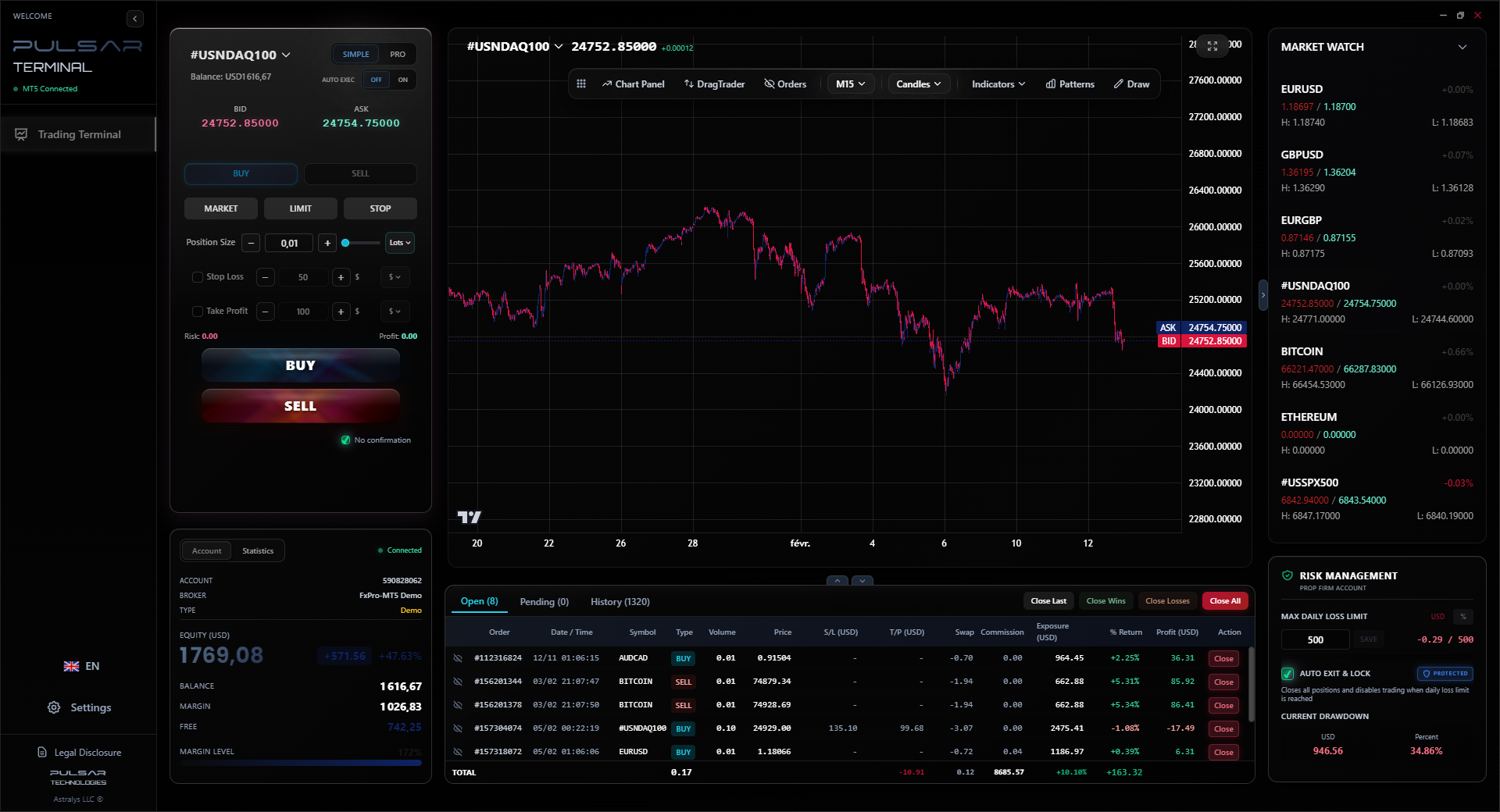
Charting Tools: Does your broker's platform (MT4/MT5) allow you to draw clean trend lines and horizontal lines easily? Can you save templates? Basic stuff, but essential. For advanced traders, using a dedicated terminal like Pulsar Terminal on top of MT5 can supercharge your analysis with better drawing tools and pattern recognition features, saving you time spotting these setups.
My advice? Start a demo account with 2-3 brokers. Practice identifying and trading the head and shoulders pattern on their platform. See which one feels most responsive and reliable for your internet connection.
Spotting and drawing clean necklines is faster with advanced charting tools that integrate directly with your MT5 platform.
Pulsar Terminal
أداة MT5 الشاملة: أوامر سحب وإفلات، متعدد TP/SL، تريلينج ستوب، تداول الشبكة، Volume Profile وحماية البروب فيرم. يستخدمها أكثر من 1000 متداول يومياً.
FAQ
Q1What is the success rate of the heads and shoulders pattern?
There's no single magic number. A well-formed pattern on a higher timeframe (like daily) with volume confirmation and momentum divergence can have a high probability, perhaps 60-70%. But success depends entirely on your entry, stop loss, and profit-taking discipline. A perfect pattern traded poorly will lose money.
Q2Can I trade this pattern on the 15-minute chart?
You can, but I don't recommend it, especially for beginners. The noise on lower timeframes leads to many false patterns and whipsaws. The 1-hour and 4-hour charts offer a much better balance between signal clarity and trade frequency for most traders.
Q3How long does it take for the pattern to form?
It varies. On a 4-hour chart, it can take 2-4 weeks. On a daily chart, it can take 2-3 months. The longer the formation time, the more significant the breakout tends to be. Avoid patterns that form in just a few bars; they're usually not reliable.
Q4What if price retests the neckline after breaking?
This is very common and actually desirable. A retest of the broken neckline (now acting as resistance) offers a second chance to enter the trade, often with a tighter stop loss. It confirms the level has flipped from support to resistance.
Q5Is the measured move target guaranteed?
Absolutely not. It's a minimum estimated target based on the pattern's size. Price can fall much further, or it can reverse before reaching it. Always manage the trade. Consider taking partial profits at the target and trailing your stop for the remainder.
Q6Which forex pairs work best with this pattern?
It works on all pairs, but it's clearest on major pairs with high liquidity like EUR/USD, GBP/USD, and USD/JPY. These pairs have cleaner trends and less erratic price action, making the pattern easier to identify.
Q7As a Nigerian trader, what's the biggest pitfall with this pattern?
Impatience. Between power issues, internet fluctuations, and the desire for quick profits, the temptation to enter before confirmation is huge. The second pitfall is not accounting for wider spreads on exotic pairs or during volatile news events, which can ruin your planned entry/exit.
درس البروفيسور وينستون
النقاط الرئيسية:
- ✓Wait for the candle CLOSE below the neckline.
- ✓Place your stop loss ABOVE the right shoulder.
- ✓Measure target: Head to neckline, projected down.
- ✓Trade it on 4H or Daily charts for cleaner signals.
- ✓Combine with RSI/MACD divergence for a stronger edge.
ما مدى فائدة هذا المقال؟
انقر على نجمة للتقييم
رؤى التداول الأسبوعية
تحليلات واستراتيجيات أسبوعية مجانية. بدون رسائل مزعجة.
عن المؤلف
Olumide Adeyemi
رائد التداول في غرب أفريقيا
أحد أنشط معلمي تداول الفوركس في نيجيريا. 8 سنوات من الخبرة في التداول من لاغوس. متخصص في استراتيجيات رأس المال المنخفض وتحديات شركات البروب للمتداولين الأفارقة.
التعليقات
تحذير من المخاطر
ينطوي تداول الأدوات المالية على مخاطر كبيرة وقد لا يكون مناسبًا لجميع المستثمرين. الأداء السابق لا يضمن النتائج المستقبلية. هذا المحتوى لأغراض تعليمية فقط ولا ينبغي اعتباره نصيحة استثمارية. قم دائمًا بإجراء بحثك الخاص قبل التداول.
قد يعجبك أيضًا

Cara Trading Forex Sukses: 7 Prinsip dari Trader Profesional
Cara trading forex sukses dengan 7 prinsip trader pro: manajemen modal, disiplin, journal trading, backtest. Data nyata, bukan janji profit palsu.
Jam Trading Forex Terbaik untuk Trader Indonesia: Panduan Lengkap dengan Tabel Waktu
Panduan jam trading forex untuk trader Indonesia. Tabel 4 sesi dunia, jam emas 20:00-00:00, sesi mana yang harus dihindari. Data akurat + tips dari trader berpengalaman.
Top 5 Sàn Forex Uy Tín Nhất 2026: Review Jujur dari Trader Indonesia
Top 5 sàn forex uy tín 2026 untuk trader Indonesia. Review jujur: spread, deposit, withdraw, dukungan lokal. Exness, XM, IC Markets & lebih.
احصل على Pulsar Terminal
جميع هذه الحاسبات مدمجة في Pulsar Terminal مع بيانات حية من حساب MT5 الخاص بك.
احصل على Pulsar Terminal