


Here's a fact that will annoy you: 90% of Nigerian traders who blow their first account do it while staring at a chart they don't understand.

Olumide Adeyemi
رائد التداول في غرب أفريقيا ·  Nigeria
☕ 11 دقائق قراءة
ما ستتعلمه:
- 1Forget Indicators, Start Here: The Three Pillars
- 2Candlestick Patterns That Actually Work (In Lagos)
- 3Indicators: Your Toolkit, Not Your Crystal Ball
- 4Nigerian Context: What Your Chart Doesn't Show
- 5Building Your Analysis Routine: From Top-Down to Trigger
- 6Common Chart Analysis Mistakes (I’ve Made Them All)
- 7Putting It Into Practice: A Nigerian Example
Here's a fact that will annoy you: 90% of Nigerian traders who blow their first account do it while staring at a chart they don't understand. They're drawing lines, adding every indicator under the sun, and praying for a signal. I know because I was one of them. Learning how to analyse forex charts isn't about finding a magic pattern, it's about learning to read the story price is telling you. In Nigeria, with our unique market pressures and the Naira's volatility, this skill isn't optional, it's survival.
Before you touch the RSI or MACD, you need to get three things straight. This is your foundation, and most people build their trading house on sand.
Price Action is King
Everything else is commentary. The chart is a record of all buy and sell orders. Your first job is to see the auction, not predict it. Is price making higher highs and higher lows? That's an uptrend. Is it crashing through previous support levels? That's momentum. I spent my first year chasing indicator crossovers while price was screaming "SELL" in plain sight. Don't be me.
Timeframes Tell Different Stories
A 1-minute chart and a daily chart are not talking about the same thing. The 1-minute is gossip, the daily is the biography. Your strategy dictates your timeframe. A scalper lives on the 5M and 15M charts. A swing trader operates on the 4H and Daily. I made a classic mistake early on: I'd get a bullish signal on the 4H chart, then jump to the 1M to find an entry, get shaken out by noise, and miss the entire 4H move. Pick your narrative and stick to it.
Support & Resistance: The Market's Memory
These are the price levels where buying and selling pressure has historically paused or reversed. They aren't magic lines, they're zones where a bunch of traders previously decided something was too cheap or too expensive. The more times price touches a zone and reacts, the stronger it becomes. Drawing these is your first real act of analysis.

Warning: Nigerian brokers like Exness or Pepperstone offer crazy use up to 1:1000 or more. Analysing a chart perfectly means nothing if your position size is suicidal. Always use a position size calculator. A 50-pip move against you with oversized use is a one-way ticket to a margin call.

💡 نصيحة وينستون
A clean chart is a thinking chart. If you can't explain your setup in one sentence using only price levels and the trend, you don't have a trade.
“Learning how to analyse forex charts isn't about finding a magic pattern, it's about learning to read the story price is telling you.”
Candlesticks show the battle between bulls and bulls in a specific period. You don't need to know 40 patterns. Know these five, and know them on the right timeframe relative to support/resistance.
- Pin Bar (Pinocchio Bar): A long wick with a small body. It shows a strong rejection of a price level. If it forms at a key resistance zone after an uptrend, it's a potential sell signal. I caught a beauty on GBP/USD in 2023 at a major daily resistance. Entry at 1.2440, stop at 1.2485 (above the wick), target at 1.2350. It worked because the context was right.
- Engulfing Pattern: One candle's body completely 'engulfs' the previous candle's body. A bullish engulfing at support suggests buyers have overwhelmed sellers. This is more reliable on higher timeframes (4H+).
- Inside Bar: A candle completely within the range of the previous candle. It shows consolidation, a coiling spring. The breakout direction from the mother bar's range often signals the next move.
- Doji: Where open and close are nearly equal. It shows indecision. Alone, it means little. At a major resistance? It adds to the evidence that the rally might be tired.
- Morning/Evening Star: Three-candle reversal patterns. More complex, but high-probability when they appear at trend extremes.
Here’s the Lagos-specific truth: volatility during European and US sessions can make these patterns on lower timeframes (like 5M) very unreliable. That 5M pin bar at 2:30 PM WAT? Might just be noise before the London fix. Focus on patterns forming on the 1H chart or higher for better accuracy. A pattern on the Daily chart, given our internet stability issues, is something you can analyse without needing to stare at the screen all day, perfect for swing trading.
“Your first analysis should be done away from the live charts. On a piece of paper, sketch the major trend and key levels.”
Indicators are derivatives of price. They lag. Use them to confirm what price action is already suggesting, not to lead you. Here’s how I use the big three.
Moving Averages: The Trend Filter
A 50-period and 200-period Simple Moving Average (SMA) on your Daily chart tells you the market's general mood. Price above both? Long bias. Price below both? Short bias. In a ranging market, they're useless. I use the 20 EMA on the 4H chart as a dynamic support/resistance level for entries.
RSI: Measuring Momentum Exhaustion
The RSI indicator tells you if price movement is overstretched. The classic levels are 70 (overbought) and 30 (oversold). The mistake? Selling just because RSI hits 70 in a strong uptrend. You'll get crushed. Instead, look for RSI Divergence. Price makes a new high, but RSI makes a lower high. That's a hidden warning the uptrend is losing steam. I missed a huge USD/NGN move in 2024 because I ignored a clear bullish divergence at a key level.
MACD: Trend Changes and Momentum
The MACD indicator is great for spotting shifts in momentum. The histogram crossing above or below the zero line can signal a trend change. The crossover of the MACD line and signal line is a common, albeit lagging, entry signal. Use it on the 1H or 4H chart to align with the broader trend you see on the Daily.

Example: Let's say EUR/USD is in a daily uptrend (price > 200 SMA). On the 4H chart, it pulls back to the 20 EMA and forms a bullish engulfing candle. The 4H RSI dips to 40 (not oversold, but showing a pullback). That's a triple-confirmation setup. The moving average gives trend context, the candle gives the entry signal, the RSI confirms the pullback is healthy. That's analysis, not guessing.
“Your first analysis should be done away from the live charts. On a piece of paper, sketch the major trend and key levels.”
Your MetaTrader chart shows global price feeds. It doesn't show the CBN's latest circular, the black-market premium on the Naira, or your own light bill. You must layer this local context onto your technical analysis.
The USD/NGN Shadow
Even if you trade EUR/USD, movements in the unofficial USD/NGN rate can affect trader psychology and liquidity in Nigeria. A sharp devaluation pressure can make Nigerian traders more risk-averse, potentially reducing market participation. It's a sentiment overlay.
Funding & Withdrawal Realities
You see a perfect setup on XAU/USD. But if your chosen broker has a 5-day Naira withdrawal process through Interswitch, and you need that profit to cover an expense, the pressure might make you exit early. Analyse your personal liquidity alongside chart liquidity. Brokers with smooth NGN processing like HFM or local support from Exness remove a layer of stress.
Regulatory Headlines Matter
The CBN's new FX Code and the unification of rates aim for stability. More stability in the official market can reduce knee-jerk reactions by local institutions, leading to cleaner technical patterns on pairs like GBP/NGN (if your broker offers it). Always know if there's a major CBN announcement scheduled. Don't get caught in a scalping trade when liquidity is about to dry up.
The Tax Man Cometh
That beautiful 150-pip win on EUR/USD is a 10% capital gains tax event. Factor that into your risk-reward. If your setup offers a 3:1 reward-to-risk, but 10% of the profit goes to FIRS, it's effectively a 2.7:1. Plan for it. It's part of your real-world profit analysis.
💡 نصيحة وينستون
The difference between a 1-pip spread and a 3-pip spread is the difference between a profitable scalping strategy and a losing one. Know your costs before you analyse.
“The chart is always right. Your analysis can be wrong. Have the humility to accept it and exit.”
This is where it all comes together. You need a repeatable process. Here’s mine.
Step 1: The Macro View (Daily Chart) I start every Sunday night. No indicators. Just the Daily candle chart. I mark clear support and resistance zones. What’s the trend? Is price near a key level? This 5-minute step frames the entire week. Ignoring this is like planning a Lagos trip without checking for police checkpoints.
Step 2: Drill Down to the Trading Timeframe (4H Chart) Now I add my 20 EMA and maybe the 50 SMA. Is the 4H trend aligned with the Daily? Where is price relative to my Daily levels? I’m looking for convergence.
Step 3: Find the Setup (1H Chart) This is for entry refinement. I’m looking for a price action signal (pin bar, engulfing) at a confluent area. Maybe that area is the 20 EMA on the 4H chart and a 61.8% Fibonacci retracement level. I’ll check the 1H RSI for divergence or momentum readings.
Step 4: Risk Management (Before Entry) I measure the distance from my proposed entry to my stop loss. That’s my risk in pips. I then use my position size calculator to determine how many lots I can trade so that risk is never more than 1-2% of my account. I set my take-profit level based on the next clear resistance/support. Only then do I click ‘Buy’ or ‘Sell’.
Step 5: Review (Weekly) I go through my closed trades. Did I follow my analysis? Was my stop loss logical based on the chart? I keep a journal. This feedback loop is how you improve. My biggest leaps came from reviewing losses, not celebrating wins.
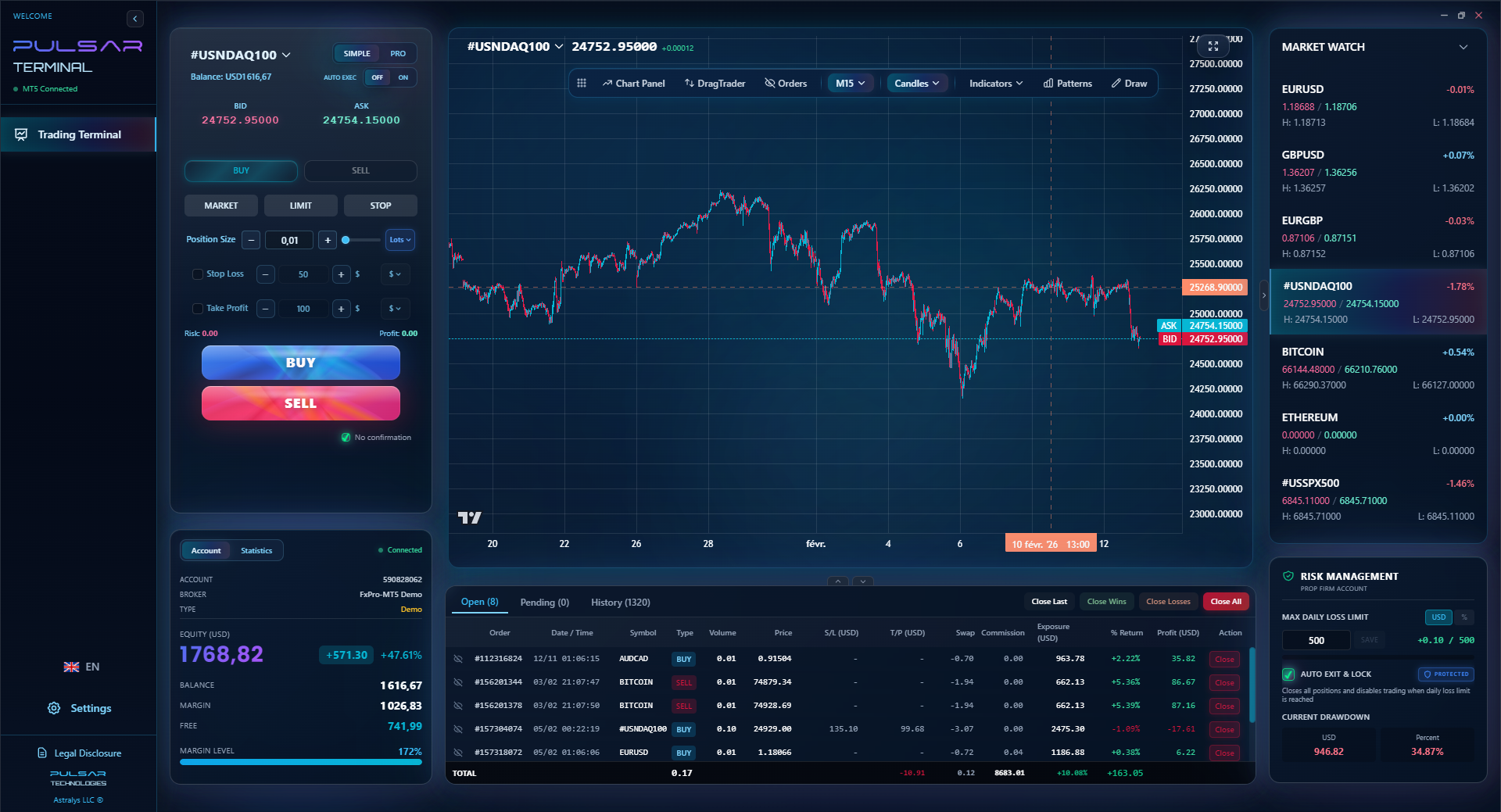
A solid analysis routine is useless without precise trade execution; Pulsar Terminal lets you drag-and-drop orders with multiple take-profit levels directly onto your MT5 chart, turning your plan into action instantly.
Pulsar Terminal
أداة MT5 الشاملة: أوامر سحب وإفلات، متعدد TP/SL، تريلينج ستوب، تداول الشبكة، Volume Profile وحماية البروب فيرم. يستخدمها أكثر من 1000 متداول يومياً.
“The chart is always right. Your analysis can be wrong. Have the humility to accept it and exit.”
Let's shorten your learning curve by exposing the pitfalls.
Mistake 1: Overcomplication You have 12 indicators on your chart. The Bollinger Bands, Stochastic, Parabolic SAR, and Ichimoku Cloud are all giving different signals. You’re paralysed. Solution: Strip it back. Price. Volume (if available). Two moving averages. One oscillator. Done.
Mistake 2: Ignoring the Spread You see a pin bar rejection exactly at 1.0850 on EUR/USD. You set your buy stop at 1.0851. But the spread on your standard account is 1.2 pips. Your actual fill is 1.0862. Your stop loss, placed 10 pips below at 1.0840, is now only 22 pips away, not 10. Your risk-reward is ruined. Always factor in the cost of doing business. This is why raw spread accounts from brokers like IC Markets or Pepperstone are popular with serious technical traders.
Mistake 3: Chasing the News with Charts A high-impact US news event hits. Price spikes 50 pips in seconds. You see a "breakout" on your 5M chart and jump in. This is not chart analysis, this is gambling. The charts are meaningless in the 10 minutes after major news. The spreads are wild, the liquidity is thin. Wait for the dust to settle and the charts to reorganize.
Mistake 4: Falling in Love with Your Analysis You’ve done your work. You’re convinced price will go up. It starts going down. Instead of respecting your stop loss, you start looking for a "better" support level to move your stop to, justifying it with a new indicator. This is how a 20-pip loss becomes a 200-pip disaster. The chart is always right. Your analysis can be wrong. Have the humility to accept it and exit.

Pro Tip: Your first analysis should be done away from the live charts. On a piece of paper, sketch the major trend and key levels. This prevents you from being hypnotized by the flickering candles and making impulsive decisions. It forces clarity.
“A stopped-out trade is not a failure; it's a cost of business and a sign your analysis for that particular setup was incorrect.”
Let's walk through a real scenario from early 2024, trading with a broker like XM or similar.
Instrument: GBP/USD Time: February 2024 Context: The Daily chart showed a strong uptrend since late 2023. Price was consolidating near a previous high (resistance).
My Analysis Process:
- Daily: Uptrend intact. Price approaching a key resistance zone around 1.2700-1.2750. I marked this zone.
- 4H: Price made a new high but then started making lower highs and lower lows - a clear pullback within the uptrend. It was coiling.
- 1H: The pullback found support near a 50% Fibonacci retracement level and the rising 50 EMA. A bullish engulfing pattern formed on the 1H chart.
- Confluence: The signal (bullish engulfing) occurred at a Fibonacci support level and a dynamic moving average support, all within the larger Daily uptrend.
- Action: I entered long at 1.2615. My stop loss went below the recent swing low at 1.2585 (30 pips risk). My take-profit target was the resistance zone at 1.2720 (105 pips potential). A 3.5:1 risk-reward.
The Result: Price rallied over the next two days, hitting my take-profit. A clean 105-pip gain. Why did it work? Not because of a magic indicator. Because I identified the trend (Daily), waited for a counter-trend pullback (4H), and entered on a reversal signal at a confluent support area (1H). The chart told a clear story: uptrend pause, dip, resumption.
The Naira context? During this period, CBN reforms were causing USD/NGN volatility. Having my trade plan and levels set in advance meant I wasn't distracted by local FX noise. I was focused on the GBP/USD chart's narrative, not the headlines.
FAQ
Q1What is the best timeframe to analyse forex charts for beginners in Nigeria?
Start with the 4-hour (4H) chart. It's slow enough to filter out the noise that plagues lower timeframes (especially with our sometimes unstable internet), and it's fast enough to see meaningful moves within a few days. Use the Daily chart to establish the overall trend direction. Avoid the 1-minute and 5-minute charts until you have a solid grasp of price action and a true scalping strategy.
Q2How many indicators should I use on my forex chart?
As few as possible. Seriously. I recommend a maximum of three: one trend-following tool (like a 20-period and 50-period moving average), one momentum oscillator (like the RSI), and maybe volume. More than that and you're creating confusion, not clarity. The goal is to confirm what the price action is already showing, not to get 10 conflicting signals.
Q3Do I need to pay for expensive courses to learn chart analysis?
Absolutely not. The core principles of technical analysis are free. Resources like BabyPips (free school), YouTube channels of reputable traders, and practicing on a demo account are all you need to start. The expensive ₦350,000+ courses often repackage this free information. Your money is better spent on a stable internet connection and trading from a funded demo account for at least 6 months.
Q4How does the Naira affect my analysis of major pairs like EUR/USD?
It doesn't affect the price feed directly, but it affects you, the trader. Sharp Naira depreciation can create a 'fear of missing out' (FOMO) or a scarcity mindset, pushing you to overtrade or use excessive use to 'catch up'. Your analysis must be disciplined enough to ignore this psychological pressure. Analyse the EUR/USD chart based on its own merits, not your desire to offset local currency stress.
Q5What is the single most important thing to look for on a chart?
The trend. Is the market moving up, down, or sideways? You can identify this simply by looking for higher highs/higher lows (uptrend) or lower highs/lower lows (downtrend). Trading with the trend significantly increases your probability of success. All your other analysis (support/resistance, indicators) should be used to find favourable entries within that trend.
Q6How do I know if my chart analysis is wrong?
The market will tell you very clearly: price hits your stop loss. That's it. A stopped-out trade is not a failure; it's a cost of business and a sign your analysis for that particular setup was incorrect. The failure is not using a stop loss, or moving it further away because you 'believe' in your analysis more than the chart. Respect your stop. It's your analysis quality control.
Q7Can I use the same chart analysis for crypto or stocks?
The core principles of support/resistance, trend, and price action are universal. However, crypto is far more volatile and can react less predictably to technical levels. Stocks are influenced heavily by individual company news. Forex, especially major pairs, tends to respect technical levels more cleanly due to its immense liquidity. Start with forex to learn pure technical analysis, then adapt cautiously.
درس البروفيسور وينستون
النقاط الرئيسية:
- ✓Always start with the higher timeframe trend.
- ✓Support & Resistance are zones, not exact lines.
- ✓Use indicators to confirm, not predict.
- ✓Factor in the spread and swap before entering.
- ✓Risk a maximum of 2% per trade, always.
ما مدى فائدة هذا المقال؟
انقر على نجمة للتقييم
رؤى التداول الأسبوعية
تحليلات واستراتيجيات أسبوعية مجانية. بدون رسائل مزعجة.
عن المؤلف
Olumide Adeyemi
رائد التداول في غرب أفريقيا
أحد أنشط معلمي تداول الفوركس في نيجيريا. 8 سنوات من الخبرة في التداول من لاغوس. متخصص في استراتيجيات رأس المال المنخفض وتحديات شركات البروب للمتداولين الأفارقة.
التعليقات
تحذير من المخاطر
ينطوي تداول الأدوات المالية على مخاطر كبيرة وقد لا يكون مناسبًا لجميع المستثمرين. الأداء السابق لا يضمن النتائج المستقبلية. هذا المحتوى لأغراض تعليمية فقط ولا ينبغي اعتباره نصيحة استثمارية. قم دائمًا بإجراء بحثك الخاص قبل التداول.
قد يعجبك أيضًا

Cara Trading Forex Sukses: 7 Prinsip dari Trader Profesional
Cara trading forex sukses dengan 7 prinsip trader pro: manajemen modal, disiplin, journal trading, backtest. Data nyata, bukan janji profit palsu.
Jam Trading Forex Terbaik untuk Trader Indonesia: Panduan Lengkap dengan Tabel Waktu
Panduan jam trading forex untuk trader Indonesia. Tabel 4 sesi dunia, jam emas 20:00-00:00, sesi mana yang harus dihindari. Data akurat + tips dari trader berpengalaman.
Top 5 Sàn Forex Uy Tín Nhất 2026: Review Jujur dari Trader Indonesia
Top 5 sàn forex uy tín 2026 untuk trader Indonesia. Review jujur: spread, deposit, withdraw, dukungan lokal. Exness, XM, IC Markets & lebih.
احصل على Pulsar Terminal
جميع هذه الحاسبات مدمجة في Pulsar Terminal مع بيانات حية من حساب MT5 الخاص بك.
احصل على Pulsar Terminal