


I remember the first time I thought about starting my own brokerage here in SA.

David van der Merwe
متداول الأسواق الناشئة ·  South Africa
☕ 12 دقائق قراءة
ما ستتعلمه:
- 1Why You Absolutely Need an FSP License
- 2The Two Main License Categories: I and II
- 3step-by-step-application-process
- 4The Real Costs: What They Don't Tell You
- 5The Rules Once You're Up and Running
- 6Alternatives: What If You Can't Afford a License?
- 7Tax: Don't Let SARS Surprise You
- 8Is It Worth It? My Final Thoughts
I remember the first time I thought about starting my own brokerage here in SA. It was 2018, and I'd just closed a decent swing trade on USD/ZAR. I figured, 'How hard can it be?' I spent about R80,000 on legal consultations and paperwork, only to realise my business plan didn't meet the FSCA's capital adequacy requirements. I wasn't even close. That failed venture taught me more about regulation than any winning trade ever did. If you're serious about getting licensed, you need to know the real numbers and the unspoken rules.
Let's get this out of way first. If you want to offer forex trading services to South Africans, you must have a Financial Services Provider (FSP) license from the Financial Sector Conduct Authority (FSCA). No ifs, no buts. Trading for yourself with your own capital? That's different. But the moment you take a client's money to trade on their behalf, offer signals, or manage a pool of funds, you're in regulated territory.
The FSCA isn't playing around. They're the watchdog, and their job is to protect consumers and ensure market integrity. Operating without a license isn't just a slap on the wrist; it's a criminal offence. You could face massive fines or even jail time. More importantly, you'll destroy any trust before you even start. Every legit broker you see advertising on SuperSport or in the business papers - like IC Markets or Pepperstone - has jumped through these hoops.

Warning: I've seen guys try to skirt the rules by calling themselves 'investment clubs' or using social media groups. The FSCA has cracked down hard on this. If you're collecting funds, you need the license. Full stop.
Not all FSP licenses are the same. You need to apply for the right one, or you'll be paying fees for permissions you can't use.
Category I FSP is your basic license. This is for giving advice or acting as an intermediary. Think of a guy who recommends forex trades to clients or places trades on their behalf through a larger broker. You're the middleman. You can't make discretionary trading decisions without the client's specific instruction for each trade.
Category II FSP is the big one. This allows for discretionary services. This means you can actively manage a client's portfolio, make trading decisions on your own within agreed parameters, and run things like prop firm challenges or managed accounts. If you want to be the trader, not just the advisor, you need Category II.
The application fee difference tells the story. As of late 2024, a Cat I application costs R2,697. A Cat II application? R15,390. That's a five-fold increase, and it reflects the higher level of scrutiny and responsibility.
Which One Is Right For You?
Ask yourself this: Do you just want to educate people and maybe share ideas (Cat I)? Or do you want to build a fund, take on capital, and trade it professionally (Cat II)? Most serious operations aiming for a brokerage model need Cat II, especially now with the new ODP rules (we'll get to that).

Pro Tip: If you're unsure, apply for Cat II from the start. Upgrading from Cat I to Cat II later is another full application process with more fees. It's a headache you don't need.
“Operating without a license isn't just a slap on the wrist; it's a criminal offence.”
Alright, you've decided to go for it. Here's the road map. It's bureaucratic, slow, and detailed. Patience isn't just a virtue here; it's a requirement.
Step 1: Register Your Company. You can't apply as an individual. You need a legal entity - a (Pty) Ltd is standard. Get this done with a good corporate lawyer.
Step 2: Appoint Your Key Individuals. This is critical. The FSCA requires you to name a 'Key Individual' (KI) who will be responsible for the managerial and operational functions. This person needs to be fit and proper, have relevant experience, and pass the regulatory exams. We're talking about the RE 1, 3, and 5 exams from an accredited provider like Moonstone. Each exam costs about R1,300.
Step 3: Draft Your Business Plan. This isn't a back-of-the-napkin sketch. You need a complete document detailing your operational plan, target market, financial projections, risk management framework, and IT infrastructure. They will pick it apart.
Step 4: Prove Financial Soundness. Here's where I got tripped up. There's no single 'minimum capital' number like in some countries. Instead, you must demonstrate you have enough capital to cover your liabilities and run your business for a period. The industry benchmark everyone whispers about? R5 million (roughly $350,000). That's the ballpark figure for operational runway. You'll need audited financials or proof of access to this capital.
Step 5: The ODP Hurdle. Since 2023, there's a new layer. If you're dealing in CFDs and forex (which you are), you also need authorization as an Over-the-Counter Derivatives Provider (ODP). This brings stricter capital, reporting, and conduct of business rules. It's a license on top of your license.
Step 6: Submit and Wait. Lodge your application with the FSCA along with all supporting documents and fees. Then, you wait. Approval can take 6 to 12 months, sometimes longer. They will come back with questions. Lots of them.
Throughout this, you must have a local physical office and local employees, including a dedicated compliance officer. Working from your garage in Sandton won't cut it.

💡 نصيحة وينستون
The R5 million operational capital figure isn't a random guess. It's what auditors use to model 12 months of runway for a lean brokerage. If you can't prove access to it, save yourself the application fee.
Let's talk money, because the application fee is just the tip of the iceberg. When I researched this properly after my initial failure, the numbers were sobering.
| Cost Component | Estimated Amount (ZAR) | Notes |
|---|---|---|
| FSCA Cat II Application Fee | R15,390 | Non-refundable, even if you're rejected. |
| Key Individual Approval Fee | R1,460 | Per KI. |
| Regulatory Exams (RE 1, 3, 5) | ~R3,900 | ~R1,300 each. |
| Legal & Consulting Fees | R150,000 - R300,000 | You NEED a specialist FAIS lawyer. Don't cheap out. |
| Operational Capital (Proof) | R5,000,000+ | The benchmark to show you're serious and solvent. |
| Technology & Platform Costs | R500,000+ | MT4/5 white label, liquidity feeds, bridges. |
| Office & Staff Setup | R200,000+ | First-year costs for rent, salaries, compliance officer. |
So, all in, you're looking at a startup cost of between R1.8 million and R2.5 million (about $120,000 - $180,000) just to get the doors open and the license on the wall. That's why you see pre-approved FSP licenses for sale for $75,000 to $175,000 - it's someone else who has done the hard graft and is now selling the asset.
And it doesn't stop there. You have annual FSCA levies, audit fees, compliance software, and the constant cost of maintaining that operational capital. Your profits will also be taxed at the corporate rate of 27%. It's a capital-intensive business, not a side hustle.

Example: Let's say you apply for a Cat II license, hire a mid-tier law firm, and set up a basic office with two staff. Your outlay before even seeing a single client could easily hit R2 million. That money needs to be in the bank, ready to burn, for at least 12-18 months before you might break even.
“For talented traders without massive capital, the prop firm path is where the action is.”
Congratulations, you got the license. Now the real work begins, and the FSCA is watching. Here are the daily rules you live by:
1. Client Money is Sacred. You must keep all client funds in segregated accounts with a reputable bank. Your company's operating money and client deposits can never mix. This is the number one rule for consumer protection.
2. use Caps. For all your retail clients, the maximum use you can offer is 30:1. This is an FSCA mandate. You can only offer higher use to clients who qualify as 'professional investors' under strict criteria (net worth, trading experience, etc.). This levels the playing field with EU-regulated brokers like Exness or XM for SA clients.
3. Reporting, Reporting, Reporting. As an ODP, you have daily, weekly, and monthly reporting obligations to the FSCA. Trade reports, transaction reports, financial reports. Your compliance officer will spend most of their time on this.
4. Treating Customers Fairly (TCF). This isn't just a phrase; it's a core FSCA principle. Your marketing must be clear and not misleading. Your risk warnings must be prominent. You must assess a client's suitability before they trade. Slapping a small-print disclaimer on a 'get rich quick' ad won't fly.
5. Your Own Trading. This is a big one. If you're personally trading while running the brokerage, you need iron-clad Chinese walls. You cannot front-run client orders or trade against your own book in a way that disadvantages clients. The conflict of interest management plan you submit will be tested.
Managing all these risks manually is a nightmare. This is where a solid trading plan and tools matter, even for your back-office. Knowing precise position sizing and having clear rules to avoid a margin call is as important for your business as it is for your clients.
💡 نصيحة وينستون
Your Key Individual's reputation is everything. The FSCA will background check them thoroughly. A spotty credit history or past business failures can sink the entire application.
Let's be real. R5 million in operational capital is out of reach for 99.9% of traders. So what are your legal options if you want to build a business around forex?
1. Become an Affiliate or Introducing Broker (IB). This is the most common path. You partner with an existing FSCA-licensed broker (like FP Markets or Vantage). You refer clients to them, and you earn a commission on their trading activity. You don't handle client money, you don't need a license, and your startup costs are minimal. You're a marketer, not a broker.
2. Offer Educational Services. You can run courses, webinars, and sell trading education without an FSP license, provided you are not giving specific, tailored advice. You teach the mechanics of a scalping strategy or how to read the MACD indicator, but you never tell someone 'buy EUR/USD now.' The line is thin, so be careful.
3. Trade Proprietary Firm Capital. This has exploded in popularity. You pass a challenge from a prop firm (many have local SA partners), and they give you capital to trade. You split the profits. You're trading their money under their rules. You don't need a license because you're not soliciting funds from the public.
4. White Label Solutions. Some licensed brokers offer white labels. It's a halfway house. You get your own branded trading platform under their license, but they handle the regulation, liquidity, and back-end. It's cheaper than a full license but still involves significant setup costs and revenue sharing.
I've done the IB route and the prop firm route. The prop firm path, honestly, is where the action is for talented traders without massive capital. The daily loss limits and rules force a discipline that directly prevents the kind of blow-ups that would endanger a licensed business.
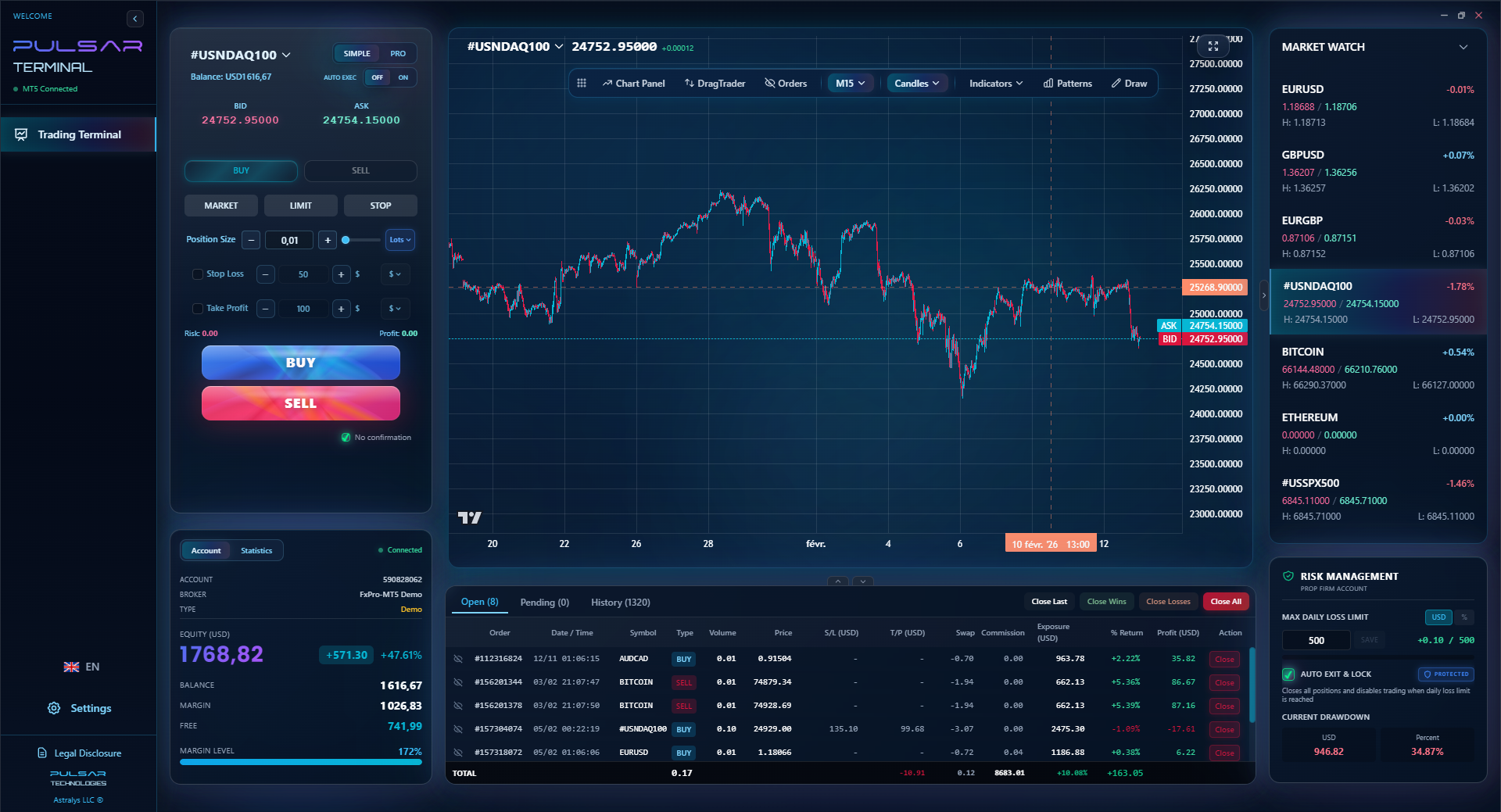
Managing a prop firm challenge or client accounts requires strict adherence to daily loss limits, a task Pulsar Terminal automates perfectly within MT5.
Pulsar Terminal
أداة MT5 الشاملة: أوامر سحب وإفلات، متعدد TP/SL، تريلينج ستوب، تداول الشبكة، Volume Profile وحماية البروب فيرم. يستخدمها أكثر من 1000 متداول يومياً.
“You can be a very successful player at the table without owning the casino.”
If you succeed and get your license, SARS will become your silent partner. Here’s how it works for your brokerage business:
Your company's net profits from brokerage commissions, spreads, and other activities are taxed at the standard corporate tax rate of 27%. Simple enough.
But there's more. If your company also holds investments or trades its own capital (which many do), the profits from those activities are subject to Capital Gains Tax (CGT). The effective CGT rate for companies is 22.4% on the gain (80% inclusion rate x 28% tax rate).
For your individual traders (or you, as the owner drawing a salary), it's different. Their net trading profits are considered ordinary revenue by SARS. It's added to their other income (salary, dividends) and taxed at their marginal income tax rate, which can go up to 45%. There's no separate 'trader tax' with lower rates. Losses can be offset against other income, which is one small mercy.
You must register for PAYE, VAT (if your taxable turnover exceeds R1 million per year), and provisional tax. Hire an accountant who understands financial services on day one. The tax complexity alone is a full-time job.
Pro Tip: Keep forensic records of every trade, expense, and client transaction from the very beginning. SARS may ask to see them, and 'my spreadsheet crashed' is not an acceptable excuse. This level of record-keeping also helps you analyze your own business's performance with the same rigor you'd use on a EUR/USD chart.
💡 نصيحة وينستون
Most 'successful' license applicants fail on their first try due to a weak compliance framework. Hire the lawyer *before* you write the business plan, not after.
After my own expensive lesson and advising others through the process, here's my blunt take.
Getting a forex trading license in South Africa is worth it only if you have a serious, long-term vision to build a substantial financial services business. You need deep pockets, immense patience, and a team you trust implicitly. It's for entrepreneurs with banking or regulatory experience, not for retail traders looking to scale up.
For the vast majority of talented traders, the alternatives are smarter. Build a track record through a prop firm. Build an audience and become a top-tier IB for a regulated broker. The barriers to entry are lower, the regulatory headache is someone else's problem, and you can focus on what you're good at: trading and client relationships.
The South African market is growing, and the Rand's volatility (it's about 1% of global turnover) creates opportunity. But opportunity doesn't mean you have to be the house. You can be a very successful player at the table without owning the casino.
If you do decide to go for the license, respect the process. The FSCA's rules - from the 30:1 use cap to client fund segregation - exist because of past abuses. They make the market safer for everyone. Building a business within those rules is hard, but if you do it right, it's legitimate, durable, and something you can truly be proud of. Just make sure you have that R5 million ready to go before you even pick up the phone to a lawyer.
FAQ
Q1What's the difference between a Category I and Category II FSP license?
A Category I license lets you advise clients or act as an intermediary (place trades for them). A Category II license allows for discretionary management - you can make trading decisions for clients without asking for permission on each trade. Most forex brokerages need a Cat II license.
Q2How much does it cost to get a forex broker license in South Africa?
All-in, you're looking at startup costs of R1.8 million to R2.5 million (approx. $120,000-$180,000). This includes the FSCA application fee (R15,390 for Cat II), legal fees, proof of operational capital (benchmark R5 million), technology, and office setup. The annual running costs are also high.
Q3Can I get a license as an individual trader?
No. You must apply through a registered legal entity, like a (Pty) Ltd company. The FSCA licenses the business, not the individual. You will, however, need to appoint and get approval for 'Key Individuals' within that company.
Q4What is the FSCA use limit for retail traders?
The FSCA mandates a maximum use of 30:1 for all retail clients. Only clients who qualify as 'professional investors' under strict criteria regarding experience, knowledge, and portfolio size can access higher use from a licensed broker.
Q5Do I need a physical office in South Africa?
Yes. The FSCA requires licensed financial services providers to have a local physical office and employ local staff, including a dedicated compliance officer and Key Individual. A virtual office or home address is not sufficient.
Q6How long does the FSCA license application take?
Brace yourself for a long process. From preparing your documentation to final approval, it typically takes between 6 to 12 months, sometimes longer. The FSCA will scrutinize every detail of your business plan and financials.
Q7Is it legal to use international brokers as a South African?
Yes, it's legal for you as an individual to trade with international brokers. However, if you are a business soliciting South African clients, you must be FSCA licensed. Many international brokers like IC Markets or Pepperstone also have local FSCA licenses to serve the SA market properly.
درس البروفيسور وينستون
النقاط الرئيسية:
- ✓A Cat II FSP license is non-negotiable for running a brokerage.
- ✓Benchmark operational capital needed is R5 million.
- ✓The full process takes 6-12 months and costs R2M+.
- ✓Client funds must be kept in segregated accounts.
- ✓Maximum retail use is capped at 30:1.
ما مدى فائدة هذا المقال؟
انقر على نجمة للتقييم
رؤى التداول الأسبوعية
تحليلات واستراتيجيات أسبوعية مجانية. بدون رسائل مزعجة.
عن المؤلف
David van der Merwe
متداول الأسواق الناشئة
متداول مقيم في جوهانسبرغ مع 11 عاماً في عملات الأسواق الناشئة. متخصص في أزواج ZAR والتداول المنظم من FSCA وتحليل السوق الجنوب إفريقي.
التعليقات
تحذير من المخاطر
ينطوي تداول الأدوات المالية على مخاطر كبيرة وقد لا يكون مناسبًا لجميع المستثمرين. الأداء السابق لا يضمن النتائج المستقبلية. هذا المحتوى لأغراض تعليمية فقط ولا ينبغي اعتباره نصيحة استثمارية. قم دائمًا بإجراء بحثك الخاص قبل التداول.
قد يعجبك أيضًا

Cara Trading Forex Sukses: 7 Prinsip dari Trader Profesional
Cara trading forex sukses dengan 7 prinsip trader pro: manajemen modal, disiplin, journal trading, backtest. Data nyata, bukan janji profit palsu.
Jam Trading Forex Terbaik untuk Trader Indonesia: Panduan Lengkap dengan Tabel Waktu
Panduan jam trading forex untuk trader Indonesia. Tabel 4 sesi dunia, jam emas 20:00-00:00, sesi mana yang harus dihindari. Data akurat + tips dari trader berpengalaman.
Top 5 Sàn Forex Uy Tín Nhất 2026: Review Jujur dari Trader Indonesia
Top 5 sàn forex uy tín 2026 untuk trader Indonesia. Review jujur: spread, deposit, withdraw, dukungan lokal. Exness, XM, IC Markets & lebih.
احصل على Pulsar Terminal
جميع هذه الحاسبات مدمجة في Pulsar Terminal مع بيانات حية من حساب MT5 الخاص بك.
احصل على Pulsar Terminal