


I remember staring at my screen in 2018, watching GBP/USD.

Olumide Adeyemi
رائد التداول في غرب أفريقيا ·  Nigeria
☕ 9 دقائق قراءة
ما ستتعلمه:
I remember staring at my screen in 2018, watching GBP/USD. I'd spotted a beautiful double top on the H4 chart. Price tapped the resistance, formed a bearish pin bar, and the RSI was overbought. I was sure. I sold at 1.3120. The trade immediately went 15 pips in my favor... then reversed. It ripped 120 pips against me before I finally cut the loss. I had the right idea, but my entry was off by a single candle. That £120 loss (about ₦180,000 at the time) taught me more about the hunt for a perfect entry than any winning trade ever did. It's not about guessing the exact top or bottom. It's about stacking probabilities in your favor, especially when you're trading from Nigeria with all our unique market quirks.
Let's get this straight first. Chasing a 'perfect' entry is a sure way to blow your account. I've done it. You wait for that mythical pinpoint reversal, watching as price moves 50 pips without you, then FOMO in at the worst possible moment. The goal isn't perfection, it's a high-probability entry where your risk is clearly defined and the potential reward justifies it.
For us in Nigeria, this is even more critical. With the Naira's volatility and sometimes tricky funding methods, you can't afford to waste capital on low-quality trades. A 'probable' entry has three things: a clear technical or fundamental reason, a tight stop loss level, and an entry that doesn't require price to do a perfect U-turn just for you.

Warning: The biggest mistake I see new traders make is entering a trade simply because they're bored or feel they 'should' be in the market. No signal is a signal. Sitting in cash, especially when the market is choppy or during major CBN announcements, is a valid position.
My rule now? If I can't draw my stop loss and take profit levels on the chart before I enter, I don't enter. This simple discipline filters out 80% of my impulsive bad ideas.

💡 نصيحة وينستون
A 'perfect' entry feels boring. The thrilling, gotta-catch-it-now trade is usually the one that catches you.
“The goal isn't perfection, it's a high-probability entry where your risk is clearly defined.”
A single indicator won't give you a good entry. You need confluence, where multiple factors agree. Think of it like a court case. One piece of evidence isn't enough for a conviction. You need a few witnesses pointing in the same direction.
Price Action is Your Primary Witness
Start with the naked chart. Look for key levels: previous highs/lows, round numbers (like 1.1000 on EUR/USD), and areas where price has reacted before. These are where big players place their orders. A perfect entry often happens just as price tests one of these levels. For a deeper look at a major pair, our EUR/USD guide breaks down its key historical levels.
Bring in the Technical Jury
This is where your indicators come in. Use them to confirm the price action story, not to create it.
- Trend Confirmation: Is the MACD indicator above or below its zero line? Is it showing divergence (price making a new high but MACD not)?
- Momentum: Is the RSI indicator showing overbought or oversold conditions, especially on a higher time frame?
- Volume: Are you seeing a spike in volume on the rejection of a level? (This requires a broker with good volume data).
A classic confluence setup I love: Price approaches a strong resistance level on the daily chart. The 4-hour chart shows a bearish engulfing pattern. The daily RSI is above 70 (overbought), and the MACD histogram is starting to curl down. That's three witnesses saying 'sell'.

Example: In early 2024, I took a short on USD/NGN (offered by some international brokers as a CFD) at ₦1,480. The confluence? It was a major psychological round number, the parallel market rate was showing resistance, and the CBN had just made a hawkish statement. My stop was at ₦1,510. It wasn't the absolute top (it briefly spiked to ₦1,495), but it was a high-probability area that yielded a great risk-to-reward move down to ₦1,420.
“No signal is a signal. Sitting in cash is a valid position.”
You can have the best chart setup in the world, but if you enter during the dead Tokyo session or 5 minutes before a massive US Non-Farm Payrolls report, you're gambling.
Know the Session Overlaps: The most volatility (and therefore the best entry opportunities for momentum) happens during session overlaps.
- London (8 AM - 4 PM GMT): Our 9 AM - 5 PM. This is the heart of forex. Most volume, tightest spreads.
- London/New York Overlap (1 PM - 4 PM GMT): Our 2 PM - 5 PM. This is often when big trends accelerate. If you're a scalping strategy fan, this is your playground.
Respect the Economic Calendar. This is non-negotiable. A perfect technical entry can be vaporized by a surprise data release. For Nigerian traders, you need to watch TWO calendars:
- Global (US CPI, Fed Rates, NFP).
- Local (CBN Monetary Policy Committee (MPC) meetings, FAAC allocations, NBS inflation data).
I learned this the hard way. I had a beautiful long setup on Gold (XAU/USD guide). Entered, trade was going well. Then, a surprise hawkish comment from a Fed official hit the wires during US hours. Gold dumped $30 in minutes. I wasn't even awake (it was 3 AM Nigerian time). My stop loss saved me, but it taught me to never leave a trade open over a major news event I'm not awake to monitor.

Pro Tip: If you're a swing trading and hold trades for days, place your entries after major news, not before. Let the market absorb the news and show its hand. The initial spike is often a trap.
“No signal is a signal. Sitting in cash is a valid position.”
Market orders are what beginners use. Limit and stop orders are how you get smarter entries. You don't always have to chase price.
- Limit Order: You set a price better than the current market price. You want to buy low or sell high. Example: EUR/USD is at 1.0850. You believe it will pull back to 1.0820 support before rising. Place a BUY LIMIT order at 1.0822. If price drops there, your order fills automatically. If it doesn't, you don't enter. No stress.
- Stop Order (Buy Stop/Sell Stop): You set a price worse than the current market price. You use this to enter a breakout. Example: Price is consolidating at ₦1,450/$ on USD/NGN. Resistance is at ₦1,470. You place a BUY STOP order at ₦1,471. If price breaks out with momentum, you're in. If it fails, you're not.
This is where good broker execution matters. A broker with slippage will ruin a limit order entry. I've had good experiences with entries on IC Markets review and Pepperstone review for these types of orders due to their ECN models.
Using these orders removes emotion. You plan your entry when you're calm, not when price is moving fast.
💡 نصيحة وينستون
Your best entry tool is the 'Delete Pending Order' button. Learn to use it when the setup isn't perfect.
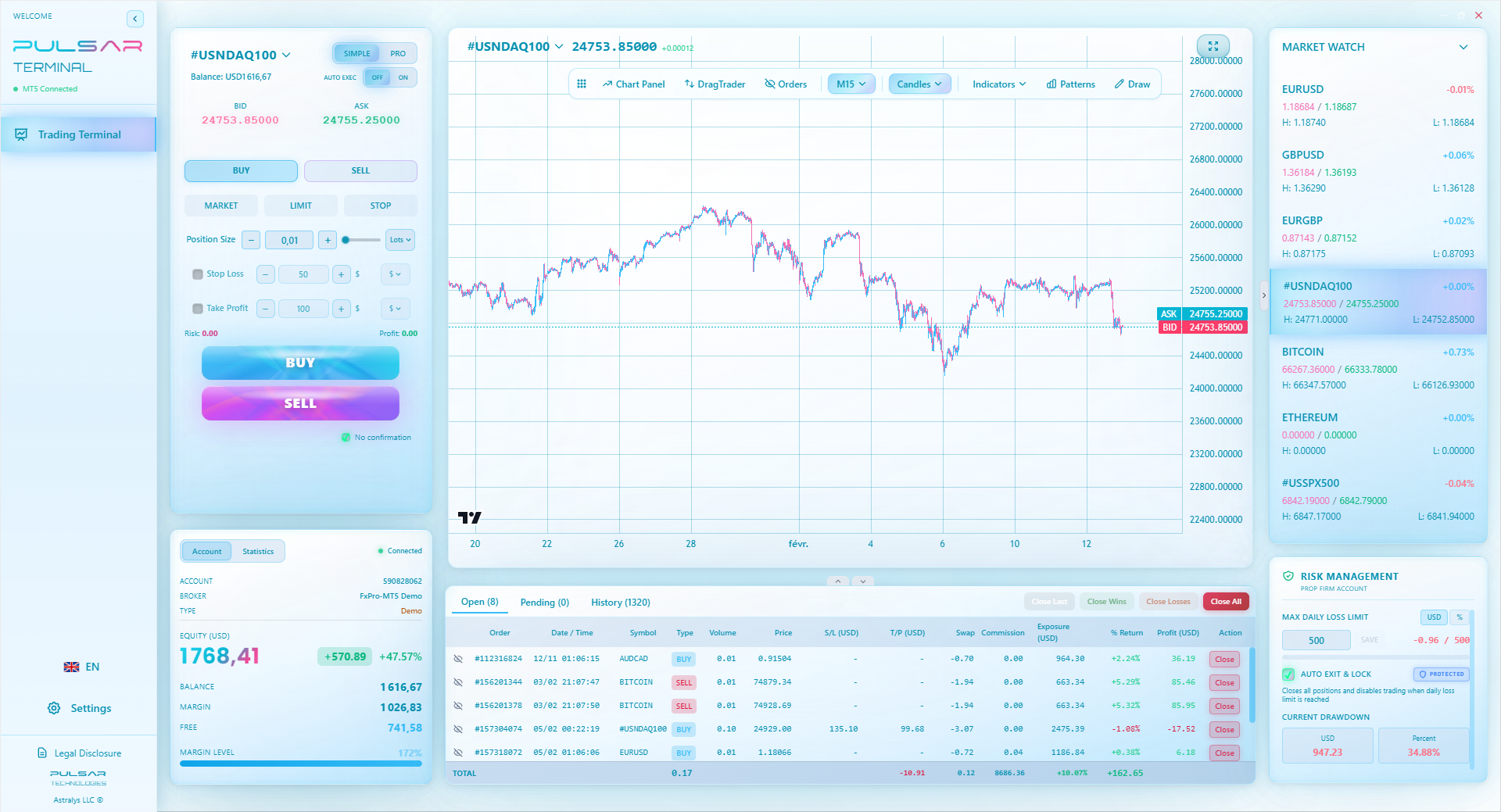
Using limit and stop orders for precise entries is key, and a tool like Pulsar Terminal lets you drag-and-drop these orders directly onto your MT5 chart for faster, more visual trade planning.
Pulsar Terminal
أداة MT5 الشاملة: أوامر سحب وإفلات، متعدد TP/SL، تريلينج ستوب، تداول الشبكة، Volume Profile وحماية البروب فيرم. يستخدمها أكثر من 1000 متداول يومياً.
“You can know everything, but if your mind isn't right, you'll choke.”
Trading from Nigeria isn't the same as trading from London. Our reality shapes our entries.
Funding and Capital: You can't talk about entries without talking about your account size. If your broker's minimum deposit is $10 (like some accounts at Exness review or FBS), your position size will be tiny. A 10-pip stop loss on a micro lot might be all you can afford. This forces you to be extremely precise with entries. Always use a position size calculator. I don't care if you're trading $50 or $5000. Calculate your risk per trade (I risk 1% max).
use is a Double-Edged Sword: Nigerian traders are often offered crazy use like 1:1000. This is a trap for poor entries. With high use, a 10-pip move against you can cause a margin call. A perfect entry with insane use is still a ticking bomb. I never use more than 1:30, even if my broker offers more. It forces me to be right on direction and timing.
Local Pairs (USD/NGN): This is a unique beast. Spreads can be wide (sometimes 50-100 pips), and moves are heavily influenced by CBN policy, oil prices, and parallel market sentiment. Your entry here is more about fundamental timing than pinpoint technicals. You're trading a macroeconomic story. A tight stop loss is often impossible, so your position size must be correspondingly smaller.
“You can know everything, but if your mind isn't right, you'll choke.”
This is the exact list I run through. If I can't answer 'yes' to most, I walk away.
- Time Frame Alignment: Is the trend on the higher time frame (Daily/4H) supporting my trade direction on the lower (1H/15M)?
- Level Confluence: Am I entering near a clear support/resistance level, trend line, or Fibonacci level?
- Indicator Agreement: Do at least 2 of my chosen indicators (RSI, MACD, Stochastic) support the entry? Are they showing divergence?
- Candlestick Signal: Is there a clear pin bar, engulfing pattern, or inside bar breakout at my entry zone?
- News Filter: Is there any major scheduled news within the next 1-4 hours? (If yes, I wait).
- Risk Defined: Have I calculated my position size? Is my stop loss level logical (beyond recent swing high/low)? Is my potential reward at least 1.5x my risk?
- Market Session: Am I trading during a active session (London/NY), or am I trying to pick tops and bottoms in the dead of night?
This checklist saved me from a disaster just last month. I had a sell setup on GBP/JPY. Everything looked good until step 5. I checked the calendar: BoE Governor speech in 30 minutes. I cancelled the limit order. The speech was dovish, GBP spiked 60 pips. That would have been an instant loser.
“The exciting, heart-pounding 'I gotta get in now!' entries are almost always the ones that lose.”
This is the final, hardest piece. You can know everything, but if your mind isn't right, you'll choke.
Fear of Missing Out (FOMO): This kills perfect entries. You see a pair moving, you jump in late, and you're instantly wrong. The cure? Remember there are always new trades. The market will be here tomorrow.
Revenge Trading: After a loss, you want to get back immediately. You take a sloppy entry just to 'be in the game.' This compounds losses. My rule: After a full stop-loss hit, I close the platform for at least 2 hours.
Overconfidence: You have three winning entries in a row. You start thinking you're a genius. Your fourth entry becomes lazy - you widen your risk, ignore your checklist. The market humbles you fast. I journal every trade, especially the winners, to see if I was smart or just lucky.
The perfect entry feels calm, almost boring. It's a planned execution. The exciting, heart-pounding 'I gotta get in now!' entries are almost always the ones that lose. Trust your plan, not your adrenaline.
💡 نصيحة وينستون
If you're proud of an entry, you're probably late. The best entries feel slightly uncomfortable, like you're the only one seeing it.
FAQ
Q1Is there a single best indicator for finding the perfect forex entry?
No, and anyone who tells you there is is selling something. I've tried them all. Reliance on one indicator is a fast track to losses. The 'best' entry comes from confluence, where price action at a key level is confirmed by other tools like RSI or MACD. It's about the collective story, not a single signal.
Q2How much money do I need to start practicing these entry techniques in Nigeria?
You can practice with a very small amount. Some brokers like FBS or Exness offer accounts with a $1 minimum deposit. But honestly, for real practice that teaches you about emotional control, I'd recommend starting with at least $100-200. This lets you trade micro lots (0.01) and experience real P&L moves without wiping out immediately. Always use a demo account first to test your strategy, though.
Q3What's more important for a good entry: technical analysis or fundamental analysis?
For your actual entry price and timing, technicals are king. Fundamentals (like CBN rates or US inflation) tell you the direction and create the major trends. But technicals show you where and when to get on board that trend. I use fundamentals to decide if I should be looking to buy or sell a currency, and then I use technicals to find my exact entry point.
Q4Why do my entries always seem good at first, then the price reverses immediately?
This usually means you're entering in a 'no man's land' - the middle of a range, far from any clear support or resistance. You're also likely ignoring higher time frame trends. A move that looks like a breakout on the 5-minute chart might just be a tiny pullback on the 1-hour. Always zoom out. Check the daily chart trend before you take a 15-minute chart entry.
Q5How do I handle entries when trading Nigerian Naira (USD/NGN) pairs?
With extreme caution and a focus on fundamentals. Technical levels still matter, but news is paramount. CBN MPC announcements, FAAC allocations, and oil price moves are your primary drivers. Spreads are wide, so you're aiming for larger moves (100+ pips). Your entry must account for that wider spread - don't place your stop loss 10 pips away. Use limit orders to avoid buying the ask or selling the bid, and always, always keep your position size small relative to your account.
Q6Should I use a fixed stop loss distance (like 20 pips) for every entry?
Absolutely not. This is a common rookie mistake. Your stop loss should be placed where your trade idea is proven wrong, not at an arbitrary distance. If the key support level is 25 pips away, your stop goes 5 pips below that. If the next swing high is only 15 pips away, your stop goes 5 pips above that. Let the market structure define your risk, not a random number.
درس البروفيسور وينستون
النقاط الرئيسية:
- ✓Confluence of 3+ factors beats a single 'perfect' signal.
- ✓Always define risk (1% max) before defining entry.
- ✓Trade the London/New York overlap for best volatility.
- ✓Use limit orders, don't chase price with market orders.
ما مدى فائدة هذا المقال؟
انقر على نجمة للتقييم
رؤى التداول الأسبوعية
تحليلات واستراتيجيات أسبوعية مجانية. بدون رسائل مزعجة.
عن المؤلف
Olumide Adeyemi
رائد التداول في غرب أفريقيا
أحد أنشط معلمي تداول الفوركس في نيجيريا. 8 سنوات من الخبرة في التداول من لاغوس. متخصص في استراتيجيات رأس المال المنخفض وتحديات شركات البروب للمتداولين الأفارقة.
التعليقات
تحذير من المخاطر
ينطوي تداول الأدوات المالية على مخاطر كبيرة وقد لا يكون مناسبًا لجميع المستثمرين. الأداء السابق لا يضمن النتائج المستقبلية. هذا المحتوى لأغراض تعليمية فقط ولا ينبغي اعتباره نصيحة استثمارية. قم دائمًا بإجراء بحثك الخاص قبل التداول.
قد يعجبك أيضًا

Cara Trading Forex Sukses: 7 Prinsip dari Trader Profesional
Cara trading forex sukses dengan 7 prinsip trader pro: manajemen modal, disiplin, journal trading, backtest. Data nyata, bukan janji profit palsu.
Jam Trading Forex Terbaik untuk Trader Indonesia: Panduan Lengkap dengan Tabel Waktu
Panduan jam trading forex untuk trader Indonesia. Tabel 4 sesi dunia, jam emas 20:00-00:00, sesi mana yang harus dihindari. Data akurat + tips dari trader berpengalaman.
Top 5 Sàn Forex Uy Tín Nhất 2026: Review Jujur dari Trader Indonesia
Top 5 sàn forex uy tín 2026 untuk trader Indonesia. Review jujur: spread, deposit, withdraw, dukungan lokal. Exness, XM, IC Markets & lebih.
احصل على Pulsar Terminal
جميع هذه الحاسبات مدمجة في Pulsar Terminal مع بيانات حية من حساب MT5 الخاص بك.
احصل على Pulsar Terminal