


Most people think joining forex is about finding a secret indicator or a hot signal.

David van der Merwe
متداول الأسواق الناشئة ·  South Africa
☕ 12 دقائق قراءة
ما ستتعلمه:
- 1Is Forex Trading Legal in South Africa? (The FSCA Rules)
- 2The Step-by-Step Process to Start Trading (2026 Edition)
- 3The Real Costs & Fees (They're Hiding More Than You Think)
- 4How Much Money Do You Really Need to Start?
- 5Choosing Your First Broker: A South African Comparison
- 6The 5 Mistakes That Wipe Out 90% of New Traders
- 7Your First 30-Day Trading Plan (What to Actually Do)
- 8Taxes, Withdrawals, and Making It Official
Most people think joining forex is about finding a secret indicator or a hot signal. They're wrong. The real first step is understanding that you're entering a regulated financial market where the rules, not your gut, determine if you survive. I've seen too many South Africans jump in with an offshore 'bucket shop' broker, trade with insane use, and lose their deposit in a week. This guide cuts through the nonsense. I'll show you how to join forex the right way: legally, cheaply, and with a risk plan that keeps you in the game long enough to actually learn something.
Let's get this out of the way first. Yes, forex trading is 100% legal in South Africa. But 'legal' doesn't mean 'unregulated free-for-all.' The Financial Sector Conduct Authority (FSCA) runs the show, and they've got rules you need to know. Ignoring them is the fastest way to get scammed or blow up your account.
The FSCA's main job is to protect you. They force brokers to keep your money in segregated accounts (so the broker can't use your deposit for their office party). They enforce strict KYC (Know Your Customer) checks to stop money laundering. And crucially, they capped use for retail traders at 30:1 back in 2021. That means you can't get the insane 500:1 or 1000:1 use some offshore brokers dangle like candy.

Warning: Trading with an unregulated or offshore broker might seem tempting for higher use. But if they disappear with your money, the FSCA can't help you. You have zero protection. I learned this the hard way early in my career, losing R5,000 to a 'broker' that vanished overnight. Stick with FSCA-licensed firms.
You can trade with international brokers too, but the smart move is to use their local, FSCA-regulated entity. Brokers like Pepperstone, IC Markets, and XM all have FSCA licenses. It's your first and most important filter when learning how to join forex.
Here's your actionable checklist. Don't skip steps.
1. Education Before Registration
Don't even look at a broker website yet. Spend at least two weeks understanding the basics. What's a pip? What's a spread? How does a margin call work? Use demo accounts to get a feel for the platforms (MT4/MT5 are the standards here).
2. Choose an FSCA-Regulated Broker
This is your most critical decision. Compare them on these points:
- Regulation: FSCA license number should be visible on their South African website.
- Costs: Look at the spreads on USD/ZAR and EUR/USD. Check for commissions, inactivity fees, and deposit/withdrawal fees.
- Platform: Do they offer MT4/MT5? Is their own platform any good?
- Minimum Deposit: Can you start with an amount you're comfortable potentially losing?
3. Open and Verify Your Account
This isn't like signing up for Netflix. You'll need:
- A clear copy of your South African ID or passport.
- Proof of residence (a utility bill or bank statement less than 3 months old). They'll run a soft credit check. This is normal FSCA KYC procedure.
4. Fund Your Account
Use a method that makes sense for you. EFTs from your bank are common, but can be slow. Credit/debit cards are faster. Some brokers accept e-wallets. A pro tip: if you can open a ZAR-denominated trading account, you might avoid currency conversion fees on deposits and withdrawals.
5. Download the Platform & Trade on Demo
Even after funding, trade on demo for a week with your real broker's platform. Get used to their specific spreads and execution speed. Then, and only then, switch to a live account with a tiny amount of real money.

Pro Tip: Your first real trade shouldn't be for more than R500. The goal isn't to make money. The goal is to feel the psychological difference between demo and live trading. It's huge. I remember my first live trade on EUR/USD, my hands were literally shaking. That's normal.

💡 نصيحة وينستون
Your first R10,000 in the market is tuition, not investment. Expect to pay it to learn. The goal is to keep the tuition fees as low as possible.
“With a R5,000 account and 30:1 use, a 0.5% move against you is a 30% loss. Use 5:1 or 10:1 while you're learning.”
Brokers advertise 'low spreads' but that's just one piece of the puzzle. If you don't understand all the costs, you'll be profitable on paper but losing money in reality.
Here’s a breakdown of what you'll actually pay, using 2026 data from top brokers serving South Africa:
| Cost Type | What It Is | Typical Range (ZAR Pairs) | How It Hits You |
|---|---|---|---|
| Spread | Difference between buy/sell price | USD/ZAR: 5-12 pips | Paid on every single trade you open |
| Commission | Flat fee per lot traded | $3 - $6 per side (per 100k lot) | Added on 'raw spread' accounts |
| Overnight Swap | Fee for holding a position past 5pm NY time | Varies daily with interest rates | Can add up fast on long-term swing trades |
| Currency Conversion | Fee for depositing/withdrawing in ZAR to a USD account | ~1-2% of the amount | Often hidden in a poor exchange rate |
| Inactivity Fee | Penalty for not trading | ~$10-$15 per month after 3-12 months | Wipes out small dormant accounts |
Let me give you a real example from my trading log. I took a swing trade on USD/ZAR, buying at 18.5000. The spread was 7 pips. I held it for 8 days. The profit was 220 pips (R2,200 on a mini lot), which sounds great. But after subtracting the 7-pip spread and R45 in total swap fees, my net was actually R1,908. That's 13% of my profit eaten by costs before I even clicked 'close trade.'

Example: Trading a standard lot (100,000 units) on EUR/USD with a 0.9 pip spread costs you $9 the moment you enter (1 pip = $10). On a $1,000 account, that's nearly 1% gone before the market moves.
The cheapest way to trade majors like EUR/USD is often a 'raw spread' account that charges a commission. For local pairs like USD/ZAR, you're stuck with the wider spread. Always, always calculate your break-even point including costs. A good position size calculator will do this for you.
You'll see brokers advertising 'Start with just $5!' It's a trap. Technically true, but practically useless. With $5 (about R70) and 30:1 use, your entire account can be wiped out by a 3-pip move against you. You're just paying for the privilege of watching your account go to zero.
Here’s the reality check, based on the FSCA's 30:1 use cap and sane risk management:
- Absolute Minimum (The 'Learning' Budget): R1,500 - R5,000. This lets you trade micro lots (1,000 units) and survive a few losing trades while you learn. Your risk per trade should be capped at 1-2% of this, meaning R15-R100.
- Serious Starter Capital: R5,000 - R20,000. This is where you can start applying real strategy. You can trade mini lots (10,000 units) and absorb reasonable drawdowns. This was my starting point back in 2014.
- The 'This is a Business' Capital: R50,000+. This allows for proper diversification, scalping strategies with tighter stops, and the psychological comfort to let trades run.
My brutal opinion? If you can't afford to lose R5,000 without it affecting your rent or groceries, you're not ready to trade with real money. Use a demo account until you've saved that buffer. The market will still be there. I blew my first R3,000 account in three trades because the pressure to 'make it back' made me overtrade. It was an expensive lesson in the link between capital size and emotional control.
“Your only job for the first month is to not break your own rules. If you can do that, you're ahead of 80% of beginners.”
Don't get paralyzed by choice. Focus on a few key players known for good service here. Based on 2026 conditions:
For Low-Cost & Advanced Traders:
- IC Markets: Consistently tight spreads, great for ECN trading. Min deposit $200. Their Raw Spread account is fantastic for active traders. Read our full IC Markets review.
- Pepperstone: Another top-tier ECN broker with FSCA license. Razor account offers spreads from 0.0 pips. Excellent execution. Our Pepperstone review has more details.
For Beginners & Ease of Use:
- XM: Famous for its low minimum deposit ($5) and huge educational library. Spreads are slightly higher, but it's a gentler onboarding. They're heavily regulated, including by the FSCA. See our XM review.
- IG: A giant in the industry. Their platform is beginner-friendly and they're one of the most heavily regulated brokers out there, including a strong FSCA presence. Spreads aren't the absolute lowest, but the trust factor is high.
For Trading the Rand (USD/ZAR):
- HFM: Offers ZAR-denominated accounts, which simplifies everything. Locally regulated, good customer support. Check their specific USD/ZAR spread.
What to do? Open demo accounts with two or three. Test their platform speed during South African market hours (when USD/ZAR is active). See how their spreads behave when news hits. Then make your choice.
Pro Tip: Customer support is a big deal. Test it. Send them a question via live chat on a weekday. See how fast and how helpfully they respond. You don't want to find out they're useless when you have a withdrawal problem.
💡 نصيحة وينستون
If you can't explain your trade setup in one simple sentence ('buying because price bounced off the weekly support line'), you don't have a reason to be in the trade.
I've mentored dozens of traders. The failures are painfully predictable. Here’s what to avoid:
- Trading Without a Stop-Loss: This is suicide. You think 'it'll come back.' Sometimes it doesn't. I once watched USD/ZAR rally 800 pips in a day on a political shock. Accounts without stops were obliterated.
- Over-leveraging: Just because the FSCA caps it at 30:1 doesn't mean you should use it all. On a R5,000 account, 30:1 lets you control R150,000. A 0.5% move against you is a 30% loss. Use 5:1 or 10:1 while you're learning.
- Chasing Losses: You lose R500. Your plan says stop. Your ego says 'double the next trade to get it back.' This is how R500 losses become R5,000 losses. Have a daily loss limit and STOP.
- Trading Too Big: Your risk per trade should be 1% of your account. Not 5%. Not 10%. 1%. This means on a R10,000 account, you should not lose more than R100 on any single trade. Use a position size calculator every time.
- Following 'Gurus' Blindly: The guy on YouTube with the Lamborghini isn't selling a trading secret. He's selling a dream. If his strategy was that good, he wouldn't need your subscription fee. Learn basic technical analysis instead, like the RSI indicator or MACD indicator, and build your own plan.
The common thread? Psychology and discipline. The hardest part of learning how to join forex isn't the analysis. It's managing yourself.
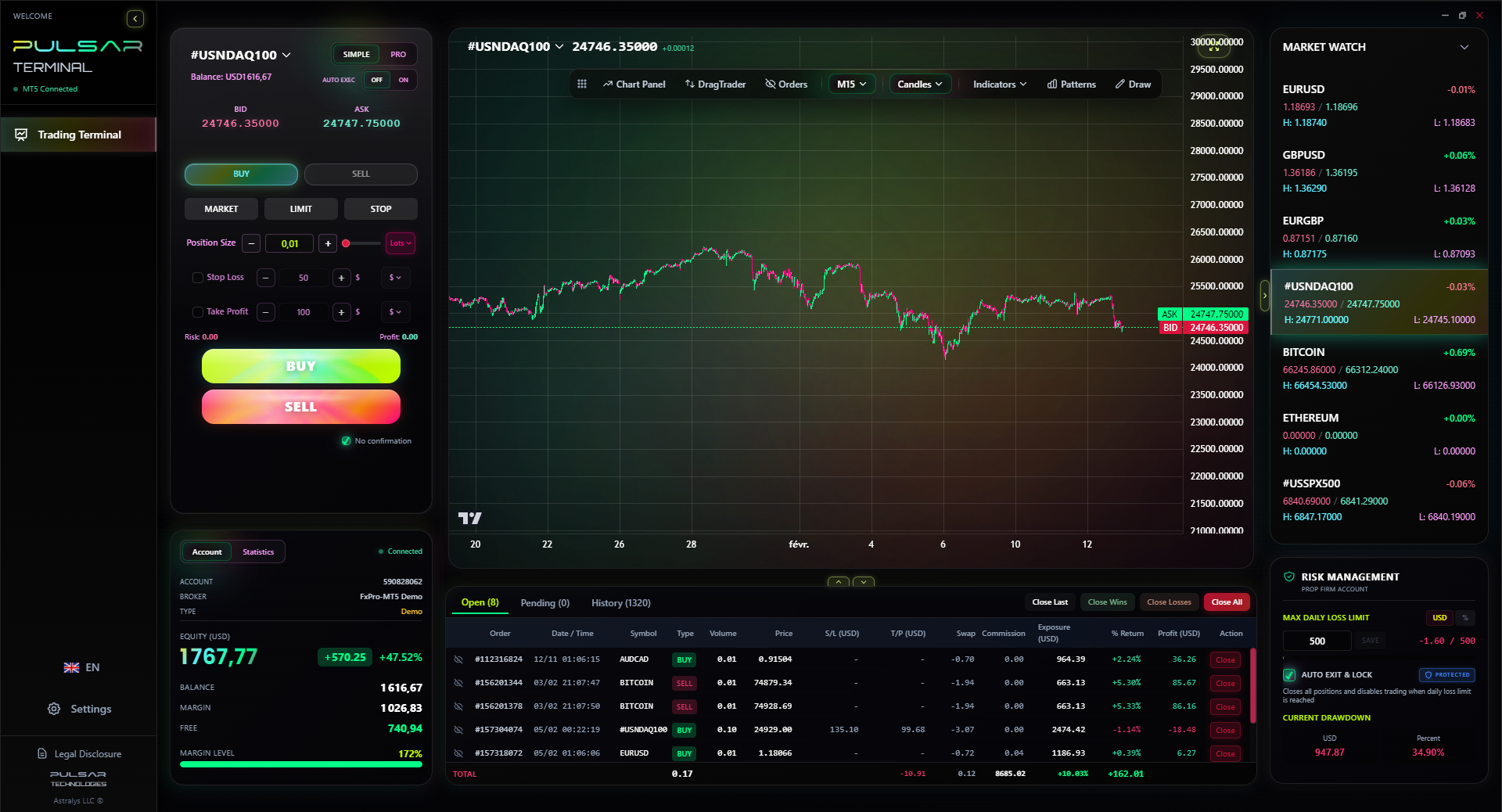
Sticking to a disciplined trade plan with precise stop-losses and take-profits is non-negotiable, and tools like Pulsar Terminal automate this execution directly on your MT5 platform.
Pulsar Terminal
أداة MT5 الشاملة: أوامر سحب وإفلات، متعدد TP/SL، تريلينج ستوب، تداول الشبكة، Volume Profile وحماية البروب فيرم. يستخدمها أكثر من 1000 متداول يومياً.
“Joining forex isn't a one-time event. It's the start of a continuous learning process. Treat it like a skilled craft, not a lottery ticket.”
You're set up. You've funded your account. Now what? Don't just start clicking buttons.
Weeks 1 & 2: The Demo Phase
- Goal: Execute 50 trades on demo. Not to make money, but to practice your process.
- Process: For every trade, write down in a journal:
- The pair (e.g., EUR/USD)
- Your reasoning (e.g., 'Bounce off daily support, RSI oversold')
- Entry, Stop Loss, and Take Profit prices.
- The position size (use your calculator!).
- The outcome and what you learned.
Weeks 3 & 4: The Live Micro-Testing Phase
- Goal: Make the psychology transition. Keep your account alive.
- Rules:
- Switch to a live account with only R1,000.
- Trade only micro lots (0.01). Your max risk per trade is R20.
- You are only allowed 2 trades per day.
- If you lose 10% of the account (R100), you stop for the week.
- Focus: Can you follow your journaling process exactly as you did on demo? The market will test you.
This plan forces discipline. It removes the pressure to make life-changing money. Your only job for the first month is to not break your own rules. If you can do that, you're ahead of 80% of beginners. I still journal every trade. It turns mistakes into lessons instead of just losses.
💡 نصيحة وينستون
The market doesn't know you exist. It doesn't care about your rent, your ego, or your need to be right. Trade the price you see, not the story in your head.
You made a profit? Great. Now don't get tripped up by the admin.
Taxes (SARS): Forex trading profits are considered income from a business or speculation by SARS. You must declare them. Keep careful records of all your trades (your journal!). You can deduct certain expenses like data fees, trading platform subscriptions, and even a portion of home office costs if you trade professionally. Get an accountant who understands trading. It's worth the fee.
Withdrawals: This is usually straightforward with regulated brokers. Go to the withdrawal section of your account, choose your method (EFT back to your bank account is common), and submit. First withdrawals might take longer for security checks. After that, it's often within 24-48 hours. If a broker makes withdrawing your money difficult, that's a massive red flag.
The Long Game: Joining forex isn't a one-time event. It's the start of a continuous learning process. The market changes. The Rand's dynamics shift, as we saw with its 13% surge in 2025. You need to stay informed, review your trades, and adapt. Treat it like a skilled craft, not a lottery ticket. That mindset shift is what separates the 10% who last from the 90% who quit.
Finally, remember why you wanted to learn how to join forex. If it was for 'quick cash,' you'll likely fail. If it's for the challenge, the intellectual puzzle, and the pursuit of a genuine skill, you've got a fighting chance. Now go set up that demo account.
FAQ
Q1What is the minimum amount to start forex trading in South Africa?
While some brokers let you start with as little as R70 ($5), that's not practical for learning. A realistic minimum to trade safely under FSCA rules is R1,500 - R5,000. This allows you to use micro lots and practice proper risk management without your account being wiped out by a tiny market move.
Q2Can I use international brokers like Exness or OctaFX?
You can, but you shouldn't unless they have a local FSCA license. Many international brokers operate offshore entities that are not regulated by the FSCA. This means you have no South African legal recourse if something goes wrong. Always check the FSCA's website to verify a broker's license. For example, you can check our review of the FSCA-licensed entity of Exness for clarity.
Q3How are my profits taxed?
SARS views consistent forex trading profits as taxable income. You need to declare them on your annual tax return. Keep a detailed log of all trades (profits and losses), as you can offset losses against profits. It's highly recommended to consult with a tax professional familiar with trading income.
Q4What is the best trading platform for beginners?
MetaTrader 4 (MT4) is the most common and beginner-friendly platform in South Africa. It's stable, has thousands of free indicators, and almost every broker offers it. MT5 is its newer sibling with more features. Start with MT4 on a demo account to get comfortable with placing orders, setting stops, and reading charts.
Q5Is forex trading a good way to make a full-time income?
Not at the beginning. For the vast majority, it should start as a part-time learning endeavor. The statistics are brutal: most retail traders lose money. Aim to become consistently profitable with a small account over 2-3 years before even considering replacing your primary income. It's a profession that requires significant skill and emotional control.
Q6What's the most traded pair in South Africa?
USD/ZAR (US Dollar vs. South African Rand) is by far the most traded pair locally. It's highly liquid but known for its volatility, especially during local political or economic announcements. Major pairs like EUR/USD are also very popular due to their tight spreads and high liquidity.
Q7What happens if my broker goes bankrupt?
If your broker is FSCA-licensed and holds your funds in a segregated client money account (as required by law), your money should be protected and returned to you through a liquidation process. This is a key reason to only use regulated brokers. Your funds are not protected with an unregulated entity.
درس البروفيسور وينستون
النقاط الرئيسية:
- ✓Regulation is protection, not restriction. Only use FSCA-licensed brokers.
- ✓Realistic starting capital is R5,000+, not the advertised $5.
- ✓Your max risk per trade must be 1% of your account. No exceptions.
- ✓Costs (spreads, swaps) can eat 10-20% of your profits. Factor them in.
- ✓The first month's goal is discipline, not profitability.
ما مدى فائدة هذا المقال؟
انقر على نجمة للتقييم
رؤى التداول الأسبوعية
تحليلات واستراتيجيات أسبوعية مجانية. بدون رسائل مزعجة.
عن المؤلف
David van der Merwe
متداول الأسواق الناشئة
متداول مقيم في جوهانسبرغ مع 11 عاماً في عملات الأسواق الناشئة. متخصص في أزواج ZAR والتداول المنظم من FSCA وتحليل السوق الجنوب إفريقي.
التعليقات
تحذير من المخاطر
ينطوي تداول الأدوات المالية على مخاطر كبيرة وقد لا يكون مناسبًا لجميع المستثمرين. الأداء السابق لا يضمن النتائج المستقبلية. هذا المحتوى لأغراض تعليمية فقط ولا ينبغي اعتباره نصيحة استثمارية. قم دائمًا بإجراء بحثك الخاص قبل التداول.
قد يعجبك أيضًا

Cara Trading Forex Sukses: 7 Prinsip dari Trader Profesional
Cara trading forex sukses dengan 7 prinsip trader pro: manajemen modal, disiplin, journal trading, backtest. Data nyata, bukan janji profit palsu.
Jam Trading Forex Terbaik untuk Trader Indonesia: Panduan Lengkap dengan Tabel Waktu
Panduan jam trading forex untuk trader Indonesia. Tabel 4 sesi dunia, jam emas 20:00-00:00, sesi mana yang harus dihindari. Data akurat + tips dari trader berpengalaman.
Top 5 Sàn Forex Uy Tín Nhất 2026: Review Jujur dari Trader Indonesia
Top 5 sàn forex uy tín 2026 untuk trader Indonesia. Review jujur: spread, deposit, withdraw, dukungan lokal. Exness, XM, IC Markets & lebih.
احصل على Pulsar Terminal
جميع هذه الحاسبات مدمجة في Pulsar Terminal مع بيانات حية من حساب MT5 الخاص بك.
احصل على Pulsar Terminal