


I was staring at my screen at 3:15 PM WAT, watching EUR/USD coil inside a tight 20-pip range for two hours.

Olumide Adeyemi
رائد التداول في غرب أفريقيا ·  Nigeria
☕ 13 دقائق قراءة
ما ستتعلمه:
- 1What a Breakout Really Is (And Why 80% of Them Fail)
- 2Finding Real Setups: What to Look For on Your Charts
- 3Entry, Stop Loss, and Take Profit: The Nuts and Bolts
- 4Risk Management: The Only Thing That Keeps You Alive
- 5Mistakes I've Made (So You Don't Have To)
- 6Applying This to the Nigerian Market Reality
- 7Your Step-by-Step Breakout Trading Plan
I was staring at my screen at 3:15 PM WAT, watching EUR/USD coil inside a tight 20-pip range for two hours. The London session was winding down, New York was about to open, and the chart looked like a spring being compressed. My finger hovered over the buy button, waiting for that decisive move above 1.0950. When it finally broke, the price shot up 45 pips in seven minutes - a classic, clean breakout. Then, it reversed and took out my stop loss. That trade, a textbook setup that still failed, taught me more about how to trade breakouts in forex than any winning trade ever did. The strategy seems simple, but the devil is in the execution, especially with the unique pressures of trading from Nigeria.
A breakout is simply price moving decisively outside a defined range. Think of it like a dam breaking. The water (price) builds up behind a wall (resistance or support), pressure increases, and eventually, it bursts through. The problem? Most of these bursts are just leaks. The dam holds.
In forex, a true breakout signals a shift in market sentiment. The old balance between buyers and sellers is broken, and one side takes control, often leading to a sustained move. The trap, especially for new traders, is the false breakout. This is when price briefly moves beyond a level, sucks in all the eager traders, and then violently reverses, stopping everyone out.
From Lagos to Port Harcourt, I've seen the same pattern. A trader spots GBP/NGN breaking a key level, jumps in with high use, and gets wiped out when the CBN makes an unexpected announcement and the pair snaps back. The market's primary job isn't to make you money. It's to transfer your money to someone else, and false breakouts are one of its favorite tools.

Warning: The first breakout attempt is often a trap. Big banks and institutions know where the retail crowd has placed their stop-loss orders (just beyond obvious support/resistance). They'll often push price to those levels to 'run the stops' before moving in the true direction. If you're always entering on the very first candle that breaks the line, you're playing right into their hands.
So, how do you tell a real breakout from a fake? You need confluence. A lone price break isn't enough. You need other factors agreeing with the move. This could be a major economic data release (like US Non-Farm Payrolls), a shift in monetary policy, or a technical signal like the MACD indicator showing strong momentum in the breakout direction. Without this agreement, you're just gambling.
You can't trade every little wiggle. You need a framework to separate noise from opportunity. Here’s what I scan for, focusing on pairs relevant to us.
Key Chart Patterns
Forget complex patterns for now. Focus on these two, which account for most profitable breakout trades:
- The Range or Rectangle: Price bounces between a clear horizontal support and resistance. This is common during quiet market periods or ahead of major news. The breakout direction from a long-lasting range is often powerful. Look for this on pairs like EUR/NGN or USD/NGN on the daily chart.
- The Triangle (Symmetrical or Ascending/Descending): The price makes lower highs and higher lows, coiling into a tighter and tighter space. The breakout from the apex of the triangle tends to be sharp. This is a great pattern for a scalping strategy on the 15-minute or 1-hour charts of majors like EUR/USD during session overlaps.
The Importance of Time
Not all times are created equal. The best breakouts happen when market liquidity is high. For us in Nigeria, that's between 1:00 PM and 6:00 PM WAT (which overlaps with the late London and early New York sessions). A breakout that happens at 2 AM WAT is far more likely to be fake due to thin liquidity.
Volume & Momentum Confirmation
Most forex brokers don't show true volume, but they show tick volume (the number of price changes), which is a decent proxy. On the breakout candle, you want to see higher-than-average tick volume. Also, use an oscillator. If price breaks above resistance and the RSI indicator is also breaking above 50 (or out of oversold territory), that's a good sign. If the RSI is above 70 (overbought) as price breaks out, be very cautious - it might be exhausted.

Example: Let's say GBP/USD has been trading between 1.2650 (support) and 1.2750 (resistance) for three days. At 2:30 PM WAT, a strong bullish candle closes at 1.2760. The tick volume on that candle is double the 10-candle average, and the RSI jumps from 55 to 65. This is a high-probability long breakout setup. Your entry could be a buy stop order at 1.2755.

💡 نصيحة وينستون
The market spends 80% of its time consolidating and 20% trending. Your job is to preserve capital during the 80% so you have enough to deploy during the 20%. Impatience is the breakout trader's cancer.
“The first breakout attempt is often a trap designed to catch the eager retail crowd.”
This is where the rubber meets the road. A good setup with poor execution will lose you money.
The Two Main Entry Methods
- The Aggressive Entry: You place a buy stop order just above resistance or a sell stop order just below support. This means you automatically enter the trade the moment price hits your level. The pro: you catch the entire move if it runs. The con: you get caught in every false breakout. I used this method for years and my account bled from a thousand small cuts.
- The Conservative Entry (My Preferred Method): You wait for the breakout to happen and then wait for a pullback or retest. After price breaks above resistance, that old resistance level should turn into new support. You wait for price to dip back to that level, see if it holds, and then enter. You miss a bit of the initial move, but your win rate improves dramatically because you've filtered out the immediate reversals.
Where to Place Your Stop Loss
Your stop loss is your lifeline. For a long breakout above resistance, place your stop loss just below the breakout level (the old resistance, now support). For a short breakout below support, place it just above the breakout level. The exact distance depends on the pair's volatility. For EUR/USD, 15-20 pips below the level might work. For a more volatile pair like GBP/JPY, you might need 25-35 pips. Never base your stop on how much money you're willing to lose. Base it on where the market proves your trade idea wrong.
Setting a Take Profit Target
Don't be greedy. Have a predefined target. The most common method is to measure the height of the pattern and project it from the breakout point.
Let me give you a real example from last month. I was watching Gold (XAU/USD) form a symmetrical triangle on the 4-hour chart. The height of the triangle (from the highest high to the lowest low within it) was about $25. The price broke upwards from the $2020 level. My take profit target was $2020 + $25 = $2045. I entered at $2023 on the retest, placed my stop at $2015, and the price hit $2045 two days later. A clean $22 profit per ounce. Using a position size calculator, I risked 0.5% of my account on that trade.

Pro Tip: Consider using a partial closure strategy. Close half your position at your first profit target (e.g., the measured move) and then move your stop loss to breakeven on the remainder. You can let the second half run with a trailing stop. This books some profit and lets you participate in any extended trend without stress.
I don't care how good your breakout strategy is. If you don't manage risk, you will blow up your account. It's not a question of if, but when. Here’s how to apply it in our context.
First, position size is everything. The high use offered by brokers like Exness or XM is a double-edged sword. Just because you can use 1:500 use doesn't mean you should. I never risk more than 1% of my trading capital on a single trade. On a $1,000 account, that's $10. If my stop loss is 20 pips away on EUR/USD, I can only trade a position size where 20 pips of loss equals $10. That’s a micro lot (0.01). It feels small, but it keeps you in the game.
Second, account for the Naira. If you're funding in Naira, remember the exchange rate risk. Your broker account is in USD. If the Naira weakens, your purchasing power for future deposits goes down. More importantly, your profits in USD will be worth more in Naira when you withdraw. Factor this into your long-term goals, but don't let it push you to overtrade.
Third, beware of local volatility. Pairs involving the Naira (like USD/NGN on CFD platforms) can have massive, news-driven gaps. A breakout on USD/NGN might be real, but if the CBN intervenes overnight, your stop loss won't protect you from the gap. The spread can also widen enormously during local market turmoil. I stick to major forex pairs (EUR/USD, GBP/USD, USD/JPY) for breakout trading because they have the deepest liquidity and most orderly breaks.
Finally, have a daily loss limit. Mine is 3%. If I lose three trades in a row (happens to everyone), I'm down 3% for the day. I shut down the platform and walk away. Tomorrow is another day. This discipline is the only reason I've survived for 12 years while watching countless others get a margin call and disappear.
💡 نصيحة وينستون
A false breakout isn't a failure of the strategy; it's a feature of the market. Your stop-loss isn't a defeat. It's the cost of doing business, like rent for a shopkeeper. Plan for it.
“Your stop loss isn't a defeat. It's the cost of doing business, like rent for a shopkeeper.”
Let's get painfully honest. Here are the errors that cost me real money, all while trying to trade breakouts.
1. Chasing the Breakout Too Far: The price breaks, runs 30 pips, and you FOMO (Fear Of Missing Out) in. You're now entering after the move has already happened, near a short-term peak. The pullback comes, hits your tight stop, and you're out. The market then resumes its trend. Entry timing is crucial. If you miss the initial move, wait for the retest. Don't chase.
2. Ignoring the Higher Timeframe: You see a beautiful breakout on the 15-minute chart and go all in. But on the 4-hour chart, price is smack into a massive, long-term resistance level. The higher timeframe wins every time. That 15-minute breakout was just a tiny blip before the larger rejection. Always check at least one timeframe higher than the one you're trading on.
3. Using Too Wide a Definition of 'Breakout': A breakout isn't just any move beyond a line. I used to draw sloppy lines and get excited by a 5-pip break. Now, I have a rule: for a daily chart breakout, I need a daily candle to close beyond the level. For a 1-hour chart, I need a 1-hour close. This filters out intraday noise. A close shows commitment; a mere wick does not.
4. Not Accounting for Spreads: You buy a breakout when the ask price hits 1.1050. Your broker's spread is 2 pips on EUR/USD. That means the bid price (the price you can sell at) is actually 1.1048. For a true breakout, you often need the bid price to clear the level. If you're using a tight stop loss, that spread can be the difference between a winning trade and a stopped-out one. This is why I prefer brokers known for tight, stable spreads like IC Markets or Pepperstone for this strategy.
5. Revenge Trading After a False Breakout: This is the killer. A false breakout stops you out. You're angry. You see the price move back in the original direction and immediately jump back in, trying to recoup the loss. You're now trading emotionally, not technically. This is how a single $10 loss turns into a $100 loss in minutes. One loss per day is a statistic. Two losses in a row is a signal to stop.
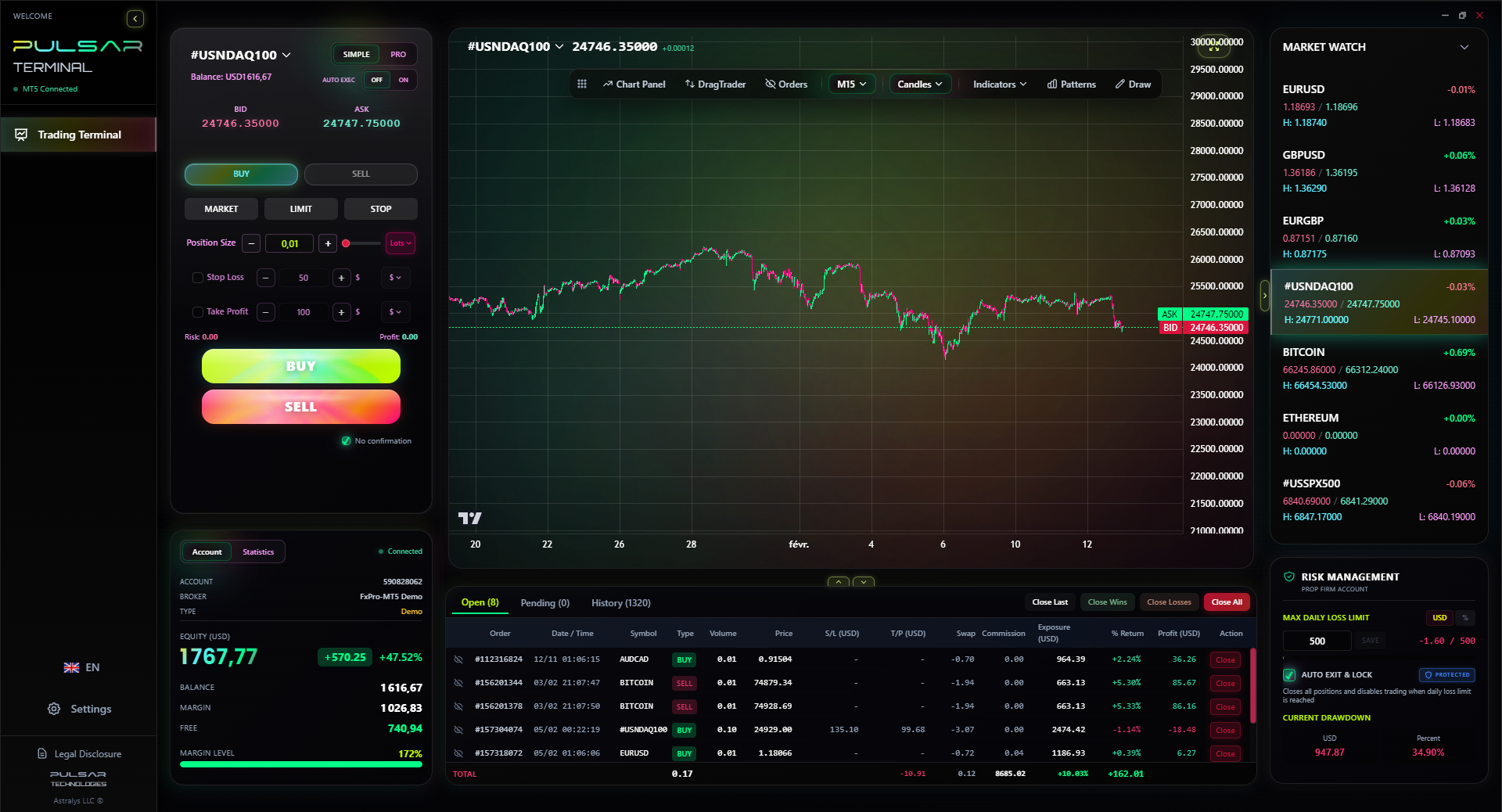
Managing multiple take-profit levels and moving stops to breakeven on a volatile breakout is stressful, but tools like Pulsar Terminal automate these actions directly on your MT5 chart.
Pulsar Terminal
أداة MT5 الشاملة: أوامر سحب وإفلات، متعدد TP/SL، تريلينج ستوب، تداول الشبكة، Volume Profile وحماية البروب فيرم. يستخدمها أكثر من 1000 متداول يومياً.
Trading from Nigeria isn't the same as trading from London. We have unique constraints and opportunities.
Funding and Withdrawals: Due to CBN restrictions, funding your international broker account with a Naira debit card can be a headache for larger amounts. The savvy traders I know use domiciliary accounts or e-wallets like Neteller. Factor in the fees and transfer times for these methods. Your trading plan should account for the fact that adding emergency funds to your account isn't always instant.
Regulation and Broker Choice: The SEC Nigeria has been clear: online retail forex trading is unregulated here. Your protection is zero. This makes choosing a well-regulated international broker non-negotiable. You need a broker that holds client funds in segregated accounts with a top-tier regulator (like the UK's FCA or Australia's ASIC). This is your first line of defense against broker insolvency or malpractice. Don't chase the broker with the highest use or flashiest bonuses. Chase the one with the strongest reputation for safety and fair execution.
Trading Naira Pairs: If you do trade USD/NGN or other Naira CFDs, understand you're not trading the physical interbank rate. You're trading a derivative whose price is based on it. Breakouts can be explosive, but so can the spreads and slippage. Your risk management must be even tighter. A 50-pip stop loss on EUR/USD is standard. A 50-pip stop loss on USD/NGN can be wiped out in a single volatile spike. Consider wider stops or smaller position sizes on these local pairs.
The Mental Game: Trading in an environment where friends and family often see it as gambling adds psychological pressure. You might feel the need to make quick, large profits to 'prove' it's legitimate. This is a direct path to overtrading and blowing up. Treat it like a business. Your breakout strategy is your business process. Follow it mechanically, manage your risks, and ignore the noise. The profits, when they come, will be the best proof.
💡 نصيحة وينستون
If you find yourself constantly moving your stop loss further away 'to give the trade room,' you are no longer trading a breakout. You are hoping. Hope is not a strategy.
“Just because you can use 1:500 use doesn't mean you should. I never risk more than 1% of my capital on a single trade.”
Let's condense everything into a checklist you can use before every trade.
- Identify the Setup: Find a clear consolidation pattern (range, triangle) on your chosen timeframe. Draw clean horizontal support and resistance lines.
- Check Confluence: Is the market approaching a key news time? Does a higher timeframe trend agree? Is volume starting to pick up? Don't trade in a vacuum.
- Plan the Trade:
- Entry: Will you enter on the break (aggressive) or on the retest (conservative)? Place your pending order or set your alert.
- Stop Loss: Place it 10-20 pips beyond the other side of the pattern (for a range) or just beyond the breakout level.
- Take Profit: Use the measured move of the pattern for your first target. Consider taking partial profit here.
- Calculate Position Size: Use your position size calculator. The distance between your entry and stop loss in pips, combined with your 1% risk rule, tells you your lot size. Do this every single time.
- Execute and Manage: Once in the trade, don't move your stop loss further away. You can move it to breakeven once price has moved in your favor by 1.5x your initial risk. Let your take profit orders do their work.
- Review: Win or lose, review the trade. Did the breakout have volume? Did it hold? What does the price action after your exit tell you? Log this in a journal.
Breakout trading isn't about being right all the time. It's about being right enough and making sure your winning trades are bigger than your losing ones. It requires patience to wait for the right setup and discipline to follow your plan when your emotions are screaming at you to do something else. Master that, and you've mastered the core of how to trade breakouts in forex.
FAQ
Q1Is breakout trading profitable for beginners in Nigeria?
It can be, but it's one of the trickier strategies to start with because of false breakouts. Beginners often get whipsawed. I'd suggest practicing extensively on a demo account, focusing on the 'wait for the retest' entry method to improve your win rate before risking real money.
Q2What is the best timeframe for breakout trading?
It depends on your style. For a more active approach, the 1-hour and 4-hour charts offer a good balance between signal clarity and frequency. For a swing trading approach, the daily chart is excellent. Avoid very low timeframes (like 1-minute) as they are mostly noise and false breaks.
Q3How do I know if a support/resistance level is strong?
A strong level has been tested multiple times (price has bounced off it at least 2-3 times). The more times price touches it and reverses, the more significant it becomes. Also, levels that align with round numbers (like 1.1000 in EUR/USD) or major Fibonacci retracement levels (like 61.8%) tend to be stronger.
Q4Can I trade breakouts on my mobile phone?
You can, but I don't recommend it for execution. It's fine for monitoring and setting alerts. The small screen makes precise drawing of levels and order placement difficult, increasing the chance of error. Use a desktop platform like MT5 for your actual trading.
Q5Do I need to pay tax on my forex trading profits in Nigeria?
Yes. According to Nigerian law, you are liable to pay Capital Gains Tax (CGT) on your trading profits. The standard rate is 10% of your net gains. It's your responsibility to declare this income and pay the tax. Keep detailed records of all your trades, deposits, and withdrawals.
Q6What pairs are best for breakout trading?
Major currency pairs like EUR/USD, GBP/USD, and USD/JPY are ideal because they have high liquidity and tight spreads, which leads to cleaner, more reliable breakouts. Avoid exotic pairs or pairs with very wide spreads, as the breakout signal is often distorted by the cost of trading.
درس البروفيسور وينستون
النقاط الرئيسية:
- ✓Wait for the retest after a breakout; it filters out 60% of false signals.
- ✓Never risk more than 1% of your account on any single trade.
- ✓The higher timeframe trend always overrules your lower timeframe breakout.
- ✓A breakout needs a daily or hourly close, not just a wick, to be valid.
ما مدى فائدة هذا المقال؟
انقر على نجمة للتقييم
رؤى التداول الأسبوعية
تحليلات واستراتيجيات أسبوعية مجانية. بدون رسائل مزعجة.
عن المؤلف
Olumide Adeyemi
رائد التداول في غرب أفريقيا
أحد أنشط معلمي تداول الفوركس في نيجيريا. 8 سنوات من الخبرة في التداول من لاغوس. متخصص في استراتيجيات رأس المال المنخفض وتحديات شركات البروب للمتداولين الأفارقة.
التعليقات
تحذير من المخاطر
ينطوي تداول الأدوات المالية على مخاطر كبيرة وقد لا يكون مناسبًا لجميع المستثمرين. الأداء السابق لا يضمن النتائج المستقبلية. هذا المحتوى لأغراض تعليمية فقط ولا ينبغي اعتباره نصيحة استثمارية. قم دائمًا بإجراء بحثك الخاص قبل التداول.
قد يعجبك أيضًا

Cara Trading Forex Sukses: 7 Prinsip dari Trader Profesional
Cara trading forex sukses dengan 7 prinsip trader pro: manajemen modal, disiplin, journal trading, backtest. Data nyata, bukan janji profit palsu.
Jam Trading Forex Terbaik untuk Trader Indonesia: Panduan Lengkap dengan Tabel Waktu
Panduan jam trading forex untuk trader Indonesia. Tabel 4 sesi dunia, jam emas 20:00-00:00, sesi mana yang harus dihindari. Data akurat + tips dari trader berpengalaman.
Top 5 Sàn Forex Uy Tín Nhất 2026: Review Jujur dari Trader Indonesia
Top 5 sàn forex uy tín 2026 untuk trader Indonesia. Review jujur: spread, deposit, withdraw, dukungan lokal. Exness, XM, IC Markets & lebih.
احصل على Pulsar Terminal
جميع هذه الحاسبات مدمجة في Pulsar Terminal مع بيانات حية من حساب MT5 الخاص بك.
احصل على Pulsar Terminal