


I remember staring at my screen in late 2023, watching the USD/INR tick up on the NSE platform.

Rajesh Sharma
محلل فوركس أول ·  India
India
☕ 10 دقائق قراءة
ما ستتعلمه:
I remember staring at my screen in late 2023, watching the USD/INR tick up on the NSE platform. I had a small long position, and the RBI had just made a hawkish comment. The move was sharp, about 15 paisa in a few minutes. That's when it really hit me: the legal Indian forex market is plenty volatile and offers real opportunity, but you have to play by a very specific set of rules. Getting this wrong isn't just about a bad trade; it's about breaking the law. Let's cut through the confusion and talk about exactly how to trade forex legally in India.
First things first, forget everything you've seen on YouTube ads about trading EUR/USD from your phone in Mumbai. The rules here are crystal clear, and they're built around the Foreign Exchange Management Act (FEMA). The RBI and SEBI are the watchdogs, and they don't mess around.
The core principle is this: you, as an Indian resident, are only allowed to speculate on the value of the Indian Rupee against other currencies. Full stop. This means your trading must be done on recognized Indian exchanges (NSE, BSE, MSE) through a SEBI-regulated broker. The moment you sign up with an offshore broker to trade GBP/JPY, you're violating FEMA. I've seen guys try to use international brokers, funding accounts with their credit cards. It might work until it doesn't - the RBI maintains an 'Alert List' of unauthorized platforms, and banks can flag those transactions.

Warning: Using your Liberalised Remittance Scheme (LRS) limit of $250,000 per year to fund an international trading account for speculative forex is illegal. That limit is for travel, education, and gifts, not for getting around FEMA.
The permitted currency pairs are your universe:
- USD/INR (by far the most liquid)
- EUR/INR
- GBP/INR
- JPY/INR
That's it. No gold (XAU/USD), no EUR/USD, no exotic crosses. Your world revolves around the Rupee. This isn't a limitation if you understand it; it's just the boundary of the game. The market has grown massively, with daily turnover hitting around $60 billion. There's more than enough action, especially in USD/INR.

💡 نصيحة وينستون
The market doesn't care about your opinion on the Rupee. It only cares about price. Trade what you see on the chart of the futures contract, not what you hear on TV.
“Your trading must be done on recognized Indian exchanges through a SEBI-regulated broker. The moment you sign up with an offshore broker, you're violating FEMA.”
This is the most critical practical step. Your broker must be registered with SEBI and a trading member of the NSE, BSE, or MSE for their currency derivatives segment. These are your stockbrokers, but they provide access to the forex futures and options market.
Forget the flashy international names like Exness or Pepperstone for this purpose. While they are great brokers globally, they are not authorized to offer speculative forex trading to Indian residents. Using them puts you in a legal grey area you don't want to be in.
You need to open an account with a firm like:
- Zerodha (their Kite platform is excellent)
- Angel One
- Upstox
- ICICI Direct
- HDFC Securities
- Kotak Securities
I use Zerodha for my Indian forex trades. The account opening is fully online, and they link directly to your bank account. Funding is instant via UPI or Net Banking - no international transfer fees. The trading platform is solid for executing futures contracts.

Pro Tip: When you open your account, you'll be asked to select segments. Make sure you enable 'Currency Derivatives'. It's a separate permission from equity trading.
A special note on Interactive Brokers: They are SEBI-regulated and a member of Indian exchanges, but they only offer exchange-traded currency derivatives, not spot forex CFDs. They are a legal option, but their platform is geared more towards sophisticated investors.
“You're not trading the spot forex price you see on Google. You're trading standardized futures contracts with monthly expiry dates.”
Here's a key detail beginners miss. On the NSE or BSE, you're not trading the spot forex price you see on Google. You're trading standardized futures contracts.
Let's break down a USD/INR futures contract. Each contract represents a specific amount of USD (usually $1000) for a specific expiry date (like the last Thursday of the month). The price is quoted in INR per USD. So if the quote is 83.2500, one contract is worth 83,250 INR ($1000 * 83.25).
You need to understand the contract specifications. For example, the minimum price movement (tick size) is usually 0.0025 paisa. A move from 83.2500 to 83.2525 is one tick. The value of that tick depends on the contract size. This is different from calculating a pip in the spot market.
Managing Expiry
This was my biggest adjustment. You can't just buy and hold a position forever. Contracts expire monthly. As your contract nears expiry, you need to 'roll over' your position by selling the expiring contract and buying the next month's contract. This can sometimes cost you (if the next month is more expensive, a situation called contango) or earn you a small credit (backwardation). I learned this the hard way early on by forgetting to roll a position and having it automatically squared off.
The benefit? Extreme transparency. Every trade is on a regulated exchange. No dealing desk, no funny business with spreads widening during news. The liquidity is fantastic for the major contracts, especially near-month USD/INR.
“You're not trading the spot forex price you see on Google. You're trading standardized futures contracts with monthly expiry dates.”
Trading costs in the Indian market are straightforward but structured differently. Forget spreads as you know them from international brokers. Here, you pay:
- Brokerage: This is usually a flat fee per lot or a percentage of turnover. Many discount brokers like Zerodha charge a fixed ₹20 per executed order for futures, regardless of the number of lots.
- Exchange Transaction Charges: A small fee levied by the NSE/BSE.
- SEBI Turnover Fee: A tiny percentage of your turnover.
- GST: 18% on the brokerage and transaction charges.
Let's run a real example from a trade I took last month. I bought 2 lots of USD/INR APR futures at 83.1500. Each lot is $1000.
- Contract Value: 2 lots * $1000 * 83.1500 = ₹1,66,300
- Brokerage: ₹20 per order = ₹20
- Estimated total charges (Exch + SEBI + GST): ~₹5
- Total cost to enter: ~₹25
I sold at 83.3000.
- Profit: (83.3000 - 83.1500) = 0.1500 INR per USD
- Profit per lot: 0.1500 * 1000 = ₹150
- Total Profit: 2 lots * ₹150 = ₹300
- Minus costs (~₹25 exit + ₹25 entry = ₹50)
- Net Profit: ₹250

Example: That 0.1500 move is 60 ticks (0.1500 / 0.0025). So my net profit was roughly ₹4.17 per tick, after all costs. Knowing your cost per tick is crucial for figuring out if a trade setup has a good risk/reward.
Always, always use a position size calculator or build your own sheet. With futures, your risk is defined by the contract size and the distance to your stop loss. A 20-tick stop on 2 lots of USD/INR is a very different dollar amount than a 20-pip stop on a 0.1 lot EUR/USD spot position.
💡 نصيحة وينستون
Your first ₹10,000 in this market is tuition, not capital. Expect to pay it to learn the rules, the platform, and your own emotions. If you can preserve most of it, you're ahead of 90% of beginners.
“The biggest pitfall is thinking the legal market is 'lesser.' It's just different. It's transparent, well-regulated, and offers deep liquidity.”
You can't just copy-paste a EUR/USD strategy onto USD/INR. The Rupee has its own drivers. RBI policy, crude oil prices (India imports a lot), and broad dollar strength are the big ones. FII flows into the Indian equity markets also cause big moves.
I tend to use a swing trading approach on the hourly and 4-hour charts. Intraday volatility can be high, but the longer-term trends are often driven by fundamentals you can follow.
Here's a basic framework I've found useful:
- Identify the Macro Trend: Is the RBI hiking or holding? Is oil rallying? That's typically negative for INR. Are FIIs pouring money into Indian stocks? That's positive for INR (as they buy rupees to invest).
- Find Key Levels: Use the futures charts. Previous highs/lows, round numbers (like 83.0000), are major magnets. The market respects these.
- Time Your Entry: I often use a simple RSI indicator to spot overbought/oversold conditions within the trend. A pullback to a key level with an RSI reading moving out of an extreme can be a good entry signal. I also watch for divergence between price and the MACD indicator on the 4-hour chart.
- Manage the Trade: This is where most fail. Your stop loss must be placed at a level that, if hit, invalidates your trade idea. For a swing trade, 40-60 ticks is common. I always set a stop immediately. I also use a trailing stop once the trade moves 50-60 ticks in my favor, locking in some profit while letting the runner go.
I got chopped up trying to scalping strategy this market early on. The tick-by-tick noise is immense. Swing trading the clearer macro moves saved my sanity and improved my results.
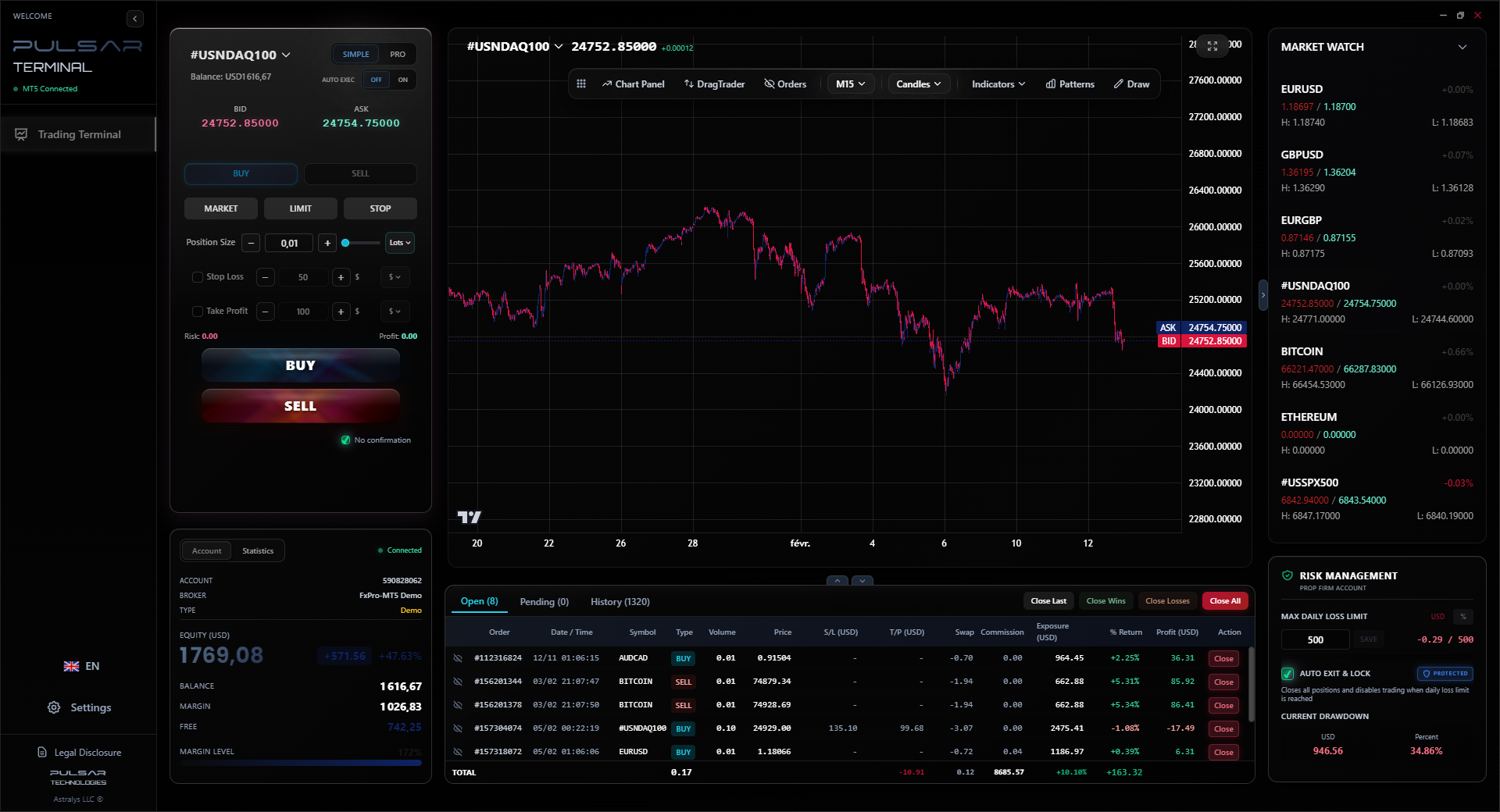
Managing multiple lots and setting precise stop losses on futures contracts is easier with a tool like Pulsar Terminal, which lets you drag-and-drop orders and set multi-level take-profits directly on your MT5 chart.
Pulsar Terminal
أداة MT5 الشاملة: أوامر سحب وإفلات، متعدد TP/SL، تريلينج ستوب، تداول الشبكة، Volume Profile وحماية البروب فيرم. يستخدمها أكثر من 1000 متداول يومياً.
“The biggest pitfall is thinking the legal market is 'lesser.' It's just different. It's transparent, well-regulated, and offers deep liquidity.”
Let me save you some pain and money by listing out my own mistakes.
Pitfall 1: Ignoring Expiry. As mentioned, I once let a profitable position sit into expiry week without planning the rollover. The volatility dried up, my profit shrank, and I ended up with a mediocre exit. Always know your contract's expiry date and plan the roll 3-5 days before.
Pitfall 2: Underestimating Margin. Futures trading uses margin. Your broker will require an Initial Margin (IM) to open the position and a Maintenance Margin (MM) to hold it. If your losses eat into the MM, you'll get a margin call and be forced to add funds or have your position liquidated. Never use 100% of your capital for one trade. A 100-tick move against you can hurt.
Pitfall 3: Chasing 'Legal' Offshore Options. You'll find international brokers that accept Indian clients. Some might even offer INR pairs. Unless they are SEBI-regulated and routing your trades to NSE/BSE, it's not compliant for speculative trading. The risk isn't worth it. Stick to the big Indian names.
Pitfall 4: Not Accounting for All Costs. That ₹20 per order seems small, but if you're an active trader, it adds up fast. It directly eats into your profitability per tick. Factor it into your risk/reward calculation before you enter.
The biggest pitfall is thinking the legal market is 'lesser.' It's just different. It's transparent, well-regulated, and offers deep liquidity for the major pairs. Embrace those facts as strengths.
💡 نصيحة وينستون
The biggest edge in the Indian forex market is patience. Wait for the monthly expiry chaos to settle, then look for the new trend in the next front-month contract. Most noise, least signal, happens during rollover.
“Your first trade should be 1 lot. Your goal isn't to make money; it's to go through the entire cycle and get comfortable with the mechanics.”
Ready to do this the right way? Here's your step-by-step list.
- Choose Your SEBI-Regulated Broker: Research Zerodha, Angel One, Upstox, etc. Compare their brokerage plans, platform usability (try their demo if available), and customer service. Open a standard trading and demat account.
- Complete Your KYC: This is mandatory. Have your PAN card, Aadhaar, bank details, and a cancelled cheque ready. The entire process is online and takes a few days.
- Activate the Currency Derivatives Segment: Log into your broker's back office after account activation and specifically enable trading in the 'Currency Derivatives' segment. It's a simple checkbox form.
- Fund Your Account: Link your bank account and transfer funds via UPI/Net Banking. Start small. I'd suggest at least ₹25,000 to begin with, so you can trade 1 lot comfortably and manage margin.
- Learn the Platform: Don't place a live trade immediately. Use the market watch to follow USD/INR futures. Understand how to place an order, set a stop loss, and view your margin. Paper trade for a week.
- Start Small: Your first trade should be 1 lot. Your goal isn't to make money; it's to go through the entire cycle: entry, management, exit, and rollover (if you hold). Get comfortable with the mechanics.
- Keep a Journal: Note down every trade, your reasoning, the outcome, and, crucially, all charges deducted. This is the only way to learn what's working in this specific market.
Stick to this path, and you'll be trading forex legally in India, building real skills without looking over your shoulder. The peace of mind is worth more than any speculative gain from an illegal offshore account.
FAQ
Q1Can I trade Forex with $100 in India?
Technically, yes, but it's very difficult and risky. One standard lot of USD/INR futures requires significant margin (often ₹10,000+). Some brokers offer mini or micro contracts, but liquidity is lower. With $100 (approx ₹8,300), your options are extremely limited and your risk of a margin call is high. It's better to save more capital first.
Q2Is Forex trading taxable in India?
Yes. Profits from trading currency futures are treated as 'Business Income' or 'Speculative Business Income' if you're an active trader. You need to file ITR and pay tax according to your income slab. You can deduct expenses like brokerage, internet, etc. If you trade infrequently, it might be classified as capital gains. Always consult a CA.
Q3Which Forex pair is most profitable in India?
USD/INR is by far the most traded and liquid pair, offering the tightest 'effective spreads' (through low bid-ask impact) and the clearest trends driven by macro news. More liquidity generally means better order execution, which is a form of profitability. Sticking with USD/INR is usually the best bet for most retail traders.
Q4Can I use MetaTrader 5 (MT5) for legal forex trading in India?
Not for accessing the legal NSE/BSE currency futures market directly. SEBI-regulated Indian brokers provide their own web and mobile platforms (like Zerodha Kite). However, if you are using a broker like Interactive Brokers (which is SEBI-regulated), you can use their platform or TWS. The MT5 platforms offered by international forex brokers are not connected to the Indian regulated exchanges for resident traders.
Q5What happens if I get caught using an illegal offshore broker?
You could face penalties under FEMA, which can include hefty fines. Your bank might freeze related accounts, and the unauthorized remittances you made could be scrutinized. The RBI actively warns against this. It's a regulatory and financial risk that completely outweighs any perceived benefit of wider currency selection.
Q6Can I trade gold or cryptocurrencies through forex brokers in India?
Not legally through the forex mechanism. Trading in international assets like XAU/USD (Gold/USD) with an offshore broker falls under the same FEMA restrictions as forex. For gold, you can trade gold futures and options on Indian commodity exchanges (MCX) through SEBI-regulated brokers. Cryptocurrency trading is a separate and evolving regulatory area.
درس البروفيسور وينستون
النقاط الرئيسية:
- ✓Only 4 pairs are legal: USD/INR, EUR/INR, GBP/INR, JPY/INR.
- ✓You must use a SEBI-regulated Indian broker like Zerodha or Angel One.
- ✓You trade futures contracts, not spot forex, with monthly expiries.
- ✓Costs are brokerage + exchange fees + GST, not spreads.
- ✓Always plan your rollover 3-5 days before contract expiry.
ما مدى فائدة هذا المقال؟
انقر على نجمة للتقييم
رؤى التداول الأسبوعية
تحليلات واستراتيجيات أسبوعية مجانية. بدون رسائل مزعجة.
عن المؤلف
Rajesh Sharma
محلل فوركس أول
أكثر من 10 سنوات في تداول الأسواق الهندية وجنوب آسيا. بدأ بالمشتقات النقدية في NSE قبل الانتقال إلى الفوركس الدولي. متخصص في USD/INR وأزواج الأسواق الناشئة.
التعليقات
تحذير من المخاطر
ينطوي تداول الأدوات المالية على مخاطر كبيرة وقد لا يكون مناسبًا لجميع المستثمرين. الأداء السابق لا يضمن النتائج المستقبلية. هذا المحتوى لأغراض تعليمية فقط ولا ينبغي اعتباره نصيحة استثمارية. قم دائمًا بإجراء بحثك الخاص قبل التداول.
قد يعجبك أيضًا

Cara Trading Forex Sukses: 7 Prinsip dari Trader Profesional
Cara trading forex sukses dengan 7 prinsip trader pro: manajemen modal, disiplin, journal trading, backtest. Data nyata, bukan janji profit palsu.
Jam Trading Forex Terbaik untuk Trader Indonesia: Panduan Lengkap dengan Tabel Waktu
Panduan jam trading forex untuk trader Indonesia. Tabel 4 sesi dunia, jam emas 20:00-00:00, sesi mana yang harus dihindari. Data akurat + tips dari trader berpengalaman.
Top 5 Sàn Forex Uy Tín Nhất 2026: Review Jujur dari Trader Indonesia
Top 5 sàn forex uy tín 2026 untuk trader Indonesia. Review jujur: spread, deposit, withdraw, dukungan lokal. Exness, XM, IC Markets & lebih.
احصل على Pulsar Terminal
جميع هذه الحاسبات مدمجة في Pulsar Terminal مع بيانات حية من حساب MT5 الخاص بك.
احصل على Pulsar Terminal