


If you're in Nigeria and you want to learn forex trading, you need to understand one statistic first: roughly 80% of retail traders lose money.

Olumide Adeyemi
رائد التداول في غرب أفريقيا ·  Nigeria
☕ 11 دقائق قراءة
ما ستتعلمه:
- 1The Legal Reality Check: Taxes, CBN Rules & Your Money
- 2The Real Costs: From Learning to Your First Deposit
- 3Choosing a Broker & Funding Your Account
- 4What You Actually Need to Learn: Core Skills, Not Indicators
- 5Building Your First Trading Plan (The Nigerian Edition)
- 6The Nigerian Trader's Pitfalls & How to Avoid Them
If you're in Nigeria and you want to learn forex trading, you need to understand one statistic first: roughly 80% of retail traders lose money. Not 'struggle' or 'break even' - they lose it. The market moves over ₦400 million daily here, and most of that capital flows from the pockets of hopeful beginners to the accounts of the prepared few. This isn't to scare you off. It's to strip away the 'get-rich-quick' nonsense you've probably seen on Instagram. Learning forex trading properly is a skill, like learning to code or weld. This guide won't promise you a Lamborghini. It will show you how to build a real, sustainable approach that accounts for Nigerian regulations, taxes, and the harsh reality of the charts.
Before you place a single trade, you need to know the rules of the game. Forex trading is legal for individuals in Nigeria, but the regulatory environment has specific quirks that directly impact your bottom line.
The Central Bank of Nigeria (CBN) and the Securities and Exchange Commission (SEC) oversee the financial markets, but complete rules for retail forex are still developing. This means there's a gap: while local brokers need CBN authorization, nothing stops you from signing up with an international broker regulated in places like the UK (FCA) or Australia (ASIC). Frankly, for safety and fund security, you're often better off with a reputable international broker. I've seen too many stories of 'local investment platforms' vanishing overnight.
Now, the big one that catches everyone off guard: tax. The Federal Inland Revenue Service (FIRS) expects a 10% capital gains tax on your gross forex trading profits. It doesn't matter if your broker is in Cyprus or Seychelles. If you make money, you owe tax. I learned this the hard way early on. I had a great quarter, withdrew $2,000, and completely forgot to set aside the 10% ($200). Come tax time, it was a painful scramble. Always factor that 10% into your profit calculations from day one. It's not an optional fee.
Also, remember the CBN's restriction: you can't use the official foreign exchange window to fund your trading account. You'll need to use the methods your broker provides, which we'll cover next.

Warning: Never trade with an unregulated broker, no matter how attractive their bonuses or use seem. Your capital is not safe. Always verify their license number with the actual regulator's website.

💡 نصيحة وينستون
Your first investment shouldn't be in a trade. It should be in a proper trading journal. A notebook is cheaper than a margin call.
“The 10% capital gains tax isn't a maybe; it's a certainty. Factor it into your profit math from your very first withdrawal.”
Let's talk numbers, because vague advice wastes your money. The cost of learning forex trading in Nigeria has a wild range.
Learning Costs: You can spend absolutely nothing. Resources like BabyPips (free online school) and quality YouTube channels can give you a solid foundation. On the other end, local mentorship programs and 'academies' can charge from ₦50,000 to over ₦350,000. I paid for a premium course early in my career (around ₦180,000). Some concepts were useful, but honestly, 70% of what I use daily I learned from free resources and painful screen time. Don't assume a high price tag equals quality. Many are selling dreams.
Your Starting Capital: This is where most dreams die. Yes, brokers like FBS or XM let you start with $1 or $5. It's a marketing gimmick. Trading with $10 is a joke - you can't practice proper risk management, and the psychological pressure is meaningless. You're just paying spread fees until the account is gone.
Through trial and error, I found the practical minimum. If you're serious about learning forex trading as a skill, you need a bankroll that allows for real trades without wiping you out on a single loss. The sweet spot is between $500 and $1,000.
Here’s why: Let's say you use a conservative risk of 1% per trade on a $500 account. That's $5 risked. If you're trading a micro lot (1,000 units) on EUR/USD, that gives you a reasonable 50-pip stop-loss to work with. On a $50 account? Your 1% risk is $0.50. The spread alone on most standard accounts would eat a huge chunk of that, forcing you to use insanely tight stops that get hit by market noise. Start with a realistic amount, or don't start at all.
Broker Costs: Spreads & Commissions
Your broker isn't free. They make money from the spread (difference between buy/sell price) and sometimes commissions. This is your cost of doing business. Check this comparison for major pairs:
| Broker | Typical EUR/USD Spread (Standard Acc.) | Minimum Deposit | Key Feature for Nigerians |
|---|---|---|---|
| Exness | 0.0 - 0.1 pips (Zero Acc.) | $10 | NGN accounts, very high use available |
| XM | From 0.8 pips | $5 | $30 no-deposit bonus, fast execution |
| IC Markets | 0.0 pips (Raw Acc.) | $200 | Ultra-tight spreads, great for scalping |
| OctaFX | From 0.7 pips | $25 | Popular copy trading service |
| Capital.com | 0.64 pips avg. | $20 | Excellent educational content |
A tight spread on your EUR/USD guide trades matters more than you think. Over dozens of trades, a 2-pip spread versus a 0.5-pip spread is the difference between profit and loss.

Example: You buy 1 micro lot (0.01) of EUR/USD. With a 2-pip spread, the price needs to move 2 pips in your favor just to break even. With a 0.5-pip spread, you're already in profit after half a pip. On a small account, this is critical.
“Trading with $10 is a joke - you can't practice proper risk management, you're just paying spread fees until the account is gone.”
Picking your broker is your most important first decision. It's like choosing a bank. You need trust, reliability, and a way to get your money in and out.
Regulation is Non-Negotiable. Look for brokers regulated by Tier-1 authorities like the UK's FCA, Australia's ASIC, or Cyprus's CySEC. These regulators enforce client fund segregation, meaning your money is kept separate from the broker's operating funds. Some brokers like HFM or XM also hold licenses from the FSCA in South Africa, which are reputable. I personally split my capital between an ASIC-regulated account (with IC Markets) for my main trading and an FSCA-regulated account for testing strategies. Diversifying broker risk is a smart habit.
Payment Methods in Nigeria: Thankfully, funding is easier than it used to be. Most international brokers accept:
- Local Bank Transfer: Directly from your Nigerian bank account (in Naira, converted by the broker/payment processor).
- Bank Cards: Visa/Mastercard deposits are usually instant.
- E-Wallets: Skrill, Neteller, and STICPAY are widely supported.
- Cryptocurrency: USDT (Tether) is becoming a very common and often fee-efficient option.
Withdrawal is typically via the same method you deposited. Processing times vary from instant (e-wallets/crypto) to 1-5 business days (bank transfers). Always check the broker's specific terms for Nigerian clients.
The Platform: You'll likely use MetaTrader 4 (MT4) or MetaTrader 5 (MT5). They're the industry standard for a reason - stable, packed with indicators, and supported by every broker. Don't get distracted by fancy alternative platforms when you're learning. Master MT4/MT5 first. All the advanced concepts, like using the MACD indicator or setting a stop-loss, are done here.

Pro Tip: Open a demo account with 2-3 different brokers. Test their platform speed, execution, and how their spreads behave during major news events (like US Non-Farm Payrolls). Demo trading doesn't teach you psychology, but it does teach you about broker quality.
“Greed is a margin call waiting to happen. I learned that by turning a 5% gain into a 1% loss on a single trade.”
Most beginners think learning forex trading means memorizing 20 different candlestick patterns and loading their chart with every indicator. That's a fast track to confusion and loss. I wasted my first year doing exactly that. The core curriculum is much simpler and harder.
1. Price Action & Market Structure: This is reading the raw price movement. Learn what support and resistance are, how to spot higher highs and higher lows (an uptrend), and lower highs and lower lows (a downtrend). Everything else builds on this. Before you even look at an RSI indicator, you need to know if the market is trending or ranging.
2. Risk Management: This is the master skill. It's boring. It's not sexy. It saves your account. You must define, before every trade:
- Risk Per Trade: Never risk more than 1-2% of your account balance on a single trade. Use a position size calculator.
- Stop-Loss Placement: Your stop-loss is not a suggestion. It's a pre-planned exit for when you're wrong. Place it at a logical level where your trade idea is invalidated.
- Profit Target: Have a target. A common starting rule is to aim for a risk-to-reward ratio of at least 1:1.5. You risk 1% to make 1.5%.
I blew my second live account because I ignored this. I caught a nice move on GBP/USD, turned a 2% risk into a 5% gain, got greedy, didn't take profit, watched it reverse, and ended up closing for a 1% loss. I broke every rule. Greed is a margin call waiting to happen.
3. Trading Psychology: You are your own worst enemy. Fear, greed, hope, and revenge trading will destroy you. The only fix is a strict trading plan and the discipline to follow it, especially when it's painful. This takes screen time and brutal self-honesty to learn.
4. One Strategy, Mastered: Pick one simple trading method. It could be trading bounces off a key moving average, or breakouts from consolidation. Learn every nuance of that single strategy. How does it fail? When does it work best? Trade only that. Don't jump to a new method after two losing trades.
💡 نصيحة وينستون
If you can't explain your trade setup in one simple sentence, you don't have a strategy. You have a hope.
“Greed is a margin call waiting to happen. I learned that by turning a 5% gain into a 1% loss on a single trade.”
Your trading plan is your business plan. It must be written down. Here's a skeleton you can adapt, with Nigerian context.
1. Trading Hours: Will you trade London session (8 AM - 5 PM WAT), when EUR/USD and GBP/USD are most active? Or the US session overlap (2 PM - 5 PM WAT)? Don't try to trade 24/7. I found my edge in the first 2 hours of the London open. Pick a session and stick to it.
2. Instruments: Start with one or two major pairs. EUR/USD is the most liquid and often has the lowest spreads. USD/NGN might be tempting, but its liquidity can be lower and moves can be erratic. Master the majors first.
3. Strategy Rules: Be painfully specific.
- Example Entry: "Buy only if price pulls back to the 50-period EMA on the 1-hour chart during a clear daily uptrend, and a bullish pin bar forms on the 15-minute chart."
- Stop-Loss: "Place stop-loss 15 pips below the low of the pin bar."
- Take Profit: "Set take-profit at 22 pips, for a roughly 1:1.5 risk-to-reward ratio."
4. Risk Parameters:
- Maximum risk per trade: 1.5% of account balance.
- Maximum daily loss: 3%. If hit, shut down the platform for the day.
- Maximum weekly loss: 6%. If hit, stop trading for the week, review your plan.
5. Record Keeping: Keep a journal. Log every trade: entry, exit, reason, screenshot, and most importantly, your emotional state. Did you feel fearful? Greedy? This log is how you diagnose your mistakes. I review mine every Sunday without fail.
6. Profit & Tax Allocation: This is the Nigerian twist. Upon any withdrawal, immediately set aside 10% of your gross profits for capital gains tax. Better yet, transfer it to a separate savings account immediately so you're never tempted to 'trade with the tax money.'
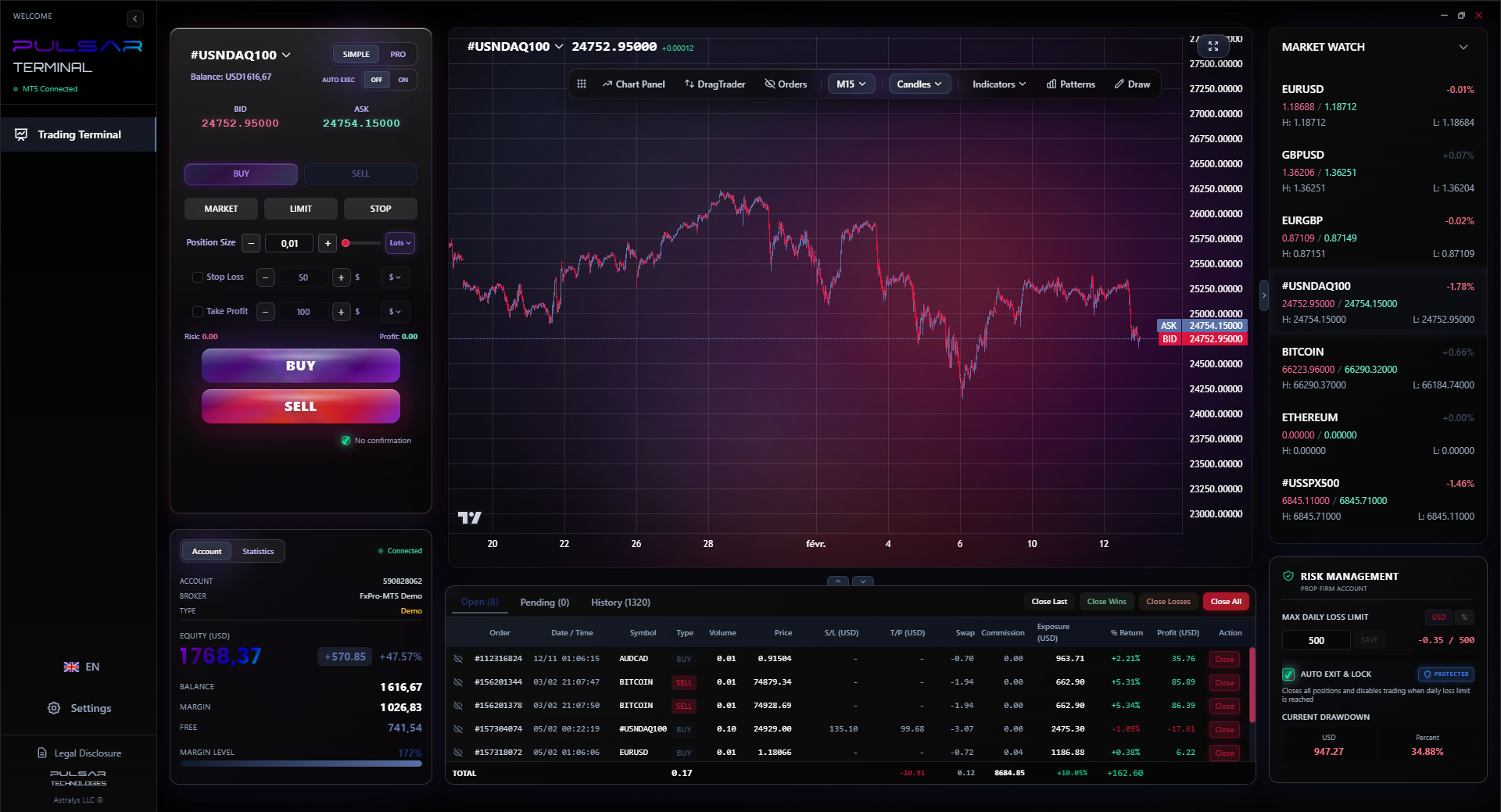
Sticking to a detailed trading plan with precise stop-loss and take-profit levels is critical, and Pulsar Terminal lets you set and manage these complex orders with drag-and-drop ease directly on your MT5 charts.
Pulsar Terminal
أداة MT5 الشاملة: أوامر سحب وإفلات، متعدد TP/SL، تريلينج ستوب، تداول الشبكة، Volume Profile وحماية البروب فيرم. يستخدمها أكثر من 1000 متداول يومياً.
“The market doesn't care about you. Approaching it with a 'smart guy' mentality is the fastest way to fund someone else's retirement.”
We face unique cultural and environmental traps. Recognizing them is half the battle.
Pitfall 1: The 'Maga Must Pay' Mentality in Trading. Trading is not a hustle where you outsmart the market. The market doesn't care about you. Approaching it with a 'smart guy' mentality leads to over-trading and revenge trading after a loss. Humility is your greatest asset.
Pitfall 2: Over-use. Brokers here offer insane use - 1:500, 1:1000, even unlimited. This is a debt tool, not a profit multiplier. It amplifies losses faster than gains. On a $500 account, 1:500 use lets you control $250,000. A 0.2% move against you wipes your account. I once used 1:200 on a gold (XAU/USD guide) trade for a quick scalp. The news spike was faster than my click. I lost 8% in 12 seconds. Never again. For beginners, I wouldn't go above 1:30.
Pitfall 3: Copy Trading Without Due Diligence. Copy trading can be a learning tool, but it's not a passive income machine. You must understand the strategy of the trader you're copying. Many 'top' copy traders on platforms have unsustainable risk profiles, blowing up every few months after a hot streak. Do your research.
Pitfall 4: Ignoring the Tax Man. As covered, that 10% is real. The FIRS is getting more sophisticated. Keep clean records of your deposits and withdrawals. When you succeed, be prepared to pay.
Pitfall 5: Going It Alone. The learning curve is steep. Find a community of serious traders (not signal peddlers). Engage in forums, discuss analysis, and share trade reviews. Isolation leads to stagnation. A second perspective on a chart can save you from a bad trade.
Your journey to learn forex trading starts with accepting it's a marathon of discipline, not a sprint for quick bucks. Fund your account realistically, risk tiny amounts, and focus on the process, not the monthly payout. The profits will follow the skill, not the other way around.
FAQ
Q1Is forex trading legal and taxable in Nigeria?
Yes, it is legal for individuals. However, you are subject to a 10% Capital Gains Tax on your gross trading profits, as stipulated by the Federal Inland Revenue Service (FIRS). This applies regardless of whether you use a local or international broker.
Q2How much money do I need to start forex trading in Nigeria?
While some brokers accept deposits as low as $1, that amount is impractical for learning real risk management. A realistic and recommended starting capital to practice properly is between $500 and $1,000. This allows you to risk small percentages (1-2%) per trade without being wiped out by spreads or tiny market movements.
Q3Which broker is best for beginners in Nigeria?
There's no single 'best,' but look for brokers that are well-regulated, offer low minimum deposits, and have good educational resources. XM (with its $5 min and free bonus) and Capital.com (with excellent learning materials) are strong contenders for beginners. Always prioritize a broker's regulatory status over flashy bonuses.
Q4Can I use my Nigerian bank card to fund my forex account?
Yes, most international brokers accept deposits via Visa and Mastercard debit/credit cards issued by Nigerian banks. Other common methods include local bank transfers, e-wallets like Skrill, and cryptocurrencies like USDT.
Q5How long does it take to learn forex trading and become profitable?
This is the hardest truth: it typically takes 1-3 years of consistent study and practice to develop the skills and discipline for sustained profitability. The first year is usually about learning and surviving without blowing up your account. Anyone promising you profits in weeks or months is selling a lie.
Q6What is the most important skill for a beginner forex trader?
Risk management. It's not glamorous, but it's essential. Before you master analysis, you must master how to size your trades, where to place your stop-loss, and how to limit your losses. Without this, even the best trade ideas will lead to an empty account over time.
درس البروفيسور وينستون
النقاط الرئيسية:
- ✓Start with real capital: $500-$1000, not $10.
- ✓Risk a maximum of 1-2% of your balance per trade.
- ✓Set aside 10% of all profits immediately for tax.
- ✓Master one strategy before trying a second.
- ✓use above 1:30 is a loss accelerator for beginners.
ما مدى فائدة هذا المقال؟
انقر على نجمة للتقييم
رؤى التداول الأسبوعية
تحليلات واستراتيجيات أسبوعية مجانية. بدون رسائل مزعجة.
عن المؤلف
Olumide Adeyemi
رائد التداول في غرب أفريقيا
أحد أنشط معلمي تداول الفوركس في نيجيريا. 8 سنوات من الخبرة في التداول من لاغوس. متخصص في استراتيجيات رأس المال المنخفض وتحديات شركات البروب للمتداولين الأفارقة.
التعليقات
تحذير من المخاطر
ينطوي تداول الأدوات المالية على مخاطر كبيرة وقد لا يكون مناسبًا لجميع المستثمرين. الأداء السابق لا يضمن النتائج المستقبلية. هذا المحتوى لأغراض تعليمية فقط ولا ينبغي اعتباره نصيحة استثمارية. قم دائمًا بإجراء بحثك الخاص قبل التداول.
قد يعجبك أيضًا

Cara Trading Forex Sukses: 7 Prinsip dari Trader Profesional
Cara trading forex sukses dengan 7 prinsip trader pro: manajemen modal, disiplin, journal trading, backtest. Data nyata, bukan janji profit palsu.
Jam Trading Forex Terbaik untuk Trader Indonesia: Panduan Lengkap dengan Tabel Waktu
Panduan jam trading forex untuk trader Indonesia. Tabel 4 sesi dunia, jam emas 20:00-00:00, sesi mana yang harus dihindari. Data akurat + tips dari trader berpengalaman.
Top 5 Sàn Forex Uy Tín Nhất 2026: Review Jujur dari Trader Indonesia
Top 5 sàn forex uy tín 2026 untuk trader Indonesia. Review jujur: spread, deposit, withdraw, dukungan lokal. Exness, XM, IC Markets & lebih.
احصل على Pulsar Terminal
جميع هذه الحاسبات مدمجة في Pulsar Terminal مع بيانات حية من حساب MT5 الخاص بك.
احصل على Pulsar Terminal