


Thinking about how to instal forex and start trading from Nigeria? You're not alone.

Olumide Adeyemi
رائد التداول في غرب أفريقيا ·  Nigeria
☕ 9 دقائق قراءة
ما ستتعلمه:
Thinking about how to instal forex and start trading from Nigeria? You're not alone. I see the ads everywhere - promises of quick money, fancy cars, financial freedom. I started with that same hope over a decade ago. Let me save you some pain: the real path to making this work isn't about downloading an app and getting rich. It's about understanding the rules of the game here in Nigeria, picking the right tools, and, most importantly, not blowing up your account before you even learn what a pip definition is. This guide is what I wish I'd had when I started.
When Nigerians say 'instal forex,' we're talking about the whole process of getting set up to trade currencies online from here. It's not just downloading MetaTrader. It's the sequence: finding a broker that works with Naira deposits, understanding our unique tax situation, and navigating a market where local regulations are, let's say, 'developing.'
Back in 2015, I thought it was simple. I signed up with the first broker that had a flashy website, deposited $200 via a sketchy payment processor, and lost it all in a week on a single bad EUR/USD trade. I didn't understand spreads, use, or that my broker might not even be legit. That's the trap. 'Instal forex' properly means doing your homework first.
The core components are: a regulated broker (often international), a trading platform (usually MT4 or MT5), a funding method, and a solid grasp of Nigerian-specific realities like the 10% Capital Gains Tax. Miss one piece, and you're setting yourself up for frustration, or worse, losing your money to an unregulated outfit.

Warning: Many 'forex mentors' on social media pushing courses are just affiliate marketers. They get a kickback when you sign up with a broker through their link, regardless of whether that broker is right for you. Do your own independent research.

💡 نصيحة وينستون
Your first N100,000 profit is the most dangerous. It convinces you you're a genius. That's when you're most likely to break your rules and give it all back.
“The real path to making this work isn't about downloading an app and getting rich.”
This is where most guides gloss over the details. Yes, forex trading is legal for individuals in Nigeria. No, the Central Bank of Nigeria (CBN) isn't going to knock on your door for trading EUR/USD. But there's a big 'but.'
Regulatory Gray Areas
The CBN's main job is monetary policy and overseeing banks. Their new Nigeria Foreign Exchange Code (2025) is aimed at wholesale markets and big institutions, not you and me trading from our phones. The Securities and Exchange Commission (SEC) says forex trading is a securities activity and warns against unlicensed platforms. The practical result? Most serious Nigerian traders use international brokers regulated abroad (like CySEC in Cyprus or ASIC in Australia). You're operating in a bit of a gray zone, protected by the broker's foreign license, not a Nigerian one.
The Tax Man Cometh
This is non-negotiable and often ignored. According to Nigerian law, your trading profits are subject to a 10% Capital Gains Tax. It doesn't matter if your broker is in Vanuatu and your money is in a USD account. If you're a Nigerian resident, the profit is taxable. I learned this the hard way after a good year in 2019. I had to go back, calculate all my closed trades, and settle up. Keep detailed records from day one.

Example: Let's say you deposit $1,000 and through your trades, you grow your account to $1,500 by year-end. Your gross profit is $500. You owe the Federal Inland Revenue Service (FIRS) 10% of that, which is $50 (or the Naira equivalent). Factor this into your profit targets.
“High use offered by brokers is a marketing tool, not a performance tool.”
Your broker is your gateway to the markets. Choosing wrong can mean terrible spreads, slow withdrawals, or losing your deposit entirely.
Broker Checklist for Nigerian Traders
- International Regulation: This is your safety net. Look for brokers with top-tier licenses (UK's FCA, Australia's ASIC) or reputable global ones (CySEC, FSCA). I've had good, reliable experiences with brokers like IC Markets and Pepperstone for their raw spreads and execution.
- Accepts Nigerian Clients: Sounds obvious, but not all regulated brokers do. Always check.
- Naira-Friendly Deposits: This is the biggest hurdle. Credit/debit cards (Visa/Mastercard) often work but can be blocked by your bank. Bank wire transfers are expensive and slow. The real solution for most of us? Cryptocurrency deposits. Brokers like Exness and XM have integrated crypto funding. You buy USDT from a local P2P platform, send it to your broker, and you're trading in minutes. It's become the standard.
- Reasonable Minimums: You don't need much to start. Many brokers offer accounts with minimums of $10-$100. Start small.
A Quick Broker Comparison
| Broker | Strong Point for Nigerians | Key Consideration |
|---|---|---|
| Exness | Crypto deposits, very high use | use is a double-edged sword; can wipe you out fast. |
| XM | Low minimum deposit ($5), lots of educational resources | Spreads on standard accounts can be wider. |
| IC Markets | Excellent raw spreads, fast execution | Minimum deposit is higher ($200). |
| Pepperstone | Great for scalping strategy, Razor account | More suited to experienced traders. |

Pro Tip: Before you deposit a large amount, do a test withdrawal. Deposit a small sum like $50, trade a little, then request to withdraw it. If you get your money back quickly and without drama, that's a good sign. I do this with every new broker I try.
💡 نصيحة وينستون
If you can't explain your trade setup in one simple sentence ('price bounced off the daily support level'), you shouldn't be in the trade.
“Your goal in the first year isn't to make millions. It's to not lose your starting capital.”
You've got a broker, your account is funded. Now the real work begins.
The Platform: MT5 is the New Standard
While MT4 is legendary, MT5 is the future. It has more timeframes, better hedging capabilities, and a built-in economic calendar. Most brokers offer it. Download it, and spend a week on a demo account. Don't even think about real money yet. Learn how to place a trade, set a stop loss, and use basic charts.
Your First Real Trade: A Ritual
Here's my exact process for a first trade on a new account, learned from many early mistakes:
- Calculate Your Risk: Never risk more than 1% of your account on a single trade. Use a position size calculator. If you have $500, your max risk is $5.
- Pick a Major Pair: Start with EUR/USD. It's the most liquid, has the tightest spreads, and moves predictably. Don't touch exotic pairs yet.
- Define Your Exit Before Entry: Decide where your stop loss and take profit will be. If your stop loss is 20 pips away, and you're risking $5, your position size is $0.25 per pip. Stick to it.
A Painful Early Lesson
In 2014, I put $100 on GBP/JPY (a volatile pair) because I heard a 'tip.' I didn't set a stop loss. The trade went against me 150 pips in an hour. I was frozen, watching the loss grow. I finally closed it at a $85 loss - 85% of my account gone in one morning. That lesson cost me $85 but taught me the infinite value of a stop loss. It's your life jacket. Never trade without one, or you'll face a margin call.
Start with a simple strategy. Maybe just use the RSI indicator to spot overbought/oversold conditions on the 1-hour chart. Or follow a basic trend-following method with the MACD indicator. Complexity is the enemy of the beginner.
“Your goal in the first year isn't to make millions. It's to not lose your starting capital.”
The markets don't care about your rent, your dreams, or the pressure you feel. This is a mental game.
Risk Management Isn't Optional
I structure my risk like this:
- Per Trade: Max 1% of account balance.
- Daily Loss Limit: If I lose 3% in a day, I shut down the platform. No excuses.
- Weekly Limit: Down 5% for the week, I take a break until Monday.
These rules have saved me from 'revenge trading' - that desperate urge to win back losses immediately, which always leads to bigger losses.
The Local Pressure Cooker
We face unique psychological pressures. Family expectations are high. The desire for 'quick money' is intense, fueled by those fake 'proof of income' screenshots online. This leads to over-leveraging. I've seen guys use 1:500 use on a $100 account, trying to turn it into a million. It always ends the same way: the account goes to zero.
Warning: High use offered by brokers like Exness or FBS is a marketing tool, not a performance tool. For a $500 account, using use above 1:30 is just gambling. It magnifies your losses as fast as your gains.
Your goal in the first year isn't to make millions. It's to not lose your starting capital. If you can end the year with the same amount you started with, you're in the top 20% of beginners. Seriously. From there, you can grow.
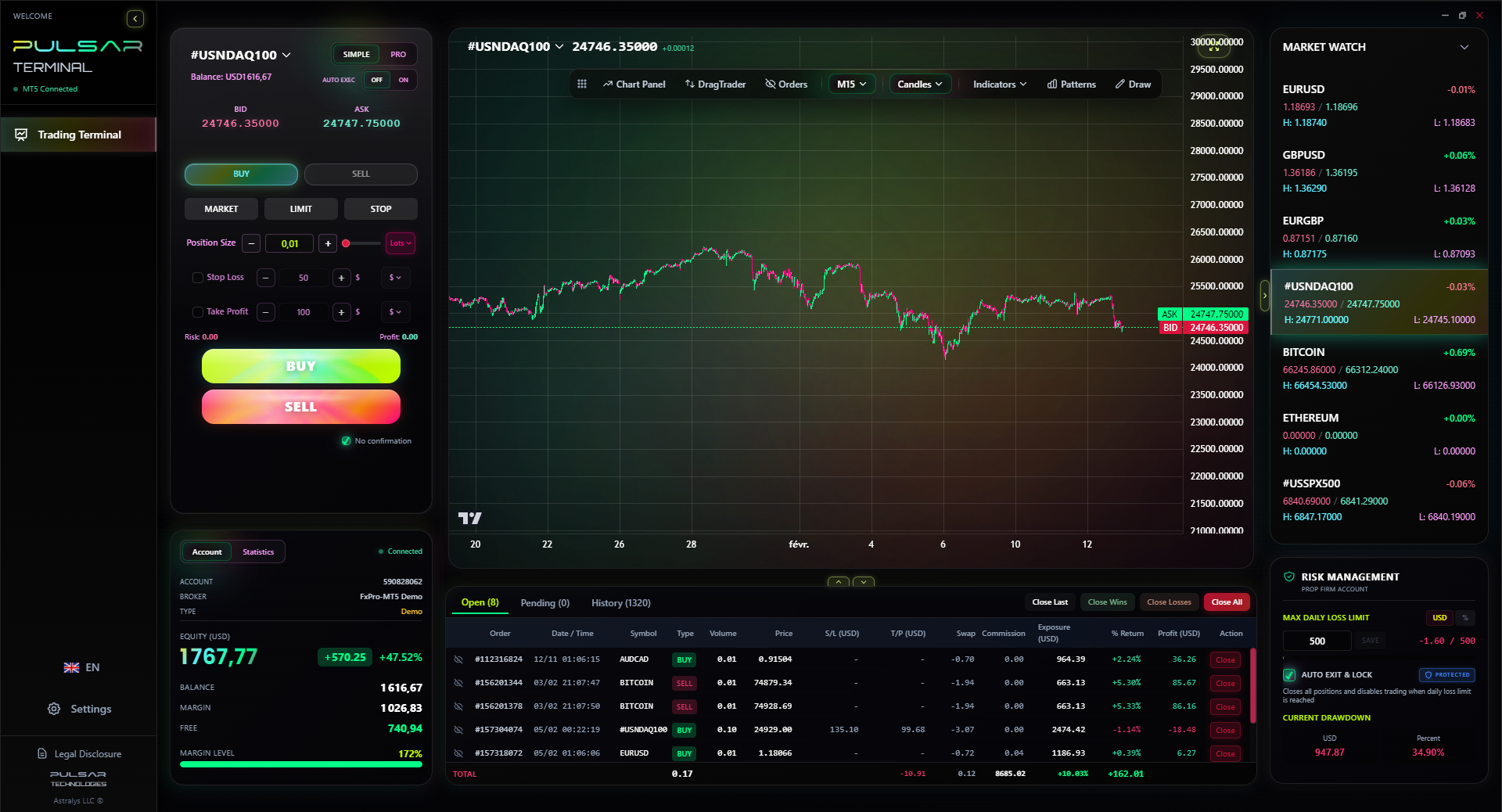
This is where a disciplined toolset helps immensely. Managing multiple trades and strict stop losses manually is stressful. Having a system that can automate parts of your risk management removes emotion from the equation.
💡 نصيحة وينستون
Track your net profit/loss after spreads and commissions. That's your real score. A strategy that's breakeven before costs is a losing strategy.
When you're managing multiple trades and strict daily loss limits, especially for prop firm challenges, a tool that automates your risk rules directly on MT5 can be the difference between passing and failing.
Pulsar Terminal
أداة MT5 الشاملة: أوامر سحب وإفلات، متعدد TP/SL، تريلينج ستوب، تداول الشبكة، Volume Profile وحماية البروب فيرم. يستخدمها أكثر من 1000 متداول يومياً.
“The market will humble you repeatedly. The goal is to learn from each humbling, not to be broken by it.”
Let's fast-forward past the beginner phase. You've survived 6 months. Here's what comes next.
The Classic Nigerian Trader Pitfalls
- Signal Services: Paying some 'guru' in Lagos or Port Harcourt for trade alerts. If they were that good, they'd be trading, not selling signals. I wasted $300 on one in 2017. Their wins were posted, their losses were silent.
- Prop Firm Hype: Prop trading firms are popular now. They're not a scam, but they're extremely difficult. Their rules (like daily drawdown limits) are designed for you to fail. If you try one, you need surgical risk management. Don't use your rent money for the challenge fee.
- Ignoring Fundamentals: Because we trade global pairs, U.S. Non-Farm Payrolls or ECB speeches move the market. You need to watch the economic calendar. Trading XAU/USD guide (Gold) during high inflation data without knowing? That's a sure way to get stopped out.
How to Actually Improve
- Journal Every Trade: Not just 'bought EUR/USD, won.' Write your reasoning, your emotion, the chart setup. Review it weekly. This is how you find your edge.
- Specialize: Don't trade 28 pairs. Get really good at reading one or two, like EUR/USD guide and GBP/USD. Understand their personality.
- Graduate to Swing Trading: Once you're stable, try holding trades for days or weeks. It's less stressful than staring at the 5-minute chart all day and often more profitable.
The journey from installing the app to becoming a consistent trader takes years, not months. Embrace the process. The market will humble you repeatedly. The goal is to learn from each humbling, not to be broken by it.
FAQ
Q1Is forex trading illegal in Nigeria?
No, it's not illegal for individuals to trade forex online. However, the regulatory environment is still developing. The CBN regulates the institutional market, while the SEC oversees capital markets activities. Most Nigerian traders use internationally regulated brokers, which is a common and accepted practice.
Q2How much money do I need to start forex trading in Nigeria?
You can start with a very small amount. Many brokers like XM or FBS allow you to open an account with as little as $5-$10. However, I strongly recommend starting with at least $100-$200. This gives you enough buffer to practice proper risk management (like the 1% rule) without your account being wiped out by a couple of small losses or the spread definition itself.
Q3What is the best way to fund my forex trading account from Nigeria?
In 2026, the most reliable and fastest method is via cryptocurrency (like USDT or Bitcoin). You buy crypto on a local P2P platform, then send it directly to your broker's crypto wallet. Credit/debit card deposits work sometimes but are frequently blocked by Nigerian banks. Bank wire transfers are slow and incur high fees.
Q4Do I pay tax on my forex trading profits?
Yes. Nigerian residents are required to pay a 10% Capital Gains Tax on their gross trading profits. You are responsible for declaring this income and paying the tax to the FIRS. Keep a detailed record of all your trades for tax purposes.
Q5Which trading platform is best for beginners?
MetaTrader 5 (MT5) is the best all-round choice. It's free, offered by almost every broker, and has a user-friendly interface. Spend significant time on a demo account first to learn how to place orders, use charts, and set stop-losses before risking real money.
Q6Can I really make money from forex trading in Nigeria?
Yes, it's possible, but it's a skilled profession, not a get-rich-quick scheme. The majority of beginners lose money. Consistent profitability requires years of education, disciplined risk management, and emotional control. Focus on preserving your capital first; making profits comes later.
Q7Are prop firms like FTMO a good way to start?
Not for absolute beginners. Prop firm challenges have very strict risk rules (e.g., 5% daily loss limit) that are difficult for new traders to follow. They are best attempted once you have a proven, disciplined strategy and can treat their capital as seriously as your own. Use your own small account to learn first.
درس البروفيسور وينستون
النقاط الرئيسية:
- ✓Risk max 1% per trade, no exceptions.
- ✓10% Capital Gains Tax applies to your profits.
- ✓Fund with crypto, not bank wires.
- ✓Start with a major pair like EUR/USD.
- ✓Demo trade for at least one month first.
ما مدى فائدة هذا المقال؟
انقر على نجمة للتقييم
رؤى التداول الأسبوعية
تحليلات واستراتيجيات أسبوعية مجانية. بدون رسائل مزعجة.
عن المؤلف
Olumide Adeyemi
رائد التداول في غرب أفريقيا
أحد أنشط معلمي تداول الفوركس في نيجيريا. 8 سنوات من الخبرة في التداول من لاغوس. متخصص في استراتيجيات رأس المال المنخفض وتحديات شركات البروب للمتداولين الأفارقة.
التعليقات
تحذير من المخاطر
ينطوي تداول الأدوات المالية على مخاطر كبيرة وقد لا يكون مناسبًا لجميع المستثمرين. الأداء السابق لا يضمن النتائج المستقبلية. هذا المحتوى لأغراض تعليمية فقط ولا ينبغي اعتباره نصيحة استثمارية. قم دائمًا بإجراء بحثك الخاص قبل التداول.
قد يعجبك أيضًا

Cara Trading Forex Sukses: 7 Prinsip dari Trader Profesional
Cara trading forex sukses dengan 7 prinsip trader pro: manajemen modal, disiplin, journal trading, backtest. Data nyata, bukan janji profit palsu.
Jam Trading Forex Terbaik untuk Trader Indonesia: Panduan Lengkap dengan Tabel Waktu
Panduan jam trading forex untuk trader Indonesia. Tabel 4 sesi dunia, jam emas 20:00-00:00, sesi mana yang harus dihindari. Data akurat + tips dari trader berpengalaman.
Top 5 Sàn Forex Uy Tín Nhất 2026: Review Jujur dari Trader Indonesia
Top 5 sàn forex uy tín 2026 untuk trader Indonesia. Review jujur: spread, deposit, withdraw, dukungan lokal. Exness, XM, IC Markets & lebih.
احصل على Pulsar Terminal
جميع هذه الحاسبات مدمجة في Pulsar Terminal مع بيانات حية من حساب MT5 الخاص بك.
احصل على Pulsar Terminal