


If you're still trading the Nigerian forex market like it's 2023, you're probably losing money.

Olumide Adeyemi
رائد التداول في غرب أفريقيا ·  Nigeria
☕ 12 دقائق قراءة
ما ستتعلمه:
- 1The New Regulatory Landscape (2024-2026)
- 2The Biggest Market Shift: The Naira Float
- 3Key Policy Changes Affecting Traders
- 4Costs, use, and Taxes: The 2026 Numbers
- 5Choosing a Broker in the New Environment
- 6Trading Strategies for Current Market Conditions
- 7Common Pitfalls and How to Avoid Them
- 8The Future: What's Next for Nigerian Forex?
If you're still trading the Nigerian forex market like it's 2023, you're probably losing money. I see it all the time - traders using old strategies while the rules have completely changed. The biggest myth right now is that 'nothing ever changes' with forex in Nigeria. Let me set the record straight: everything has changed since the Naira float, and if you don't understand the latest news on forex market regulations and realities, you're trading blind. I've made costly mistakes by ignoring policy shifts, and I don't want you to do the same.
For years, trading forex in Nigeria felt like navigating a grey area. That's over. The Central Bank of Nigeria (CBN) and the Securities and Exchange Commission (SEC) have drawn clear lines in the sand, and you need to know where they are.
The Nigeria Foreign Exchange Code (FX Code) kicked in on October 14, 2024. Think of it as Nigeria's rulebook for how big banks and financial institutions handle wholesale forex transactions. It's based on the global FX code, which means Nigeria is trying to play by international standards. This doesn't directly stop you from trading with an international broker, but it shapes the entire market's structure.
More importantly, the CBN's Revised Guidelines for the Nigerian Foreign Exchange Market (NFEM) from November 29, 2024, consolidated all the different official market windows. Before, there was confusion. Now, there's one official market with one set of rules. This aims for more transparency, which is good for everyone in the long run.
The SEC isn't sleeping either. Their 2024 updated rules on digital platforms and virtual assets created a crucial distinction. They're cracking down on shady, unregistered schemes masquerading as forex trading, while providing a clearer path for legitimate retail trading. This is actually protective for serious traders like you and me.

Warning: The days of funding your international broker account with massive Naira card transactions are numbered. The CBN's focus on monitoring capital flows means brokers might tighten deposit methods. Always check your broker's latest funding options for Nigeria.
Here’s the bottom line: regulation is no longer an afterthought. Operating within these guidelines isn't just about compliance; it's about trading in a more stable, predictable environment. The Exness review and IC Markets review detail how major brokers adapt to these regional changes.

💡 نصيحة وينستون
The market's memory is short, but a regulator's is long. Trade every CBN announcement as if it will set the trend for the next quarter, because it often does.
This is the single most important piece of latest news on forex market dynamics. In June 2023, the CBN stopped trying to hold the Naira at an artificial price and let it float. The impact has rippled through 2024, 2025, and into 2026.
What does this mean for you? Volatility. Real, market-driven volatility. The USD/NGN pair (though you'll more likely trade Naira proxies like USD/NGN futures or African currency baskets) is now moved by supply and demand, not just CBN decree.
I learned this the hard way. In early 2024, I was short USD/NGN, expecting a steady decline. I entered based on old patterns. When liquidity dried up and genuine demand surged, the pair spiked. I watched a 2% move against my position in a single session - a move that would have been unthinkable before the float. I got stopped out, losing about $400 on that trade. It was a cheap lesson in respecting new market regimes.
Trading in a Floating World
You can't just buy dips and sell rallies blindly anymore. You need to watch:
- Oil Prices: Nigeria's major forex earner.
- CBN Interest Rate Decisions: They still use monetary policy to influence the Naira's value.
- Inflation Data: High inflation puts downward pressure on the currency.
The float has also narrowed the gap between the official and parallel market rates. This is healthy. It means the price you see is closer to the 'real' price, reducing arbitrage opportunities but increasing market efficiency.
For trading major pairs like EUR/USD, the float has indirect effects. A volatile Naira can affect broader emerging market sentiment, which can spill over into pairs like USD/ZAR or even cause risk-off flows into the US Dollar.
“I watched a 2% move against my position in a single session - a move that would have been unthinkable before the float. It was a cheap lesson in respecting new market regimes.”
Beyond the float, specific policies have reshaped the trading environment. Ignoring these is like driving with a fogged-up windshield.
1. BDCs Are Back (February 2026): After being kicked out of the official market in 2021, Bureau de Change operators were allowed back in February 2026. They can now buy up to $150,000 weekly from banks at market rates and must sell it within 24 hours. This policy aims to improve retail forex access and squeeze the black market. For you, it means the official market is absorbing more retail demand, which could reduce extreme volatility spikes.
2. The Electronic Matching System (EFEMS): Rolled out in late 2024, this system forces all interbank FX trades to be matched electronically. By 2026, it's fully operational. This means price discovery is faster and more transparent. For retail traders, the 'wholesale' market that influences your broker's prices is now less opaque.
3. Rules for Oil Companies (May 2024): The CBN now requires International Oil Companies (IOCs) to keep 50% of their export earnings in Nigeria for at least 90 days. This keeps more dollars in the country, supporting the Naira. When this policy was announced, I saw a short-term boost in Naira sentiment. It's a reminder to watch for similar regulatory injections of liquidity.
4. The Non-Resident Nigerian Platform (2025): This lets Nigerians abroad remit money more easily. More formal remittances mean more forex entering the official system, supporting the Naira. Formal inflows hit $21 billion in 2024, up 18%. That's a lot of new market fuel.

Example: Let's say the CBN announces a new dollar retention policy for exporters. Historically, this would strengthen the Naira. In the old market, that move might be 0.5%. In the new floated market, with electronic matching, that same news could trigger a 2-3% move as algorithms react instantly. Your stop-loss needs to account for this new volatility.
Let's talk about the practical stuff: what it costs to trade now. The numbers have shifted, especially for Nigerian traders.
Spreads & Commissions: Tight spreads are more available than ever, but you need to choose the right account. Raw spread or ECN accounts are the way to go for active traders.
| Broker Account Type | Avg. EUR/USD Spread | Typical Commission |
|---|---|---|
| Standard Account | 0.6 - 1.2 pips | $0 |
| Raw/ECN Account | 0.0 - 0.2 pips | $3 - $7 per lot |
I use a raw spread account with a $3.5 per lot commission. On a 5-lot trade in XAU/USD, that's $17.50 in commissions. It sounds high, but with a 0.2 pip spread instead of a 0.8 pip spread, I save $30 on the spread. I come out ahead. Always do the math.
use: This is where you must be careful. Brokers like Exness still offer use up to 1:1000. It's tempting, but it's a trap for most. In this new volatile market, high use will blow up your account faster. I never use more than 1:30 on major pairs, and even that feels risky sometimes. A 3% move against you at 1:1000 use is a 300% loss. Game over.
Taxes: This is the most commonly ignored cost. Yes, you are supposed to pay tax on trading profits. The standard is 10% Capital Gains Tax on your gross profits. If you make ₦1,000,000 profit in a year, you owe ₦100,000. If trading is your main business, it could be taxed as personal income. Keep a simple trading journal. It’s not just for strategy; it’s for the taxman.
Minimum Deposits: You can start small. Brokers like XM have a $5 minimum, Pepperstone $0. But honestly, starting with less than $200 is very hard for proper risk management. A single margin call from a volatile move can wipe a tiny account. I recommend a minimum of $500 to realistically apply a scalping strategy or swing trading plan.
💡 نصيحة وينستون
In a floated currency market, the 'fundamental' price is whatever the market says it is at this second. Your job isn't to argue with it, but to react to it.
“Sometimes, the best trade is to avoid local complexity. During peak Naira volatility, I made 8% on gold while my Naira-focused trades were breaking even.”
With all these changes, your broker choice is more critical than ever. You need a partner that can handle the new Nigerian reality.
What to look for now:
- strong Naira Funding/Withdrawal: Can you deposit and withdraw in Naira easily? Check for local bank transfers, e-wallets (like Skrill), and mobile money (OPay, Paga). After the CBN's new guidelines, some international deposit methods became slower. My broker, for instance, now processes Naira deposits within 4 hours via a local payment partner, compared to 2 days for an international card transaction.
- Strong International Regulation: Since the SEC Nigeria doesn't license retail forex brokers, your broker must be regulated elsewhere - FCA (UK), ASIC (Australia), CySEC (EU). This is your safety net. Check our Pepperstone review for an example of a well-regulated broker popular here.
- Platform Stability: With increased volatility, you need a platform that won't freeze during big news events. MT4 and MT5 are still the gold standards. I’ve had a proprietary web platform crash during a major CBN announcement, missing my exit. Never again.
- Customer Support that Understands Nigeria: Can you call them? Do they have local support hours? When you have a withdrawal question, you don't want to wait 24 hours for an email reply.
Brokers like HFM and XM have made strong efforts to cater to the Nigerian market with Naira accounts and local support. IC Markets and Exness offer the tight spreads that are essential for trading in a competitive, volatile market. Don't just go for the highest use offer. Go for the most reliable execution.

Pro Tip: Open a demo account and test the deposit/withdrawal process before you fund a live account. If it's a hassle with fake money, it will be a nightmare with real money.
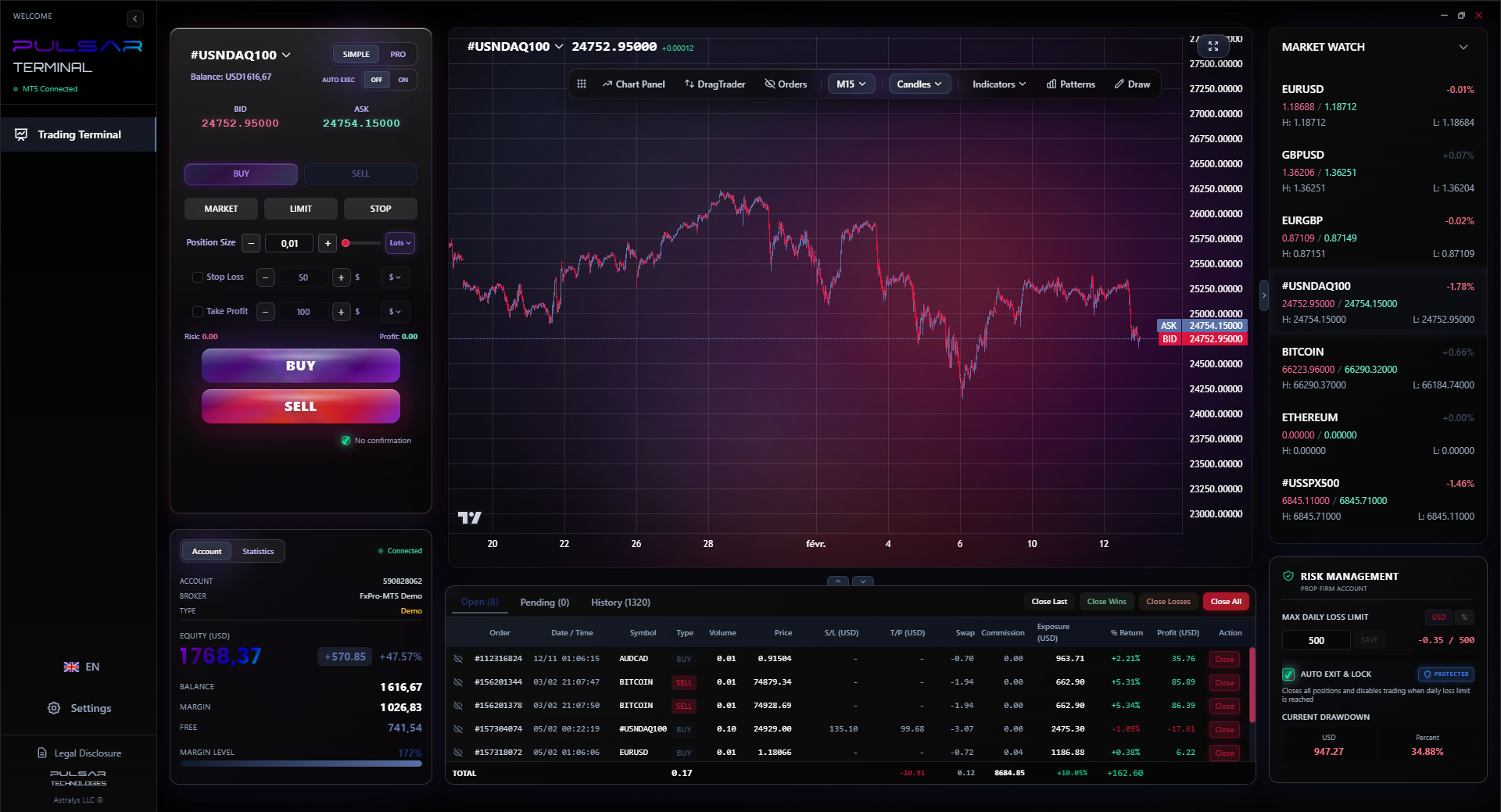
Managing multiple trades and setting precise stops in this volatile market is crucial, and Pulsar Terminal's drag-and-drop order management and multi-TP/SL tools on MT5 make it far simpler to execute your strategy without panic.
Pulsar Terminal
أداة MT5 الشاملة: أوامر سحب وإفلات، متعدد TP/SL، تريلينج ستوب، تداول الشبكة، Volume Profile وحماية البروب فيرم. يستخدمها أكثر من 1000 متداول يومياً.
The old buy-and-hold-forever strategy on USD/NGN is dead. The market is faster and smarter. Here’s how I’ve adapted.
1. News Trading is Back (But Be Smart): CBN policy announcements, SEC guidelines, and monthly inflation data are major movers. The key is to trade the expectation and the reaction, not just the headline. I use an economic calendar and set alerts. When the CBN announced the BDC reinclusion, the initial spike was bought up quickly. I waited for the pullback and entered long on a USD/NGN proxy, banking a 1.2% gain over two days.
2. Volatility-Based Position Sizing: My position size is now inversely related to expected volatility. If the MACD indicator shows high momentum and there's pending news, I cut my normal lot size by 50%. This one habit has saved me more money than any perfect entry this year. Always use a position size calculator.
3. Focus on Majors and Gold: Sometimes, the best trade is to avoid local complexity. The EUR/USD guide shows it's the world's most liquid pair. In times of Naira uncertainty, I often park in major pairs or XAU/USD (gold), which acts as a safe haven. During the peak of Naira volatility in Q4 2024, I made 8% on gold while my Naira-focused trades were breaking even.
4. Technicals Still Work, With a Filter: Support and resistance, RSI indicator divergences - they still matter. But you must filter them through a liquidity lens. A support level from 9 AM might not hold at 2 PM when London comes online. I use the 1-hour and 4-hour charts for direction, but the 15-minute chart for entries, always mindful of the session overlap.
The mindset shift is crucial: you are no longer trading a controlled currency. You are trading a free-market asset with real volatility. Respect it.
“The Nigerian forex market is growing up. It's becoming more professional, more volatile, and more integrated with the world.”
I've made these mistakes so you don't have to.
Pitfall 1: Ignoring the News. You might think you're a pure technical trader. In Nigeria's forex market now, that's a luxury you can't afford. A single CBN circular can invalidate your beautiful chart pattern. I lost $250 on a USD/NGN short because I didn't see the EFEMS implementation details that were set to boost liquidity (and strengthen the Naira) the next day.
Pitfall 2: Over-leveraging on 'Sure Things.' The float means there are no sure things. A trade that looks 99% certain can be undone by a sudden shift in offshore investor sentiment. Keep your use low.
Pitfall 3: Chasing the Parallel Market Rate. Your trading signals should come from your charts and the official market data, not from the black-market rate on the street. They influence each other, but they're not the same. Using the wrong price as a benchmark will mess up your analysis.
Pitfall 4: Not Having a Backup Funding Method. Your favorite deposit method could be restricted tomorrow. Have at least two ways to fund your account: maybe a bank transfer and an e-wallet like Skrill. I was once stuck for a week waiting for a card deposit to clear during a market move I wanted to trade. It was frustrating and costly.
The core lesson? Adaptability is your greatest skill. The market rules changed. Your trading plan has to change with them.
💡 نصيحة وينستون
Your first loss is often your smallest. If a new policy move goes against your position, get out. Trying to 'wait it out' against a central bank is a recipe for a margin call.
Where is all this heading? Based on the trajectory, here’s what I expect for the rest of 2026 and beyond.
Increased Electronification: The EFEMS is just the start. More trading will move to transparent, automated platforms. This is good for you - fairer prices and faster execution.
Tighter Integration with Global Rules: The Nigeria FX Code shows the direction. Compliance will become stricter for institutions, which trickles down to more formalized processes for everyone. This might mean more paperwork for you, but also more protection.
Continued Volatility: The Naira won't stabilize overnight. We're in a multi-year adjustment period. Expect swings based on oil, elections, and global risk sentiment. Trading opportunities will be plentiful, but risky.
Potential for More Retail Products: As the market matures, I wouldn't be surprised to see more locally accessible FX derivatives - futures, options - through regulated channels. This would be a game-changer for advanced strategies.
Your job is to stay informed. Follow reputable financial news, not social media hype. Read the CBN circulars yourself (they're online). Understand the latest news on forex market policy not as boring bureaucracy, but as the map that shows where the money is flowing.
The Nigerian forex market is growing up. It's becoming more professional, more volatile, and more integrated with the world. That means more opportunity for the prepared trader. Stay sharp, manage your risk, and trade the market in front of you, not the one you remember.
FAQ
Q1Is forex trading still legal in Nigeria in 2026?
Yes, absolutely. Trading forex through internationally regulated online brokers is legal. The Central Bank of Nigeria (CBN) and Securities and Exchange Commission (SEC) have introduced new guidelines (like the 2024 FX Code and SEC rules) to bring more structure and transparency to the market, not to ban retail trading.
Q2How has the Naira float affected my trading?
It's increased volatility significantly. The USD/NGN rate is now driven by market forces like supply, demand, oil prices, and investor sentiment, not just CBN setting a rate. This means bigger, faster price swings. You need to use wider stop-losses, manage your use carefully, and pay close attention to economic news and CBN announcements.
Q3What is the best way to fund my forex account from Nigeria now?
The landscape has changed. While international debit/credit cards can be used, they may face limits. The most reliable methods in 2026 are local bank transfers to a broker's Nigerian partner, e-wallets (Skrill, Neteller), and mobile money services (OPay, Paga). Always check your specific broker's 'Deposit' page for Nigeria-specific options.
Q4Do I have to pay tax on my forex trading profits?
Technically, yes. The law views profits as capital gains, subject to a 10% tax on gross profits. In practice, enforcement on individual retail traders has been limited, but as the market formalizes, this could change. It's wise to keep clear records of your trades and profits for tax purposes.
Q5Which brokers are best for Nigerian traders considering the new rules?
Look for brokers that combine strong international regulation (FCA, ASIC) with practical support for Nigeria. This includes offering Naira account options, local payment methods, and responsive customer support. Brokers like HFM (Naira accounts), XM, Exness, and Pepperstone are consistently popular choices among Nigerian traders for these reasons.
Q6What's the most important news source for a Nigerian forex trader?
Your primary sources should be the official channels: the Central Bank of Nigeria website for circulars and monetary policy news, and the National Bureau of Statistics for inflation and economic data. For analysis, rely on reputable global financial news (Reuters, Bloomberg) and trusted trading education platforms - avoid getting your 'news' from unverified social media groups.
درس البروفيسور وينستون
النقاط الرئيسية:
- ✓The Naira float in 2023 created a new, volatile market that demands new strategies.
- ✓CBN's 2024 FX Code and SEC rules formalized the market, increasing transparency.
- ✓Always factor in a 10% Capital Gains Tax on your gross trading profits.
- ✓Broker choice is critical: prioritize Naira funding & strong regulation over high use.
- ✓In current conditions, cut your normal position size by 50% during high volatility.
ما مدى فائدة هذا المقال؟
انقر على نجمة للتقييم
رؤى التداول الأسبوعية
تحليلات واستراتيجيات أسبوعية مجانية. بدون رسائل مزعجة.
عن المؤلف
Olumide Adeyemi
رائد التداول في غرب أفريقيا
أحد أنشط معلمي تداول الفوركس في نيجيريا. 8 سنوات من الخبرة في التداول من لاغوس. متخصص في استراتيجيات رأس المال المنخفض وتحديات شركات البروب للمتداولين الأفارقة.
التعليقات
تحذير من المخاطر
ينطوي تداول الأدوات المالية على مخاطر كبيرة وقد لا يكون مناسبًا لجميع المستثمرين. الأداء السابق لا يضمن النتائج المستقبلية. هذا المحتوى لأغراض تعليمية فقط ولا ينبغي اعتباره نصيحة استثمارية. قم دائمًا بإجراء بحثك الخاص قبل التداول.
قد يعجبك أيضًا

Cara Trading Forex Sukses: 7 Prinsip dari Trader Profesional
Cara trading forex sukses dengan 7 prinsip trader pro: manajemen modal, disiplin, journal trading, backtest. Data nyata, bukan janji profit palsu.
Jam Trading Forex Terbaik untuk Trader Indonesia: Panduan Lengkap dengan Tabel Waktu
Panduan jam trading forex untuk trader Indonesia. Tabel 4 sesi dunia, jam emas 20:00-00:00, sesi mana yang harus dihindari. Data akurat + tips dari trader berpengalaman.
Top 5 Sàn Forex Uy Tín Nhất 2026: Review Jujur dari Trader Indonesia
Top 5 sàn forex uy tín 2026 untuk trader Indonesia. Review jujur: spread, deposit, withdraw, dukungan lokal. Exness, XM, IC Markets & lebih.
احصل على Pulsar Terminal
جميع هذه الحاسبات مدمجة في Pulsar Terminal مع بيانات حية من حساب MT5 الخاص بك.
احصل على Pulsar Terminal