


I remember staring at my screen in 2018, watching a ZAR/JPY trade bleed out.

David van der Merwe
متداول الأسواق الناشئة ·  South Africa
☕ 10 دقائق قراءة
ما ستتعلمه:
- 1What 'Logo Forex Trading' Really Means (It's Not What You Think)
- 2FSCA Regulation & The Messy Legal Reality
- 3The South African Broker Landscape: Real Numbers, Not Hype
- 4Costs, Taxes, and Realistic Profit Expectations
- 5Choosing Your Logo & Strategy for the SA Market
- 6Pitfalls I Fell Into (So You Don't Have To)
- 7Getting Started: A No-BS 5-Step Plan
I remember staring at my screen in 2018, watching a ZAR/JPY trade bleed out. I was up R4,200, got greedy, didn't take profit, and watched it reverse to a R1,800 loss. The broker's slick logo and promises of 'institutional-grade' trading didn't save me from my own stupidity. That's the thing about logo forex trading in South Africa: the broker's branding is just the wrapper. What matters is the FSCA license number, the real cost of trading, and whether you have the discipline to survive. Let's cut through the marketing and talk about what actually works here.
When you hear 'logo forex trading,' you might picture a fancy broker website with a sleek emblem. In reality, it's shorthand for the entire environment of branded brokerage services in South Africa. It's the face of the industry you interact with. But here's the critical part: that logo is utterly worthless if it's not backed by a Financial Sector Conduct Authority (FSCA) license.
I've seen traders, especially newcomers, get seduced by a flashy platform or aggressive adverts. They don't check the FSP number. Big mistake. The logo is your gateway, but the license is your guarantee of basic protection - things like segregated client funds and a formal complaints process. The FSCA is the sheriff in town, and trading with an unlicensed offshore broker is like inviting a wolf to guard your sheep. You might get away with it for a while, but when things go south, you're on your own.

Warning: An FSCA license doesn't mean the FSCA will bail you out of bad trades. It means the broker operates under South African rules. You can still lose all your money through poor trading. The license protects you from fraud, not from yourself.
So, the first step in any logo forex trading journey is verification. Go to the FSCA's website, find their register, and punch in the broker's FSP number. If it doesn't check out, walk away. No matter how good the spreads look.

💡 نصيحة وينستون
A broker's FSP number is more important than its logo. Verify it on the FSCA website before you deposit a single cent.
Let's clear up the confusion. Yes, forex trading is legal for South African residents through FSCA-licensed brokers. This is the current, operational reality. The framework comes from the Financial Advisory and Intermediary Services (FAIS) Act and the Financial Sector Regulation Act (FSRA). These laws force brokers to be transparent about risks, costs, and their own financial health.
The Rand Speculation Grey Area
Now, here's the historical wrinkle that causes headaches. A 2020 National Treasury document referenced old exchange control laws from 1933, suggesting residents couldn't speculate against the Rand. This created a narrative that all forex trading was illegal. It's not. The market evolved, regulation adapted, and the FSCA's licensing regime for Derivative Providers (which includes forex/CFDs) is the proof. When you trade with an FSCA broker, you're operating within the legal perimeter as it stands today.
What Regulation Actually Does For You
Regulation means your broker must:
- Keep your trading capital separate from their company funds.
- Provide you with a Key Information Document (KID) detailing all risks.
- Have a dispute resolution process.
- Meet certain capital adequacy requirements. It doesn't cap your use (many FSCA brokers offer 1:500), guarantee profits, or stop you from making terrible trades. I learned this the hard way early on with an FSCA-regulated broker. I over-leveraged a USD/ZAR trade, a news spike hit, and I got a margin call that wiped out 40% of my account in minutes. The license didn't prevent that. My poor risk management did.
“The logo is your gateway, but the FSCA license is your guarantee of basic protection.”
With over 200,000 active traders and daily volumes pushing $21 billion, South Africa is a serious market. Brokers know this. Let's look past the marketing and talk specifics.
| Broker Example | FSCA Licensed? | Typical EUR/USD Spread | Min. Deposit (ZAR Equivalent) | Note |
|---|---|---|---|---|
| IG | Yes | ~0.98 pips | ~R1,800 ($100) | Established, solid platform. |
| Tickmill | Yes | 0.71 pips (effective) | ~R1,800 ($100) | Good raw spreads + commission. |
| XM | Yes | From 0.6 pips | ~R90 ($5) | Very low entry, popular. |
| Exness | Yes | From 0.0 pips* | ~R180 ($10) | *Raw spread, commission applies. |
| Pepperstone | Yes | From 0.0 pips* | ~R0 (No min on some) | Great for active traders. |
*Raw spreads mean you pay a commission per lot. Always calculate the total cost: (Spread in pips x pip value) + Commission.
A personal experience: I once moved from a broker with a '0.5 pip' advertised spread to one with a '0.0 pip + $3.5 commission' model. On my typical scalping strategy trading 2 lots per day, the commission broker was cheaper by about R280 a week. The logo looked less fancy, but my bottom line improved.

Pro Tip: Don't get hung up on the absolute lowest minimum deposit. Starting with R90 is possible, but it's a trap. You can't manage proper risk. A realistic starting capital for learning without blowing up in a week is R5,000 to R20,000. This lets you use a sane position size calculator and survive your inevitable rookie errors.
Let's talk money. Really talk. The average retail trader loses. Studies show between 51% and 89% of accounts are unprofitable. Your goal is to be in the minority. Here’s what eats into your profits before you even see them.
1. The Silent Killers (Trading Costs):
- Spread: The difference between buy and sell price. On EUR/USD, 0.8 pips is decent, 0.2 is great. On exotic pairs involving the ZAR, expect 5-10 pips or more.
- Commission: Often $3-$7 per standard lot, per side. On a 2-lot trade, that's $12-$28 round trip.
- Swap/Overnight Fees: Holding a position past 10pm SAST? You pay or receive interest. For swing trading, this can be a significant cost or a small income.
2. The Taxman Cometh (SARS): Forget the myths. Profits from forex trading are taxable income in South Africa. It's not capital gains unless you're a long-term investor (which almost no active trader is). You need to:
- Keep careful records of every trade.
- Declare your net profit (income minus expenses, including platform fees) on your annual tax return.
- Pay income tax at your marginal rate. Speak to an accountant who understands trading.
3. Realistic Monthly Earnings (After Costs, Before Tax): These are net figures for disciplined traders with a proven edge. They are NOT guaranteed.
- Beginner (First 1-2 years): R1,000 - R10,000. Many months will be break-even or loss.
- Intermediate (Consistent): R10,000 - R50,000. This is where solid swing trading or day trading systems can land you.
- Experienced/Professional: R50,000 - R300,000+. Requires significant capital and exceptional risk management. I didn't touch the 'intermediate' range consistently until my fourth year. The first three were a brutal education funded by my own losses.
💡 نصيحة وينستون
The 'minimum deposit' is a marketing tool. Your 'minimum survivable capital' is what matters. Start with at least R5,000 to give yourself a fighting chance.
“I didn't touch consistent profits until my fourth year. The first three were a brutal education funded by my own losses.”
Your broker's logo and your trading strategy need to be a matched pair. You wouldn't use a scalper's broker for long-term position trades.
For Scalpers & High-Volume Day Traders: You need the lowest total cost. Look for FSCA brokers like IC Markets review or Pepperstone review that offer raw spreads + low commission. Execution speed is critical. A 50ms delay can cost you the trade. These platforms are built for speed, not necessarily for beginner education.
For Swing Traders: Spread is less critical than swap rates and platform stability for holding trades over days/weeks. Brokers like XM review or AvaTrade might be suitable. Your focus should be on technical and fundamental analysis. You'll be using tools like the MACD indicator and RSI indicator to find entry points on higher timeframes.
For Beginners: Choose a broker with a strong educational section, a reliable demo account, and responsive customer support. The logo should represent stability. Minimum deposit is less important than the quality of learning resources. Don't even think about high use yet.

Example: Let's say you're a swing trader eyeing XAU/USD guide (Gold). Broker A has a 0.5 pip spread on EUR/USD but a 50 pip spread on XAU/USD. Broker B has a 1.0 pip spread on EUR/USD but a 25 pip spread on Gold. If Gold is your main market, Broker B's logo is the better choice, even though its headline rate looks worse.
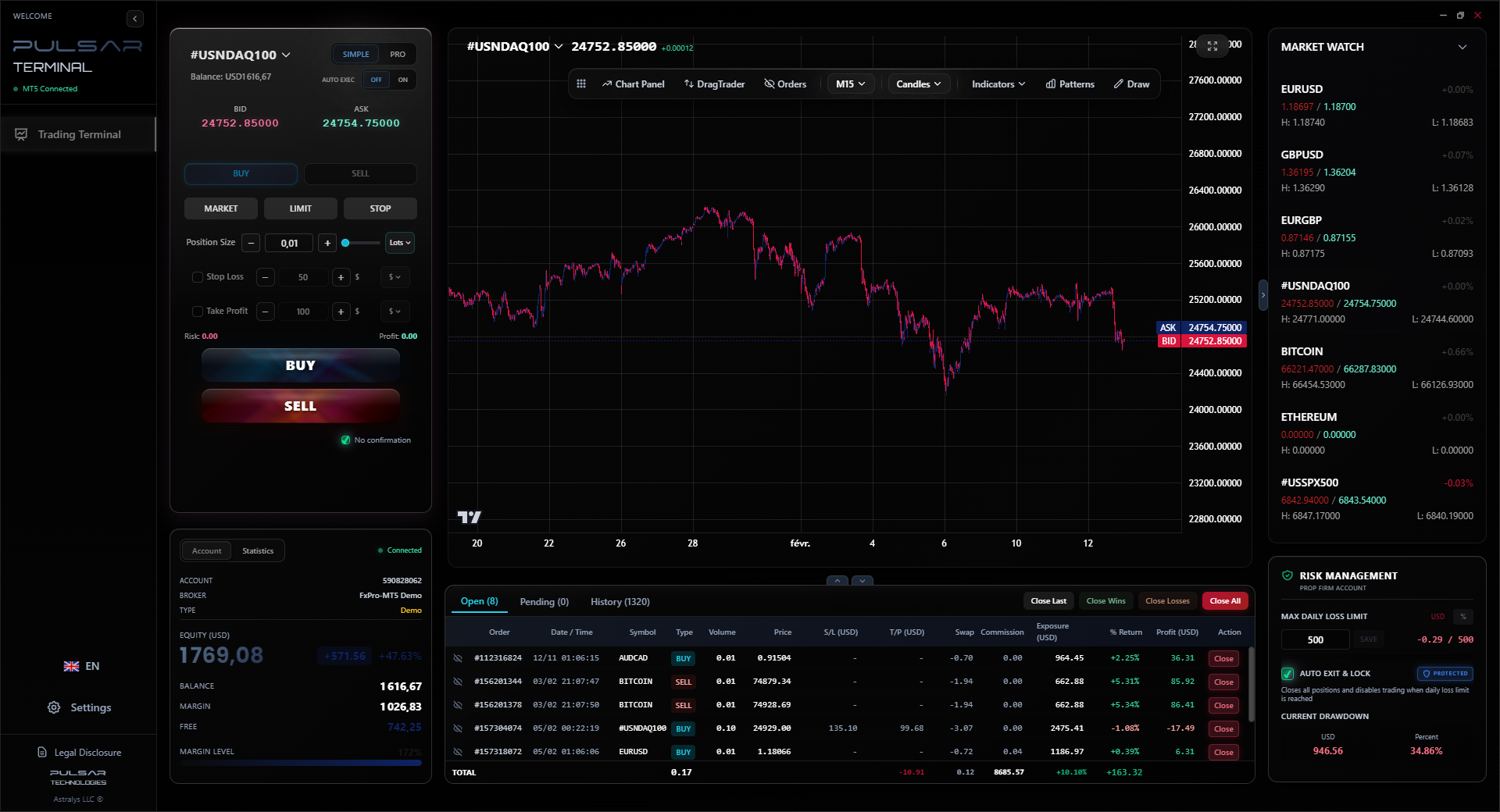
Managing multiple trades and risk on volatile pairs is complex, but tools like Pulsar Terminal streamline it with drag-and-drop orders and automated stop-loss management directly on your MT5 platform.
Pulsar Terminal
أداة MT5 الشاملة: أوامر سحب وإفلات، متعدد TP/SL، تريلينج ستوب، تداول الشبكة، Volume Profile وحماية البروب فيرم. يستخدمها أكثر من 1000 متداول يومياً.
I've paid my 'tuition fees' to the market. Here are the expensive lessons.
Pitfall 1: Chasing the 'Hottest' Logo. A new broker with insane deposit bonuses launched. I funded an account with R10,000. The platform was buggy, withdrawals took weeks, and the 'tight spreads' widened massively during news events. I lost R2,500 before pulling the rest. Lesson: A sexy logo and big bonus often hide poor execution. Stick with established, boringly reliable FSCA names.
Pitfall 2: Ignoring the True Cost. I was trading USD/CHF on a 'commission-free' account with a 2.5 pip spread. Felt fine. Then I calculated: on 10 micro lots (1 standard lot), I was paying $25 in spread cost per trade. A commission account with a 0.5 pip spread + $5 commission cost me $10 total. I was throwing R225+ away per trade for no reason. Always calculate the total cost per lot.
Pitfall 3: Over-leveraging the Rand. Trading USD/ZAR with 1:500 use is like juggling dynamite. The pair can move 500 pips in a day. Early on, I used too much size on a ZAR trade. A 150-pip move against me (which is common) decimated my account because my stop loss was too tight. I now treat ZAR pairs with twice the caution and half the use of majors like EUR/USD guide.
The common thread? Every mistake was mine. The broker's logo was just there, watching me do it.
💡 نصيحة وينستون
Your first profitable year in trading isn't measured in Rands, it's measured in not blowing up your account. Survival is the first win.
“A sexy logo and big bonus often hide poor execution. Stick with established, boringly reliable FSCA names.”
- Education Before Registration: Spend a month learning. Understand what a pip definition is, what a spread definition costs, what use really does. Use free resources. Don't touch real money yet.
- Pick a Regulated Broker: Select one from the FSCA list that fits your intended style (scalper vs. swing). Open a demo account first. Test everything: order execution, platform crashes, how their charts feel.
- Develop a Paper-Traded Strategy: Use the demo account to test a simple strategy for 3 months. Keep a journal. You must prove you can be profitable on paper over dozens of trades. Most people skip this and pay with real losses.
- Fund with 'Risk Capital': Deposit an amount you can afford to lose completely - R5,000, not your rent money. Use proper position sizing. A good rule: never risk more than 1% of your account on a single trade.
- Review and Refine: After every month of live trading, review your journal. What worked? What didn't? Adjust. This is a business, not a casino. Treat it like one. This process is slow and boring. It won't make you rich next week. But it's the only way I've seen people build a lasting presence in this logo forex trading world.
FAQ
Q1Is forex trading really legal in South Africa?
Yes, provided you use a broker licensed by the Financial Sector Conduct Authority (FSCA). This is the current regulatory stance. While old exchange control laws cause confusion, the active, licensed market under the FSCA makes it legal for individuals to trade through those regulated entities.
Q2What is the minimum amount I need to start forex trading in South Africa?
Technically, you can start with as little as R90 (e.g., $5 with XM). But this is a terrible idea. You cannot practice proper risk management. A realistic minimum to learn seriously without immediate blow-up is between R5,000 and R20,000. This allows for meaningful position sizes and room for error.
Q3How much tax do I pay on forex trading profits?
Forex trading profits are considered taxable income by SARS, not capital gains for active traders. You pay income tax at your marginal tax rate on your net profit (profits minus trading expenses). You must declare it and keep detailed records of all trades.
Q4Which broker has the lowest spreads for South African traders?
Brokers like IC Markets, Exness, and Pepperstone (all FSCA licensed) often offer raw spreads from 0.0 pips on majors like EUR/USD. However, you pay a commission per trade. To find the true lowest cost, you must calculate the total cost: (Spread + Commission). For high-volume traders, these commission-based accounts are usually cheapest.
Q5What percentage of forex traders actually make money in South Africa?
Global statistics indicate most retail traders lose money, with estimates ranging from 51% to 89% of accounts being unprofitable. There's no reason to believe South Africa is different. The 'average profitability' is often cited around 40%, but that masks the high risk and the fact that a small minority of professionals likely take the majority of profits from the losing majority.
Q6Can I trade USD/ZAR with high use?
Many FSCA brokers offer use up to 1:500 on major pairs, which can include USD/ZAR. However, this is extremely dangerous. The ZAR is a volatile currency. Using high use on it significantly amplifies your risk. A small move against you can wipe out your account. Experienced traders use much lower use on ZAR pairs.
درس البروفيسور وينستون
النقاط الرئيسية:
- ✓Always verify the FSCA FSP number, not just the broker's logo.
- ✓Real starting capital is R5k-R20k, not the advertised R90 minimum.
- ✓Calculate TOTAL cost (spread + commission), not just the headline spread.
- ✓Taxable income, not capital gains. Declare profits to SARS.
- ✓Use half the use on ZAR pairs that you would on majors.
ما مدى فائدة هذا المقال؟
انقر على نجمة للتقييم
رؤى التداول الأسبوعية
تحليلات واستراتيجيات أسبوعية مجانية. بدون رسائل مزعجة.
عن المؤلف
David van der Merwe
متداول الأسواق الناشئة
متداول مقيم في جوهانسبرغ مع 11 عاماً في عملات الأسواق الناشئة. متخصص في أزواج ZAR والتداول المنظم من FSCA وتحليل السوق الجنوب إفريقي.
التعليقات
تحذير من المخاطر
ينطوي تداول الأدوات المالية على مخاطر كبيرة وقد لا يكون مناسبًا لجميع المستثمرين. الأداء السابق لا يضمن النتائج المستقبلية. هذا المحتوى لأغراض تعليمية فقط ولا ينبغي اعتباره نصيحة استثمارية. قم دائمًا بإجراء بحثك الخاص قبل التداول.
قد يعجبك أيضًا

Cara Trading Forex Sukses: 7 Prinsip dari Trader Profesional
Cara trading forex sukses dengan 7 prinsip trader pro: manajemen modal, disiplin, journal trading, backtest. Data nyata, bukan janji profit palsu.
Jam Trading Forex Terbaik untuk Trader Indonesia: Panduan Lengkap dengan Tabel Waktu
Panduan jam trading forex untuk trader Indonesia. Tabel 4 sesi dunia, jam emas 20:00-00:00, sesi mana yang harus dihindari. Data akurat + tips dari trader berpengalaman.
Top 5 Sàn Forex Uy Tín Nhất 2026: Review Jujur dari Trader Indonesia
Top 5 sàn forex uy tín 2026 untuk trader Indonesia. Review jujur: spread, deposit, withdraw, dukungan lokal. Exness, XM, IC Markets & lebih.
احصل على Pulsar Terminal
جميع هذه الحاسبات مدمجة في Pulsar Terminal مع بيانات حية من حساب MT5 الخاص بك.
احصل على Pulsar Terminal