


You're sitting there, phone in hand, thinking about trading.

David van der Merwe
متداول الأسواق الناشئة ·  South Africa
☕ 10 دقائق قراءة
ما ستتعلمه:
- 1What the Hell is a Micro Account, Really?
- 2The Real Rand & Cent Cost for South Africans
- 3Who a Micro Account is ACTUALLY For (Spoiler: It's Not Everyone)
- 43 Mistakes That Will Blow Your Micro Account Before Lunch
- 5Micro vs. Standard Account: The South African Showdown
- 6Choosing a Broker: Look Beyond the Minimum Deposit
- 7A Veteran's Blueprint for Using a Micro Account (Without Losing Your Shirt)
- 8The Hard Truth: When to Step Up (Or Step Away)

You're sitting there, phone in hand, thinking about trading. You've seen the ads, heard the stories, and you've got maybe R2000 burning a hole in your pocket. The question is screaming in your head: 'Should I start with a micro account?' Let me stop you right there. Having traded through more market cycles than I care to admit, I can tell you the answer isn't a simple yes or no. It's a 'maybe, but only if you understand the game you're really playing.' We're going to strip the marketing gloss off micro accounts, look at the real Rand and cent costs for South Africans, and I'll tell you about the time I nearly blew up a micro account thinking I was a genius.
Forget the fancy broker terminology. A micro account is simply a trading account where one lot is 1,000 units of the base currency, not 100,000 like a standard lot. That means when you trade 1 micro lot on EUR/USD, you're controlling €1,000, not €100,000. Your profit or loss per pip is about R0.15-R0.20 (10 US cents), not R15. It's trading with training wheels, financially speaking.
Every major broker offers them: Exness review, IC Markets review, XM review, Pepperstone review. They're marketed as the perfect, low-risk entry point. And they can be. But here's the psychological catch nobody talks about: because the stakes feel so small, it trains you to be sloppy. You'll take trades you'd never take with real money on the line. I've seen it a hundred times.

Warning: A micro account can teach you how to place an order, but it won't teach you discipline. That only comes when the loss actually stings.
Let's talk numbers. This is where brokers get sneaky. They'll shout about low minimum deposits (sometimes as low as $5 or R100), but they don't highlight the hidden friction that eats your tiny account.
The Spread Tax
On a major pair like EUR/USD, a standard account might have a 1.0 pip spread. On a micro account with the same broker? It can be 1.5 or even 2.0 pips. That's a 50-100% premium just for trading small. On a R2000 account, that extra half a pip on every trade is a massive percentage drain.
The Currency Conversion Shuffle
You deposit Rands. Your broker converts it to USD (or EUR) at their marked-up rate. You trade. You make a profit in USD. You withdraw, and they convert it back to ZAR at another poor rate. On a R5000 trade, that double conversion can easily shave off R50-R100. It's death by a thousand cuts.
Here’s a real example from 2023. I opened a $100 micro account (about R1800 at the time) with a broker known for tight spreads. I traded 0.1 lots (10 micro lots) on GBP/JPY. My spread was 2.1 pips. On a standard account, it was 1.4. That extra 0.7 pip cost me $0.70 per trade. Doesn't sound like much? I was scalping, doing 5-6 trades a day. That's $4 gone before the market even moved. In a week, I'd paid $20 in extra spread - 20% of my account - just for the privilege of having a small balance.

Example:
- Trade: Buy 0.1 lots (10 micro lots) EUR/USD
- Micro Account Spread: 1.8 pips
- Standard Account Spread: 1.0 pips
- Extra Cost: 0.8 pips
- Cost in Rands: 0.8 pips * $0.10 per pip * Exchange Rate (~R18) = R1.44 per trade Do that 10 times a day? That's R14.40. Your R2000 account is leaking.

💡 نصيحة وينستون
Fund your first micro account with an amount you'd be perfectly happy to spend on a one-day trading course. That's all it is: tuition.

“A micro account can teach you how to place an order, but it won't teach you discipline. That only comes when the loss actually stings.”
If you're just looking to 'try out trading' with a few hundred Rand, you're going to lose it. Full stop. A micro account serves two specific types of people.
- The Absolute, Complete Beginner: Someone who has never placed a trade, doesn't know what a pip definition is, and needs to learn the mechanics of their trading platform without immediate financial catastrophe. It's a simulator with real emotion attached.
- The Strategy Tester: You have a live standard account, but you've developed a new strategy. Instead of backtesting on historical data alone, you run it live on a micro account for a month. You're testing execution, slippage, and your own psychological adherence to the rules with real, but minimal, capital.
I fell into the second category back in 2018. I had a wild idea for a swing trading strategy based on a specific MACD indicator divergence. Instead of risking my main account, I funded a $500 micro account. I followed the rules rigidly for 6 weeks. The result? A 12% loss. It saved my main account from a R15,000 mistake. That's the power of a micro account used correctly.
I've made these. My friends have made these. You will be tempted to make these.
1. Over-leveraging the 'Small' Balance. Your broker gives you 1:1000 use on your R2000. They're whispering, 'You can control R2,000,000!' This is a trap. You think, 'It's only a micro lot, how bad can it be?' You put your entire balance on one trade. A 50-pip move against you - a common daily fluctuation - and you're down 50%. The margin call is already looming. Use a position size calculator. On a R2000 account, you shouldn't be risking more than R20-R40 per trade (1-2%). That means tiny position sizes, even for micro lots.
2. Chasing the 'Big Win' to Make it 'Real Money'. The account feels like play money. So you take a massive, lottery-style trade on some exotic pair, hoping to turn R2000 into R20,000 overnight. I tried this with USD/ZAR during a volatile political announcement. I threw 70% of my micro account at it. I was right on the direction, but the spread was enormous and the volatility stopped me out. I lost 35% in 20 minutes. The psychology is toxic.
3. Ignoring Costs Because They're 'Small'. As we calculated above, the costs are proportionally huge. Trading 20 times a day with a wide spread definition and commission is a guaranteed way to evaporate capital. Micro accounts are for quality, not quantity. If you're not using it to learn discipline, you're just paying expensive tuition to the broker.

“If you can't articulate exactly what you're learning on the micro account, you shouldn't be trading it.”
Let's lay it out clearly. This isn't about which is 'better,' but which is right for your current phase.
| Feature | Micro Account (The Training Ground) | Standard Account (The Real Arena) |
|---|---|---|
| Lot Size | 1,000 units (0.01 standard lots) | 100,000 units (1 standard lot) |
| Risk per Trade (on R10k) | R100-R200 (1-2%) feels like pennies | R100-R200 (1-2%) feels real, teaches respect |
| Typical Spreads | Higher (1.5-3 pips on majors) | Tighter (0.8-1.5 pips on majors) |
| Psychological Impact | Low. Promotes sloppiness. | High. Enforces discipline. |
| Best For | Learning platform mechanics, live strategy testing | Actually growing capital with disciplined trading |
My rule of thumb? If you can't articulate exactly what you're learning on the micro account, you shouldn't be trading it. It's not an investment vehicle. It's a paid educational tool.
💡 نصيحة وينستون
If you find yourself checking your micro account P&L less than twice a day, you're probably using it correctly. If you're checking it every 10 minutes, you're gambling.
When picking a broker for your micro account journey, the R50 minimum deposit is the last thing you should care about. Here’s what matters:
- Spread Structure: Compare the micro account spreads directly to their standard account spreads on the same pair. That difference is your 'small account tax.'
- Deposit/Withdrawal Fees in ZAR: Do they charge for FPS payments? What's their conversion rate markup? Call their support and ask directly. If they waffle, walk away.
- Platform Stability: You need a platform that won't freeze when you're trying to get out of a trade. MT4/MT5 is the standard for a reason.
- Regulation: Yes, even for a tiny account. The Financial Sector Conduct Authority (FSCA) oversight or a top-tier international regulator (like ASIC) matters. It's about the safety of your funds and fair treatment.
I started my first micro account with a broker offering 'zero spread' but huge commissions. It was a disaster for my scalping strategy. I switched to a broker with a slightly higher but fixed spread, and my consistency improved immediately. The tool must fit the strategy.
“The step up to a standard account isn't about having R50,000. It's about having a system.”
If you're going to do this, do it right. Here's the exact plan I wish someone had given me.
Phase 1: The Apprenticeship (Weeks 1-4)
- Deposit the minimum amount the broker allows, not a cent more. R500 is plenty.
- Your only goal: Learn to place market, limit, and stop orders. Set take-profit and stop-loss every single time. Learn what a trailing stop is. Practice on a EUR/USD guide or XAU/USD guide because they're liquid.
- Risk no more than 0.5% of your balance per trade. This forces nanoscopic position sizes. It's boring. Good.
Phase 2: The Strategy Drill (Weeks 5-12)
- Pick ONE simple strategy. Maybe a basic RSI indicator overbought/oversold on the 1-hour chart.
- Write down every rule. Entry, exit, stop loss. Trade only that strategy.
- Keep a journal. Not just 'won/lost,' but 'Did I follow my rules? Why did I deviate?'
- Your success metric is NOT profit. It's rule adherence. If you follow your rules on 20 consecutive trades, you pass.
Phase 3: The Graduation
- When you can look at your journal and see 3 months of disciplined, rule-based trading (even if you're down 5%), you're ready.
- Withdraw your remaining capital from the micro account. Close it.
- Open a standard account with a proper, meaningful amount of capital you can afford to lose. Your first trade on the standard account will feel different. You'll be ready.

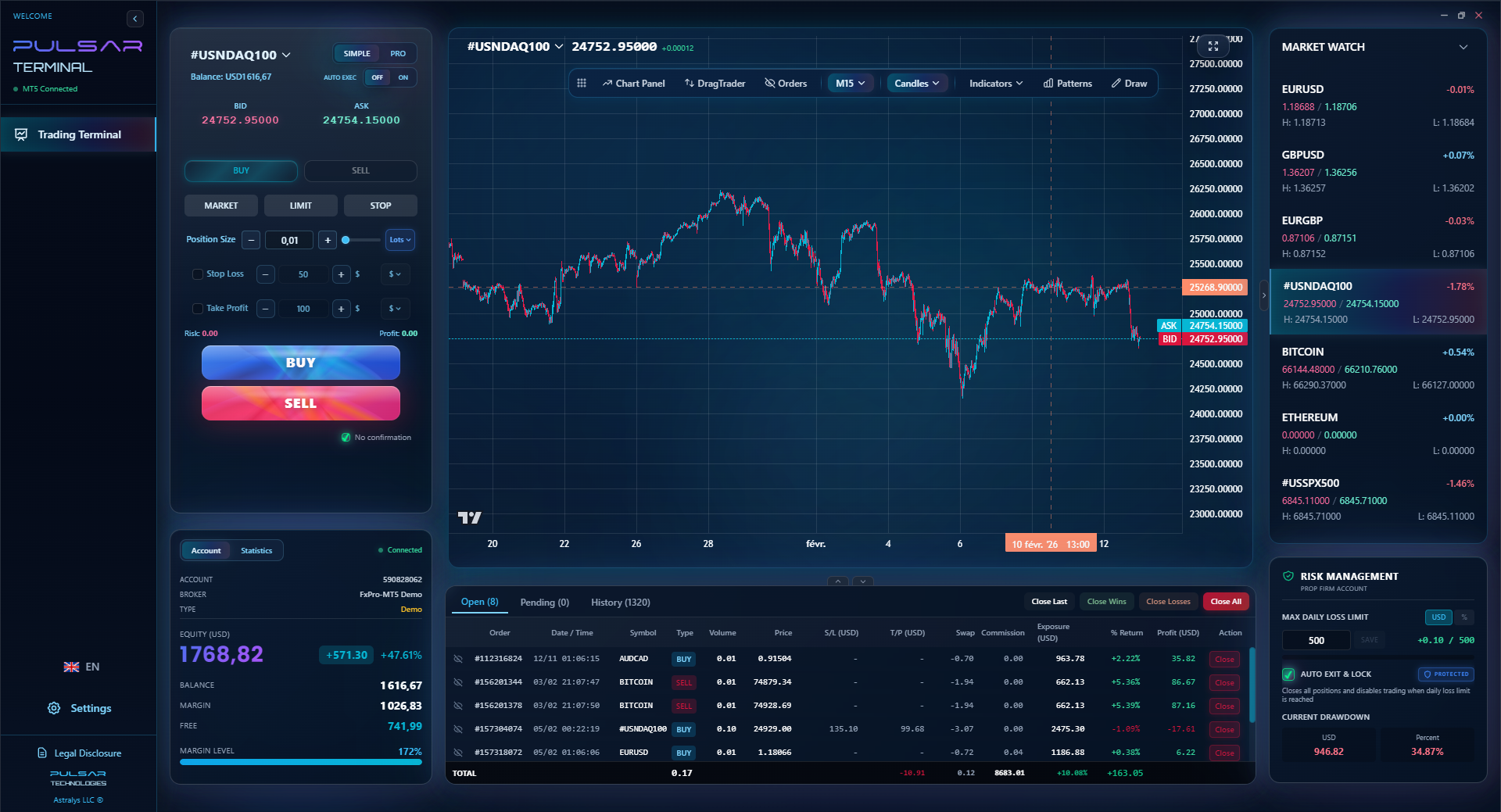
When you're drilling a strategy in Phase 2, tools like Pulsar Terminal let you set multi-level take-profits and trailing stops on MT5 with one click, so you can test advanced exit rules on your micro account without the manual hassle.
Pulsar Terminal
أداة MT5 الشاملة: أوامر سحب وإفلات، متعدد TP/SL، تريلينج ستوب، تداول الشبكة، Volume Profile وحماية البروب فيرم. يستخدمها أكثر من 1000 متداول يومياً.
The micro account has an expiration date. If you're still trading a micro account after 6 months, one of two things is true:
- You're not treating it seriously, and it's just an expensive video game. Stop funding it.
- You're too scared to move up, which means you haven't built the confidence that comes from a proven, disciplined process. You need more time in Phase 2.
The step up to a standard account isn't about having R50,000. It's about having a system. If you have a written strategy, a proven risk management rule (like that 1-2% risk per trade), and the emotional control to follow them when real money is involved, then you can start with R10,000 or even R5,000. The lot size is bigger, but the percentage risk is the same. The psychology is everything.
I held onto my first micro account for 9 months out of fear. I was breaking even, but I was comfortable. Moving to a standard account felt like jumping into the deep end. But that pressure forced me to tighten up, to respect the market. My first year on a standard account was my first truly profitable year. The micro account taught me the buttons. The standard account taught me to be a trader.
FAQ
Q1What is the minimum deposit for a micro account in South Africa?
It can be as low as $1 (about R18) with some international brokers, or R50-R100 with others. But listen: depositing the minimum is a smart move. The goal is learning, not funding. If you can't learn with R500, you won't learn with R5000.
Q2Can I make real money with a forex micro account?
Technically, yes. Realistically, no. The math works against you. To make R5000 profit starting with R2000, you need a 250% return. The high relative costs and the temptation to over-use make achieving that consistently nearly impossible. It's a learning tool, not a profit engine.
Q3Is a micro account good for beginners?
It's good for learning the mechanics of trading, like how to place an order or set a stop loss. It's terrible for learning trading psychology and discipline, because the losses don't feel real. A beginner should use it with a strict, written plan focused on process, not profits.
Q4What's the difference between a micro, mini, and standard account?
It's all about lot size. Micro = 0.01 lots (1,000 units). Mini = 0.10 lots (10,000 units). Standard = 1.00 lot (100,000 units). Your profit/loss per pip scales directly with this. Most brokers now just offer Micro and Standard.
Q5Which South African brokers offer the best micro accounts?
Don't limit yourself to only South African brokers. Look at global brokers with FSCA regulation that accept ZAR deposits. Compare their micro account spreads directly against their standard account spreads on pairs like EUR/USD. That spread gap is your true cost. Check our reviews for Exness, IC Markets, and others to see their specific micro account terms.
Q6How much can I lose with a micro account?
You can lose 100% of what you deposit, just like any account. Thanks to use, you can lose it very quickly if you don't use proper position sizing. A R2000 account risking 5% per trade is R100. Ten losing trades in a row (not uncommon for a newbie) and you're done.
درس البروفيسور وينستون
النقاط الرئيسية:
- ✓Micro account spreads are often 50-100% wider, a huge tax on small balances.
- ✓Risk no more than 0.5% per trade on a micro account to force discipline.
- ✓Use it for 3 months of rule-based practice, not indefinite trading.
- ✓Your success metric should be rule adherence, not profit.
ما مدى فائدة هذا المقال؟
انقر على نجمة للتقييم
رؤى التداول الأسبوعية
تحليلات واستراتيجيات أسبوعية مجانية. بدون رسائل مزعجة.
عن المؤلف
David van der Merwe
متداول الأسواق الناشئة
متداول مقيم في جوهانسبرغ مع 11 عاماً في عملات الأسواق الناشئة. متخصص في أزواج ZAR والتداول المنظم من FSCA وتحليل السوق الجنوب إفريقي.
التعليقات
تحذير من المخاطر
ينطوي تداول الأدوات المالية على مخاطر كبيرة وقد لا يكون مناسبًا لجميع المستثمرين. الأداء السابق لا يضمن النتائج المستقبلية. هذا المحتوى لأغراض تعليمية فقط ولا ينبغي اعتباره نصيحة استثمارية. قم دائمًا بإجراء بحثك الخاص قبل التداول.
قد يعجبك أيضًا

Cara Trading Forex Sukses: 7 Prinsip dari Trader Profesional
Cara trading forex sukses dengan 7 prinsip trader pro: manajemen modal, disiplin, journal trading, backtest. Data nyata, bukan janji profit palsu.
Jam Trading Forex Terbaik untuk Trader Indonesia: Panduan Lengkap dengan Tabel Waktu
Panduan jam trading forex untuk trader Indonesia. Tabel 4 sesi dunia, jam emas 20:00-00:00, sesi mana yang harus dihindari. Data akurat + tips dari trader berpengalaman.
Top 5 Sàn Forex Uy Tín Nhất 2026: Review Jujur dari Trader Indonesia
Top 5 sàn forex uy tín 2026 untuk trader Indonesia. Review jujur: spread, deposit, withdraw, dukungan lokal. Exness, XM, IC Markets & lebih.
احصل على Pulsar Terminal
جميع هذه الحاسبات مدمجة في Pulsar Terminal مع بيانات حية من حساب MT5 الخاص بك.
احصل على Pulsar Terminal