


I lost R8,400 in 22 minutes.

David van der Merwe
متداول الأسواق الناشئة ·  South Africa
☕ 12 دقائق قراءة
ما ستتعلمه:
- 1NY Session 101: Why Your SAST Clock is a Trading Superpower
- 2Mapping Your Trading Day: The Critical SAST Timelines
- 3Strategies That Work (And One That Blew Up My Account)
- 4Trading USD/ZAR: Navigating Our Home Turf During US Hours
- 5Choosing Your Tools: Brokers and Platforms for the SA Trader
- 6The Non-Negotiable: Risk Management for NY Session Volatility
- 7Mistakes I've Made So You Don't Have To
I lost R8,400 in 22 minutes. It was 3:15 PM SAST, the heart of the New York session, and I was stubbornly short on EUR/USD. The US retail sales data hit, the market spiked 45 pips against me, and my stop-loss got taken out like a piece of paper in a storm. I was trading London hours like a local, but I hadn't adjusted my mindset for the New York beast. That loss, back in 2017, taught me a brutal lesson: trading the NY session from South Africa isn't just about being awake. It's about understanding a different market personality, one that eats unprepared traders for breakfast. Here’s what I’ve learned since.
For us in South Africa, the New York forex session isn't some distant, graveyard shift. It's prime time. While our friends in Asia are wrapping up and London is thinking about lunch, we're right in the sweet spot. The session officially runs from 8:00 AM to 5:00 PM Eastern Time (ET). That translates to 2:00 PM to 11:00 PM SAST during our standard time (March-November), and 3:00 PM to midnight SAST when the US is on Daylight Saving (November-March).
This timing is a gift. It means the first few hours of the NY session (2:00 PM - 5:00 PM SAST) have a massive overlap with the tail end of London. This overlap, from about 2:00 PM to 4:00 PM SAST, is the most liquid period of the entire trading day. Spreads on majors like EUR/USD can tighten to almost nothing, and order execution is lightning fast. It's when the big banks and institutions are most active, moving real money. For a retail trader, this is where you want to be if you're looking for clean, high-probability setups.
But here's the catch I learned the hard way: high liquidity doesn't mean easy money. It means moves can be swift and decisive. That R8,400 loss? It happened because I mistook the initial London-driven trend for a sure thing, ignoring the fact that New York often has its own agenda. They can reverse London's moves, accelerate them, or just chop around until everyone gets bored. You need a plan for each scenario.

Warning: Don't confuse high liquidity with low risk. The NY session can produce violent, news-driven spikes that will blow through poorly placed stops. Always check an economic calendar for US data releases like Non-Farm Payrolls, CPI, or Fed announcements before you open a trade at the NY open.

💡 نصيحة وينستون
The market's first move after a major data release is often a trap - a stop hunt. Wait for the second move, the one that establishes a new high or low 15-20 minutes later. That's the real one.
“The NY session doesn't reward bravery; it punishes imprecision.”
Your trading diary should be built around these SAST windows. I literally have them blocked in my calendar.
The London-New York Overlap (2:00 PM - 4:00 PM SAST): The golden hours. This is your best shot for scalping strategy or catching the initial directional bias for the US day. Volume is at its peak. I often place my most significant trades in the first 30 minutes of this window, after assessing the London session's footprint.
Pure NY Session Momentum (4:00 PM - 8:00 PM SAST): After London closes, the market's character changes. It becomes more reactive to pure US flows and news. This is where you see trends either accelerate or fail. It's a great time for swing trading entries if you're targeting a move that lasts into the Asian session.
The US Data Witching Hour (Typically 3:30 PM SAST): A huge amount of top-tier US economic data (GDP, Durable Goods, etc.) is released at 8:30 AM ET. That's 3:30 PM SAST for most of the year. The market can go absolutely silent for 5 minutes before, then explode. I made a rule after my big loss: no open positions 5 minutes before major data unless I'm intentionally trading the news (and even then, with tiny size).
The Late NY Session (8:00 PM - 11:00 PM SAST): Liquidity starts to dry up as US traders head home. This can lead to exaggerated, thin-market moves or just sideways drift. It's generally a time to manage existing positions, not open new ones. This is when I review my trades, update my journal, and plan for the next day.
“Trading the overlap is about catching the wave of institutional orders, not guessing which way the wind will blow.”
You can't just throw any strategy at the NY session and hope it sticks. Its personality demands specific approaches.
The Overlap Breakout
This is my bread and butter. During the London-New York overlap, price often consolidates in a tight range. I wait for a clear break above or below this range with increasing volume (I use the Volume Profile tool in my platform). My entry is on a retest of the breakout level. In early 2023, I caught a beautiful breakout on GBP/USD. Price consolidated between 1.2050 and 1.2080 from 1:45 PM to 2:15 PM SAST. It broke above 1.2085 on a surge of volume. I entered long at 1.2082 on the first pullback, set a stop at 1.2065, and took profit at 1.2120. A clean 38-pip move.
Fading the London Extreme
New York traders love to prove London wrong. If the EUR/USD has made a strong, extended move during the London session, I'll often look for a reversal setup in the first hour of NY. I use the RSI indicator on a 15-minute chart to spot overbought/oversold conditions, combined with a rejection at a key daily support or resistance level. This strategy requires patience and tight stops - it's counter-trend, after all.
The Strategy That Cost Me: Chasing News
My infamous R8,400 loss was a lesson in this. I saw strong selling in London and jumped in short just before US data, trying to "get ahead" of the move. The data was bullish for the dollar, but the market had already priced it in. What happened? A classic "buy the rumor, sell the news" reversal. The spike was a stop-hunt, liquidating all the weak shorts (like mine) before the trend resumed downward. I was right on the direction eventually, but my timing and risk management were catastrophic. Now, I wait at least 15 minutes after major data before even considering a trade.

Pro Tip: Pair your strategy with the right instrument. The NY session is best for major pairs like EUR/USD guide and GBP/USD. Save exotic pairs like USD/ZAR for when you have a specific, high-conviction thesis on local factors.
“Trading the overlap is about catching the wave of institutional orders, not guessing which way the wind will blow.”
This is where being South African gives you an edge, but also a unique risk. The USD/ZAR is incredibly active during the NY session. US macro data (Fed interest rate decisions, inflation prints) is the single biggest driver of the Rand's value against the Dollar.
How It Works: At 3:30 PM SAST, US CPI data comes out hot. Instantly, the market prices in a more hawkish Fed. US Treasury yields jump. This attracts capital flows into the dollar. For an emerging market currency like the ZAR, this is a double whammy: the dollar strengthens globally, and risk appetite falls, causing investors to pull money out of riskier assets. The USD/ZAR can rocket higher in minutes.
I traded this on November 14, 2025. The US PPI data was stronger than expected. I was watching the USD/ZAR, which was hovering around 18.25. The minute the data hit, it spiked to 18.40. I didn't chase. I waited for the initial panic to subside. It pulled back to 18.32 over the next hour, finding support. Seeing that the higher-high and higher-low structure was intact on the 1-hour chart, I went long at 18.33. My stop was at 18.22, and I scaled out at 18.55 and 18.65 over the next two days as the trend continued.
The Critical Factor: You must understand the global risk mood. The ZAR is a risk-sensitive currency. If the NY session is characterized by a "risk-off" sentiment (stocks down, volatility up), the ZAR will likely weaken, regardless of local news. Always cross-reference the USD/ZAR chart with the S&P 500 or the VIX index during the NY session.
Warning: The FSCA's expected use cap of 1:200 for major pairs by early 2026 is specifically for moments like these. USD/ZAR can move 200-300 pips in a day during volatile NY sessions. High use will guarantee a margin call. Use a position size calculator religiously.
💡 نصيحة وينستون
If you wouldn't place the trade at 2:05 PM SAST, don't place it at 9:05 PM. Thin liquidity turns every trade into a coin flip. Respect the market's closing hours.
“That R8,400 loss taught me more about session timing than any winning trade ever could.”
Your broker and platform are your lifeline during the fast NY session. You need reliability above all else. Here’s my take, based on years of use and chatting with other local traders.
The FSCA License is Non-Negotiable. This protects your funds. Brokers like Exness review, XM review, and IC Markets review are popular here because they hold local FSCA licenses. I've used a few over the years.
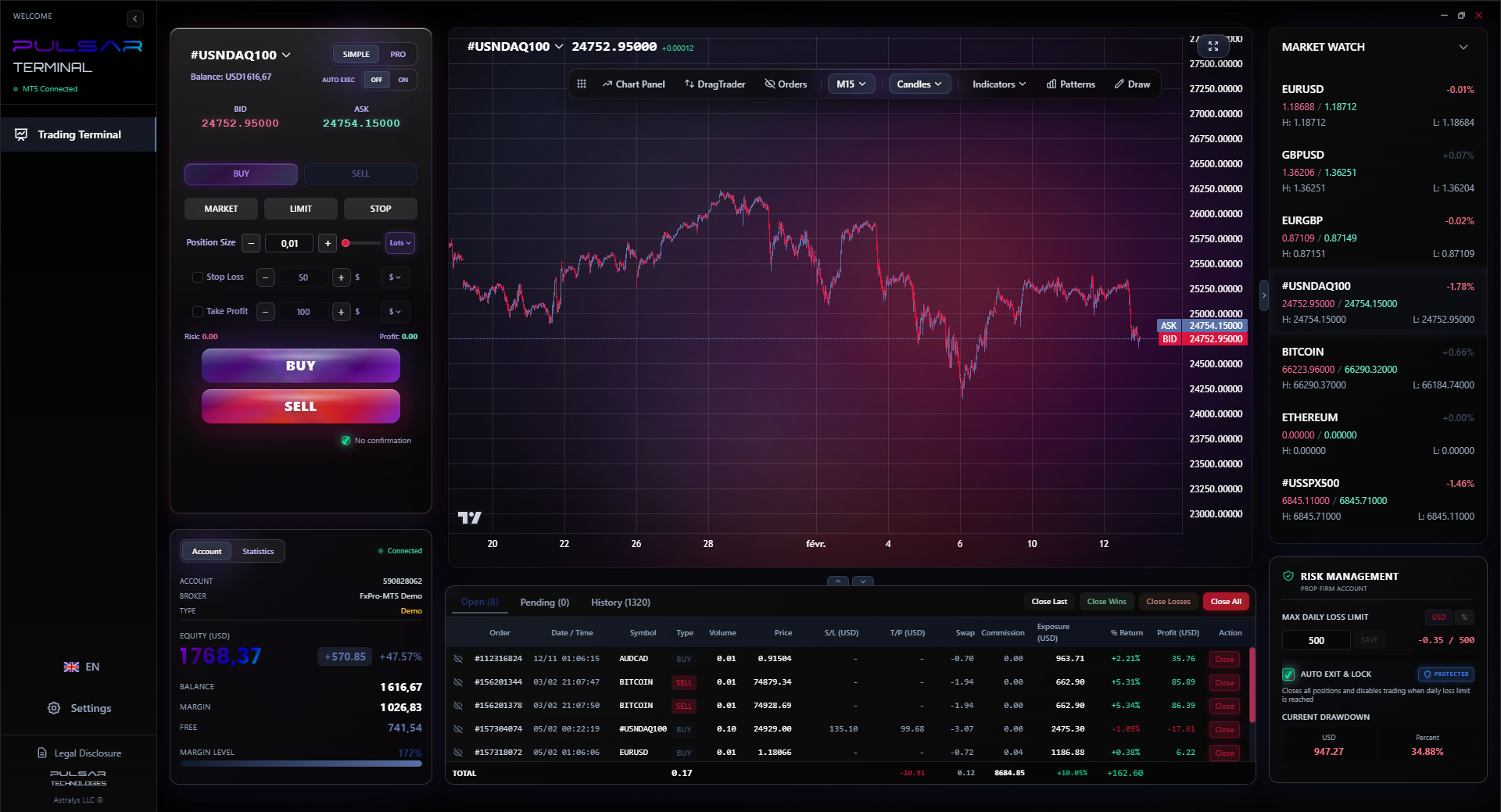
Platform Stability is Key: When the NFP data drops at 3:30 PM SAST, your platform cannot freeze. MT4 and MT5 are the universal standards in SA for a reason - they're generally stable. However, the native MT5 platform lacks advanced order management tools. This is where companion apps become essential. I now use a tool that plugs into MT5 and lets me set multi-level take-profits, trailing stops, and breakeven orders with one click. When the USD/ZAR is moving 50 pips in a minute, you don't have time to manually drag stops.
Account Currency Matters: If you're trading from a ZAR-based bank account, look for a broker that offers a ZAR trading account. It saves you the double conversion fee (ZAR to USD to trade, then USD back to ZAR on profit). Brokers like XM and Pepperstone review offer this. It seems small, but over hundreds of trades, those fees add up.
My Personal Setup: I run MT5 for charts and execution, but I manage all my orders through a separate terminal app. It allows me to set a grid of orders for a range-bound strategy on USD/ZAR during quieter Asian hours, and then switch to a single trade with a trailing stop for the NY session breakout. Having that flexibility without changing platforms is a game-saver.
Managing multiple take-profit levels and a trailing stop on a fast-moving NY session trade is nearly impossible manually, which is why I rely on Pulsar Terminal to automate it all directly on my MT5 charts.
Pulsar Terminal
أداة MT5 الشاملة: أوامر سحب وإفلات، متعدد TP/SL، تريلينج ستوب، تداول الشبكة، Volume Profile وحماية البروب فيرم. يستخدمها أكثر من 1000 متداول يومياً.
“That R8,400 loss taught me more about session timing than any winning trade ever could.”
This is the chapter written in red ink. The NY session's volatility demands military-grade discipline.
Position Sizing is Everything: The standard "2% risk per trade" rule? During the NY session, especially around data, I cut it to 1% or even 0.5%. A 50-pip stop on EUR/USD is reasonable in London; in NY, a news spike can blow through that and hit 70 pips before you blink. Use a calculator. Every. Single. Time.
Wider Stops Are Often Smarter: Trying to place a 10-pip stop on a major pair during the NY overlap is asking to be stopped out by market noise. I plan my trades based on technical levels (like the day's high/low or a clear swing point) and let the market's structure determine my stop distance, not an arbitrary pip amount. Sometimes that means a 25-pip stop, and that's okay. It just means my position size has to be smaller to keep my rand risk the same.
The Trailing Stop Mandate: If you catch a trend during the NY session, you must use a trailing stop. Letting a 50-pip winner reverse into a 10-pip loser is a special kind of pain. I set my trailing stop to activate once price moves 1.5x my initial risk in my favor. So, if my initial stop was 20 pips away, once I'm 30 pips in profit, the trailing stop engages and locks in profits. This is automated in my trading terminal - doing it manually is too emotional.
One Trade at a Time (When Starting): The temptation is to trade EUR/USD, GBP/USD, and Gold all at once during the volatility. They're all correlated to the US dollar. If you're wrong on the dollar's direction, you'll lose on all three. I focus on one, maybe two, high-conviction setups per session.
💡 نصيحة وينستون
Your biggest edge trading USD/ZAR is understanding local sentiment. Watch the JSE Top 40 index during the NY session. If it's selling off hard while the US market is flat, it's a local risk-off signal for the Rand.
“Your SAST clock isn't a constraint; it's a strategic advantage if you know how to use it.”
Let's get painfully honest. Here's my hall of shame.
1. Trading the Open Like It's London: The first 15 minutes after the NY open (2:00 PM SAST) are chaotic. Liquidity is still building. I used to place market orders right at the open, often getting filled at the worst possible price. Now I wait for the first 30-minute candle to close. Let the market find its feet first.
2. Ignoring the 1-Hour Chart: In the heat of the 5-minute or 15-minute chart action, it's easy to lose the broader trend. I entered a short on AUD/USD on a nice bearish pattern on the 15-min chart during NY. What I missed? It was sitting right on a massive rising trendline support on the 1-hour chart from the Asian session. It bounced perfectly off it and took out my stop. Always zoom out.
3. Overtrading the Late Session: Boredom is a killer. At 9:00 PM SAST, with the family watching TV, I'd sometimes scroll charts looking for "just one more trade." The liquidity is gone. Spreads widen. You're trading in a ghost town, and the market makers can push price around easily. 90% of these late-night trades were losers. My rule now: charts off at 8:30 PM SAST.
4. Not Accounting for SA Bank Holidays: US markets are open on Heritage Day. You might be braaing, but the USD/ZAR is moving. If you have open positions, you need to be aware. Similarly, on a US bank holiday, the NY session is dead. Don't expect your usual volatility. Mark both SA and US holidays on your calendar.

Example: Let's say you have a R100,000 account and risk 1% per trade (R1,000). You're trading USD/ZAR, which is at 18.50. Your technical stop is 150 points away (to 18.35). A 150-point move on a standard lot is R1,500. Too big. So, you size down. R1,000 risk / R1,500 per lot = 0.66 lots. Round down to 0.6 lots. That's your position size. This math is your best friend.
FAQ
Q1What is the best time to trade forex in South Africa?
The absolute best time is the London-New York overlap, from 2:00 PM to 4:00 PM SAST. This period offers the highest liquidity and tightest spreads, providing optimal conditions for most strategies.
Q2Is the NY session good for scalping?
Yes, but with a major caveat. The high liquidity is great for scalping, but you must avoid the minutes immediately before and after major US economic data releases (like at 3:30 PM SAST). The volatility around news is too unpredictable for most scalping methods.
Q3How does US economic data affect the South African Rand (ZAR)?
It's the primary driver during the NY session. Strong US data (high inflation, good jobs numbers) typically strengthens the US Dollar and reduces global risk appetite. This causes a double-whammy for the ZAR, an emerging market currency, sending USD/ZAR higher. Weak US data often does the opposite.
Q4Can I trade the NY session with a South African broker?
Absolutely. Most major international brokers serving South Africa, like those regulated by the FSCA, provide full access to the forex market 24/5. Your platform will reflect the price action of the NY session in real-time.
Q5What use should I use for the NY session?
Use the lowest use you can that still makes sense for your strategy. The FSCA currently limits retail use to 30:1, with a potential cap of 1:200 for majors coming. Given the NY session's volatility, I rarely use more than 10:1 for my intraday trades. High use is the fastest path to a blown account during a news spike.
Q6What is the most volatile currency pair during the NY session?
Among majors, GBP/USD and GBP/JPY often see high volatility. For South African traders, USD/ZAR can be extremely volatile, especially when US data surprises the market. Always check the average true range (ATR) of a pair before trading it in the NY session.
Q7Do I need to stay up until 11 PM SAST to trade the whole session?
No, and I advise against it. The most productive, liquid hours are the first half (2:00 PM - 8:00 PM SAST). The late session sees liquidity drop significantly, leading to erratic price action. It's better to close out or manage trades by 8:30 PM and plan for the next day.
درس البروفيسور وينستون
النقاط الرئيسية:
- ✓Trade the 2:00-4:00 PM SAST overlap for maximum liquidity.
- ✓Cut position size by 50% around major US data releases.
- ✓Always zoom to the 1-hour chart for trend context.
- ✓Use a trailing stop on any NY-session trend trade.
- ✓Never chase a news spike; wait for the retest.
ما مدى فائدة هذا المقال؟
انقر على نجمة للتقييم
رؤى التداول الأسبوعية
تحليلات واستراتيجيات أسبوعية مجانية. بدون رسائل مزعجة.
عن المؤلف
David van der Merwe
متداول الأسواق الناشئة
متداول مقيم في جوهانسبرغ مع 11 عاماً في عملات الأسواق الناشئة. متخصص في أزواج ZAR والتداول المنظم من FSCA وتحليل السوق الجنوب إفريقي.
التعليقات
تحذير من المخاطر
ينطوي تداول الأدوات المالية على مخاطر كبيرة وقد لا يكون مناسبًا لجميع المستثمرين. الأداء السابق لا يضمن النتائج المستقبلية. هذا المحتوى لأغراض تعليمية فقط ولا ينبغي اعتباره نصيحة استثمارية. قم دائمًا بإجراء بحثك الخاص قبل التداول.
قد يعجبك أيضًا

Cara Trading Forex Sukses: 7 Prinsip dari Trader Profesional
Cara trading forex sukses dengan 7 prinsip trader pro: manajemen modal, disiplin, journal trading, backtest. Data nyata, bukan janji profit palsu.
Jam Trading Forex Terbaik untuk Trader Indonesia: Panduan Lengkap dengan Tabel Waktu
Panduan jam trading forex untuk trader Indonesia. Tabel 4 sesi dunia, jam emas 20:00-00:00, sesi mana yang harus dihindari. Data akurat + tips dari trader berpengalaman.
Top 5 Sàn Forex Uy Tín Nhất 2026: Review Jujur dari Trader Indonesia
Top 5 sàn forex uy tín 2026 untuk trader Indonesia. Review jujur: spread, deposit, withdraw, dukungan lokal. Exness, XM, IC Markets & lebih.
احصل على Pulsar Terminal
جميع هذه الحاسبات مدمجة في Pulsar Terminal مع بيانات حية من حساب MT5 الخاص بك.
احصل على Pulsar Terminal