


Let's cut through the noise.

David van der Merwe
متداول الأسواق الناشئة ·  South Africa
☕ 12 دقائق قراءة
ما ستتعلمه:
- 1The Legal Landscape: FSCA, SARB, and You
- 2Choosing the Right Broker: Local vs. International
- 3Account Types, Minimum Deposits, and Real Costs
- 4Step-by-Step Guide to Opening Your Account
- 5Tax Implications: How SARS Sees Your Forex Profits
- 6Common Pitfalls and Mistakes to Avoid
- 7Funding, Withdrawals, and Managing Your ZAR
Let's cut through the noise. Opening a forex account in South Africa isn't about getting rich quick, it's about not getting legally and financially wrecked by a system that's watching you. The FSCA isn't your friend, but their 30:1 use cap might just save your bacon. I've seen too many traders blow up because they didn't understand the two golden rules here: you can't legally bet against the Rand, and SARS always gets its cut. I'll walk you through the real process, from picking a broker that won't vanish with your money to navigating the taxman's demands, all based on 12 years of trading these markets.
Forget what you've heard from those YouTube gurus in their rented Lambos. Forex trading in South Africa is legal, but it's wrapped in a regulatory blanket that's both a shield and a straightjacket. The main player is the Financial Sector Conduct Authority (FSCA). They're the ones who decide who gets to play. Any broker offering services to South Africans should ideally be licensed by them as a Financial Service Provider (FSP). You can and should check this on their public register. It's not just a formality. I once nearly deposited with a slick offshore outfit that promised the world. A five-minute FSCA check showed they had no local license and a history of complaints. Saved myself a major headache.
Then there's the South African Reserve Bank (SARB). This is where it gets serious for us locals. SARB's exchange control rules have one non-negotiable clause: South African residents are not permitted to speculate against the Rand. Think about that. It means you can't simply open an account and short USD/ZAR hoping the Rand will collapse. That's a fast track to getting your account frozen and facing penalties. Your trading needs to be for legitimate purposes, like hedging or investing in foreign assets, using your annual allowances (R10 million foreign capital allowance, R1 million discretionary). This rule alone shapes every trading decision you'll make.
The FSCA also slapped a 30:1 use limit on retail forex trading back in 2021. Some moan about it, calling it restrictive. After blowing a $5,000 account in my early days using 500:1 use on a single EUR/USD trade, I see it as a public service. It forces you to use proper position size calculator and think before you leap. It's there to stop you from doing something profoundly stupid, which, let's be honest, we're all capable of when greed takes over.
This is your first major decision, and it's more than just comparing spreads. You have two paths: a locally regulated FSCA broker or an international one that accepts South African clients.
Local FSCA Brokers (Like Khwezi Trade): The big plus is local recourse. If something goes wrong, you're dealing with a South African entity under South African law. Communication is easier, deposits/withdrawals in ZAR are seamless, and they inherently understand the SARB rules. The downside? Often, their trading conditions (spreads, platform options) aren't as competitive as the global giants. Their minimum deposit might be in ZAR, like Khwezi's R500, which is accessible.
International Brokers (Like IC Markets, Pepperstone): These are the heavyweights. They offer razor-thin spreads (often 0.0 pips on majors), superior technology like MT4/MT5, and a vast range of instruments. Many, like IC Markets and Pepperstone, are highly respected globally. But here's the catch: while they may be regulated in Cyprus (CySEC) or Australia (ASIC), that regulation doesn't directly cover you as a South African resident. Your legal recourse is in that foreign jurisdiction. Also, you must ensure they explicitly allow South African clients and can help ZAR deposits.

Warning: Never, ever deposit with a broker that isn't transparent about its regulation. If you can't easily find their license number on their website, run. The 'offshore bucket shop' is a real thing, and they love targeting eager new traders.
My personal take? For most serious retail traders starting out, a top-tier international broker with a strong reputation is the way to go for execution quality. But you must do your homework. I've used both types. For my main scalping strategy, I need the tightest spreads possible, so I use an international broker. For a longer-term account where I'm holding positions for weeks, I use a local broker for peace of mind.
Let's talk real numbers. When I opened my Exness account years ago, the minimum deposit was $10. I funded it with $200 just to test the platform. My first trade was on EUR/USD, a 0.01 lot buy at 1.1050. The spread was 0.3 pips. I closed it at 1.1070 for a 20-pip gain, which was about $2. The process was smooth, but I was acutely aware I was dealing with an entity far from home.

💡 نصيحة وينستون
Your first R10,000 in the market is tuition, not capital. Expect to learn, not earn. The goal is to have some left over after the lesson.
“The FSCA's 30:1 use cap isn't there to limit your profits, it's there to limit the speed of your financial suicide.”
Brokers love to dazzle you with account type names: Standard, Raw, ECN, Pro. Strip away the marketing, and you're usually choosing between two pricing models: spread-only or commission-based (raw spread + commission).
Spread-Only Accounts: The broker's profit is baked into the difference between the bid and ask price. It's simple. You see one price to buy, one price to sell. These are great for beginners and smaller accounts because your costs are predictable and visible. For example, XM offers accounts with average spreads around 0.8 pips on EUR/USD with no commission.
Commission-Based (Raw/ECN) Accounts: Here, you get access to interbank spreads, which can be as low as 0.0 pips. But you pay a separate commission per trade, usually per lot. This model is better for high-volume traders (scalpers, day traders) because the overall cost per trade can be lower. On my main account, I pay a $3.50 commission per 100k lot (round turn). On a day where I'm in and out of EUR/USD ten times, those commissions add up, but the ultra-tight spread makes it worth it.
Minimum Deposits: The Gateway
This is where they get you in the door. The numbers from the briefing are spot on:
- No Minimum: Fusion Markets, Pepperstone. (Yes, you can start with $1).
- $5-$10: XM ($5), Exness ($10).
- $50-$100: IG, Vantage ($50), IC Markets, FP Markets ($100).
- Local: Khwezi Trade (R500).
My advice? Ignore the minimum. Just because you can start with $10 doesn't mean you should. You need enough capital to survive your learning phase without being margin call on your first few losing trades. I recommend a minimum of $500-$1000 as a realistic starting buffer.
The Hidden Cost: The ZAR Pairs
Want to trade USD/ZAR or EUR/ZAR? Get ready for wider spreads. That's liquidity, not broker greed. Where EUR/USD might have a 0.1 pip spread, USD/ZAR can easily be 5-10 pips. That means the price needs to move 5 pips in your favor just for you to break even. It completely changes your trading approach. I learned this the hard way trying to scalp USD/ZAR. The spread ate my potential profits alive. These pairs are better suited for longer-term swing trading views.
- Choose Your Broker: Based on the above, pick one. Start with just one. Don't spread yourself thin.
- Visit the Website & Click 'Open Account': This will start the registration. You'll be asked for:
- Full name (as per your SA ID).
- Date of birth.
- Country of residence (South Africa).
- Email and phone number.
- Physical residential address (no PO Boxes).
- Financial & Trading Experience Assessment: This is mandatory under FSCA/global regulations. You'll be asked about your employment, annual income, net worth, trading experience, and knowledge. Be honest. This determines the use and products you're offered. If you lie and say you're an expert when you're not, you might get higher use and blow up faster.
- Identity Verification (FICA): You'll need to upload clear copies of:
- Your South African ID book/card (both sides).
- Proof of residence (a utility bill or bank statement less than 3 months old, with your name and address).
- Fund Your Account: Once verified, you'll get login details. Go to the deposit section. Common methods for South Africans:
- Credit/Debit Card (Visa/Mastercard): Instant, but your bank may charge a forex fee.
- Bank Wire Transfer: Slower (1-3 days), can have higher bank charges. You'll need to use your Authorised Dealer (your bank) and reference your trading account number.
- E-Wallets (Skrill, Neteller, etc.): Fast, but check if the broker supports them and what fees they charge.
- Download the Trading Platform: Usually MetaTrader 4 or 5. Download it from your broker's website (never from a random link). Log in with the credentials they provided.
- Place a Practice Trade First: Use a demo account if available, or on your live account, start with the smallest possible position size (0.01 lots). Get a feel for placing orders, setting stops, and closing trades before you risk real money.

Pro Tip: During verification, if your proof of address is in your spouse's name, you'll need an affidavit confirming you live there, plus their ID and the marriage certificate. It's a hassle, but it's standard anti-money laundering practice. Get it right the first time.
“In South Africa, your biggest trading risk isn't the market - it's forgetting about SARS until they send you a letter.”
This is the part everyone wants to ignore. Don't. The South African Revenue Service (SARS) views profits from forex trading as taxable income. It's not a hobby if you're making consistent money. How it's taxed depends on your trading frequency and intent.
- If you trade frequently (day trading, scalping): Your profits are likely to be classified as revenue and taxed at your marginal income tax rate (up to 45%). You can deduct certain expenses like data fees, platform fees, and even a portion of home office costs if you qualify.
- If you hold positions for the long term (investing): It might be considered capital in nature, and you could be liable for Capital Gains Tax (CGT). Only 40% of the capital gain is included in your taxable income.
The line is blurry. The key is record-keeping. From day one, keep a detailed trading journal: every trade entry/exit, date, profit/loss, and broker statements. I use a simple spreadsheet. When tax season comes, you provide this to your accountant. I learned this after my second year of trading. I had a profitable year but had mingled trading funds with my personal account. Reconciling it for my accountant took a week of agony. Now, I have a separate bank account just for trading funds. Clean, simple, defensible.
Remember, your broker won't automatically deduct tax. It's your responsibility to declare. SARS is getting increasingly sophisticated at tracking online income. It's not worth the risk of an audit and massive penalties.
💡 نصيحة وينستون
The SARB rule against speculating on the ZAR isn't a limitation, it's a forced diversification. It pushes you to understand global pairs like EUR/USD, which have deeper liquidity and cleaner charts.
I've made most of these, so you don't have to.
- Ignoring the 'No Speculation Against ZAR' Rule: This is the big one. Don't think you're clever and can get away with it. SARB and your bank have systems to flag suspicious cross-border flow for speculative purposes. The consequences are real.
- Starting with Too Little Money: Depositing $50 because you can, then using maximum use to try and turn it into $500. This is lottery ticket mentality, not trading. You'll get wiped out by a single normal market fluctuation. Use a proper position size calculator every single time.
- Chasing Bonuses: Some offshore brokers offer 100% deposit bonuses. Sounds great, right? Usually, these come with insane rollover requirements (trade volume you must generate before withdrawing). They're designed to make you lose. I fell for this early on. I deposited $200, got a $200 bonus, and had to trade 10 lots before I could withdraw anything. I blew the account trying to hit the target.
- Not Understanding the Spread: Thinking you bought at 1.1050 and are in profit at 1.1051. If the spread was 1 pip, you're still at breakeven. That 1-pip movement just covered the broker's fee. This is crucial for scalping strategies.
- Trading Exotic Pairs (Like EUR/ZAR) Like Majors: The wide spreads and lower liquidity mean your standard strategies might not work. A 10-pip stop-loss on USD/ZAR is nothing; the pair can chew through that in seconds on minor news. I treat ZAR pairs with much wider stops and longer timeframes.

Example: You deposit R10,000 (~$530). With 30:1 use, you control R300,000. A 1% move against you (R3,000) wipes out 30% of your capital. That 1% move is common. This is why use is a double-edged sword.
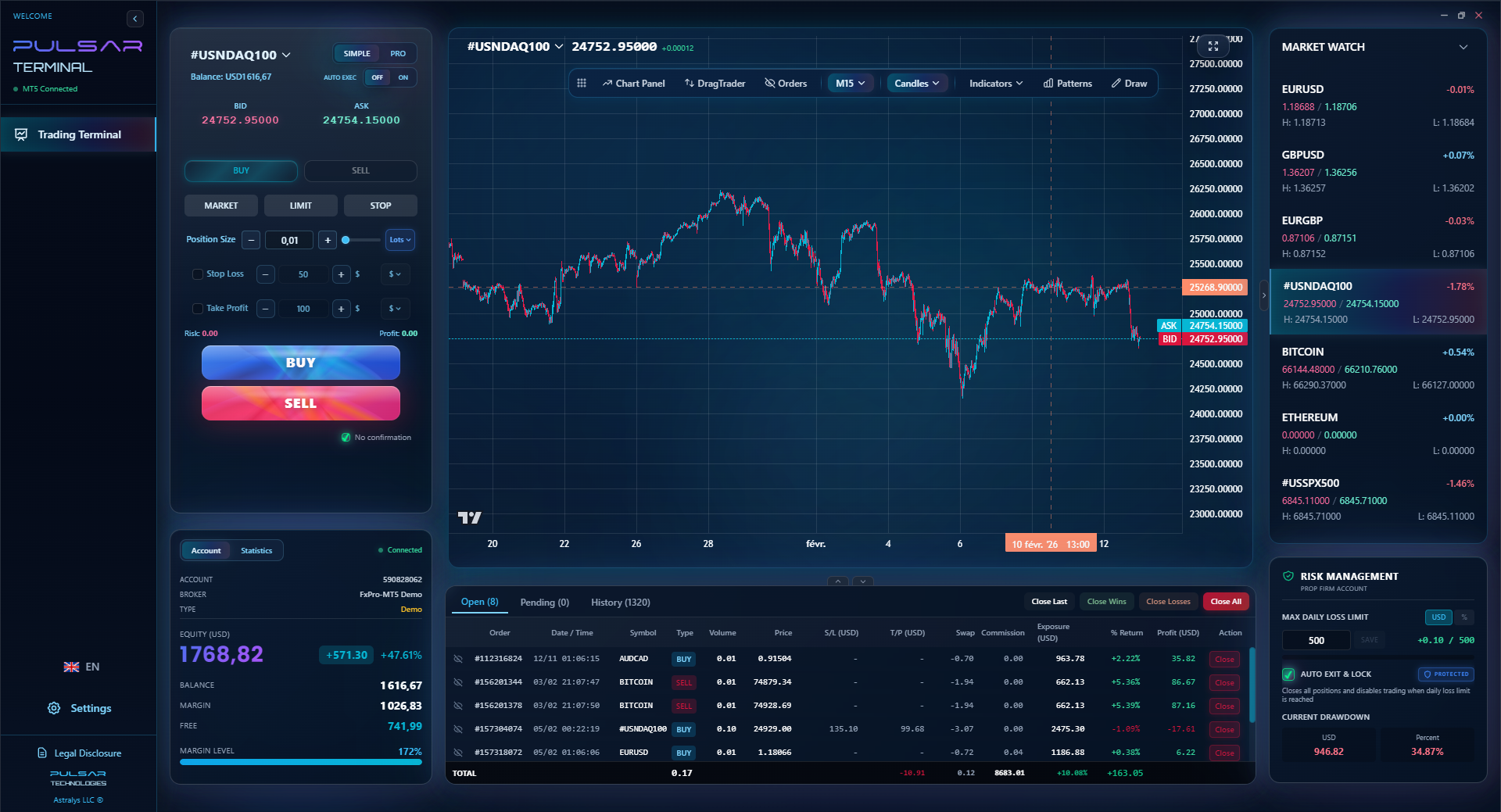
Managing the complex risk of trading exotic pairs like USD/ZAR, with their wide spreads, requires precision tools for order placement and stop-loss management that basic MT5 lacks.
Pulsar Terminal
أداة MT5 الشاملة: أوامر سحب وإفلات، متعدد TP/SL، تريلينج ستوب، تداول الشبكة، Volume Profile وحماية البروب فيرم. يستخدمها أكثر من 1000 متداول يومياً.
“Choosing a broker based on a welcome bonus is like choosing a surgeon because they give you a free lollipop.”
Getting money in and out is the final piece of the puzzle.
Funding:
- International Brokers: You'll likely fund in USD, EUR, or GBP. Your South African bank will convert your ZAR to the foreign currency at their rate, plus a fee (usually 1-3%). This happens instantly with a card or in a few days via wire. The amount will count against your annual discretionary allowance.
- Local Brokers: You'll fund in ZAR via EFT directly into their South African bank account. No forex conversion, faster, and simpler.
Withdrawals:
- This is the true test of a broker. Reputable brokers process withdrawals back to your original funding method within 24-48 hours. I've never had an issue with Pepperstone or IC Markets. The money lands in my SA account, converted back to ZAR by my bank.
- Red Flag: If a broker makes withdrawal difficult, asks for more fees, or delays for weeks, sound the alarm. It's a major warning sign.
Managing the Rand Risk: Even if you trade USD pairs, you have ZAR risk. If you deposit ZAR, it's converted to USD. If the Rand strengthens when you withdraw, you get fewer Rands back even if your USD trading profit was flat. For larger accounts, some traders use a simple forex hedge, but that's an advanced topic. For most, just be aware that your final profit in Rands has two components: your trading skill and the USD/ZAR exchange rate.
FAQ
Q1Is forex trading legal and safe in South Africa?
Yes, it's legal and regulated by the FSCA. 'Safe' depends on you. Using an FSCA-licensed broker makes it safer from fraud, but trading itself is high-risk. The regulations (like 30:1 use) are designed for consumer protection, but they don't guarantee profits.
Q2What is the minimum amount needed to open a forex trading account in South Africa?
Technically, as low as $5 or R500 with some brokers. Practically, I wouldn't start with less than $500-$1000 (R9,000-R18,000). Starting with too little forces you to use excessive use to make meaningful gains, which is a surefire way to lose it all quickly.
Q3Can I trade USD/ZAR as a South African resident?
Yes, but with a massive caveat. You cannot 'speculate' against the Rand. In practice, this means your trade should be part of a legitimate hedging strategy or linked to a foreign asset investment. A simple short trade betting the Rand will weaken could put you in violation of SARB exchange controls. It's a grey area, so tread carefully.
Q4How are my forex trading profits taxed by SARS?
Profits are generally taxed as income at your marginal rate if you're an active trader. You must declare them on your annual tax return. Keep careful records of all trades. It's wise to consult with a tax professional who understands trading income.
Q5Should I choose a South African FSCA broker or an international one?
Beginners might prefer the local recourse of an FSCA broker. More experienced traders who need the best execution conditions often opt for top-tier international brokers like IC Markets or Pepperstone. Always verify the broker's regulation regardless of where they're based.
Q6What happens if my broker goes bankrupt?
If it's a reputable FSCA-regulated broker, client funds should be held in segregated accounts. This means your money is separate from the company's money and should be returned to you. This is a key reason to use a regulated broker. With unregulated brokers, your funds are likely gone.
درس البروفيسور وينستون
النقاط الرئيسية:
- ✓Verify FSCA license before depositing a single cent.
- ✓30:1 use is a protective ceiling, not a target.
- ✓Never speculate directly against the ZAR (SARB Rule).
- ✓Start with at least $500, treat your first trades as paid education.
- ✓Log every trade for SARS from day one.
ما مدى فائدة هذا المقال؟
انقر على نجمة للتقييم
رؤى التداول الأسبوعية
تحليلات واستراتيجيات أسبوعية مجانية. بدون رسائل مزعجة.
عن المؤلف
David van der Merwe
متداول الأسواق الناشئة
متداول مقيم في جوهانسبرغ مع 11 عاماً في عملات الأسواق الناشئة. متخصص في أزواج ZAR والتداول المنظم من FSCA وتحليل السوق الجنوب إفريقي.
التعليقات
تحذير من المخاطر
ينطوي تداول الأدوات المالية على مخاطر كبيرة وقد لا يكون مناسبًا لجميع المستثمرين. الأداء السابق لا يضمن النتائج المستقبلية. هذا المحتوى لأغراض تعليمية فقط ولا ينبغي اعتباره نصيحة استثمارية. قم دائمًا بإجراء بحثك الخاص قبل التداول.
قد يعجبك أيضًا

Cara Trading Forex Sukses: 7 Prinsip dari Trader Profesional
Cara trading forex sukses dengan 7 prinsip trader pro: manajemen modal, disiplin, journal trading, backtest. Data nyata, bukan janji profit palsu.
Jam Trading Forex Terbaik untuk Trader Indonesia: Panduan Lengkap dengan Tabel Waktu
Panduan jam trading forex untuk trader Indonesia. Tabel 4 sesi dunia, jam emas 20:00-00:00, sesi mana yang harus dihindari. Data akurat + tips dari trader berpengalaman.
Top 5 Sàn Forex Uy Tín Nhất 2026: Review Jujur dari Trader Indonesia
Top 5 sàn forex uy tín 2026 untuk trader Indonesia. Review jujur: spread, deposit, withdraw, dukungan lokal. Exness, XM, IC Markets & lebih.
احصل على Pulsar Terminal
جميع هذه الحاسبات مدمجة في Pulsar Terminal مع بيانات حية من حساب MT5 الخاص بك.
احصل على Pulsar Terminal