


Ever looked at your trading account and thought, 'If only I had more capital, I could really make this work'? That's the exact itch an options prop firm promises to scratch.

James Mitchell
محلل تداول أول
☕ 11 دقائق قراءة
ما ستتعلمه:
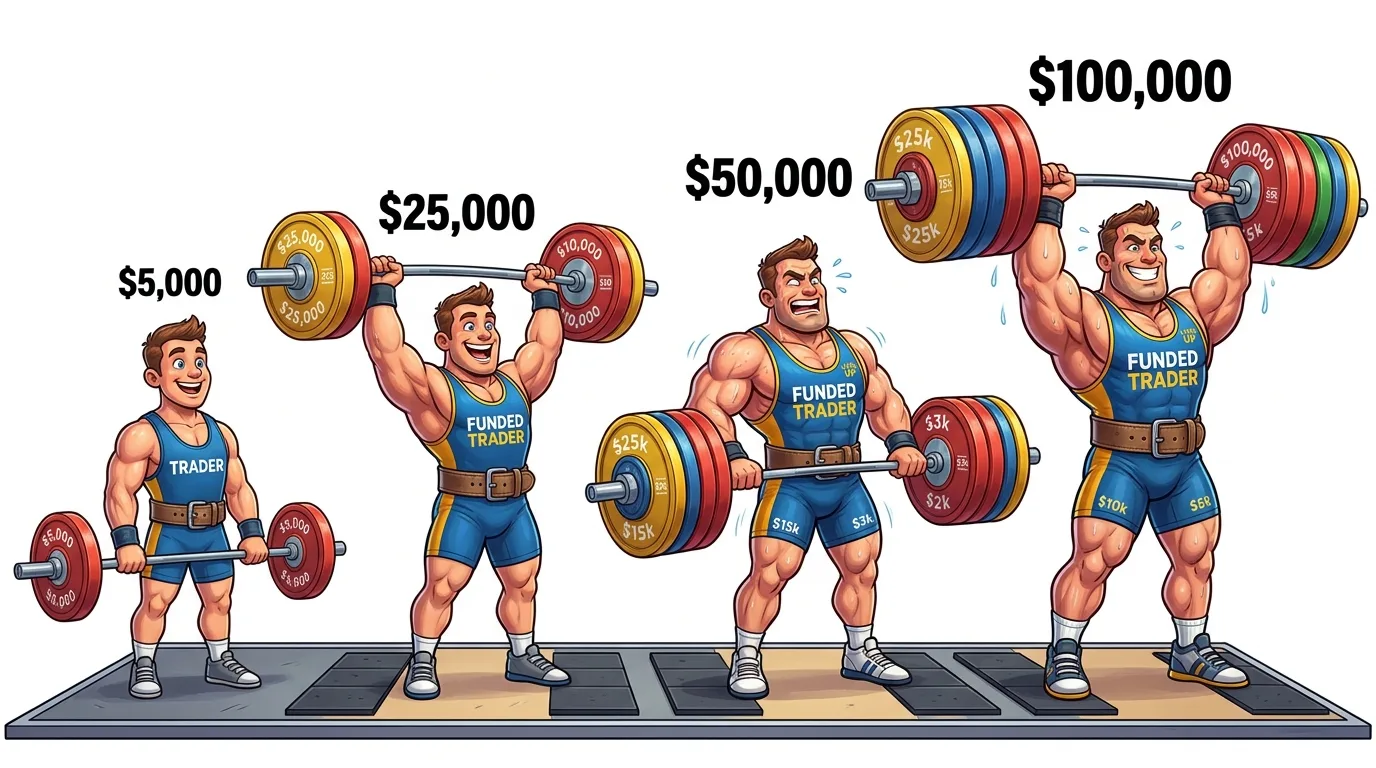
Ever looked at your trading account and thought, 'If only I had more capital, I could really make this work'? That's the exact itch an options prop firm promises to scratch. They give you their money to trade with, and you take a cut of the profits. Sounds like a dream, right? Well, it can be, but the path is littered with fine print, tricky rules, and firms that are more interested in your evaluation fee than your trading talent. I've been through it, funded and blown up a few accounts along the way. Let's talk about what these firms really are, how to pick a good one, and how to actually succeed in the unique world of trading options with someone else's capital.
At its core, a proprietary trading firm is a company that provides traders with capital. You're not depositing your own life savings. Instead, you're trading the firm's money. For this privilege, they take a slice of your profits - anywhere from 10% to 50%. The classic model was for in-house traders, but the modern, online version is what we're talking about here.
An options prop firm specializes in, you guessed it, options trading. This is a newer frontier. While forex and futures prop firms have been around, options require a different skill set and risk management approach. These firms are looking for traders who understand volatility, the Greeks (delta, gamma, theta, vega), and can manage multi-leg strategies without blowing up the account in a single bad week.
The big appeal is use. You might pay a $200 evaluation fee for the chance to trade a $50,000 account. That's access to serious buying power you likely don't have personally. But remember, it's not a gift. It's a business arrangement where you are the product. Your job is to generate consistent, risk-adjusted returns.

Warning: Many retail-focused prop firms operate in a regulatory gray area. They often structure themselves as 'educational evaluation programs' to sidestep strict SEC or FINRA rules. This means your funded account isn't always a direct line to a live brokerage account; it's often a simulated account where they just pay you your profits. Understand the structure before you pay a dime.

💡 نصيحة وينستون
The evaluation's daily loss limit isn't a suggestion, it's the law. Build your entire trading plan so that three consecutive maximum losing trades in a day still won't breach it. That's how you survive.
This is the part that confuses everyone. The regulatory landscape is a patchwork, and it completely depends on the type of firm.
The Two Main Models
First, you have the traditional broker-dealer prop desk. Think of the trading floors of old. These firms are usually FINRA members, and their traders often need a Series 57 license. They have direct market access, pay for professional data feeds, and trade real money in real accounts. This is the 'legit' end of the spectrum, but it's harder to get into and often requires you to be physically present or have a proven professional track record.
Then, you have the online retail prop firm. This is where 95% of the ads you see are targeted. Firms like FTMO (though they're more forex/futures) paved the way. These companies often avoid direct SEC/FINRA registration by not holding client funds for trading and by framing their challenge as a skills assessment. Your 'funded account' is typically a simulated account. When you make profits, they withdraw money from their own corporate account to pay you. It's a legal loophole, for now.
The CFTC oversees futures and options on futures. If a prop firm is trading those instruments, similar rules apply - if they don't handle client money, they can often avoid registration.
The bottom line? For the retail trader, most options prop firms you'll find online are not SIPC-insured broker-dealers. Your 'capital' is a simulation, and your payouts are dependent on the firm's solvency and honesty. Do your due diligence like you're investing in a startup, because you are.

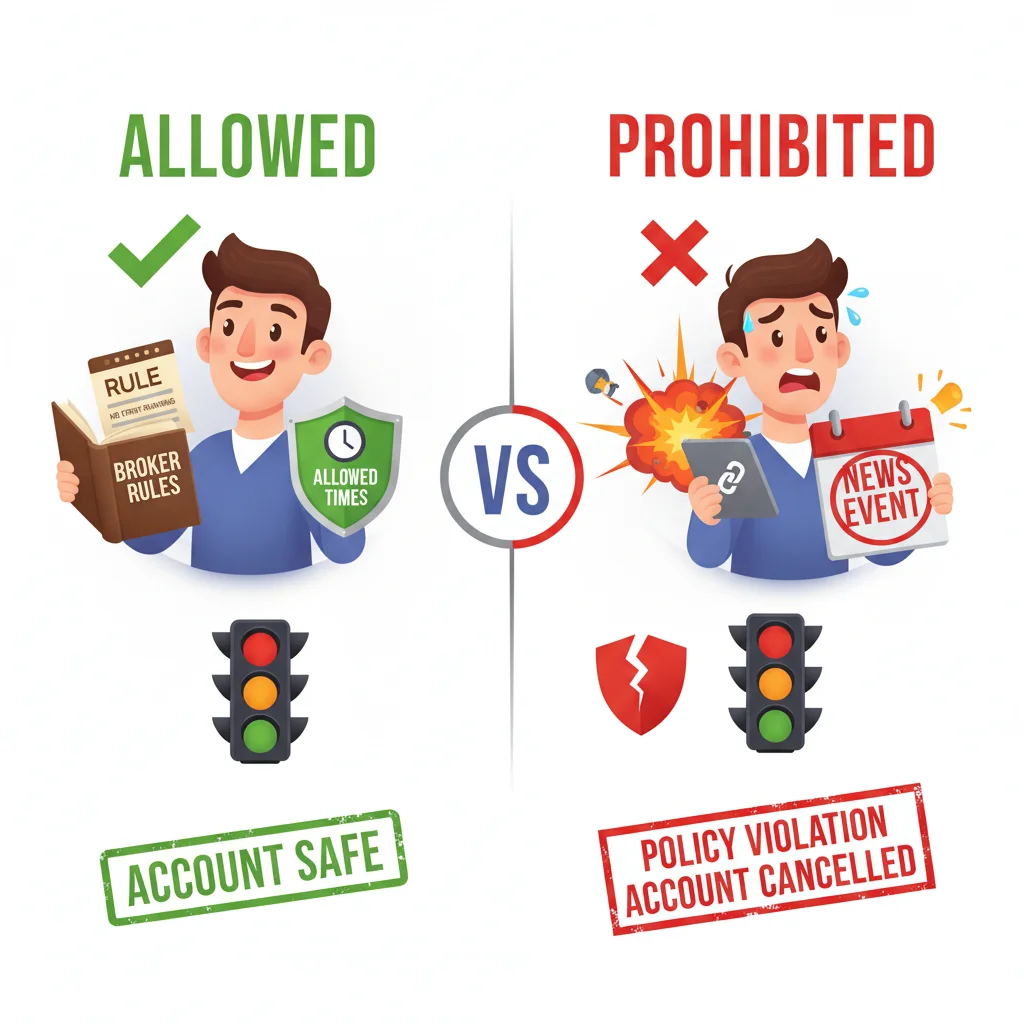
Pro Tip: Always ask: 'Is the evaluation and funded account traded in a live brokerage account in my name, or is it a simulated platform?' If it's simulated, ask how they hedge their risk. A good firm will mirror trades in their own live account. A shady one is just running a glorified casino where your losses are their profit.
“In this game, protecting the capital is 90% of the job. The profit will come if you just stay in the game.”
Let's talk numbers, because this is where dreams get priced. I once got excited about a 'low-cost' $50 evaluation, only to realize the profit target was nearly impossible for an options trader given the account size and rules.
Evaluation Fees: This is your ticket to the game. They range wildly.
- Low-end: $15-$50 for a small account ($2k-$10k). These are tempting but often have the toughest profit targets relative to size.
- Mid-tier: $100-$300 for a $25k-$100k account. This is the sweet spot for many serious beginners.
- 'Premium' Evaluations: $500+ for accounts over $150k. These sometimes have slightly better rules, but that's a big upfront bet.
Monthly Fees: Some firms charge a monthly 'data' or 'platform' fee on top of the evaluation, even after you're funded. This can be $50-$200 a month. It eats into your profits, so factor it in.
Profit Splits: The standard seems to be 80/20 or 90/10 in your favor for the first payout. Some offer scaling plans up to 95/5. Be very skeptical of any firm offering a 100% split. Their revenue has to come from somewhere, and it's usually from traders failing the evaluation.
The Hidden Cost: Data & Platforms. Trading options professionally requires good data. Real-time OPRA data can cost $150-$400 per month. A professional platform like Sterling Trader Pro or Thinkorswim (with professional pricing) can add another $100-$300 monthly. Some firms bundle this, others make you pay. Ask.
Here’s a quick comparison of what you might actually keep:
| Account Size | Evaluation Fee | Profit Target | Your Split | Monthly Fees | Realistic First Payout (After Hitting Target) |
|---|---|---|---|---|---|
| $25,000 | $199 | 8% ($2,000) | 80% | $99 | $1,600 - $99 = $1,501 |
| $50,000 | $299 | 10% ($5,000) | 90% | $150 | $4,500 - $150 = $4,350 |
Notice how the monthly fee is a constant drain. Your first goal isn't just to hit the profit target, it's to generate enough to cover fees and still have a meaningful payout. I learned this the hard way on a futures prop account, where a slow month of small gains was completely wiped out by the platform fee, triggering a margin call on my personal funds to cover the firm's charge.
This is the gate. Most people fail. The reported pass rates are between 5% and 20%. Your mission is to understand the rulebook better than the other 80%.
The rules are designed to find consistent, risk-averse traders, not lottery ticket buyers. Here are the common ones and how they impact an options strategy:
1. Daily Loss Limit: This is the big one. Often a fixed dollar amount or a percentage of the account's starting balance (e.g., 5%). If you hit it, you're done. For options, this is critical. A single poorly-timed naked short option can blow through this in minutes. Your strategy must include hard stops on every position, something tools like a position size calculator are essential for.
2. Maximum Drawdown: This is usually a trailing drawdown from the account's highest point. If you start with $50k, make $5k (so equity high of $55k), and have a 10% max drawdown, you can't let your equity fall below $49,500 ($55k - $5.5k). This rule kills revenge trading. You can't just wait for a loss to come back; you have to stop out and reset.
3. Profit Target: Usually 8-12% of the starting balance. You need to hit this without violating the other rules. This favors steady, incremental gains, not home runs.
My Personal Mistake: In my first serious evaluation, I focused solely on the profit target. I was up 6% in two weeks trading credit spreads. Got greedy, sold a wide iron condor without a defined risk plan, and a surprise earnings move wiped out 7% in a day. I hit the daily loss and violated the max trailing drawdown. Game over. $299 fee gone. I learned that in this game, protecting the capital is 90% of the job. The profit will come if you just stay in the game.
Your strategy must be built around these constraints. This often means smaller position sizes, a higher preference for defined-risk strategies (like vertical spreads or iron condors), and an obsessive focus on daily loss limits. A scalping strategy for quick, small gains can work well here, as can a more patient swing trading approach on longer-dated options, provided you manage your risk daily.
💡 نصيحة وينستون
Don't look at the profit target. Seriously. Ignore it. Focus only on making high-probability, well-sized trades each day. The target will hit itself when you're not looking. Chasing it is the fastest way to blow up.
“The prop firm model is a fantastic training ground for discipline. The strict rules will make you a better trader.”
You can't just transplant your Robinhood YOLO strategy here. The rules force discipline. Here’s what tends to work.
Favor Defined Risk: Naked options are a path to instant failure. Your bread and butter should be spreads.
- Vertical Spreads (Bull Put / Bear Call): Great for directional plays with a known max loss. You can set your width to ensure your max loss on the trade is well within your daily loss limit.
- Iron Condors: My personal workhorse for range-bound markets. You get premium from both sides. The key is managing them early. Don't wait for the underlying to test your short strike; if volatility expands or the price moves, adjust or close for a small loss.
Use Volatility, Don't Fight It: Options are volatility instruments. Selling premium (credit spreads, iron condors) works best in high volatility environments when premiums are juicy. Buying directional options (debit spreads) can be better when volatility is low and expected to rise. Keep an eye on the VIX.
Position Sizing is Your Lifeblood: This is non-negotiable. If your daily loss limit is $1,000, your max loss on any single trade should be a fraction of that - maybe $200-$300. This means you can have 3-5 trades on at a time without sweating one going against you. I use a simple rule: Risk no more than 1% of the account's starting balance on any single trade. For a $50k account, that's $500. It feels small, but it keeps you alive.
Trade Management is Key: The 'set and forget' mentality will fail. You need to manage winners and losers actively.
- Have a Profit Target: Take profits at 50-75% of the max potential gain on a credit spread. Don't get greedy.
- Have a Stop Loss: This is your circuit breaker. For a credit spread, a common stop is 1.5x to 2x the credit received. If you sold a spread for a $1.00 credit, you might buy it back if it costs $2.50.
- Adjust or Roll: If a trade moves against you but your thesis is still intact, you can often 'roll' it - close the current position and open a similar one further out in time or at different strikes. This takes a loss on the first trade but gives you more time to be right.
Managing multiple trades with individual profit targets and stops across different underlyings is a headache on most standard platforms. This is where having the right tools makes all the difference.

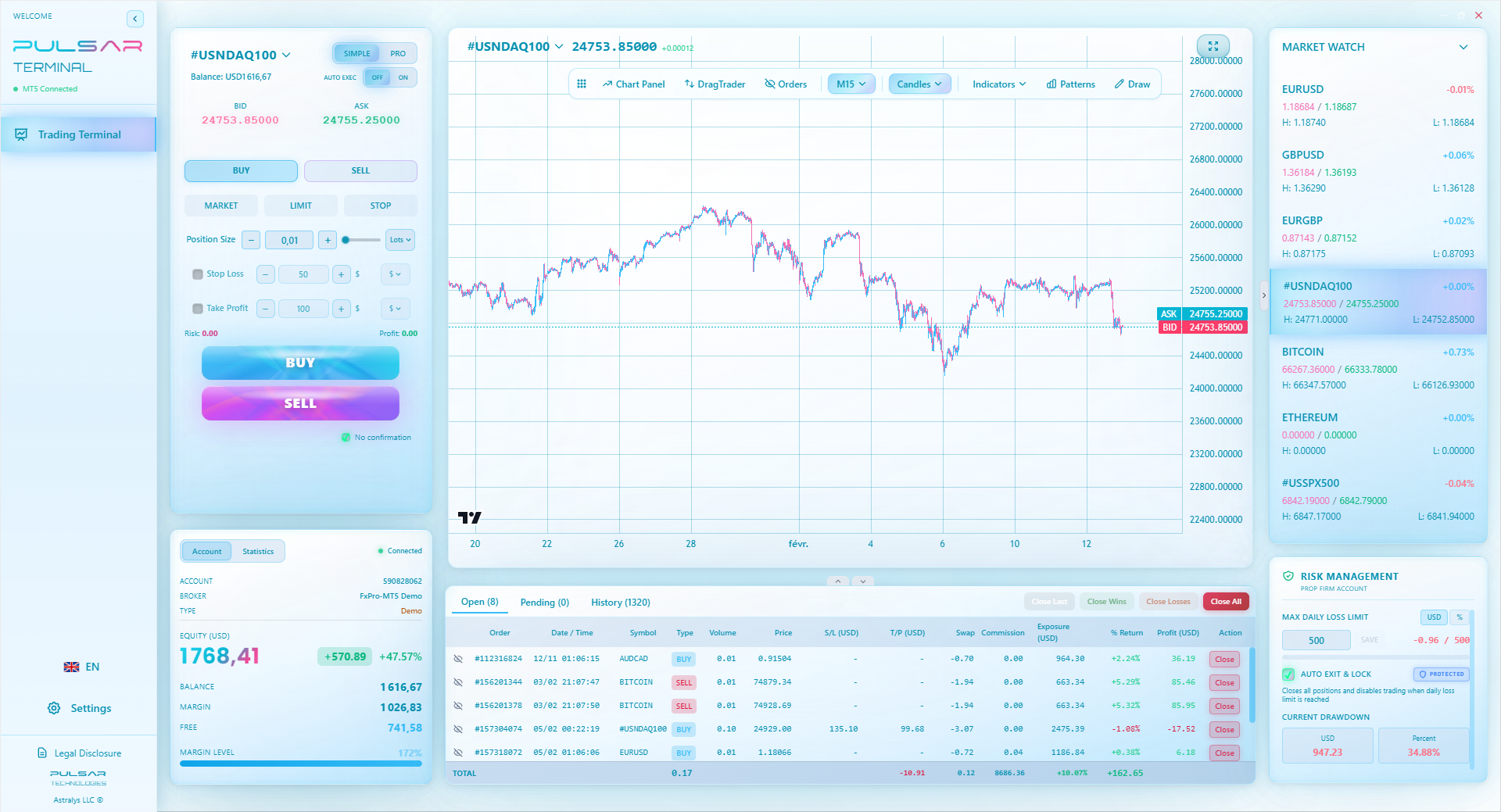
Managing multiple option spreads with individual profit targets and stops is a manual nightmare, but Pulsar Terminal automates this with its drag-and-drop order system and multi-TP/SL features directly on your MT5 chart.
Pulsar Terminal
أداة MT5 الشاملة: أوامر سحب وإفلات، متعدد TP/SL، تريلينج ستوب، تداول الشبكة، Volume Profile وحماية البروب فيرم. يستخدمها أكثر من 1000 متداول يومياً.
With dozens of firms popping up, how do you pick one that won't vanish with your payout? Look for these signs.
Green Lights (Good Signs):
- Transparent, Simple Rules: The rules are clearly stated on their website, not hidden in a 50-page PDF.
- Realistic Profit Targets: 8-12% is standard. Anything over 15% for a one-phase evaluation is a red flag.
- Community Reputation: They have a visible, mostly positive track record on forums like Reddit or Discord. Look for consistent payout proofs.
- Good Support: They respond to questions promptly before you pay.
- No Hidden Fees: All monthly or platform fees are disclosed upfront.
Red Flags (Run Away):
- 'Guaranteed' Funding or 100% Profit Splits: This is mathematically impossible for a sustainable business.
- Extremely High Profit Targets: 'Make 30% in 30 days with no drawdown!' That's a scam.
- Pressure to Trade Specific Products: If they push you toward ultra-high-risk instruments, they're betting on your failure.
- Poor or Vague Communication: If they can't explain their own rules clearly, imagine trying to get a payout.
- No Verifiable Payout Proof: Any legitimate firm will have traders sharing payout screenshots. If you can't find any, that's a major warning.
My advice? Start small. Pick a mid-tier firm with a one-step evaluation (not a two-step where you have to pass two separate challenges). Use a strategy you've already proven in a personal paper trading account for at least 3 months. The evaluation should be a formality, not a gamble.
Finally, remember this: The prop firm model is a fantastic training ground for discipline. The strict rules will make you a better trader, even if you fail the first few times. It taught me more about real risk management in six months than I'd learned in six years of trading my own account. Just go in with your eyes open, your position sizes small, and your expectations in check.
FAQ
Q1Do I need a Series 57 license to trade with an options prop firm?
Not for most online retail prop firms. They operate under an evaluation model that typically avoids the need for you to be licensed. However, if you're joining a traditional, in-house broker-dealer prop desk that trades live client money on exchanges, a Series 57 (or similar) license is almost always required.
Q2What's the biggest mistake new prop firm traders make?
Oversizing their positions. They see a $50,000 account and trade it like it's their $5,000 personal account, but with 10x the size. They violate the daily loss limit on one or two bad trades. The key is to trade the account based on the firm's risk rules, not the nominal dollar amount. Start with position sizes 1/10th of what you initially think is right.
Q3How are payouts handled? Do I get paid monthly?
It varies by firm. Most have a minimum profit threshold (e.g., $1,000 in realized gains) and a payout cycle, often bi-weekly or monthly. You request a payout, the firm verifies the trades were within rules, and then they send the money via bank transfer, PayPal, or similar. Always check the firm's specific payout policy and processing time.
Q4Can I trade any options strategy I want?
Almost always, no. Firms will have a list of approved and prohibited instruments and strategies. Highly risky strategies like naked short calls or puts are frequently banned. Defined-risk spreads (verticals, iron condors) are almost always allowed. Always review the firm's allowed instruments list before signing up.
Q5Is the capital in a funded account real?
For online retail firms, usually not in the way you think. You are not given login credentials to an Interactive Brokers account in your name. You trade on the firm's proprietary platform or a simulated version of a professional platform. The firm then mirrors the risk in their own master account. Your profits and losses are tracked internally, and they pay you from their corporate funds. It's 'real' in that you can make real money, but it's not a traditional brokerage account.
Q6What happens if I lose money in a funded account?
You lose the firm's capital, not your own (beyond any fees you paid). However, if you hit the maximum drawdown or daily loss limit, your funded account will be closed or downgraded. Some firms offer a 'reset' option where you can pay a reduced fee to restart the account from its original balance, but you'll lose any profits you had accrued.
Q7Are options prop firms better than trading with your own money?
It's different. They provide capital and enforce discipline through strict rules, which is a huge benefit. However, you give up a share of your profits and operate under their constraints. For a disciplined trader with a solid strategy but limited capital, it can be an excellent path. For someone who wants complete freedom, it can feel restrictive. It's a trade-off.
درس البروفيسور وينستون
النقاط الرئيسية:
- ✓Risk no more than 1% of the starting balance per trade.
- ✓Favor defined-risk spreads over naked options.
- ✓The daily loss limit is your most important rule.
- ✓Assume a 90% failure rate and trade to be in the 10%.
ما مدى فائدة هذا المقال؟
انقر على نجمة للتقييم
رؤى التداول الأسبوعية
تحليلات واستراتيجيات أسبوعية مجانية. بدون رسائل مزعجة.
عن المؤلف
James Mitchell
محلل تداول أول
يقيم في نيويورك ولديه أكثر من 9 سنوات من الخبرة في التداول. يركز على أزواج الدولار الرئيسية وتحديات شركات البروب وبيئة التنظيم الأمريكية.
التعليقات
تحذير من المخاطر
ينطوي تداول الأدوات المالية على مخاطر كبيرة وقد لا يكون مناسبًا لجميع المستثمرين. الأداء السابق لا يضمن النتائج المستقبلية. هذا المحتوى لأغراض تعليمية فقط ولا ينبغي اعتباره نصيحة استثمارية. قم دائمًا بإجراء بحثك الخاص قبل التداول.
قد يعجبك أيضًا

Cara Trading Forex Sukses: 7 Prinsip dari Trader Profesional
Cara trading forex sukses dengan 7 prinsip trader pro: manajemen modal, disiplin, journal trading, backtest. Data nyata, bukan janji profit palsu.
Jam Trading Forex Terbaik untuk Trader Indonesia: Panduan Lengkap dengan Tabel Waktu
Panduan jam trading forex untuk trader Indonesia. Tabel 4 sesi dunia, jam emas 20:00-00:00, sesi mana yang harus dihindari. Data akurat + tips dari trader berpengalaman.
Top 5 Sàn Forex Uy Tín Nhất 2026: Review Jujur dari Trader Indonesia
Top 5 sàn forex uy tín 2026 untuk trader Indonesia. Review jujur: spread, deposit, withdraw, dukungan lokal. Exness, XM, IC Markets & lebih.
احصل على Pulsar Terminal
جميع هذه الحاسبات مدمجة في Pulsar Terminal مع بيانات حية من حساب MT5 الخاص بك.
احصل على Pulsar Terminal